Amazon ($AMZN) Drops 7.5% After Earnings Report
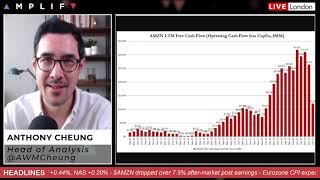
Amazon stock fell 7.5% after earnings, dragging the Nasdaq lower. The company beat on earnings per share at $15.12 but missed revenue expectations and cut Q3 guidance to $106-$112 billion versus $119 billion forecast. Free cash flow dropped 62% year-over-year amid margin compression across all segments.
Chapters
All right, good morning folks. It is Friday the 30th of July, so hope you're doing well and have had a good week so far. And as per every Friday, just to remind you, new podcast episode coming out later. The head of trading, Piers Curran, is back from vacation, and so he and I will be having a chat probably about mega-cap tech earnings and also what's been happening in China with the volatility we've seen in their local stock market this week. So that's what's going to be on the agenda. The episode we recorded this morning, it will go out around midday London time. So all you need to do is just search and subscribe to Market Watch by Amplify Live and you'll be able to find it on the likes of Apple, Google Podcasts, and Spotify and so on. All right, well, look, let's get straight into it and talk about what's going on for today. And main thing I'm going to talk about actually this briefing, going to have a drill down into Amazon earnings which came out last night. And as you can see, usual kind of uniform charts that I have up, the NASDAQ 100 came under some pretty aggressive selling pressure last night post the Amazon earnings. And the rationale behind that is the fact that Amazon, one of the largest companies of course in the world, fell 7.5% in aftermarket trade following their numbers last night. And consequently the Nasdaq continued to move lower. And when the Asia-Pacific markets opened, we moved lower. We've just found a bit of a footing this morning before seeing a bit of a bounce. The last kind of leg of the move down just materializing as early birds in Europe have come in this morning. So we're down about 206 points still, um, just nursing that blow from Amazon yesterday. And it comes after equity markets like the S&P 500, of course, printed a fresh all-time high briefly in the session. And of course, a slightly odd scenario if you're not looking or used to looking at markets, because this rally that came at the open on Wall Street, of course, came after what was a weaker than expected US GDP print, a higher than expected US jobless number yesterday. These are kind of negative developments, and yet the equity market rallied at the time. Oil markets, in fact, even, even pushed back up again yesterday. And of course, the notion there being the fact that Jerome Powell's right for the time being. There's been improvements, but there's still some way to go before really they start talking about tapering and the kind of first steps towards normalizing their policy. And so from an equity perspective, it's, it's a good thing because the fear of tightening gets pushed away and the idea about inflation and so on starts to drop off if economic activity starts to decrease in its speed. And thinking about the fact that the likes of GDP forecasting only around 4 or 5 weeks ago was looking at a double-digit percentage GDP number, and here we are pretty much unaltered from Q2 to Q1. So yeah, for the moment, that was, that was kind of a the main, uh, situation from yesterday. And then we had the NASDAQ situation with Amazon coming out, and that kind of, kind of fed into the Asia-Pac session. China saw a bit of a moderation after yesterday's outperformance following that intervention that we saw in various means to try and, uh, soothe market concerns from the, uh, crackdown that we've been seeing in technology and education in China. And so just reverting back to course a little bit, and obviously sentiment just dampened by those post-market earnings in the US. So elsewhere this morning, oil faded in step with the equity move, but not quite as pronounced as you would expect given it's more indirectly tied to it. In terms of fixed income, so actually in the 10-year, we continue to respect pretty much a range. I mean, X-ing out any volatility that's been seen around data releases, as you can see from some of the extremities. On these wicks. And this is the actual— this ellipse is the FOMC kind of pump and dump, if you like, on the fact of market positioning, perhaps unwinding some of those outside hawkish bets upon the kind of consistency in Powell's commentary and the fade of that move thereafter. And at the moment, with equities just softening up a little bit, the 10-year has just been edging up through Asia-Pac trade. and this morning. So at the moment, not looking too interesting at the current price point, but importantly, still just watching this range that's really been in play all week, uh, for the US 10-year. So when you're looking at the fixed income market there, a little bit more controlled, you would say, than some of the more violent movements that we've been seeing in equities of late. Otherwise, all of this just means it's kind of a bullish environment for gold. One from a weaker dollar perspective on the whole Fed monetary play on yesterday's data, and then you throw in some downside equity movement as well that's materialized overnight. And actually then that's just kind of keeping prices elevated for the time being. So the predominant portion of that move though really started to come from late on, on Thursday— excuse me, Wednesday night— and we've just continued that upward trend amid some of the more persistent dollar movement that we've had to the downside. Of late. And that in itself, although the major pairs trade in the currency space top left pretty much unchanged, has kept them elevated from the upward movement that they've seen in recent sessions. So let's get straight into it and let's have a little bit of a chat about Amazon. So again, just to kick things off, um, Amazon shares, you can see here from a visual perspective, kind of just stepping over the cliff and remaining substantially lower in aftermarket trade. So they were down about 7.5% when those numbers— after those numbers came out. And this is an important point again for anyone who's new to, to kind of watching, um, these companies. You know, a lot gets made about the just humongous size of the revenues that these big mega-cap tech names, uh, are putting out in, in these earnings reports this season. And Amazon, no different. They posted their third $100 billion quarter in a row. But that in itself is a disappointment because markets are just hungry for more. Uh, and having seen such spectacular readings now, it's almost like the bar is just set so incredibly high. It's kind of like doing the high jump at the Olympics and it gets to the point where the bar is so high, it becomes insurmountable at that point. And therefore, despite actuality, the numbers being quite strong, it's just that analysts' expectations are so incredibly high that the company is kind of doomed to fail at some point. And we kind of reached that point yesterday. So a couple of things to be aware of here. I mean, obviously Amazon was a massive beneficiary of the shift in consumer and business behavior over the last year, just given the pandemic. I think for everyone, we've been highly dependent. I know I have on Amazon for all kinds of things. And they've also continued to grab market share in the cloud space. So although there is kind of competition concerns with the amount of money that Alphabet are pumping into their cloud division, given the fact that they're currently sat well in third place at the moment, you know, these are concerns over the horizon. But for the moment, AWS is still dominant in that space. And then, you know, the other things are we're having wider availability of vaccines. Particularly in the Western developed world, in the US in particular, but also elsewhere in the UK, mainland Europe, and so on. So employees, through the loosening of lockdowns, have been able to go back to physical offices. And the risk is that the trends that we're seeing in terms of what the CFO was saying last night about the potential then for revenue growth to decrease going forward into the next quarter, is, is what spooked investors yesterday. So going by the numbers, firstly, a few things to be aware of then. So their EPS came in and that was far and above expectations, $15.12 against $12.30 expected. Revenues though missed, so $113 billion in one quarter, but analysts were looking for $115 was the problem. AWS net sales exceeded expectations, just under $15 billion. Online store net sales, $53.16 billion, was weaker than expected, $56.7 billion. But the, the kind of devil was in the detail of the outlook, which was particularly important. Their Q3 2021 revenue view, and I've got it here, their Amazon revenue growth projection percentage, you can see here, is going to substantially slow down. Obviously we had this massive jump on the onset of the pandemic. But as we've gone through the last two quarters and really going through this year, as the US has been really at the forefront of, uh, the commencement of reopening and that becoming ever more present as time goes on, then the projection is that in the coming quarter this is going to decrease further. And their Q3 2021 revenue view is for a range between $106 to $112 billion. That's against expectations previously of $119 billion. And so as you can see here, quite a distinct drop-off from where we were just 2 quarters ago. The CFO himself said that he sees a step down in revenue growth continuing for the next few quarters due to lapping growth from pandemic and additional mobility among customers, noting that customers are getting more, getting out there more and doing things besides shopping, because remember, hospitality industry, for example, which got absolutely decimated in the pandemic, is reopening. So people, instead of just shopping on Amazon these days and buying things there in a virtual store place, they're going out and doing things from a more physical form— eating dinner, going to bars, restaurants, these sorts of things. And that's going to detract from the potential business then that Amazon was realizing over the previous periods. A few other things I think were quite interesting with Amazon One thing that a few people have commented on is Amazon's operating margin by segment, being North America in the center, International on the left, and then their, their kind of monster AWS cloud unit, and moderation across the board basically in margins. And what's been particularly interesting with Amazon is, you remember, there was quite a few people questioning their kind of expenses, how much it was to operate that company, given that to really take advantage of the pandemic period, they really accelerated spending. And of course, that's having an impact on squeezing their margins, given the fact that they've employed more people to facilitate more demand for their products over the last 15, 18 months, opening up new distribution centers, warehouses, so on and so forth. So that was one thing that got flagged as well, decreasing operating margins across all major segments. And as I said, you know, they've really ramped up through the pandemic. I mean, this is the pandemic response as far as Amazon saw it, which was a business opportunity. And of course that was going to be costly, but the idea being that they could service that with more business. And so it's kind of where do we go from here now that their employee count is at its all-time high? The bright spot, of course, is AWS. So as I said, despite competition, AWS sales growth continues to grow. And that was a metric which did exceed expectations. And as you can see, you know, it's growing at a nice consistent rate. But the other thing that some people are looking at then is their free cash flow. So operating cash flow less CapEx. And as you can see, quite a radical drop-off in total free cash flow, including leases and obligations. Was another kind of black mark, if you like, on the earnings report. And it fell— this drop-off is 62% year on year to just $12.146 billion for the trailing 12 months. So a couple of things here which obviously created this negative response. The shares were down quite heavy. What I would say is that I don't feel particularly too spooked with Amazon on the longer-term picture. And in fact, I'm just going to quickly bring up a chart here. I mean, you have to forgive me, I haven't marked it up with fresh technicals, so I'd ignore some of the price points I've gotten here. But here are Amazon shares, and so in the aftermarket they're currently trading, uh, 3, 3, 3, 3, 1, so 33.31. 33.31 puts us back down. So we're anticipated to open kind of down here in this rectangle here for Amazon shares. Now I'm looking at Amazon shares on a daily, and if you look where that puts us on a 7.5% decline on the closing yesterday, I mean, we are pretty much mid-table of that range that we had been thrashing out through really the majority of the pandemic. So we're still elevated even with a 7.5% decline. So I think context is key. It basically puts us back down. I mean, check this out. What seems like a monster decline in Amazon shares basically puts us back to where we were pretty much about 2 months ago. So it just takes back some of that move, essentially. So it's not, it's not the end of the world for Amazon. I don't think that these are issues which are any type of existential threat to Amazon. I I just think it's just, you know, wearing the pains basically of coming out of what they had to do in order to take advantage of the pandemic period. And as we come out of that, there's going to be some readjustment pains. But long term, I still feel pretty confident and comfortable with, with Amazon and where they're generally heading. Other than Amazon, really, then it's just looking at the day ahead. And so for this morning, things are Kicking off with— we've had some, some data already coming out of Germany, and today is eurozone flash GDP readings. So similar case to what we've had in the US yesterday, we get the first look on second quarter growth. And as far as the French GDP number came in, Q2 quarter-on-quarter 0.9% against 0.8 expected. And then moving further forward to 10 o'clock was when we get the GDP flash preliminary reading. It's actually expected, according to, according to Eurozone, to come in at 1.5%, so pick up, of course, from the prior negative 0.3%. The HICP flash CPI will also be closely watched as it is expected to move back to the ECB's target of 2%. However, Lagarde obviously noted last week that the central bank is willing to look through temporary price increases, although the high German inflation yesterday may mean inflation hawks have room to become more, more vocal going forward. But I definitely don't think that this is quite as acute a problem as what we're likely to see in a market reaction to a high-side US inflation print, given that inflation in eurozone is that much lower at this point in time, and also in context, as we said, from what Lagarde has said more recently. So this is a key number to watch. The range on the year-on-year print is quite wide, 1.6% to 2.6%. And obviously it gets much more interesting if we start seeing an outlying figure more north of, say, 3%. And then certainly that does start to raise eyebrows, and you probably would see EURUSD break through the high that was seen in the currency pair from yesterday evening for sure. But all in all, definitely these are important, but I don't think they're really going to change the game as far as the central bank is concerned. So then therefore overall market impact might be moderate, to put it at best. Then in the US we've got personal income spending, core PCE. This is a few people looking at these as well as the University of Michigan sentiment, which is coming out, which is the final reading Obviously these give a degree of inflation insight, and so people will be watching that closely to, to just track ongoing inflationary pressures in the US. So those data points coming out at 1:30 and then 3 o'clock respectively. Fed's Bullard, non-voter, speaking later at 2 PM London time. A couple of European French earnings to be aware of, Renault and BNP Paribas already out this morning in the UK. IAG, and NatWest. And then in the US, we get the kind of big energy names, so Exxon Chevron coming out prior to market open alongside Caterpillar, which is often seen as a bit of a bellwether as well for just general economic activity, with Procter Gamble, the other notable slightly larger market cap name as well, pre-market. But that is it for the briefing. Gonna leave it there, let you get— guys get on with things. Don't forget to check out the podcast. Uh, as I said, it's going to be quite an interesting episode, I'm sure, because I'm really keen to see what Piers' take is on a lot of the things that we've had this week, and it's been quite a busy one. So, uh, yeah, make sure you, you check out that latest episode. Have an amazing weekend, and I'll see you, uh, back as normal on Monday morning. Take care.
More from Anthony


Inside the Biggest Banking Stories You Need to Know This Week (Anthropic, Diageo, Private Credit)


Inside the Biggest M&A Deals You Need to Know This Week (UniCredit, GameStop, eBay, Eli Lilly)







AI Breakthrough or Hype? Anthropic’s Claude Mythos, Tim Cook Steps Down & LIV Golf Collapse