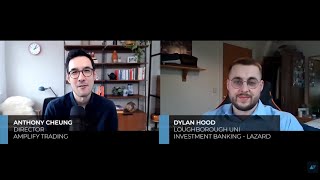
In this interview, Amplify host Anthony Cheung talks with Dylan Hood, a second‑year Politics and Economics student at Loughborough University, about his transition from elite sport to finance, his involvement in the Amplify programme, and how it prepared him for a 12‑month placement at Lazard. Dylan explains how the pandemic sparked his interest in markets, leading him to apply for Amplify, where he gained experience building pitch decks and learning DCF/LBO modelling. He describes the application and interview process for Lazard, noting the mix of technical and interpersonal assessments, the role of rejections, and the advantage of a longer placement. Dylan also discusses his regular finance blogging for outlets like Motley Fool, which reinforces his market knowledge and technical valuation skills. The conversation highlights the transferable skills from his ten‑year elite sport background—particularly time‑management, workload handling, and commitment—and reflects on the perception of Loughborough graduates in investment banking. The interview concludes with Dylan confirming his start date at Lazard in August and providing his LinkedIn contact.
Chapters
Hey, hello and welcome. I'm joined by Dylan Hood, who is a former summer analyst trainee that we had back in 2021, and I've kindly asked him to join me on the call just to catch up really and understand what Dylan's been up to. I know Dylan, you're still studying at the moment, so, so I guess to kick this off, why don't you tell us a little bit about your background, where you're from, where you're studying at the moment?
So yeah, my name is Dylan, as Anthony mentioned, and I'm currently in my second year at Loughborough University, and I study Politics and Economics. And I think kind of maybe the best way to start off is just to explain kind of a bit like why I chose that course and why I, kind of how it's led me to where I am now. So originally it was, I'd wanted to go down a kind of professional sport route. And that's why I kind of came to Loughborough University. And I came to the uni kind of in the midst of COVID And that was where I kind of really found a bit of a passion for markets. That sounds a bit cliché. It's kind of the volatility and stuff. I kept seeing kind of news articles on the FT, et cetera. And that's when I kind of became involved. And from there, I, yeah, I just, I kind of took steps to build my interest in markets and a few kind of work-related opportunities, and I saw Amplify and thought that looked kind of a great way to spend my first year summer because I knew I'd be applying for internships. And yeah, I went through the vigorous application process and was lucky to land a placement with a firm called Lazare, and I'm, uh, that's kind of where I am now.
Okay, cool. Why don't we, um, so go back to Amplify. What was it, um, if there was like just one or two things that you found that were most kind of beneficial for you, particularly then the path you ended up going down with Lazare, was there anything that particularly resonates now that was useful?
Uh, yeah, I think, I think the biggest thing that I took away, um, was definitely kind of what I learned in some of the group exercises. So I'm very interested in, or what I'm going into is M&A, and a lot of the group exercises where we were kind of creating like pitch decks was something I found really interesting. And there are a few people on the, on the course who had a little bit more experience than I did, and it was great to kind of learn from those people and implement small changes. And yeah, kind of build some, some great pitch decks and then pitch those to obviously the 60 or 70 other people I was on the course with, which was a really great experience. And then definitely some of the more technical things, so building the DCF and the LBO models is kind of an essential thing that you need to know how to do for the kind of technical side of interviews. So having real step-by-step kind of walkthroughs of those from Eddie was really great and was definitely something I talked about in interviews.
And I know just, just before this call you were mentioning about you're doing a— you're going to be doing a placement year, and I know doing a placement year, the— probably the opportunities are fewer just because most people just do a summer internship. So securing that 12-month placement is quite unique. So how was that process for you? I mean, certainly landing a a role at Lazard as well?
Yeah, I mean, it was a very kind of similar process, I think, to the summer internship applications. But I think if anything, it was perhaps kind of slightly less on the technical side because I think when you're there for 12 months, they can kind of afford to teach you kind of early on some of the stuff, some of the more technical things you need to know. So I think it was, yeah, it had all the kind of standard interview stages, but it was very kind of interpersonal, I think. And kind of again, going back to some of the experiences that I had from Amplify, just kind of working within like different teams, rotating around different teams, speaking to different people. I think again, that's something I kind of tangible experience of doing that was definitely something I could kind of take into the, to the assessment centers. And kind of maybe make myself stand out a bit.
And I remember you and I having a couple of chats along the way, and I know that for everyone, you know, securing that placement is never an easy thing. So how was that in terms of for you personally going through that? Because I'm assuming that there were rejections as well as the role that you got, right?
Yeah, yeah, although there were plenty of rejections. Yeah, of course, I think that's kind of something everyone goes through. Kind of through applying. And it is— I remember one firm I did a kind of a 2-hour maths and English test, and it took ages to get through. And like 10 minutes later, I got an email saying, sorry, you've been rejected from the role. And there are kind of a lot of moments like that which are really, yeah, they can kind of quite easily get you down, and you maybe think, like, is it, is it worth it? But it's I don't know, it's just sounds cliché, but it's just like seeing the positives in those things. It's like, right, I didn't get through that, but these are like XYZ skills I've been able to learn, I've been able to forward, I could then use for the kind of next application. And I think by the end of it, it had kind of got to the stage where I'd kind of done a certain amount where I just had those skills that I could just pass from one straight onto the other. So I think definitely it is a bit of a kind of numbers game, but it does really help you to have done lots of applications and kind of have that experience.
Now I saw on your LinkedIn that you're quite actively writing blogs. I saw one for Motley Fool, which is like one of the biggest financial blog sites in the world. So how did that come about and what benefit have you got out of out of doing that?
So that's something that I've been doing for kind of quite some time now, and it was kind of initially something that I did in my first year. And again, I applied for, and kind of through keeping up with the markets, it just kind of made sense to kind of do that work alongside my uni work. And but that's something that's definitely really helped me because kind of having those articles which I, uh, which I write really forces me to keep up with everything that's going on in the markets. And then obviously going into kind of that world, I think that really helped me, um, a few of the kind of technical questions about how to value, um, stocks and kind of based on other stocks and financial ratios and things like that. Just keeping up with those and just kind of writing, writing those on a regular basis, um, is something which definitely really helps me. And plus, it's just, it is something I'm really interested in. So, you know, we've got the kind of everything going on in the world right now. It really directly filters kind of into markets and it's interesting to kind of keep up with everything. So yeah, it's been a really great experience, definitely.
So with the writing that you've been doing for a while, then you did Amplify Experience and now doing the placement you will be going on, —like it seems like you were fairly sure in the area, because there seems to be a lot of equity-based research-type activities, and then M&A, IBD. Was that always quite clear to you, or was it not always like that?
I think it's— for me, it kind of has always been quite clear. I actually did a— I mean, when I— like I said, when I first came to uni, I thought I wanted to pursue professional sport. And it was through speaking to a flatmate who had done a year's placement in asset management. And that was my first kind of like flavor into what a bank is, how it works. And he could kind of explain the different divisions in the bank. And just through kind of going away, having a bit of general research, and I just think like M&A, from what I could kind of see, really suited my kind of interest and my skillset almost. 'Cause I don't know, as kind of sad as it may sound, I do really enjoy putting decks together. That kind of, I don't know, more, perhaps my slightly more creative side of it, of kind of putting stuff together coupled with kind of speaking to people, kind of client-facing role, as well as the technical stuff, which I mentioned. And it kind of seemed to like knit all of those things together. And again, I had some experience through doing an M&A competition with Loughborough Finance and Investment Society, and that kind of gave me more insight. And I guess just kind of all the experiences that I'd done kind of came together, and yeah, I just, I kind of decided that this is what I want to do. Let's try and build some skills to really make myself stand out in the interview process, and it kind of went from there.
Loughborough now, I know, just generally ranking-wise, it's gone up and up and up over time. Yeah, when I went to university. So how, how has that been for you? Because I know, uh, obviously it's a top uni, it's not a traditional catchment one like an LSE, UCL.
Has that ever been a thing that's come up, or you found a challenge, or, um I think kind of, I think for a few I did kind of apply and just get like a straight rejection, and I think a few of the firms still do have that traditional, the kind of, well, you said the catchment of like LSE, UCL, your kind of big finance unis. But I think kind of the industry more broadly now is definitely moving towards kind of realizing that people from loads of different backgrounds actually have some kind of really great skills to offer. I think kind of more broadly, that's something which I was wary of because my degree is predominantly politics-based. So I think that's again perhaps not like a traditional kind of route into investment banking, but I think that in a way it can almost like make me stand out because I have— I've kind of— I keep up with the finance side of it outside of uni, but I can kind of build maybe some other kind of writing analytical skills throughout my degree. And yeah, like you said, Loughborough is kind of climbing the rankings at the moment, which is great as well. But I guess it's kind of trying to have that mindset of, okay, maybe this can make me stand out as opposed to like hold me back.
And you've mentioned sport a few times.
Yeah, sport. Well, so I was going to say that that was I mean, that's the only— I mean, Loughborough is a great uni and it was a great choice to come to Loughborough, but it was predominantly for the sport that I came. I swam kind of from like 10 all the way up until I was 19 to kind of, yeah, national, international level. I represented England and then I, in my gap year, actually before university, I switched over to rowing. I was kind of landed a, landed a position. I'm already going into the finance, the finance lingo. Yeah, I basically went on to a program, a GB Rowing program, and I did that for about a year and a half, which was again kind of at that high elite level of sport. But it was a kind of combination of the pandemic and not being able to train. And kind of, again, it was finding this passion for markets and finance and then kind of seeing that whole world that I'd never really considered before. Um, and yeah, it was just a kind of natural decision that I thought, actually, um, you know, this is why— this is what I want to do, um, instead of the professional sport. And, and yeah, that's kind of led me to where I am now.
So having had like 10 years of what sounds like elite-level sport. Yeah, at least at the tail end of that. What's been like, uh, transferable, you think, skills that you, you're able to apply now in the finance world sense, if anything?
Um, yeah, so I think definitely for me the biggest thing is just kind of being able to manage workloads. Um, because I've kind of since— yeah, since about 12 or 13, I've probably done going on about 30 hours a week of sport, of training. So kind of now having— it's almost like I have like an extra 30 hours a week to kind of do all of my stuff outside of uni. Um, but aside from that, it's definitely time management. Oh, that was the big one that I kind of got across in all of my, all of my interviews because it was a question that did come up. It was kind of how, how can you use your sport transferable skills? But I think definitely the time management is a big one. And kind of creating plans, being diligent, kind of getting stuff down to a T. And that's, that's something personally which really works for me, really helps me get tasks done, is definitely the kind of creating a plan and the time management side of things. So I think that's probably the big one, um, aside from, yeah, just, just general commitment and kind of hard work ethic.
Yeah, cool. Well, look, I really appreciate you taking the time out um, to talk with me. And look, you start in August, is that right, at Lazard? Yes, yeah, late August. Yeah, okay, well cool. Keep us, keep us posted how that goes. I'm sure we'll stay in contact, and I'm sure if anyone wants to reach out to you, they can reach you on LinkedIn. Is that okay?
Yeah, yeah, LinkedIn is— yeah, LinkedIn's perfect. So just Dylan Hood on LinkedIn. Yeah, if anyone has any questions, feel free to reach out.
Cool, all the best for the placement and, uh, and not forgetting your studies as well.
Yes, yeah, yeah, exactly.
Still got to get the job done. Exactly, exactly. Good stuff. All right, Dylan, good to catch up and take care.