Apple To Cut iPhone Production, Chinese Exports Accelerate & Transitory Is A Dirty Word
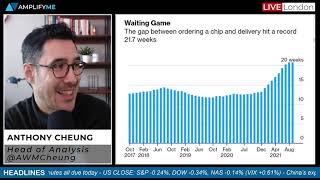
In this morning market commentary, the host provides a comprehensive overview of global financial markets on October 13, 2021. He begins with a technical snapshot of major indices, currencies, commodities and bonds, noting flat price action and key support levels in the S&P 500 and Nasdaq futures. The core narrative centers on Apple’s reported decision to slash iPhone 13 production by up to 10 million units due to a prolonged semiconductor shortage, contextualized with record‑long chip lead times (21.7 weeks). The discussion then shifts to China’s September export data, which showed a $66.76 billion trade surplus and 28.1 % YoY export growth—far above expectations—while cautioning that the pace may slow later in the year. The host reviews recent Fed commentary, highlighting Bostic’s dismissal of “transitory” inflation, Clarida’s view that tapering conditions are met, and Bullard’s hawkish call for rapid tapering. He outlines the upcoming US CPI release, expected at 5.3 % YoY, and its potential market impact. The segment also covers Evergrande’s bond payment defaults, upcoming earnings from major banks (JPMorgan, BlackRock, Wells Fargo, Citi, Goldman Sachs), and fixed‑income supply events such as a $24 billion 30‑year Treasury auction. Throughout, the tone remains analytical and measured, emphasizing data‑driven insights while acknowledging uncertainty in macro trends.
Chapters
Okay, very good morning. Hope you are doing well. It's Wednesday the 13th of October and I'm going to talk to you a few different things. We're looking at Apple's aftermarket decline in share price that we saw last night and I'll explain why that's happened as it's reported that the company might well slash its iPhone 13 production targets. We're also going to talk about Chinese trade data a couple of Fed comments as well to be aware of, one of which Bostic said that transitory is a dirty word. And in fact, when he was giving his speech last night, he was dropping dollar bill every time into a naughty jar he said the word transitory. We also talk about the formalities around the US debt ceiling and then, of course, the day ahead. And actually, just before I get stuck into Apple, looking at the general setup of the charts at the moment this morning. So just to remind anyone who's, who's new to joining us, I've got EURUSD top left, cable top center, gold futures top right, and I've got the center left to right DAX futures, NASDAQ 100, S&P futures, and I've got WTI crude down here on the bottom with bottom right the US 10-year. And so overall pretty flat this morning. In fact, there's not too much movement seen. The dollar index is, is pretty much unchanged and therefore just marginal gains seen in the major pairs to get the European session underway. As far as the equity markets are concerned, pretty similar setup for the NASDAQ as it is in the S&P, where yesterday's lower bound levels that were seen around this time, um, on Tuesday morning session are still holding for the time being. So certainly key areas to watch is support now really on 3 more meaningful tests that we've had in the last 24 hours around 4,300 21.5 in the S&P. And as I said, the NASDAQ is, is pretty similar here, uh, in its formation for the time being. On a daily chart, on the downside, we're still a little bit away from what would be seen as more longer-term crucial levels of support, with generally that rising channel that we have with the horizontal area of support coming in around 14,471 As you can see here, we're trading well above that at the moment by around 200 points or so. And markets at the moment, as you can see here, just moving up the Nasdaq future to its pivot level under no real new fresh catalyst this morning. But perhaps people just looking to just enter again lower down on those technical areas of support. Otherwise, gold not too interesting right now, but positive around $5. Oil's pretty much just locked in a bit of a sideways period of consolidation for the time being after some of the recent surge in price that we've had. So it's pretty flat overall but holding an $80 handle, uh, and T-notes just tracking sideways for the moment, basically trading unchanged. So let's jump straight into it and talk about Apple first. And why did their share price decline around 1.3% after market? Well, the headline is here: the company is likely to slash its projected iPhone 13 production targets for this year by as many as 10 million units. And the rationale behind this is because of a prolonged chip shortage hitting then its flagship product. Again, I must stress, this is according to people familiar and have knowledge of the matter rather than an explicit comment from the company itself. But you can pretty much take it that it is the way that these news cycles tend to work. And so Apple shares, yeah, they did fall aftermarket and certainly something we'll be keeping an eye on. I guess for a bit of context, here's a look at, you know, given the impact that these global chip supply shortages having on a number of manufacturing processes, that this is looking at the gap between ordering a chip and a delivery of it hitting now a record of 21.7 weeks. So as you can see here, in pre-pandemic times, the average kind of time from order to delivery would have been in terms of weeks, roughly about half of what it is at the moment currently. So definitely puts that into a bit of perspective. But in this article, it was on Bloomberg. If you want to have more of a read, I did retweet it from the AmplifyMe Twitter account. It does go on to talk about the fact that it's still likely that Apple is going to have an absolutely phenomenal quarter going into that Christmas season when we get to Q4. Given the fact that the refresh rate for the iPhone 13 is like to be quite strong. And I think we're looking at predicted revenues for that quarter alone when that time comes around $120 billion in a quarter, which is just phenomenal in that respect. So some snags now. I don't think ultimately this is a real deal breaker. Some people talking about a little bit of weight in the Nasdaq future overnight, but can't really say I see it that evident on my charts, to be, to be quite honest. And the market at the moment is moving higher. For the time being. Otherwise, the other thing from overnight in the Asia-Pac session is Evergrande assigned. It's still generating a few headlines, but I think important is that yes, they are missing some of these bond payments still, uh, and it is still a bit up in the air about what is the next step for them as a company. But I would say overall, broader markets in the, the assets that I've just shown you on my charts, I think generally have just kind of accepted the reality of what Evergrande is at the moment. And I think that, that kind of period of heightened sensitivity to that whole contagion effect has definitely diminished a great deal. And so as much as their headlines— and I continue to monitor them, remain vigilant— I don't really see that really shaping much of the intraday short-term sentiment or strategy for the time being. On the flip side though, from an economic point of view, we did have overnight China's export growth accelerated in September, and that has defied quite a lot of expectations of a slowdown amid a nationwide power crunch that has forced factories to cut production. So by numbers, the Chinese trade balance came in at $66.76 billion. This would be US dollars in September. That was above the expected $46.8 billion. The export number year on year for September was at 28.1%. Above the expected 21%, uh, and up on the previous 25.6%. A couple of things though, um, and this was a comment from the spokesman of the Customs Department in China who said that fourth quarter trade growth may slow because of higher base of comparison from a year ago plus logistical problems. In addition, global appetite for Chinese goods, analysts say, could also start to kind of wane after buyers front-loaded their Christmas orders, because everyone's— it's kind of the chicken or the egg at the moment. People are aware that there's going to be production distribution issues most likely going into the Christmas period, given the kind of bottlenecks that we've been experiencing. And that— is that going to change consumer behavior and therefore companies forward front-loading very early their Christmas orders, which is which means then we get quite a dramatic drop-off as we go into the latter part of this year, perhaps. So yeah, I mean, how important is this Chinese data? I mean, it's interesting, but if it is good, I don't think it's necessarily a positive trigger to initiate any type of long-lasting sentiment. I think it is what it is on the surface level, but as I said, it's probably unlikely to remain at such a good pace as what we've seen with the last two trade data numbers coming out of China, which have actually exceeded expectations. I probably don't see that lasting for too long, and I think the markets are aware of that for the factors I've just mentioned. The other thing then is, yeah, transitory is a dirty, dirty word. I can honestly say I can think of worse dirty words, but, um, yeah, the three speakers that we've had— Bostic, who is a voting member of the Atlanta Fed, uh, voting member on the FOMC, said that inflation surge is lasting longer than expected So it is not appropriate to refer to such a rise as transitory. I don't think that's surprising. I think that's just generally how the markets become to view that situation, and hence the reason why yields have seen some of the biggest moves in recent, recent months. In the last couple of weeks, Bostic favoring tapering bonds sees liftoff in more than a year. So very explicit again to kind of define the timelines, that tapering is not rate hikes. The two are kind of two different processes. The other speakers that we have had is— well, here's a look at the not-so-transitory inflation figures. And certainly, obviously, we're looking at this today because we get US CPI, which I'll touch upon in a moment, coming out this afternoon, which is obviously a critical component for how sticky or not this inflationary pressure is at the moment. The other speakers that we've had was the Vice Chair Richard Clarida, who noted that conditions required to begin tapering the Fed's bond buying program have all but been met. And so again, given the green light, as markets are very much expecting for that November announcement of tapering. And then the last one is Bullard, who sits right at the most kind of hawkish end of the spectrum, said here bond purchases should be tapered quickly in case rate hikes are needed. Started talking about advocating trying to get finished with tapering process by the end of the first quarter of next year. And to give that context, as what we heard at the previous FOMC meeting, they were talking more around the summer of next year. So hence the reason why he sits much more on that aggressive hawkish end of the spectrum. Not unusual to hear that comment from Bullard. So again, of the three, nothing really there too shocking, I would say. And hence the reason why there's been no reaction Despite the kind of hawkish sounding comments in the US dollar, which if anything is retesting actually as I speak some of the recent lows that the Dixie has been trading. So actually keeping an eye on the Dixie as I'm speaking now, it's just retesting the APAC low at the moment, down about 0.2% this morning in the Dixie. And then a few other things to be aware of today. You've got corporate earnings. We kick off the big banks today. JPMorgan's coming out just ahead of 12 o'clock London time. You've got the likes of BlackRock as well pre-market, and then that kicks us off with then Wells Fargo Citi MS on Thursday and Goldman's coming out on Friday. Quick look at JP, um, what can we expect? So, um, focus on JPM's net interest margin. So key metric of course for the banking industry, reflecting the difference between the interest banks earn on their assets and the interest they pay out to depositors and other creditors. Um, quick refresh though, in Q2 of 2021 results that, that came out in mid-July for, for JP Morgan, the bank bolstered their profits by freeing up another $3 billion in pandemic loan loss reserves that it originally set aside for pandemic-related defaults. So again, it's kind of how do you kind of pump the numbers and make them look fantastic? Well, yeah, if you're freeing up reserves to the tune of $3 billion, that certainly helps. And so that start to, to obviously fade as those loan loss reserves have already been kind of shifted in that sense. In recent months, JP Morgan's rebound has faced a couple of challenges, and I guess some of these are quite true of other bank stocks as well that we'll be looking out for later in this week, that the Delta variant of COVID-19, particularly over the summer, has slowed the rebound somewhat of the economy. JP Morgan's costs have also risen boosted by pay to attract junior employees. You remember, of course, there was that kind of infamous Goldman report that came out and rather than seeing any structural change in the hours that they work, 100 hours, which of course is pretty insane, just throw some more money at these kids and hopefully the problem goes away. And so obviously your cost base going up in that respect as well. Analysts expect tepid year-over-year growth for earnings per share. So the EPS and revenue for the quarter. And this would mark a significant slowdown in earnings growth compared to the previous 3 quarters. So again, it's probably a recurring theme that we'll see through this earnings period is that there's a bit of a realization about what the future now is going to, to look like. And so a bit of a deceleration for some of the astronomical growth that we were seeing going through this really strong equity run that we've had through the post-pandemic initial period. Now we're coming to see the, the top and slight fatigue of that. And so a bit of a recalibration back to a degree of sense of normality from those much more bullish outlooks that we're seeing before is probably going to be the order of the day to some degree. Final point from a, from a student perspective, because I know there's a number of students I've been talking to that are interviewing the likes of JP Morgan and other US banks. One thing I would say is that, you know, jump on the earnings, the investor relations pages of these, these banks after they come out and do take a look at those top-level sheets to get a real just glossary of like what the major divisions, how they're performing, the different drivers of different divisions, just generally get a flavor of how beyond just then the surface level that bank is performing. So when you go into these interview situations, you're just that better equipped about knowing your target institution. Anyone who needs help with that, just drop me a comment. I can shoot you the, the full actual press releases that come out. Not a problem at all. Otherwise, just jumping to what's happening today, we've already had some UK data. To be quite honest, pretty disinterested in that. I mean, GDP estimate for August month on month was 0.4 against 0.5. The 3-month on 3-month figure, 2.9 against 3%. In terms of sterling reactions, not really so much sterling reaction, but I'd say dollar a little bit softer this morning. EURUSD cable kind of following a uniform approach. Cable just accentuating that move a little bit on the short-term technical breach of the late APAC high that we've seen. So just a short run-up here towards its R1, up about 30 pips this morning. But equally so, EURUSD is up about 21, albeit that's being held for the time being by the APAC high. So yeah, I'd say the UK data really not a big deal as far as really shaping any new thoughts about the UK economic recovery at this point. Otherwise, jumping further forward, you've got eurozone industrial production at 10:00, but the real more interesting events are really happening this afternoon. You've got US CPI, of course, happening at 1:30, and that's probably going to generate the most interest, probably one of the main highlights of the week. And certainly, I think much more interesting perhaps than what we'll get out of the FOMC minutes. Which are coming out at 7 PM later on this evening. That's going to be scanned for clues, of course, any hints towards the, the formalization of the announcement of tapering in November meeting. But I think that's no surprise if that is the case, so I don't think we're going to get too much more out of those minutes. So for CPI, analysts at the Dutch bank ING write that the reopening spike in key areas that we've seen the rate of price increases moderate but it's still faster than what we saw pre-pandemic, with higher food housing costs particularly evident. And they suggest then that this will keep the year-on-year inflation rates elevated, with the risk being that they rise further in coming months given supply chain issues and inventory shortages as we go into the key holiday season. Hence the reason why as well you're getting these central bankers talking about, well, look, we shouldn't really be using this word transitory. So, so clearly at the moment, because perhaps that's not quite the case. I guess more importantly, how's the market going to take that figure and react? Well, I don't think whether it's a little bit stronger or a little bit weaker, that's really going to change the game for the Fed in November. So any type of price volatility we see intraday is probably going to be relatively short-lived, I'd say, in that respect. Um, could it move? I mean, certainly, sure. I mean, if we get a forecast-beating number— the headline is expected at 5.3 3, if it goes up to 5.5, and let's say the core reading as well comes in the top of the range, 4.3%, yeah, you'd probably expect the immediate reaction to be dollar yield strength, gold under some pressure, perhaps equities have a little bump on the downside. And if we break that technical areas of support that we were looking at in the likes of the NASDAQ and the S&P, you might get a little extended run on the downside. I don't think it would be dramatic though, even under that scenario. Because I think at this point it doesn't really change the bigger picture. I think people are of that view that inflation is going to hang about a little longer, and if it comes out a little higher on this side, again, with always with the CPI report in the US, just having a look through the breakdown of the report, what is causing these price pressures to determine or not whether how transitory they are. And so yeah, I'll tweet that table and identify for you any of those things that stick out later on this afternoon. And yeah, that's pretty much it. So otherwise, speakers, you've got ECB's De Coste speaking at 11:30, Bank of England's Cunliffe, Fed's George this afternoon, 2:30, and then the evening George at 9:30, speaking alongside Brainard as well. And then fixed income supply, Italy, Germany, and then $24 billion in a 30-year note auction as well, coming out at 6 PM from the US. So that is it, gonna leave it there. I hope that was useful. Any comments or questions at all, feel free to just, just drop those below. Otherwise, I will see you guys tomorrow. Thanks very much.
More from Anthony


Inside the Biggest Banking Stories You Need to Know This Week (Anthropic, Diageo, Private Credit)


Inside the Biggest M&A Deals You Need to Know This Week (UniCredit, GameStop, eBay, Eli Lilly)







AI Breakthrough or Hype? Anthropic’s Claude Mythos, Tim Cook Steps Down & LIV Golf Collapse