Are US Stocks About To See A 5-10% Pullback?
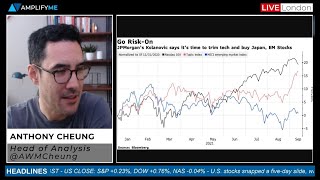
Deutsche Bank's investor survey shows 58% expect a 5-10% stock correction, while the S&P 500 hasn't seen a 5% pullback since October 2020. JP Morgan recommends rotating from tech into economically-sensitive sectors as COVID risks ease. Oil rallied on Storm Nicholas and OPEC forecasts, aluminium hit record highs, and the Nikkei closed at its highest level since 1990.
Chapters
Very good morning, it's Tuesday the 14th of September. Hope you are doing well. What I'm going to talk about in the briefing this morning, I'm going to talk about the US stock market snapped a 5-day slide yesterday. We finished in positive territory for the S&P and the Dow, albeit the NASDAQ pretty flat overall. We're going to talk a little bit about the future then for the equity market direction in the US. There's been growing calls, as we discussed last week, from a variety of different banks talking about the ideas of the negatives stacking up and the fact that we could well see a bit of a short-term pullback for, for equity markets. So I wanted to just have a look at a few things that I found from a Deutsche Bank survey that was released yesterday to give you a bit of context as to where heads are at as an overall Wall Street view at the moment. And also going to talk about JP Morgan's outlook for US equities because they're bringing back this idea of coming out of tech and rotating back more into those names exposed to the economic performance, because in summary, they see the COVID situation in the US as a short-term issue and something that we will get over in the near term. Otherwise, other things to quickly talk about. We're going to touch upon Powell's reappointment. Obviously, that is still an open question at this point, but some backing from some senior figures last night in the US, which we can talk about. UK booster shots, Storm Nicholas, which has helped keeping oil prices elevated at the moment. It's worth just having an update on that as well. So yeah, as the headline here suggests, US stocks first day they've gone up in 5. Energy companies led the gains as WTI crude actually extended its rally to a 6-week high. Just having a look at crude futures this morning, you can see really nice continuous move that we've seen really since the second half of last week when we were trading a $67 handle. We're now trading up in a 71 mark for the time being and up 58 cents again this morning, having just traded above in the overnight APAC session yesterday's high print. On the daily chart, you can see that from a technical perspective, the breakout above then the early September highs then does mean that from the upside, um, not too much in the way of resistance till we get up closer towards the $72 handle, which would be that high that we had on the daily print on the 3rd of August. At $71.76. So continuation of the rebound that we've been seeing in crude since the 23rd of August when we hit that initial low. And so probably prudent then to have a quick update on why oil is moving like it is. And OPEC predicted stronger demand for its crude on a combination of rising global fuel consumption and output disruptions elsewhere. One of those main things, of course, that we're tracking at the moment is Storm Nicholas. So the oil industry overall has been struggling a little bit to get back on its feet following Hurricane Ida. Now, to be clear, in terms of a weather pattern and its intensity, Ida is far more stronger than what we've seen from Nicholas so far. But the point is, is where we're starting from as this latest weather system hits the Gulf Coast, and that's because analysts suggest that roughly 44% —of capacity was still offline, and efforts now to restore that output have been compounded by the emergence of this new tropical storm Nicholas hitting the Texas Gulf Coast. As you can see, pretty much right on the coastal line at the moment. So heavy rainfall will impact portions of southeastern Texas, Louisiana, southern Mississippi through the middle of this week, and that's just helping keep crude oil prices elevated for the time being. Otherwise, in the commodity space, Something we were talking about a few weeks ago is aluminium, the industrial metal now reaching £3,000 a tonne in London, first time it's done that in 13 years amid ongoing supply disruptions from Guinea. And then in terms of the Asian session, as I mentioned then, we did actually finish generally positive for the first day in 5 for the S&P and Dow. They were up a quarter and three-quarters of 1% each respectively. And that did kind of drip through into the Asia-Pac session where the Nikkei 225, as you can see here, is on track for its highest close since 1990. You can see here going all the way back to this initial peak that we saw in the late '80s. So it continues to remain firm, latest trigger being of course Suga saying he was going to step down, and the idea then a bit more continuity, more fiscal firepower coming. And obviously in context as well of the ongoing loose, accommodative central bank stance, monetary policy. Elsewhere though, in the region of Asia, China wavered slightly. People still evaluating the troubles of China Evergrande Group and also Beijing's kind of latest regulatory curbs that we saw with Alipay, which we spoke about yesterday. Meanwhile, over elsewhere in Australia, the latest here is from the RBA chief Philip Lowe, who pushed back against investor bets on early interest rate increases, arguing it will take some time to drive faster wage growth, reiterating that he doesn't see or expect liftoff by the first rate increase before 2024. The Aussie, a little bit softer, just trending lower overnight, more broadly speaking, down 16 pips going into the European Open. The other thing then, just quickly talking about COVID in that region new local COVID-19 infections have more than doubled, uh, in China's southeastern province of Fujian, uh, health authorities have said overnight, prompting officials to quickly roll out measures including travel restrictions to halt that spread of the virus. Um, timing-wise, worth being aware from a seasonal perspective, the infections come ahead of a week-long National Day holiday starting on October 1st, which is a major tourist season for the country. And obviously this coming up possibly the worst time for that event to happen from a tourist perspective. Um, on the COVID side, uh, just a quick look elsewhere geographically in the US, a little bit more positive in the developments that we've been seeing, hence the reason why it has been generating fewer headlines in the more mainstream media. And that's because COVID-19 hospitalizations have remained below 100,000 for a third day running for the first time in more than 3 weeks as of yesterday, a further sign then the summer wave may well have peaked in several of those states, which were obviously seeing quite aggressive upticks just a few weeks ago. So that risk dissipating a little bit. Um, but one of the things I wanted to talk about a little bit was the US stock market, because we've had a number of banks getting bearish. I've actually had a number of students asking me, you know, is the stock market going to pop, and are we going to see a decent correction to the downside, what type of probability would we assign to that type of price movement occurring? And quite timely, Deutsche Bank did an investor sentiment survey. And so here's what we're looking at here. There's a few different graphics I can, I can kind of cycle through. So they were asked then basically, what's the chance that you see of a pullback in equities? And the bar, first bar here is Yes, I think there will be, and it will be between the size of 5% and 10% in terms of an S&P pullback. 58% of people held that view. It's quite a wide investor survey that was conducted by Deutsche. Yes, but more than 10%, so people who are looking for a much more aggressive correction plus type move, uh, technically speaking, in the market was the least popular view. And then no, there won't be a correction before year end, and we keep going. Now the reason why this is growing in conversation is really because of this chart, and that's a reminder then that the— basically the S&P 500 has not had a 5% drawdown since October of 2020. And typically when we start to see that type of lack of drawdown in the market, it kind of builds up manifests itself into quite an episode of volatility at some point. Hard to say what the timing of that will be, but markets rarely remain without a 5% pullback for long. And the longer it goes on, then ultimately the higher we've gone, the bigger the consequent pullback might be when it does occur. So hence the reason why a lot of this bearish conversation is happening. And then Deutsche were looking even more specifically, the net of just 14% see the S&P 500 higher in 3 months. And as far as the year goes, that's the second lowest reading in a year for people who are more bullish, essentially, in terms of where we're going to end the year. So a couple of things there that I thought were quite interesting. Flipping a slightly different angle, but still US stocks. This is coming out of JP Morgan strategist, um, who basically was saying that the growth scare that are prompting investors to seek safety in technology companies is overdone as the economic drag from the Delta coronavirus variant is likely short-lived. And the strategist at JP added investors should consider cutting exposure to tech stocks while raising stakes in economically sensitive companies like energy. Now logically that makes sense, and we are seeing of course US COVID coming down but still very much a global issues to, to see the complete, more tempered control, let's say, given the fact of lack of vaccinations across much of the undeveloped world, as well as case rates still high in countries like the UK and so on, albeit with vaccination still ongoing and immunity rising. The point being here is that I think these calls— if you remember, probably 3 months ago, people were talking about the end of tech and we should be bailing on that and rotating into growth names. I just like to remind people that that call at that time from these banks was ill-timed. It was bad timing because if anything, growth stocks really just kicked on. Um, and so now comes the question: is this the right time? Um, for me, I still think it's a little early to be making that switch But again, I guess that's where the opportunity comes. If you're early into that position and you get your timing right, obviously the payoff much bigger. But I still think that there's a few complications here still to, to go through from the COVID situation, particularly as we go through a calendar year period of where temperatures, uh, definitely in the Western Hemisphere start to decrease as well. Uh, be interested to see how, how those developments pan out. So yeah, I think logically makes sense. Don't have any issue with the rationale. I just think timing perhaps a touch early for me personally, but who am I to contest the mighty JP Morgan? Uh, let's see who wins. Otherwise, a quick look then at some other things I wanted to talk about, and we're going to move over to Jerome Powell. And the reason why we're talking about Jerome Powell is former Democratic Senator Chris Dodd and Representative Barney Frank Now, if you've never heard of those names in terms of their full names in their kind of titles, you might have heard them in regards to the Dodd-Frank Bank Reform Act in America that got enacted. And the reason why this is quite interesting is that these guys have said that Jerome Powell's reappointment would provide, quote, strong support for President Joe Biden's comprehensive program for tackling the underlying social and economic problems challenging the US at the moment. Now, their support is particularly noteworthy because a number of progressives have criticized Jerome Powell for rolling back some of the reforms that were initially initiated through the Dodd-Frank legislation and called on Biden to replace him as Fed chair. But now you're getting the, uh, the actual originators of that act themselves are giving their backing to Powell, and that will kind of silenced the naysayers, I would say. So for me, I think Powell is pretty much a shoo-in at this point. I can't really see anything else— anyone else stepping into that role for the time being, I think, would be a surprise for markets. So obviously markets will tend to like that idea of continuity and so forth. Final thing for the UK to talk about was that we are expected to hear an update from UK Prime Minister Boris Johnson later today. To confirm that booster vaccinations against coronavirus will be rolled out to the most vulnerable people this fall. This comes contradictory to some studies we were seeing yesterday about the fact, an idea that vaccines are kind of good enough and we should be distributing these to other parts of the world which are unvaccinated even by one shot at this point. But nonetheless, I definitely, you know, think that when push comes to shove, um, nations will typically look to take care of themselves. And this, I think, doesn't come as a surprise. The UK government has been saying that this was going to be the strategy anyway. It comes after the government said on Monday that 12 to 15-year-olds in England will be offered a single shot of the Pfizer-BioNTech vaccine in schools as well from next week. And that's obviously going to be very important because if you wanted to have a look at some statistics about the impact of schools reopening, of which It's the end of August now, the kids are going back to school. The impact that that can have on the consequent new trigger of a wave that we could see, according to some mathematicians and people doing the modeling, in the weeks and months to come. So hence the strategy to try and get some of those students vaccinated. The other thing today, we do have Apple, uh, they're hosting their event It's called California Streaming, it's what they've dubbed it. It's going to be at 6 PM London time when that starts. I think Apple shares did see a decent move higher, outperforming the, the broader NASDAQ index yesterday. Quite typical, we tend to see this kind of buy the rumor, sell the fact, because a lot of the stuff that comes out is highly anticipated and very rarely is there any surprises at these new product launch events. Um, quick skinny The iPhone 120Hz ProMotion displays are expected, improvements for the camera, an A15 chip which means faster 5G, battery life improvements, this massively innovative change— gonna take that notch, make it a tiny bit smaller. Um, these are all things that we can expect from the, the iPhone 13. They also got Apple Watch Series 7, expecting the first design update in quite a while. The Apple Watch expected to feature smaller bezels and a flat-edged design, much like the new phones have in the latest models, with a faster chip and new wireless capabilities. And then AirPods 3s are due to come out, pretty similar, anticipated to be what the AirPod Pros look like but just without active noise cancellation, meaning that they can be cheaper. So you still look the part, but the actual product's not as good. Um, I'm sure they'll get a good, good amount of volume on the sales of those going forward, given their lower price point that's anticipated for that product. So that's Apple, 6 o'clock, that starts kicking off if you're looking at the single stock. And then probably from a calendar perspective, we've already had a couple of UK data points come out this morning, so let me just get you up to speed and I can fill you in how, how that came out just now. So the UK average earnings, um, ex-bonus, 6.8%, was in line with expectations. The unemployment rate, 4.6%, also in line as well. So not too much fluctuation in the sterling currency, which at the moment both currency pairs are being buoyed by a softening dollar. The dollar index now this morning into the European session is trading down Moderately, about 1/10, but it's broken through yesterday's low. That's exacerbated some of the weakness in the greenback, and as such then you can see a bit of an elevated move on a technical break up here in the euro through the high from yesterday afternoon and the APAC Asia high. We've just seen a fast money move right up to the R1 on the, on the move there. Otherwise, the other products are fairly quiet. The 10-year, gold, pretty sideways. Just a little bit of fatigue from that run-up in US equities yesterday. And of course, the main event for today is US CPI, and that's going to be at 1:30, probably one of the main data points of the week. And here it is, this is what we're looking at. So these are the last— well, this is the last two decades of US CPI And here we are at the moment in this latest kind of pandemic squeeze that we've been seeing, creating inflationary pressures. So a few things here to be aware of. It's expected to show an annual pace of inflation of 5% or more for a fourth month. The actual year-on-year reading is expected at 5.3%. Um, and this follows a report last week which showed the Producer Price Index, the PPI, for final demand rose to a fresh series high as persistent supply chain disruptions continue to push prices higher. One of the things that people are looking at for today's reading is on a month-to-month basis, price increases have somewhat moderated, but the focus is shifting now to whether sectors beyond those most sensitive to pandemic-related disruptions are starting to register higher gains. So kind of like what Piers and I were talking about in the podcast, we we did on the Market Maker on Friday is, is this— if you think about over in China where they've got COVID disruptions in ports and manufacturing, commodity price spikes that we're seeing pushing up the cost of goods, the US then importing those price pressures, consequently then moving that down to the consumer— and is overall then actually inflation proving to be a little bit more sticky in that sense. And this all of course plays into the mindset of the Federal Reserve policymakers and their decision over tapering. So that's going to be quite a key event for the week. It's coming out 1:30 today and could well be— although we're seeing a bit of a drift south in some of the US stock futures as Europe comes in— could well be fairly tame price action as the market will want to sit on its hands to a certain degree and wait for those numbers to hit. Later. Otherwise, that is really the main thing. Some supply coming out, any fixed income traders, Italy, UK, and a German Schatz auction this morning. And then that is it. So gonna leave it there, let you guys get on with the day. Thank you for listening. If you're watching on YouTube and you're not subscribed to the channel, please do, and you can get these updates from me every morning as well as some other content coming out as well later on today on the channel. All right, take care guys and have a good one.
More from Anthony


Inside the Biggest Banking Stories You Need to Know This Week (Anthropic, Diageo, Private Credit)


Inside the Biggest M&A Deals You Need to Know This Week (UniCredit, GameStop, eBay, Eli Lilly)







AI Breakthrough or Hype? Anthropic’s Claude Mythos, Tim Cook Steps Down & LIV Golf Collapse