Are We Due A Pullback In US Stocks?
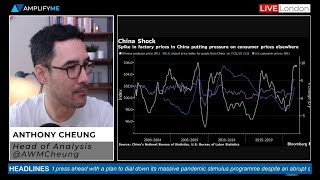
Anthony Cheung breaks down macro risks for September 2021: major US banks are pessimistic on equities with forced liquidations possible, Chinese factory prices hit a 13-year high at 9.5% while US import costs rise, and natural gas futures surge to seven-year highs on tight supply.
Chapters
All right, very good morning, Thursday the 9th of September. Hope you're doing well. I'm going to focus predominantly on the, the kind of news and fundamentals this morning rather than the charts from a technical perspective. A few things definitely I want to get my teeth into, which is the growing pessimism amongst some US major banks about the direction for US stocks going forward. I want to talk about Asia. We had some inflation data overnight, Chinese PPI 13-year high. What are the implications for that, for the stickiness of US inflation, and why is that not impacting consumers in China? Also want to talk about the Fed. There's a whole batch of Fed speakers this afternoon, and it comes on the coattails of what we heard from Fed's Williams yesterday. And we'll have a look at his comments because they're particularly important because he was speaking explicitly about the economy and policy, and he is very closely aligned with the Fed Chair Jerome Powell. A lot of focus, of course, on more details on tapering. We also had the Fed's Beige Book last night. We're also going to talk about the energy market. We've had the delayed release of the API inventories last night. We've got the DOE's obviously this afternoon. Natural gas futures trading a 7-year high, and why is that happening, we can discuss. And then of course we've got the ECB interest rate meeting and subsequent press conference with Christine Lagarde as usual, with also their latest economic forecasts. So all of that coming out later on today, and we're going to discuss a little bit more at length. But let's just have a quick review of the charts as they reside this morning. Dollar index pretty much unchanged. That's reflected in the major pairs top left, both trading in EURUSD and Cable pretty flat. US 10-year the same. As far as other products, the equity index futures marginally lower. However, just gone through 7 AM, slight bounce off their lower levels. Does come after a lower close on Wall Street, and what we saw was the S&P and Dow finishing down 0.1%, 0.2% each respectively. A little bit of underperformance in the NASDAQ 100, down 0.35%. Um, but yeah, pretty, pretty steady this morning overall. Not too much to talk about from a sentiment perspective right here, right now. So let's get straight into the headlines and let's talk about this Bloomberg article that came out yesterday. Now we're talking about investment banks turn tower on US equity outlook. And two names you can see cited here being Morgan Stanley and Citigroup. And as I always say, you know, if you are a student and you're applying to these banks, or indeed preparation for interviews, you definitely should know what the house view is for these types of institutions. It's going to, it's going to definitely give you a little bit of an edge in understanding their view as well as constructing your own. So Citigroup strategists, they've said that positioning uh, in particular has become ultra bullish. And what they're talking about is longs on the S&P 500 outnumbering shorts at a ratio of 10 to 1, which is pretty extreme. And it means that half of those bets are likely to face losses according to their calculation on a drop in the index of as little as 2.2%. And even a small correction could be amplified because of the notion then that it would create forced long liquidations. You could see that kind of very quick unwinding in markets that could promote then on any one day quite a significant drop. Morgan Stanley, they've slashed US equities to underweight and global stocks to equal weight on Tuesday, citing outsized risk, they called it, going through October. That's not unusual. I've seen a lot of Wall Street banks saying a similar type of thing about a near-term perhaps spot of weakness before then we resume the upward trend. The upward trend generally has been fairly one-dimensional, so some would suggest that perhaps it's a little bit overdue anyway. Credit Suisse, the final bank, they said that it maintains a small underweight on US equities due to region reasons such as extreme valuations and regulatory risk as well. They also— Morgan Stanley noted, which I thought was quite interesting from an analyst who works in their cross-asset division. He said we're going to have a period where data is going to be weak in September. We've already kind of seen that, right, in US equities, whether it be the jobs report, but more broadly, US kind of the idea of the, the peak recovery, these sorts of things we've, we've seen clearly evident in US economic data in recent weeks. Went on to add that there's heightened risk of the Delta variant, which we know across pockets in the US, but that again exacerbated somewhat by the fact that we're going to go into the seasonal school reopenings as well in the US, and obviously the possibility of further greater transmission of the Delta variant, of course. So a couple of things there I thought I'd summarize. Um, again, if you're a trader, you need to take this all with a bit of context, of course. This doesn't mean that, right, let's just pile in today and and reassert short positions. I mean, the market has been drifting lower throughout the week, and so, you know, technically I think the S&P perhaps is trading at the moment on a daily chart below quite a key area of support. So it's on the south side of that, which does give some scope perhaps for a deeper move. But overall, I think it's just to be aware of. I don't think anything that's being said is particularly new information. And we saw Goldman Sachs come out with a note downgrading US GDP a few days ago Again, context is super important. Goldman's always more super bullish on the vaccine rollout and the impact that would have on the economy, and them downgrading growth forecasts is actually them coming back in line with the Street. So it's not quite as bearish as it might sound on the surface. Um, but let's move on. There's a couple of other things here that I wanted to talk about. One was this idea about seasonality in September. A lot of people were talking about that, of course, going into the month Bloomberg kind of featuring it in this article talking about these pessimistic bank comments. September is the worst month of a year for stocks in the last two decades. You can see here kind of negative months over a 20-year period would be February, June, and September being quite clearly the outlier, which is the worst, which on an average basis finishes down 0.8% as far as the S&P's monthly change is concerned. Again, good thing to do when I, you know, when I look at this sort of thing, the first thing I think, being curious-minded, is, so what's the deal with September? And so I thought I'd share is, yeah, guessed it, everyone's best friend, particularly if you're a student, Investopedia. But they had a couple of good points about the explanation for the September effect, which I thought was quite interesting. So importantly, the September Effect is not limited to just US stocks. So that's point number 1. It's associated with a phenomenon that happens associated with all global equity indices. Um, most analysts consider the negative effect on the markets to be attributed to seasonal behavior biases. Now, a couple of things to be aware of there. Another reason could be that most mutual funds cash in their holdings to harvest tax losses. Another particular theory points to the fact that summer months usually have lightened trade volumes, and so then when those market vacationists come back then in September, they kind of come in and start to readjust then more actively their portfolios. And then once the fall season begins, those people who were on holiday exit positions, they've been planning on selling When that occurs, obviously increases the overall market selling pressure. And then finally, many mutual funds experience their fiscal year end in September. Manager or mutual fund managers on average typically selling losing positions before year end. The trend is another possible explanation behind that September seasonal bias. So there isn't kind of one thing, but all of those factors just mentioned seem to make quite logical sense. So Something to just be aware of. All right, let's jump elsewhere geographically and talk about China. Why? Well, we had some inflation data overnight. The, the latest CPI number came in at 0.8%, expectations were for 1%. The PPI, perhaps as per the headline, the more interesting, China factory inflation surging to add pressure to global prices. And that year-on-year PPI number came in at 9.5% versus an expected 9%. That does mark a 13-year high. Interesting points here that Bloomberg points out. Let me run you through it. China's exports to the US through the end of August are up by a third compared with 2020. The boost to US demand from stimulus recovery combines with rising commodity costs and faster factory prices in China to drive up the value of goods trade. Now, here's an interesting graphic. So this is looking at the white line. I did share these on my Twitter account if you wanted to review them in more detail, these graphics, by the way. The white line is Chinese producer prices. So as you can see, just peaking up here, 9.5% as we saw overnight. We're then looking at the blue line, which is import, US import price index specifically for goods from China ticking up. and therefore consequently the pass-on effect, then the trickle-down on what that then means for US consumer prices, which we know are elevated up at around the 5% mark at the moment. You know, the other thing here that's, that's interesting is in addition to what I've just mentioned, um, you've also got shipping costs have soared due to container shortages, shuttered ports. Remember, particularly that main one in China because of COVID outbreaks we've been seeing, amongst other factors, have all been adding to the cost of moving goods from China to the US or elsewhere. And so as producer prices are going up, that's then causing import prices from the US to China to increase, and subsequently then does give a bit of a further support and evidence to the fact that US inflation might be that little bit more sticky than perhaps this full transitory pullback. Um, in terms of how far that argument has gone back and forth over recent months, again, I would say the transitory effect outweighs the stickiness. But it does mean though that inflation is not just going to disappear overnight, and hence the rationale why on these factors alone the Fed's probably right to start tapering, um, before year end. The other thing here though is having a look at looking at China in itself, interestingly, um, the gains in PPI are not being passed through to the Chinese consumer inflation reading, the CPI. Remember, we've got this very big divergence typically between PPI and CPI. Now, the reason behind that is that the consumer price inflation is remaining subdued due to lackluster demand. Remember, there has been a COVID outbreak through many provinces in China. There's also falling food prices. There was some time ago that whole kind of African swine flu cull of pork in particular, which is causing price to be very elevated. So from a year of comparison, it's down quite sharply. And also a drop on travel services, as I mentioned, after the government imposed stringent controls to curb the virus outbreak through the month of August, which further amplifies that division or divergence in those numbers. So that hopefully explains a little bit about context of China, what they're confronting at the moment, implications for US inflation, but why that isn't actually feeding through into China in itself. Elsewhere overnight in Asia, it's probably worth being aware of the fact that the Hong Kong, the Hang Seng, actually underperformed down over 1.5%, but the mainland stock index was relatively flat. Now, the Hang Seng has a lot of tech names in particular, and names like Tencent came under some quite significant selling pressure overnight again after the government and cyberspace regulators summoned gaming companies to instruct them to implement measures against gaming and entertainment. So putting pressure on them to do as the government is saying, otherwise the government literally warned of severe punishment for those not implementing regulations, whatever that might mean. Um, all right, elsewhere I did say there's a lot of Fed speakers coming out later, so first things first, let's get up to speed with what Fed's Williams— this was kind of one of the things I highlighted on Monday for the week ahead to be watching out for on Wednesday— he said, assuming the economy continues to improve as I anticipate, could be appropriate to start reducing the pace of asset purchases this year. I will be carefully assessing the incoming data on the labor market and what it means for the economic outlook, as well as assessing risks such as the effects of the Delta variant. So overall, I'd say that's very balanced, very much then the status quo of what you'd expect from Jerome Powell himself and someone aligned with him such as Williams in that kind of small center ground position. So certainly nothing near as hawkish as as the likes of Bullard and Kaplan and all of those guys. And I think that still speaks to the core of the Fed message at the moment, and certainly why, as we discussed in previous briefings, I don't think it's going to be a case of seeing tapering beginning as soon as next month. The other thing you had overnight was the Fed's Beige Book. So very briefly, the Beige Book is this regional representation of the 12 reserve districts across America. and essentially it gives you a health check of these different locations. And US economic growth downshifted slightly to a moderate pace in early July through August, according to the Beige Book kind of top-level summary. The deceleration of economic activity largely attributed to a pullback in dining out, travel, tourism in most districts. So again, this is all reflecting those safety concerns to do with the latest outbreak we've been seeing over that period. Of the Delta variant in the US. So nothing too surprising there. Now, Fed speakers though continue in earnest today, um, so just brushing aside Lagarde for now, um, later on this afternoon you've got Fed's Evans and Fed's Daly, both who are voters, speaking at just after 4 PM London time. And you've also got Bowman, a voter, and Williams again at 6 and 7 PM respectively. And then You've got Kaplan, Kashkari, and Rosengren, um, at the close on Wall Street, so at 9 PM London time. So a whole load of Fed speakers to keep an eye on today, and of course just sensitive to the idea about any details on tapering. On the speaker front, while we're here, obviously Christine Lagarde later, and you've also got Bank of Canada's Macklem speaking, um, as well later on late afternoon. Um, quick look in the energy market. I just thought I'd mention this. This is a multi-year look at natural gas futures. And the reason why I've brought this up is that we are, as you can see here, this dotted line, we've just yesterday got our heads above the peak in late 2018, which puts us at a 7-year high amid escalating concerns about tight supplies heading into the winter heating season. I mean, remember, we're going into September now and towards the fall, and a confluence of production and processing disruptions are running headlong into robust demand for the fuel in some of the world's biggest economies. And, um, just separately, the other thing is in the US sector of Gulf of Mexico, about 78%, reports are suggesting, of production remains offline more than a week after offshore crews fled for safety concerns because of Hurricane Ida at the time's arrival. Meanwhile, European energy executives are warning of a difficult winter as a already tight supplies are stretched by post-pandemic economic reopenings as well. And this is all fueling this latest uptick that we've been seeing quite aggressively in natural gas futures of late. Away from that, in the energy complex, you also had the delayed, as per usual due to Labor Day holiday, API inventories. Um, I think really not that interesting, to be honest. Perhaps the gasoline number, a little bit of a standout. We had a build there of 6.4 million. Expectations were for a draw of 3.6. The headline not too dissimilar from expectations, a draw of 2.88 million. And of course, we'll get those DOEs later. No real definable impact really on the price of crude oil, which in context still trades up close proximity to its weekly high at the moment. And trades flat this morning, 6940. All right, to finish things off, just a quick word on the ECB. The market certainly has recently been a little bit more doubtful on the ability of the ECB to remain very much of a dovish disposition. And the reason for that, it comes in the context, for one, about a lot of central banks talking about tapering. Of course, of course, led by the narrative coming out the Fed. And also we've had a couple of other things specific for the ECB. One is we've had a rise in eurozone inflation seen the other week to a level much higher than many were anticipating. Secondly, as a byproduct of that, we've had a number of kind of more northern-based geographic eurozone nations, so typically your Germans, Austria, Netherlands, talking about this idea of sounding much more hawkish and playing to the tune of that. At the moment, we are seeing excessive monetary stimulus. ING analysts, they expect the Governing Council will try to keep any tapering speculation at bay. And I think that definitely is an important thing for Lagarde to kind of convey today because she definitely doesn't want to spook the market and should refrain from front-loading of asset purchases, which would, would likely be interpreted as a de facto tapering. So a couple of things: the meeting marks the beginning of a crucial period, of course, for the ECB, and this is why that whole bond buying question is emerging, is because that €1.85 trillion envelope that was created in order to then counteract the COVID-19 crisis is on track to expire in March. So unlike the Fed, which is generally unlimited and open-ended, with the ECB, they have a definitive deadline. As we've discussed before, a lot of times this is how monetary policy works. It's very much sending the signals now in September for something that's actually not finishing in March, because the journey to get there, the communication forward guidance, needs to start now in order to make sure that markets can cope with the withdrawal of stimulus in the future. Economists polled by Bloomberg still expect the ECB— because separately we're going to get forecasts— so economists still expect the bank to upgrade its growth projections for this year while keeping those for next year, '22 and '23, roughly unchanged. They also said the inflation outlook will likely be revised up for this year. That I don't think will come as any surprise given the figures we've already seen. Um, and so As per usual, ING have issued their normal kind of bingo card crib sheet, really useful of course to determine the kind of what is the base case, what needs to be said on things like inflation, growth, rates, QE, taper, these sorts of things, and what combination of these might constitute a more dovish, i.e., euro weakness, or hawkish, euro strength type move. And so again, I tweeted that if you wanted to have a look. uh, at that table in your own time. Um, all right. But other than that, quick jump back on the calendar. Uh, the only other things to mention are from the US this afternoon, you've got your regular US jobless claims coming out. Um, and that is it. So gonna leave it there. Let you guys get on with the day. Hopefully that was interesting and useful. Any questions at all, feel free to leave me a comment. If you're watching this and you're not subscribed to, uh, the YouTube channel, Really appreciate it if you hit that subscribe button, turn on the bell icon, and you'll get a notification every day when these videos go out. All right, have a good day and good luck.
More from Anthony


Inside the Biggest Banking Stories You Need to Know This Week (Anthropic, Diageo, Private Credit)


Inside the Biggest M&A Deals You Need to Know This Week (UniCredit, GameStop, eBay, Eli Lilly)







AI Breakthrough or Hype? Anthropic’s Claude Mythos, Tim Cook Steps Down & LIV Golf Collapse