AUD falls overnight as weak GDP prompts calls for rate cuts
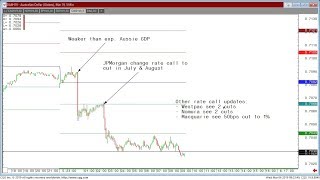
Australia's Q4 GDP came in at just 0.2% quarterly growth, the weakest since 2016, prompting JPMorgan, Westpac, Macquarie, and Nomura to forecast RBA rate cuts. Private consumption slumped and Sydney and Melbourne house prices fell 9-10% year-over-year, dragging the Australian dollar lower overnight.
Chapters
Okay, very good morning, Wednesday the 6th of March. Hope everyone is well. Briefing today, going to cover a couple of things going from Australia to Brexit to Italy, and then the oil inventories, uh, APIs last night and DOE's coming out later. So that's kind of the fundamental overview of what I'm going to cover, then I'll hand you over to Sam as per usual and he can look at the charts in more detail. But first of all, just having a look at the general Overall risk sentiment, and I would say it was fairly neutral this morning. As we're going to see, there's been some significant news that has moved quite significantly the Australian dollar overnight, but otherwise things are pretty quiet. There's no real major groundbreaking developments on the US-China trade talks, anything of that nature. And as we're going to see, despite there being a couple of interesting Brexit headlines, nothing of which really is particularly new and as a byproduct, no real reaction in cable either. So index futures relatively flat, slight negative. The DAX futures just broken some of its overnight very tight range as Eurex trade got open. Cash markets now underway. So a little of a rundown to S1. FX-wise, the dollar index is essentially flat, but a bit of a divergence between the major pairs. Very minor gains in EURUSD just coming up to— if I just bring it up here in terms of recent price action, just coming up to retest the low point down from what would have been Monday's session, an area of some resistance as well that was seen late yesterday evening in the US session. Otherwise, cable a little bit underperforming but off its worst levels that were seen in the Asia-Pac session. But I'll leave Sam to really get into that in more detail. So let's kick things off and let's talk about the Aussie. And to do that, we need to start with the data which came out overnight. And a couple of different things, because I know that in terms of the economy of Australia, the data that came out overnight was the growth figure. But what exactly is happening under the bonnet in the, in the Australian economy? And why has it now prompted many big, uh, both foreign and domestic investment banks to start updating their rate call for potential Australian rate cuts in the near future? Because this is kind of the factors that are driving the price action overnight. And so in terms of the Australian GDP, came in at 0.2% quarter-on-quarter, 2.3% year-on-year. Now both missed expectations. It marked the weakest pace of expansion in Australia since the contraction in Q3 of 2016. Private consumption was subdued and non-dwelling construction continued to fall. So just looking at this chart here, in the recent kind of 12-month period, you can see we've gone from, you know, growth of around 1% or so at this time last year to almost flat now. Now, a couple things here that people look at with the Australian economy that draw most attention And there's kind of two major challenges that that economy is facing. One is external, and that is the economic performance of Australia— of, excuse me, China. And that's because— sorry, I do realize I say China awfully like Donald Trump. I do apologize for that. I'm getting— my mind's getting warped by the guy. But China's economic performance is absolutely critical given the high dependency from a trade partner point of view that Australia has with that nation. And so the economic downturn that has been incredibly severe through 2018 has now recovered and stabilized, particularly with some of the commitments we heard from Chinese government yesterday. However, it does bring about big issues for the Australian economy. And not only that, we've seen as well that politically between those two countries is a little bit of growing tension, particularly what we saw in those coal import headlines about two weeks ago. Something that does definitely warrant monitoring. The other challenge then, the domestic one, is definitely looking at the housing market. Now, the housing downturn, um, has then as a net result led to weaker business confidence. We are seeing the biggest downturn in the Australian housing market since the 1980s. To give you an idea, house prices in Sydney Sydney and Melbourne have fallen 9% and 10% respectively in the last 12 months alone. So, you know, if you thought Brexit was bad for UK house prices, which on average have only kind of flatlined, if anything, in Australia they dropped in the major capital and large populous cities by around 10%. You know, it's an incredible amount. What this has led to then are a couple of different things. One is the point that, uh, the RBA is homing in on household spending. And the reason why that's particularly important is because that accounts for almost 60% of GDP, and it's remained subdued for the past two quarters amid signs that basically consumers are holding back in response to property prices that have fallen and persistently weak wages. And so this obviously just translating into the economic impact and the overall slowdown and so, so on. Um, let me just bring this into shot then, and this will describe it a little bit better. I'll transition my screens in one second. Here you have the movement from overnight. So as far as where do we go from here, again, I'll leave that to Sam to discuss. But obviously we found a quite definitive range low since the move bottomed out at about half past 3 last night, or 3:30 AM I should say. We've retested that since Europe came in and again this morning. But the two big waves of price action have obviously come, one with the, the weakness in the GDP, looking at the Aussie future here, and then secondly You can see we broke the, the respective S1 and the previous day low, which saw an extension of that move, came back up, played out quite technically nice with the, the pivots kind of set up. Then JPMorgan came out and they have changed their rate call now, looking much more dovish for a potential cut in interest rates in Australia in July and August. Now, this prompted then this data, a flurry of other major banks to follow suit. So two Australian firms, Westpac, now see two cuts this year. Macquarie see 50 basis points of cuts to 1%, and the Japanese bank Nomura also see two cuts. So just given, uh, the kind of the, the buildup of this weak economic situation has prompted now quite a shift in market expectations towards what they think the RBA is going to do. Interestingly, RBA Lowe, Philip Lowe, is the governor of the Reserve Bank of Australia, and he did speak overnight but really was quite dismissive of a lot of this and sounded generally trying to be optimistic of the situation, focusing particularly on the positive labor market data, and that unemployment at 5% was the lowest it's been in a long time. But such is the state of things like in the UK, in the US, where unemployment is particularly low. That doesn't necessarily mean that that equates to a healthy economy, of course. So yeah, that was the Aussie. That's probably the biggest story from, from overnight in terms of the market-moving events that were out there. Okay, looking at another thing. This was something I thought I would share, just a few people looking at this. This is from Bloomberg, and this is looking at the— or asking the question, is the Chinese equity rally that we've had, because it's been very powerful, one in step with the turning global equities led by the dovish Fed, the progress in trade wars, amongst other things. Um, but what this is looking at is the Shanghai Composite, um, the constituents of that index and the percentage of which now are above the 200 daily moving average. And as you can see here, we're looking, I think, at 77%. So the question mark becomes then, is the market, um, overbought in that respect, or do we still have some room to the upside? Certainly yesterday there was a favorable response, albeit just a moderate one, to the government's latest proposals, irrespective of the fact that they have downgraded their GDP expectations to now that band of 6 to 6.5%. Other things, of course, Brexit. Can't go a day without really talking about the subject, and I'm sorry to say that I'm going to have to talk about Brexit a hell of a lot more in the coming days. As we get closer toward the next kind of milestone, which is the 12th of March, when Theresa May either brings a deal forward or not. But what's happened overnight is a couple of things. One is, first of all, the Attorney General Geoffrey Cox was meeting his counterpart Michel Barnier yesterday, trying to still fix this problem of of a legally binding amendment to the essential backstop agreement. Can they find something where both countries can find palatable and they can progress now into a transitionary phase? Now, everyone was looking quite positive. However, the talks broke down, and as I understand, the meeting lasted only a few hours and then that was it. No one is budging at this point, particularly from the European side. Side. So a bit of a disappointment, I guess, in that respect, but I would say managed by markets because I firmly believe that— I think it's a little bit, um, you're a bit misguided if you think that they're going to cut a deal now. This is going right to the, to the wire. This is just how political negotiation works, full stop. So I don't think that was massively surprising. One thing we have had though is chap here that you can see, looking rather strained in his face, and rightly so. He is the Chief Whip, Julian Smith. He's got a bit of a tough job on his hands because he's the guy that basically behind the scenes needs to cajole all the MPs to back the Prime Minister's plan. Now, he was saying a couple of things. He said that the vote that's going to happen on Tuesday, which is March 12th, is going to be incredibly tight, according to 3 people who wanted to remain anonymous. Now this obviously is very important because either she brings forward the deal— and let's just quickly remind ourselves what that deal is, which is here— Theresa May's working on 3 different prongs of attack, if you like. And this is the Attorney General Geoffrey Cox looking to renegotiate the language on the backstop. So that's point one. Then Labour lawmakers are being offered a lot of money from the government, i.e., with the windfall that we were talking about from Chancellor Hammond, where he's going to release in the spring statement, which means he's going to put just a couple of billion pounds up the way of the Northeast. That certainly helps then get the backing required, although some would say you're paying for that vote. And then thirdly, the Conservative Brexit backers are being warned that if they reject this May deal, they run the risk of a no Brexit situation. So that's how she's trying to maneuver this in her favor. But the Chief Whip saying this is getting right down to the wire, incredibly close. This is that tree, of course, that we've seen of the potential options that go from here on. This is March 12th, so this is the date you need in your, your kind of diary. And I would suggest then that really Brexit headlines with more substance will start to materialize and become more frequent towards the weekend, and the Sunday papers of course will be key. Other things, I just thought I'd mention two stories, and not, not particularly relevant for an intraday strategy, but I thought from a global macro point point of view, there's a couple of really interesting things geopolitically, I think, that are going on at the moment. And I won't spend too much time on this, so I'll keep it brief. One is, what I'm most interested in at the moment is China. And the reason for that is figuring out, you know, they— we obviously know what their long-term vision is, which is to become the global kind of main trading partner of the world. But to facilitate that, a lot of things need to happen. In order to deliver the kind of infrastructure through this Silk Road long-term project requires a lot of political relationships to be formed. Now, we saw this come about last week, and, you know, some of you might not have been aware about the fairly close ties that China has with Pakistan, for example, as a key area of investment in the southern ports to facilitate then the most important part of that entire global infrastructure project for China, which is the China-Pakistan Economic Corridor, which leads into western China. So that's kind of point one. Then you've got what's been happening, which was that recent Vietnamese meeting between Kim Jong-un, the North Korean leader, and US President Donald Trump. Now for me, I thought that that event was nothing to do about North Korea. It was a proxy for what was going on in the bigger picture, which is the US-China trade talks at the moment. Now what's been quite interesting is as those talks have kind of progressed, but it still looks quite fragile, North Korea has gone from a peace agreement to now reports that they are basically re-equipping themselves and nuclear test facilities are coming back online. Now the only person who can resolve this situation is not Donald Trump. The people that can control the North Korean situation, at least, is China. And so when you're having this top-level trade negotiation going on, it's just interesting, I think, timing-wise, that North Korea is doing this now, has made quite a reversal on their previous pledge, and what's been a backward step in this peace agreement just in the midst of the trade talk situation. You know, is China going to use this as leverage against the Americans? Because the Americans obviously have allies in the East China Sea, in Japan, and so on and so forth. The other thing, of course, that's happening with China, and this is kind of point 3, is Italy is planning to officially announce its support this month for China's Belt and Road Initiative. So this has absolutely riled up the politicians in Brussels. This is basically Italy also jumping into bed with China. You know, it's just such a fascinating thing at the moment. China's there, obviously has grand ambitions and a big fat checkbook, and Italy is someone who at the moment, given its populist government, is absolutely at loggerheads with Brussels at this point in time. And so, you know, looking at these other options, having this conversation, whether or not Italy follows through all this, uh, is kind of a moot point. Uh, the thing here is that China definitely is trying to make hay of the situation, and it's just interesting how they're forming these relationships, causing, you know, trying to take advantage of what has been globally, particularly in the Western world, quite a political division, which is playing almost into their hands to capture these opportunities, so to speak. So yeah, I just think there's some really interesting stuff going on at the moment for sure on that front. So I just thought I'd point out a couple of things there. Moving on back to right now, I just saw flashing on my chart WTI crude has just printed a fresh session low. Um, presumably this is a trend line Sam was looking at the March movement going back to the quite dramatic fall we had on the 1st. Scaling it back up, we broke that late yesterday evening. Now that ellipse I've got marked up on my chart, that was the release, obviously 9:30. So this is the API crude oil inventory numbers, and we had a build, surprisingly large build, 7.29 million. Expectations were for a fraction of that, 1 1.45. Uh, Cushing, a build of 1.1 million. So actually that was slightly, uh, in that respect, uh, uh, the opposite. So a little bit more bullish rather than the headline, but only, only a tiny bit. Uh, gasoline was a draw of 391,000, distillates a draw of 3.1 million. So all in all, whenever you look at this data, uh, obviously the crude, Cushing generally take precedence, but when one figure is so radically outlying, well, that's going to really influence the overall perception of the report. And so this being ultimately quite bearish, and so we broke the trend line. Technically, that helps as well. And then we broke the previous day morning low. In the overnight session, we had a period of consolidation. This tends to be— it's quite an interesting thing actually, all infantry numbers, when we do get substantial figures, quite often what you get is kind of what I'd call a phasing of the move. Now what I mean by that is, if you think about this, this is here the initial US reaction, and then here you get the UK/EU entrance. So this is kind of the how, you know, this data isn't particularly traded too much at that time because of the complications with the, the access to the information in a timely way. It means you're taking a highly risky trade unless you have subscription to the Institute to get the report firsthand. So what you tend to see then is that a lot of UK, European people are out of the market. They're not sticking around to trade this. The only people that are might be a couple of speculative kind of prop traders, particularly all US-focused in that respect. Therefore, when we come in in the morning, first thing you look at is, well, what are the numbers last night? And you see the composition of those numbers and you think, wow, that's, that's pretty bearish. Now, markets have already repriced about, at that point, a good 25 cents or so, let's say, from the consolidation from overnight in the Asia-Pacific session. However, just given how big the build was, you get that little further push. You then look to also challenge the kind of bottom end of the range that was holding the price activity from overnight, and then you get a little extension and run lower. Um, so what will be interesting is again the third phasing of the move that can come in, let's say, which will time-wise be around here, is how do the US perceive this? Do the US come in, take it down again, so that by the time we get to the release later on this afternoon, the price point now has moved from around $56.40 down to $55.80, for example. We've actually priced in about a 60-cent move back down, which means now we are pre-positioned for a fairly bearish report, and anything short of that might see the price flip and reverse. So all of this thinking definitely is what I'd look at if you were trading that type of oil inventory data. But quite frankly, what does it mean for the bigger picture? I mean, not a great deal because there's a lot of demand stuff we need to look at, like China growth, the trade war, the economic slowdown in Europe, all these different things. Then the supply side, the cuts and commitments from OPEC+. I think the oil inventory data is a little bit more short-termist in that respect. But yeah, something to have a look at. Okay, finally, just to wrap things up, let's get calendar up. Banana, hand you over to Sam. So I just transition my screen. What have we got? So this morning is actually pretty quiet. Um, you've got ADP though, National Employment. So any new traders, don't be caught off guard with that. It does come out at a slightly, slightly unique time, i.e., 1:15 rather than regular 1:30. This being, of course, a little bit of a precursor to the, the national report from the BLS. We'll get Non-Farm, of course, on Friday. We are expecting a slight deterioration from the prior figure of 213,000 to 188,000. Then you've got trade balance coming out, US and Canada, at 1:30. Got the Bank of Canada rate decision happening at 3 o'clock. Always very responsive in the Canadian currency for that. And you've got the oil inventories, as mentioned, coming out at 3:30. Speakers, you have a couple. Um, Bank of England's Cunliffe speaking at LSE, the university. That'll be at 12:15. The others though, from a US and Bank of England perspective, not speaking until after really UK and European markets have closed. Fed's Williams, a voter. Fed's Mester, not a voter. Both of which have a hawkish disposition, speaking at 5 PM. And then for the Bank of England, Saunders and Haldane are speaking a bit later on. Bank of England commentary, I guess of all of them, I'd probably say Cunliffe may be quite interesting. I think he is a vice kind of governor in that sense, so a bit more senior. Haldane may be interesting because he tends to flip-flop between being either neutral or hawkish. Saunders, we kind of know his deal. But ultimately, I'd say, what can a Bank of England member really say at this point, given the juncture that we're at with, um, with Brexit at this point in time? One thing with that though, you'll remember we did see a bit of a pop in the UK pound yesterday on Mark Carney's speech. Now if I just scroll back here, this was the comment that he said that moved markets. So just to get you up to the status of the latest rhetoric from the bank, Carney said market path of Bank of England rates may not be high enough. And if you remember at the time, that saw the pound pop very momentarily because this is way more hawkish than, than what markets are focused on at the moment, which is the bigger economic slowdown narrative on the back of Brexit and so on. Interesting. I think he's saying this to try and manage markets accordingly, because if we do have an orderly Brexit, the UK economy, all else being equal, if you remove, let's say, Brexit, or you have an incredibly long protracted extension of, say, a year, 2 years, that the Bank of England really wants— the economy, um, in underlying parts needs a rate hike at some point if you were looking at potential wage and inflation and that side of things. So yeah, I think this is more a play to make sure markets don't get too overly extended in a dovish view if then what still is a base case, we have an orderly Brexit, which would mean an economic recovery of sorts. Okay, that's it for me. I'll leave you to it. Sam will come on now. I wish you a good day. Thank you very much.
Hi guys, good morning. Uh, yeah, we'll just have a start over by looking at that that euro-pound. I know obviously quite a few people were getting in short on the sort of retest of that level on Friday evening, and you know, quite a few people would have been nervous yesterday as we, we came back to sort of retest that area. Good, good hold for now. Be interested to see what happens over the coming days and weeks even. Does this level now hold as a real significant resistance and we drift lower or not. Definitely one to, to keep an eye on. Um, the euro on a, on a more intraday chart, you can see we're drifting. Obviously with the ECB tomorrow, uh, will be the main event that probably drives price until— and if, well, until NFP potentially. Uh, worth having a look around this sort of pivot area. We've got quite a lot of resistance here, notably the high of yesterday evening, the low that was also on the, on the, on the Monday. Just above that, you've got the low yesterday from around this sort of time, uh, as well. So quite a lot of resistance there as well. Probably can get a bit of a trend line in the mix as well that would, would mark up quite nicely potentially with the pivot as well. So yeah, definitely a key area for today, for, for the euro around that pivot. The low that we had from today also, uh, really important. If I just drag the, the camera out the way just to show you why, it was also the low that we had back on the, on the 19th. So real strong test of that yesterday and then again today. So strong support, worth keeping an eye should we get down there again. Uh, obviously you can imagine there's a few stops around that area. As well. Having a look at the pound against the dollar, so we've done the euro pound, euro dollar, and I think in terms of trend lines, still got to have that one from the, the high that's, uh, hasn't really come back to be retested over the last couple of days. And if we were, you've got to imagine it's, it's going to be around that sort of 132 handle today, and, and some previous highs in the mix are quite a strong resistance level from that point. The low that we did come through yesterday, sort of fill in that gap here on the futures, and it did spike down to almost make 131. So it was a tricky one for sure whether people would have got in long straight away, but on the rejection and then retest of it, a good opportunity to have got in. And you can just see how strong a resistance it was before that breakthrough. So be keeping an eye potentially on this trend line and also on these these lows. Might need a bit of dollar strength to come back into the market to get the low tested in both the euro dollar and the pound against the dollar. Aussie obviously understandably moved lower here. That longer-term trend line's under pressure. Uh, also if we have a look, and I'll just drag it above the camera, you can see those lows, uh, from the 11th, that's now broken. So potentially short if we can get back up to retest that, but you've got a imagine that wouldn't be coming today. However, we are just testing that low now of the day, and if I put it on a 5-minute, you can just see how strong a support that had been. 1, 2, 3, 4, and we're just getting the, the 5th test of that level now after breaking out this mini range that we've been in. So yeah, worth keeping an eye to see how, how we react around here. In terms of real key levels to go. Obviously the handle on the futures not too far away, about 30 ticks. And with the break of the trend line that we, we've had, I guess you could call it around there, and also the key support from that 11th, this market is, is coming under a bit of pressure. And that New Zealand dollar, I know we talked about it a couple of times as well, so wait for that to unfreeze. You can see we did break through that yesterday, and this is on a 240, but the breakthrough yesterday afternoon I think has now provided a good opportunity should we retest it. If anyone's been getting aggressively to then get back short again, you can see we found quite good support previously before that breakthrough. And with the Aussie under some pressure as well, you know, these, these markets the next sort of key level, the 20th of, of Jan, which is also that 12th of Feb, might not be too far away here for the Kiwi. And definitely one to keep an eye on. The yen, just to wrap up the currencies here, uh, obviously we're still near that, that low. This is— let me just flip it around for the dollar yen and say almost, you know, near that high. But similar to gold, we're just starting to range out a bit here. Um, almost probably halfway between the, the high and the low of, of that range, if you like. So whether I'd want to get involved too much around these areas or not, not too sure. Maybe worth getting a bit of a trend line from those lows to see how it reacts. But yeah, I think better opportunities elsewhere for the dollar pairs to be aware of. And as I mentioned, for all those trend lines, it's a sort of getting a little bit of a break and a push down. The, the low that we had back on Monday afternoon, uh, around, well, evening I should say, has just held quite well. And we're now back into that little mini range. So oil with the DOE, you know, potentially worth, you know, saving, uh, the ammo for later if you'd like to see how that reacts. Do we get confirmation of the API or not? Um, obviously quite a lot of key support around, around these lows there. You know, if we were to have a confirmation of, uh, the build, then, you know, we could drift lower. Equities as well in the US anyway, just starting to, to slow down and tire a bit. And, you know, if we have a look, just really going back from here— I'll just move it above the camera again— the, the 20th, that low has obviously been quite well respected. And again, just looks like we're stuck in a range and You know, are the trade talks stalling? Is there any, any progression? You know, you can take that how you want, and the market seems to be just sort of waiting for either some negative or positive news to, to come. And we're again pretty much in the middle, or not far away from the middle, of, of that overall picture. The NASDAQ, I think, looks cleaner in terms of an opportunity and, and potentially sort of waiting for a break of, say, one of these trends to go. Um, obviously the high from yesterday was a great opportunity. Yesterday we talked about this in the briefing, those previous lows from the breakdown, uh, whether you could, you know, you could really have got in on that to hold overnight. Obviously always a bit of a risk, but such a strong key technical level matching up today with, with the R1. Um, but again, you know, just looking at those equities might better off waiting for some key developments to come out. The DAX this morning from the open just, just pushing lower, obviously on electronic trade now, the extended hours, but the gap has been pretty much filled. So still one to keep an eye on. That was early this morning around sort of quarter to 7. Let's have a look at this trend line. Had a bit of a false break but still holding well. So this is quite interesting trend here. You've got from the Monday to Tuesday false break today, and then we found again support on that. So that's still something I would keep an eye on. If we can get a confirmation of a close below that area as a decent resistance, along with the support we found yesterday post-US cash open, will be one that, uh, I'd have marked up on the charts. Gold, just to, to wrap things up. So again, opportunity opportunity-wise, you'd have to be at the screens early this morning. But I think a couple guys got in on this, the sort of the retest of the low of the first, um, of the morning— or evening, I should say. And that NR1 has held superbly. But last few days, again, we're now pretty much bang in the middle of that range. So keep an eye on the pivot. A bit of dollar strength comes into the market, then we might get a confirmation of a break of that. But in general, at the moment, you've commodities just starting to, to, you know, continue this sort of bearish pattern that we've had over the last few days. So worth again bearing in mind when looking at gold, have a look at the other commodities as it's, you know, under a bit— they are under a bit of pressure as we speak. Any questions, as usual, please do get them in there in the chat. I like the look of EUR around the pivot, which is still holding quite well. And then be interested to see what happens into the afternoon with equities and of course oil. But if I don't check to you guys, hope you'll have a great rest of the trading day.
More from Anthony


Inside the Biggest Banking Stories You Need to Know This Week (Anthropic, Diageo, Private Credit)


Inside the Biggest M&A Deals You Need to Know This Week (UniCredit, GameStop, eBay, Eli Lilly)







AI Breakthrough or Hype? Anthropic’s Claude Mythos, Tim Cook Steps Down & LIV Golf Collapse