Bank of England Shocks Markets & 5 Useful Tips If You Don't Have An Internship This Summer
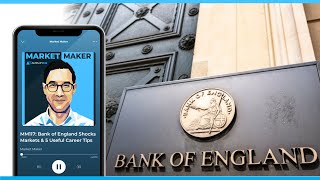
In this episode Adam and Stephen discuss four main themes: (1) the Bank of England’s unexpected 50‑basis‑point rate hike, driven by a surprise rise in UK core CPI to 7.1% YoY – the highest since 1992 – and the implications for market stability, inflation persistence, and the credibility of monetary policy; (2) the knock‑on effects on the UK mortgage market, where 2‑year fixed rates have surged above 6% for many borrowers, the government’s limited immediate response, and banks’ modest support measures such as payment holidays, with a comparison to the 2008 crisis; (3) a deep dive into ESG ratings, highlighting the disconnect between ESG risk scores (e.g., Nvidia’s low‑risk ranking, Philip Morris’s surprisingly high ranking) and actual sustainability impact, and a critique of ESG‑focused investing as risk mitigation rather than true impact; (4) extensive career advice for students who missed spring‑week internships, covering (a) leveraging transferable skills from unrelated jobs (e.g., a waiter’s client‑pitching experience), (b) upskilling through short‑term certifications and bootcamps, (c) aggressive networking and building a high‑visibility LinkedIn presence, (d) staying open to non‑ideal first roles and seeking mentorship, and (e) non‑traditional entry routes into corporate finance such as accounting qualifications, industry‑expert roles, and internal mobility within firms. The conversation blends market analysis, sustainability critique, and practical guidance for early‑career finance aspirants.
Chapters
It's Friday, so welcome back to the Trading Floor. But rather than Piers, I'm joined by Stephen again. It's a little bit of musical chairs this week, I'm afraid, but we got plenty to talk about, uh, 4 things in fact. But before I give you those, I've finished Succession, Stephen. It's done. Oh, last night? Last night?
Yeah. Oh yeah, I can imagine you probably didn't— you didn't sleep afterwards. You were too excited. You were thinking about making deals yourself, you know. Um, Did you think that it wrapped up the series well enough? Did you think that it was, that it was an appropriate conclusion?
I was— I'm going to be honest and I don't want to throw out too many spoilers if people haven't watched. I think there's been enough time lag now between it being released and now. I was disappointed. I thought it was a pretty weak ending and I was a bit like, oh, was that it? And yeah, I don't know. I wasn't— I guess for me, I was looking at thinking retrospectively, I think they just killed off Logan too early. He was so strong a character.
Yeah, I can imagine you were disappointed because you were saying in the office that, you know, you were saying in the office that you just thought that Logan was going to rise from the dead. So that was the thing.
But yeah, no, all good. That was done. So yeah, finally, finally got it under my belt. But yeah, if you haven't listened to Steven's take on tying Succession back to some actual real tangible things that are very, uh, prominent in banking, then go back just a couple of episodes, check it out. I think it's only like 20 minutes long, but it's super interesting because it's tied right in there to the, the narrative of the story of the program. So yeah, check that out. But the 4 things we're going to cover today are 2 markets and 2 careers. And so on the market side, going going to have a little chat about, of course, the Bank of England. Uh, the papers will say the shock, but we can see whether— how shocking it was and, and is in terms of how markets are reacting, the mortgage market and so forth. And then we'll talk about Nvidia. There was some headlines that that's now topped Tesla as ESG funds have ratcheted up exposure to AI. And, uh, Stephen's got a bit of a background in the ESG space, so good to pick his brains on that. And then on the career side, 2 parts: advice for students that have missed internship spring week cycles and how can they still get on the kind of grad track in the application phase. So we'll talk about a couple of tactics that perhaps you could deploy to help improve your prospects. And then finally, some non-traditional ways to get into corporate finance. We encounter so many different students from different backgrounds. We often get things like, can I pivot from accounting, for example, into investment banking or equity research? So we'll dive into that. As well. But yeah, Bank of England.
Yeah, tell me, tell me what's going on. You know, I follow this stuff, but I think that you're the, you're the expert here. So 50 basis points, uh, was this a shock? What's this going to do to markets? Give me, yeah, give me the story.
Yeah, so really there was quite a big sea change in expectation in markets, um, after UK CPI came out for May. So we were very much expecting the Bank of England to hike that wasn't really contested. It was a pretty much shoo-in they were going to hike the common route, which is now 25 basis points. However, big last moment, uh, headache for the Bank of England because literally days before you get this bombshell that UK inflation in fact was quite substantially higher than they were expecting. So the headline at 8.7%, importantly the core reading— so this is the one the market tends to latch onto, so ex things like food and energy which volatile components, that actually went up to 7.1% year over year in May, and that's the highest rate since March of 1992. So they were kind of forced into action really, which is inflation is actually getting worse at this point. And so they had to go bigger to show that they're serious to get on top of this. And furthermore, They said that if there were evidence of more persistent pressures, that you could argue is currently the case right now, then they said further tightening of monetary policy would be required. And so this is what the markets look at. Um, it's not so much the shock of yes, they've gone big, they've gone 50. So they've kind of— normally with an interest rate cycle, you, you kind of go on the on-ramp, is fairly slow. And what I mean by that is you kind of— the first hike is very meaningful in the cycle because it sets the, sets the starting gun then of a series of hikes. It's very rarely one and done. So they go 50 or 25, then 50, get up to 75, and then the offboard is kind of, right, I don't want to shock the markets, let's decelerate the size of hike. What the Bank of England have effectively done is gone up through the gears, hit 5th gear, come back down to 3rd, and now they've ramped it back up to 5th again, which is a little bit destabilizing for markets because it's hard to really see the credibility of do they have control? Are they able to manage this period of economic stress appropriately without the tail end effect of increasing the chance of recession, essentially? So yeah, that's the summary.
So, so yeah, this is really interesting and, and it's a good representation that no two economies are alike. And it seems like in the US, they, you know, inflation's still around, it's above target, but maybe, maybe it's coming off and maybe it's not quite so sticky as we thought it could be. So is there any explanation as to why the UK, this, this, you know, this core inflation is holding so strong and actually going up, whereas in other countries we're starting to see the back end of it?
Yeah, probably 3. You're right, there's probably 3 elements of this. There is the there's the COVID shock that was already happening that was the key component to create global inflation in the first place, the disruption of supply chains. You then had the Russian invasion of Ukraine, and that's going to be much more prominent for Western European— I'm going to, I'm going to throw the UK in the European bucket for the sake of this conversation, but just given the proximity and the reliance side, then that starts to be a factor. Then you've got Brexit. Brexit is a unique factor, of course, for the UK, which isn't so much a thing in terms of the United States. And then you've got Liz Truss's disastrous budget. So there's kind of like a, a quad of factors here that have basically, uh, made the UK situation, uh, uniquely different in how sticky it's been. One could argue actually that the fact that people are— unemployment rates are still pretty healthy, i.e., it's a good situation, people are in work. But if people are in work, and as we just saw from UK retail sales that came out this morning, I mean, we've had a pretty killer few weeks for weather. People are spending. We've had the coronation, all these other things are kicking off. And so people are still spending. It's almost like, hang about, we're in a cost of living crisis. There's supposed to be a bit of a crunch on confidence at the moment, but people are still spending. And that's actually somewhat also adding, if you like, this robustness of the consumer to continue in a cost of living crisis. Allows us to spend, it's kind of keeping things a little bit elevated at this point in time. So I think there's a couple of factors there that make the UK a bit unique.
And yeah, and so, so is the government doing anything about this? Are banks doing anything about this? We talk about kind of mortgage cliff edges and all of this stuff. So, you know, are they, are they going to do anything, or are they going to let the pain ride out through the economy?
Yeah, so it's a good question. And if you read the— I think if you read a national newspaper I think if you were ever considering getting on the property ladder, I think at any point in history you've probably gone, ooh, bit punchy at the moment, bit pricey, or the mortgage market, the state of lending rates never feels quite like a good time. But there's a key secret to, I guess, investing in a physical asset like that. It tends to go up over a long period of time. So even if it feels not right, it, you know, generally getting on is a healthy thing. So point one, if you can afford it, of course, and that's, that's obviously the problem right now. So I think let's deconstruct that a little bit. So yeah, the mortgage situation, long story short, the average 2-year fixed rate mortgage deal has now risen to above 6%. Um, remember, interest rates were risen by a larger amount than expected, 50 basis points this week, but only to 5%. So there's always that little bit of kind of cream on the top, if you like, of where the mortgage rate will sit. Now, the context for this is there's around 9 million outstanding residential mortgages. 800,000 are due to come off fixed rate deals in the second half of this year. So that's that fixed rate. So if you've had a fixed rate for the last couple of years, you might have locked in pretty much super low interest rates, certainly the speed of this rate hike cycle has been— given the rapid increase in inflation— has been fast comparative to historical norms. So a lot of people are locked in at basically like 1 to 2%, and now they're going to get hit with 6%. And when you're already getting pressured with your, your shop at Sainsbury's or Lidl costing you literally like double as much as your energy bills at home and everything else, and now you're going to get this mortgage, um, addition, and that is your biggest pain point out of your monthly paycheck. That's what makes this such a strong narrative for the media to latch onto. So the question then, what is the government going to do about this? Um, I think there's an important point to break up that what's happening now and what happened in 2008 and '09, I feel, is quite different. Back in the global financial crisis, there was literally the trigger moment of a complete breakdown in markets which led to mass unemployment. Then people have no source of income, and with no source of income, you default, and then you've got a housing crisis. In this situation, the UK jobs market is still pretty robust for now, and I would stress that's one of the key areas to really monitor. Going forward. Any movement in that could well be then a sign that things could get worse. So for major banks, I think they're offering help in whichever ways that they can. I don't think a bank really wants people to default. They want to make the extra money out of you paying your mortgage and the kickback on that. So they're offering ways to support, uh, financial health checks, temporary payment holidays. You'll probably remember that during COVID People were, were getting these kind of exemptions where they could kind of put off payments for a period. They can extend them, the, the period of the, the loan itself, so on and so forth. So at the moment, the UK government, quite rightly I think, are sitting on the sidelines. They're doing one thing that's very important— they are meeting with all the major banks today. And so it's prudent, right, either from an optics point of view that the government is taking interest, is preparing the ground, is having the preparatory work for if something needs to happen. Whether or not they will ever get to that point is kind of besides the case. They need to just instill a bit of confidence into the market at this point of view. Now, obviously Labour, Labour's beating the drum and it's a great opportunity as an opposition leader I think to be like, right, it's just another reason of a government failing. If I was a Labour leader, that's how I'd be pitching it. And you've gotta come up with an alternative plan for them. They're talking about, you know, requiring lenders to allow borrowers to lengthen their mortgage periods and so on. That's not gonna happen, I don't think, unless we see a more broader deterioration in the bigger economic picture, which isn't happening. As per the data points that we've seen.
Yeah, I can't remember who said this, but if it isn't hurting, it isn't working. Someone said that once about interest rates. And there is a bit of a— there's a little bit of that in this. We can't necessarily keep propping up everything. There will have to be failures or delinquencies or whatever it is, and times will be tough at certain periods within a business cycle. Yeah, you kind of mentioned this earlier on. Um, I've always thought traditional view, interest rates ratcheting up, share prices get hit, right? You know, that, that just seems to have always been what's been told to me. But I was just doing a little bit of just a very quick look at, you know, we'll talk about the UK. The UK interest rates have increased by 4.5% in the last 12 months, and the FTSE 100's up 7%. The S&P is up 15% and interest rates are up 3.75%. So, you know, so what's, what, what's going on here? I'm confused.
Yeah, I think there is, um, there's an interesting stats there. So what, the, the US is outperforming the UK benchmark index by 100%, like double basically. So I think that's a telling point. So the UK is underperforming in the context of the global index kind of exposure that you can have as an investor. Um, and largely I think a lot of that is down to things like, you know, Brexit. These other things feed into that. Political instability has made the UK fairly unattractive through that period that we had through the exit of Boris and the flashless Truss crisis that, that ensued. Um, and then the lack of real kind of exciting companies that just don't exist, as you and I have discussed, in the FTSE 100. I mean, there's some, there's some mega-sized companies in there some real bellwether names, but there's no tech, and there's no certainly sizable tech. And that's what's really been the trade, if you like, in recent months, is to get on that gravy train. So yeah, I think in, in a sense that explains the divergence in the underperformance. But I think the broader market has been just led by the US, really. And I think all global indices have benefited from that factor. It's just the UK has not benefited so much for those aforementioned reasons.
It's really interesting. I was thinking about this relationship between interest rates and, and share prices. I was thinking about it from a corporate finance perspective, and what we often think from a corporate finance perspective is we look at future cash flows, um, and we project out future cash flows and we discount them back down in order to get to our what's the value of those future cash flows, and then we can value a company. That's one of the valuation models that we use. And as interest rates go up, our discount rate goes up, and therefore the valuation of a company goes down. And if we're valuing companies lower, then maybe we may not buy, you know, maybe we are going to sell shares in those companies, stock markets go down. However, I guess when interest rates are going up, it is a sign usually that economies are rip-roaring, maybe even overheating. Inflation's high, GDP's high, unemployment's low, you know. So when I'm doing my discounted cash flow analysis, yes, interest rates are going up, so my discount rate is rising, but also my top line is rising because the economy, you know, has and is kind of overheating. And you, you're seeing it here, you know, interest rates are rising partly because the economy just seems to be quite resilient, and sales, as you said, retail sales are going up. So if I'm looking at my ETF model, my discount rate's rising, fine, that should lower my valuation. But if my top line's rising, should increase my future free cash flows, and they should balance— they might balance each other out. So that's one explanation as to why maybe there's not this inverse correlation.
I also think as well is that perhaps the benefit of not being so tech-heavy as an index composition when things are going badly is that for one, you've got companies like Shell, BP, you know, these comprise of the biggest index weighting within the FTSE 100, and they've, they've gone gangbusters as far as profit is concerned. So they're there right at the top. And then you've got healthcare's normally quite big, generally basic resource names, things of that nature. So also those companies, I would imagine, probably have less variance than what you've described, just given the nature of their business comparative to, say, tech, which I'm sure multiples can go overstretched but then be pulled back rapidly and see higher volatility in that, that measure. So yeah, I think super interesting. But yeah, I mean, one thing to close on this section, I'd say is that so banks are now offering these like 6% fixed rates and that kind of is quite scary as a prospect for a consumer. However, a week ago we didn't think the Bank of England were going to hike 50. They've hiked 50. Let's just say like in a couple of months' time, because these are pricing mechanisms that are dictating for the next several months. Over the next several months, things can change quite dramatically. And actually, you know, you look at things like producer price inflation, um, that's a measure of prices coming further down the line. They're actually sort of surprised and are moving lower. So is it just the CPI is just lagging a little bit, and will it actually start to decline? So just because markets are pricing 6 now, you know, I hate the phrase, but they're right when the central bank says we are data dependent. And should the data warrant it, we can move in either direction. And I, I know that sounds incredibly uncommittal from a— from not what you want to hear as an investor or a trader, but they're right. You can only react to the information at hand at the time. And so all I'm saying is that anything can happen. Things can change quickly.
So hopefully change for the better. Oh, we'll see.
Yeah. All right. Well, let's, uh, let's kick, kick into the second topic then. Nvidia has now topped Tesla. Uh, is it— sorry, is Tesla ESG? Is that— I mean, I read that headline when I first saw it, it was like Tesla ESG. Is that, is that actually true?
This is— I mean, this is the problem, right? Is Tesla ESG? I mean, so I was looking at some ESG rankings just, just before we came on the podcast and just saw that Tesla is— it ranks lower than Philip Morris International on an ESG rating. Now, Philip Morris International, that's a cigarette company. So, um, is Tesla ESG? Is Philip Morris ESG? What is ESG?
Yeah, you know, I mean, let's start there. How can a cigarette company be ESG? How does that work, these rankings? What's the structure of it?
Okay, this is, this is relatively complex, um, but fundamentally an ESG rating— environment, social governance— looks at— and ESG ratings are comprised by the likes of S&P and Sustainalytics, and a lot of big asset managers have their own in-house teams that provide their own ratings— but an ESG rating comprises environmental, exposures and risks, environmental factors, everything from Scope 1, Scope 2, Scope 3 carbon emissions through to wastewater, through to pollutants, etc. Social factors. So everything from board diversity, gender pay gap, through to charitable outreach programs and fair working practices. And then governance. Do we have an independent board? What is the quality of our auditor? Is the chairman also the CEO? How are the board controls? And all of that kind of stuff. That's an ESG framework. Now, we, when we hear ESG, and when the media talks about ESG, what we kind of immediately assume is that ESG means a good company. That's, you know, that's what we think, you know. Well, how could— how can Philip Morris be pretty highly ranked as an ESG company? How can British American Tobacco be in the top 40% of the category food products in the ESG rankings? How is that possible? How can it— how can it be better than a food company, a cigarette company? What ESG ratings look at is they look at risk and they look at risk factors. So when I, when I talk about an ESG rating, what I'm actually talking about is an ESG risk rating. So I'm looking at to what extent do these companies understand, manage, and mitigate ESG—environment, social, and governance—risks. ESG does not look in any meaningful manner ESG does not look at the full product and its effect in the short, medium, and long term on its consumers. Therein lies the disconnect. So we could talk about NVIDIA. NVIDIA is ranked number 6 out of 331 ESG ratings in the semiconductor industry, you know, as, and as you say, ESG funds are pouring into NVIDIA as they have been pouring into the big tech names for the last 10 years because these big tech names have relatively low ESG risk from a traditional sense. Are they good companies? That's the big question. And it's not the question that ESG ratings answer. So I could make the very, very, very understandable arguments that NVIDIA actually is it fermenting, is it facilitating some pretty dangerous future existential threats to our society, and therefore why the heck should it be an ESG stock? But they are two separate things. So when I'm thinking about investing sustainably, ESG is kind of important to the extent that I want to invest in a company that is relatively low risk from an environmental regulation and catastrophe and future goals and things like that. But if I'm trying to invest sustainably, just putting my money in an ESG exchange traded fund, ETF, that tracks the S&P 500, overweight some ESG names, you're not, you're not, you're not gonna change the world that way. Let's be honest. You might feel quite good about yourself, but it's not sustainability in the way that we like to think about it. And it's certainly not impact. You know, we're not doing good. We might be avoiding harm and mitigating risk, but we're certainly not doing good.
Hmm. So, so people don't like teach this stuff that I've seen. So whenever I interact with say students or universities, there's no like course for this stuff at the moment. So where would young people go to educate themselves more about this type of stuff so they can be more informed?
It's a really good question. And, and to give some business schools their credit, there are, there are a growing wave of sustainable finance courses that are available. I think my— whenever I talk about ESG with the students that we teach, you know, on a weekly basis, I always invite them to be a skeptic, not because being a cynic and a skeptic makes you sound smart, but because that gives you the opportunity to really think about what good is. So you look at ESG and you understand that it is a, an interesting framework to overlay on publicly listed stocks in order to have a different view on the ESG risk associated with that benchmark and, or with that index. But if you really want to get sophisticated and if you really want to be thinking about how can I use my money or how can I invest in a way that is going to actually contribute to moving the needle positively, I'm going to start thinking about moving away from passive index trackers and moving into— there are some absolutely brilliant funds out there, actively managed, where they are engaging with companies on a weekly basis to decrease some of their negative and increase some of their positive. So by inviting people to be cynics or to be skeptics, they can actually start rooting out the people that are doing this, the investment professionals that are doing this with what I would call intentionality. You know, I want to make these companies better on a wide range of really, really high-impact stuff. You know, get rid of their, you know, become net zero, really, really change the lives of their consumers by offering, you know, fantastic products to people that really need them. These are the things that are, you know, that's what we think of when we think of sustainability. We do not think I don't think we do not think about Apple and Nvidia being the most held ESG companies in the world. We don't think of them as highly impactful, sustainable companies. They're great companies, but they're not kind of, they're not where we want to go if we want to be properly impactful.
Cool. All right. Well, let's move on to the career section then, because I know we've got two parts to cover. One is you put to me offline about what advice that I and we can give to many students who, for whatever reason, haven't secured something like a spring week or an internship. How can they still obtain a graduate job? And I know you'll probably have some, some input into this, but I thought I've got 5 that I'm going to put on the table first. And then please feel free to interject or, or add when the 5 are delivered. But number 1, I'm going to start with— got to think beyond, um, an internship. Think about other work experiences. The best story that I've encountered with a student was this Italian student who, when we were a proprietary trading firm— so this was a couple of years ago now— and we used to teach people how to trade, right? So this young guy came, and he was at the time— came from Italy. He was studying at Birkbeck doing a part-time undergrad degree. He was then working in a warehouse overnight to box up vegetables, uh, to pay his way to— so he could do partially our course part-time. And then he was working as a waiter at a West End restaurant, so quite fancy. And I was like, okay, tell me a little bit more about this restaurant experience. And he was like, okay, yep, so I wait tables. And I was like, what type of food? What type of clientele do you get? And he started explaining to me, he said, well, really it's not that many English people, it tends to be Chinese, Russians, Indians, because, you know, the bill's pretty substantial. 'You need to be quite wealthy to dine at these places.' I was like, 'Okay, so tell me a little bit, like, so what's your interactions with them? Like, do you get paid tips and stuff like that?' He's like, 'Yeah, actually, so we're always encouraged to try and mark up the wine. We push the wine, right?' And I was like, 'Okay, so, you know, culturally then, how would you sell— tell me how you'd sell some wine to a Chinese person.' And he would talk me through, like, his approach. And I was like, how about a Russian? And it would be radically different in how you'd pitch that. Not just the type, but the length of conversation, the things he'd highlight. And as he was telling me all this stuff, I was like, it was so persuasive how he was tailoring the pitch. And I was like, wow, like, you're great at that. I was like, have you never thought about that being a skill? And he was like, yeah, but I'm just a waiter. And I was like, I'm not sure about that. And then actually we started doing a lot of the simulations and so on, and he didn't mind talking because obviously that was part— big part of his job as a waiter. So essentially, after a lot of months of perseverance on his side, he got a lot of market knowledge which he didn't have, he completed his studies, um, and then through all those skills I managed to persuade him to start to interact with a couple of brokers. So a role where you act as basically an intermediary, you're a facilitator of connecting one person with another. And I was like, you'd be made for that. And he was like, yeah, but I, you know, I'm not— everyone else is so like well-educated and well-schooled, how am I going to compete? And I was like, no, honestly, just go for it. Like, that is quite a unique part of finance, which I think you'd fit very well in terms of the characters that work in it. And then, yeah, long story short, he then managed to secure that role and he's been working at TPI Cap for the last 4 years, absolutely smashing it. And so the point here is that I wanna make is that other work experiences can be highly useful even if they're not directly working in finance. It's about, well, what skills do I need to perform as a banker, as a trader, whatever it might be, and how can I then demonstrate the same skill but just in a different context? Because it can definitely be transferred fairly, very seamlessly.
Yeah, I mean, that's a great story. And I think not only transferable skills, but also having something interesting to say. You have to think that the person who's interviewing you has probably heard quite a few generic stories about, you know, first-class degrees and multiple internships and all of that stuff. If you could go out there, I remember I had a friend who, who made quite a big point about how he used to, uh, how he used to work on a sheep farm during the, during the Easter holidays in the summer. And again, turn it into a narrative, and that just stood out as something a little bit different. So don't be afraid to be a little bit individual. Obviously you've got to temper it, um, but it can stand out in a really positive way.
Yeah, and there's lots of other things you can do, you know, sports, organizing charity events. There's lots of other stuff that you can, you can do that doesn't cost you anything in that, in that sense. The other thing then is the second one is, uh, developing your skills, getting certified, and just using your time wisely. So what I mean by this is we're just heading into summer and a lot of students are finishing. Some will have internships, the majority won't. So then it's like, right, okay, how can I best utilize this period in order that I can be as well equipped then for the next application cycle, which pretty much starts right now. So all of the time you're thinking, right, I know it's hard when you're young cuz you're like, oh, I just wanna have some fun. Definitely I would kind of bookmark some time in your calendar to have some fun. And do that and go crazy. But basically then, once that's out of your system, be focused then of what else can I do. And here, you know, things like, um, you know, my, my wife's currently on a coding boot camp, for example. So you can do those which can be light touch, in your own time, on demand, that can be over several months. You can do intense stuff that could be maybe 4 weeks. The point being is, it's like, you don't need to become an expert but just get competent to be able to highlight and utilize those skills in a lot of these roles and get a certificate as proof of concept that yes, you have that knowledge and you can apply it. You know, I think that's a good way to kind of use your time as wisely as you can. Yeah.
And I think the barriers to learning are so low these days that it's almost incumbent upon you to, to at least do a few things to show that you're you're going out there and you're, you're independently trying to learn on a very, very low cost base because these things don't cost a lot of money. So, you know, why wouldn't you?
Yeah, and there's a pattern of behavior, you know, everyone loves like a self-starter, you know, when you land on the trading floor on a team, you're expected to be fairly proactive. So if you can demonstrate that proactivity yourself in all these other things that you've been doing, I think it's a strong thing. And of course You can come to Amplify Me as well. You can come and do our summer program. Uh, we— the next one starts on Monday actually, but there's another one I think 21st of August. But a lot of the people we get on that are doing exactly what I've described. They've, you know, not managed to perhaps just get in through the front door, but it's that, that mindset of, right, I've just got to skill up, get experience, and, um, and go from there. So yeah, definitely that's another another route to explore for those it's suitable for. So number 3, networking. Yeah, it's just so, so powerful. I know you hear about it all of the time and I'm sure as a student it's incredibly annoying when people like me and Stephen bang on about networking, but we do it for a real reason and it's about just getting yourself out there. And my point 4 to help promote that networking journey is develop your profile on LinkedIn. Really amazing to see. There's this one student, I'll give him a shout out, Johanna, on our current summer intern program. We did like a LinkedIn content creating like masterclass day one of the program. And the reason why I did that is because I want them to understand that they can promote themselves, they can promote their interests in a certain field, their ability to write, their ability to be engaged. This all then draws in an audience. And credit to Johanna, he did a piece immediately after the Bank of England hiked and it got picked up by the UK LinkedIn finance team. And he was rung in the LinkedIn newsfeed alongside the head of market analysis at RBC, the head of FX at another bank. And there he is, an undergrad student with no real experience, has been selected and his post had more likes than all the rest of them. The idea being is that went out then to 2.5 million people on LinkedIn. That's what I'm talking about. Like, that's— but he did that through consistency, quality of content, and it was timely content. Now that sounds easy as a formula. It's quite hard to do that, but that's where you get the real results off the back of that. And, you know, he's made some great connections, I'm sure, through just that single post. That is amazing.
I didn't know it. I didn't know it got picked up. I need to speak to him about how to do that. I think the most amount of likes I've ever got on LinkedIn post is about 60, so I'm gonna, I'm gonna have to up my game.
Yeah. And then my, um, my final point, I guess, will kind of lead us into then that final overall question for the podcast. My final point is be open to taking roles that might not be quite perfect for you that you had in your initial kind of, uh, goal. A lot of people are like, I want to be an investment banker, and if I'm not that, I'm a failure. It's like, most people's first job are not the jobs that they end up in over the long run. I think that's probably true for nearly everyone. So to think that, yes, it helps applications to have a little bit of guidance towards certain sectors, But don't get anchored to this idea that you've got to nail it from year 1, thinking that that's going to determine the 50 years of your working life. It's not the case for nearly everyone. So I think as a young person, think about, um, a couple of things. Obviously money is important, and it will differ individual to individual on your circumstances. Some people have some flexibility, some people just have to earn, and that will dictate some decisions in terms of the weighted factor of money. More importantly, I think, try to look for good mentorship. That's key. I think when you start a job as a young person, who is it that you can absorb information, experience from to help you develop more, more quickly? And a good way to do that as a hack, I think, if you're thinking about joining a team or a company, is to look at similar people who are a few rungs up the ladder from you, and what's been their career development to date. How quickly have they progressed? Has the, the manager, the mentor, are they someone who puts time into their juniors? And you've seen that develop then through these LinkedIn profiles. I think that's a good way to identify, yes, that's the place where I should be. So, you know, I'm all— I'm always for it if you can take the hit early on the money, that will come back and pay dividends like later, tenfold for sure.
Yeah. And there's always the classic advice that if you can find a slot, and it doesn't necessarily need to be the first slot that you go into out of university, but if you can find a slot where you're actually doing something that you enjoy and that aligns with at least a portion of your skill set, the money will come because you're good at it and you like it and you enjoy it and it doesn't feel like work. If you can find that, and it won't necessarily be the first thing you do, then you're on to a winner, even if you have to take that short-term, a little bit of pain financially.
So on that point then, non-traditional ways to get into corporate finance. So I know, you know, corporate finance is obviously probably the most popular area that many students will want to work in. So it's competitive, so the majority don't, don't get in through normal applications. So what are a couple of ways to, to think about different tactics?
Yeah, we spend a lot of time, we spend a lot of time thinking about this and talking about this with our, with our summer analysts and trying to work through different backgrounds and things like that. The first thing I would say before I give you, you know, a couple of side doors maybe, The first thing that I always say is whenever you're thinking about accessing the next rung in your career or a career that you'd quite like to get into, always start with what do you have as opposed to what do you not have. You know, you get a lot of people coming up to you and saying, yeah, but I didn't, I didn't do a spring week or I didn't do an internship. But what did you do? You know, what do you have? Maybe you're a little bit older. What do you have that 18, 19, 20-year-olds absolutely do not have, and how can you use that to your advantage when you're speaking to, you know, a potential employer or even a recruiter or something like that. So I always like to view it from the, from a positive foot as opposed to I'm on the defensive. And when it comes to corporate finance roles, I think there are probably 3 ways to get in there that are non-traditional. First, I would always say doing a professional qualification like an accountant, if you can work for a Big Four or a, you know, a relatively well-respected accountancy firm, get your qualifications. You are instantly— not instantly, over a period of time— you become a really valuable member of a corporate finance team. I think about it with an M&A hat on. If I had a qualified accountant in my M&A team, I would feel much more comfortable about some quite complex things that I need to be working through in, you know, as we come to integration and deal mechanics and things like that. So I would never turn my nose up at accountants or accountancy as a great on-ramp if you haven't quite kind of made the, made the kind of the milk round, as it were. Uh, the second is Maybe you're— maybe you go into industry, maybe you have a particular interest in a particular area of industry, maybe because it's your background from a university perspective, maybe because there was a really interesting graduate role in a drinks company or a consumer-facing company or whatever it might be. You can join a sector team within a corporate finance institution as an industry expert. You know, so maybe there's a passion that you've got there that you pursue in the early years of your career that you can jump over into the finance space as someone that really knows their domain. And again, if you think about building the killer M&A team, you've got— if you've got industry expertise and you've got accounting, you're starting to build a really, really good, really, really good group of people. And then the third one, and this is something that I've witnessed many times actually whilst I was working at HSBC, if you don't get that kind of plum job that you were really banking for, but you like the organization and there are other jobs available, go for the other jobs. You know, it may not be the most amazing first job and you might have to suck it up for a couple of years, but there is something to be said internally, whatever the ranking system is, 1 to 5, 1 to 10, A to E, whatever it is in terms of your performance. If you're consistently hitting 1s and you've got a bit of credibility within the organization, you start, you start to have the power. If I've been hitting 1s 2 or 3 years in a row, even if it's in a job that I don't think I'm going to do forever, I can start to go to my HR manager you know, I'm actually really interested in this area, you know, I'm pretty good, how can we work that through? Maybe it's a secondment, maybe it's a placement, and you just have to keep performing. So get in, even if it's not front office, even if it's not, you know, high-level M&A, get in, work hard, prove yourself, and then you can start to take that jump across.
Yeah, great advice. And yeah, if anyone has any questions at all, I know we don't normally talk so much careers on a, on a normal end of week episode, but there is a Q&A function on built into the Spotify app. So do take advantage of that. Anything we've discussed, if you want to know more, or if you want us to cover something else, obviously Stephen's episodes go out typically on a Wednesday, all things corporate finance, and then we'll talk markets, uh, normally myself and co-founder Piers on a Friday. But look, we'll wrap it up there. Steven, thank you for your insights as ever. And yeah, have a great weekend.
Thanks, Adam.
More from Anthony


Inside the Biggest Banking Stories You Need to Know This Week (Anthropic, Diageo, Private Credit)


Inside the Biggest M&A Deals You Need to Know This Week (UniCredit, GameStop, eBay, Eli Lilly)







AI Breakthrough or Hype? Anthropic’s Claude Mythos, Tim Cook Steps Down & LIV Golf Collapse