Biden and Xi To Meet Virtually While Putin Comes To The Rescue
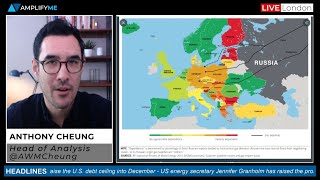
Biden and Xi plan a virtual meeting as tensions simmer, while Putin offers Europe more gas and gains leverage. The U.S. debt ceiling gets a temporary reprieve, and the ECB considers new bond purchases. Oil retreated on Putin's supply pledge, but JPMorgan says stocks can handle prices up to $130-$150 a barrel.
Chapters
Okay, very good morning. It is Thursday, the 7th of October. I hope you are doing well. And quite a few things for me to get you up to speed on. From Vladimir Putin coming to the rescue of the energy crisis following yesterday's comments, natural gas futures globally all coming under significant pressure, pulling back from the multi-year highs that we had been seeing. Of course, Joe Biden virtually is going to be meeting the Chinese President Xi Jinping by the end of the year. And the market's liking that as well as the fact that there were some ECB sources coming out as well from Bloomberg last night talking about the fact that the European Central Bank is thinking about a new bond buying plan or program, which I'm going to talk about a little bit more detail in a moment. So lots of different things going on. I haven't even mentioned the fact that we've made progress as well on the US debt ceiling. So some positive forces in play. And as such, then we've had a general kind of more optimistic open here in mainland Europe and the UK. But before I begin, don't forget to check out AmplifyMe.com. If you just go to AmplifyMe.com/market-maker, I'll drop the link in the video comments below, but you can subscribe to my daily newsletter that I put out just plucking out one singular theme of the day and giving a bit of an explanation behind what it means and why and how and so on. So a good way to accumulate and build out your kind of macro fundamental knowledge. So feel free to sign up to that. It's absolutely free, of course. Otherwise, let's get straight to it and talk about the charts and what's going on this morning. So as you can see, equity index futures are in positive territory. The Nasdaq's up about 128. The DAX is up a good 200 this morning. Energy prices continuing to fade some of that move following the gas commentary out of Vladimir Putin yesterday. On the weekly chart, absolutely perfection on the technicals to that previous level that we were looking at. And so a good point as well, technical resistance, to book some profit on the resurgent price that we've had over the course of the last week or so. So quite optimal then to close out those long positions over the short term given the commentary that we had yesterday and movement in that gas futures. USD index has just broken down through yesterday's low, so a little bit of weakness there on extension of that technical break. And as such, EURUSD then just managing to get its head above the range in the top left chart here from yesterday's session. And again, through the pivot, that's just helped propel the price a little higher this morning. We're trading up about 14 pips now, uh, pivot and that previous range high just acting as a bit of near-term support. Likewise, cable trading up around a similar margin but more dollar-led both pairs up an equal amount at the moment. Gold then subsequently a touch higher again, similarly breaking up a little bit out of its recent range, up $5, very much influenced by the US dollar. And T-notes trading unchanged this morning. And as mentioned, oil down, continuing that downward trend seen from yesterday, down $1.50 at the moment, but fairly sizable intraday move for oil. But in context comes as that, as I said, big ramp up in prices that that we've had. So let's get straight into it and talk about some of the major news flow because some really interesting stuff actually going on. And don't forget, you can access my early morning call on my, my Twitter handle for those interested. But let's talk about US-China relations first because it's been a bit of a hot and cold relationship between Biden and Xi so far. But what came about overnight was that Biden plans to virtually meet Xi before the end of the year, according to a US senior official. This comes as well amid the US Trade Representative Katherine Tai. You remember she was talked about a lot at the weekend because she was going to come out, as she did on Monday, and criticize China about their lack of adherence to phase 1 of the agreed trade deal. And she is set to meet her counterparty, the vice premier, today, or as soon as this week, I should say, to discuss those matters. So definitely there's been a bit of a kind of olive branch put out. To kind of, I guess, pacify any more confrontation ahead of those trade talks, which obviously are of material importance to both nations. So that's the latest there. Then we've got the debt ceiling. You might have seen me tweet about this last night, but Democrats have signaled they would take up the Senate Republican leader Mitch McConnell's offer to raise the debt ceiling into December. I think it's December 3rd that they're penciling in. And so that way alleviating any immediate risk of a default looming on the horizon, which is about 11 days away from now, as what Janet Yellen has been saying, the 18th of October. Senate Majority Leader Chuck Schumer said early today that— so their talks were going well into, into the night— that the two sides were making good progress and they hope to have a worked-out agreement by the morning. So when the US starts to come back in, in a few hours' time, definitely be looking out for confirmation of some of this more positive headway that they've made. A couple of things to be aware of here then. So the Republican plan, what is it? They want to increase the limit of federal borrowing by a fixed dollar amount that would be sufficient to tide the Treasury over basically till December, when Congress would then have to vote again in order to avoid a default. Uh, the vote could come at the same time Democrats want to attempt once again to pass that massive tax and spending package, which has been one of the main complications, of course, of trying to bundle them all up into one package. So for me, this is very reminiscent of all the other debt ceiling talk that we've had. This is why the markets have been relatively sanguine about the whole situation. We certainly on the desk feel the same. The debt ceiling gets a lot of airplay in the media, but really carries very, very little consequence because it's just used as leverage for politicians and ultimately dealmaking happens. And what they're doing here is essentially kicking the can down the road. Absolutely normal practice. We've seen this many times before. It's just going to be the same conversation is going to come back by the end of November and it'll be the whole thing. The US going to default again. Janet Yellen will start making some noises about how risky that is to the economic recovery. The politicians will play a game of brinksmanship right to the end, and then they'll probably extend it again. It's quite likely, given the fact that the most tricky thing here— and I actually think of everyone, the Republicans might come out in terms of the political upper hand on the right side of this because they're the ones who've tabled a solution to an impending problem as far as the public is concerned. And now it's going to be the Dems then when they again try to club everything together with this huge spending package at the end of the year, which is again going to cause delay and complications. So I think it's quite a good strategic move by the Republicans at this point in time. So we'll see how that plays out. But again, it kind of nips that in the bud. We let— we're looking out for confirmation, of course, from later on today when they will come into Capitol Hill. But as we were expecting, not really too much of a big deal for the debt ceiling. The other thing that came out late last night that I thought was really interesting, um, you might not actually recognize this lady, but her name is Jennifer Granholm and she is the US Energy Secretary. And she came out in an FT exclusive, which was last night, and she was talking about the prospect of releasing crude oil from the government's Strategic Petroleum Reserve, so otherwise known as the SPR. She declared that all tools are on the table as the Biden administration confronts a politically perilous year, as the surge in price of gasoline obviously would significantly weigh on US consumers. And so this, of course, adding complications because we're coming into the midterms next year, and hence the reason why that you're likely to get a lot of, um, kind of talk and pressure coming by way of the US on a lot of those OPEC names again to try and counteract some some of the resurgent price of energy that we've had of late. The Energy Secretary also said they did not rule out the ban on crude oil exports. So that was actually something that the US legislation changed several years ago to be able to export crude. But if they put a ban on that, that would kind of replenish, if you like, the amount of supply in the market and thus try to tame some of the resurgent prices being experienced specifically in the US. To give you context, the special— or the Strategic Petroleum Reserve, I should say— is managed by the US Department of Energy. And per the numbers, the reserve contained about 617.8 million barrels of oil last week. And that's, I guess, how much is that in terms of what it equates to in demand? It'd be enough to effectively be able to match US petroleum product demand for about a month worth. The last big release that we did see would be back in the Obama era. We'd have to go back to basically 10 years in 2011, the last time it happened. So at the moment, do I expect this to happen? I don't think so. Usually when these types of things and they tap the SPR, it's more to do with, say, a natural weather system, a hurricane that's caused massive destabilization that squeeze the price higher and they need to control that. I think it would be too political to be doing it now, given that it would obviously be aimed at taming the price to appease then consumers going into a major political event. I think that would be quite harming for Biden. So is the talk enough? Again, a part of this, of course, is to kind of address just general market concerns. If the market buys into the idea that they could step into the market, Does that kind of tame some of the outright speculators who are just super bullish going into the price at the minute? Perhaps. But let's see. The price obviously has come back quite a bit today because you know who, your main man Vlad's come in and dropped the bomb and basically said, you know what, we can sort this out, no problem. We'll just start through the state-owned Gazprom pumping more gas, no problem, got you covered. Problem is, is that I would fully expect Putin to use energy supplies to gain leverage over Russia's neighbors and also, most importantly, advance Moscow's strategic priorities. So obviously the market has been very sensitive to inflation of late, and rightly so. This energy price squeeze has meant that it's much more than just a transitory issue. And hence the reason why yields have been moving. Subsequently, it starts to impact just general sentiment, particularly tech stocks and so on and so forth. Now, one of the points here is that while Putin's comments certainly come timely and as relief for politicians and central bankers in the, in the Western developed world, these things definitely come with a cost. And I think Putin here has played an absolute blinder. And the reason for that is that He certainly has strategic interests, certainly in neighboring nations, but also because of the heavy dependence that European nations have on Russian gas supply. This is a chart just to show you the more red the color, the more heavy the dependency on Russian gas. And as you can see here, we include the likes of obviously Poland, most importantly Germany, which is why Merkel historically has always been very passive to talk about Putin on the international stage for the very reason that Germany is highly dependent on Russian gas. Austria, Hungary, Greece, Serbia. There's a lot of countries here and it does trickle all the way through, of course, even to the likes of France and the UK. So Putin has the solution. He's kind of held back on it, let the crisis burn for a little bit and then step in with a solution. But as I've said, I would definitely look at this now as Moscow looking to push their strategic priorities further. And Europe doesn't really have too much to counteract that anymore, other than make, you know, make way for him to do some of his proposals going forward, or at least be more open to listening to that. So yeah, hopefully that gives a bit of context. Otherwise, the other thing I wanted to mention was the ECB. Hasn't been too much of a move on the back of this. You could argue that European yields are a touch lower this morning, the bunds coming up to yesterday's high in the fixed income market. But the ECB is said to be studying a new bond buying program to prevent any market turmoil when their pandemic emergency purchase program— so this was kind of the way it works in the ECB, you've got the APP, the kind of standardized QE. Then you've got the added pandemic emergency purchase program on top of that, which is very sizable. That's the one that will end and is, is scheduled to end by, um, phased out by next year. And hence the reason why now they're talking about the potential, according to unidentified officials familiar with the matter, of a new program. So the plan would both replace the existing crisis tool and complement that older open-ended quantitative easing scheme that's currently acquiring around €20 billion in debt every month, said the officials. So yeah, this, um, there's no smoke without fire, and the actual article sources that Bloomberg put out is pretty detailed. So for me, this is definitely a very much a coordinated effort on behalf of the ECB to use the back door of sources to drip feed in the idea of kind of a, a stopgap between them to soften the impact of what it would be to, to start tapering in a European style, so to speak. So I don't think it's too surprising, but certainly it's a new thing to be aware of for sure. The other thing that's happening today is Olaf Scholz and his SPD party, the Social Democratic Party, are starting exploratory coalition talks today with the Greens and the pro-business Free Democrats today. And of course, this comes after that slight victory that they had over the CDU/CSU. And so we're looking at forming pretty much an unprecedented three-way coalition of a traffic light system being then red, kind of red, yellow, and green is what we're looking at. Not expecting a great deal to happen anytime soon. Um, the problem, of course, the more fractured a government, the more parties within the coalition, essentially the more headache it creates because subjects such as taxes, budget, climate, housing, spending, everything has to be agreed in a uniform fashion with parties that generally have different points of view. So hence the reason why politically it's going to be incredibly challenging going forward for Germany. But at this point in time, just kind of figuring out the, the balance of power amongst these parties is, is going to take time. So even though they're talking today in these exploratory coalition talks, I definitely would not be looking for any type of outcome, certainly not one that would impact markets today. The other thing is then equities have, have seen a nice bounce obviously from the lows, and it was helped a lot yesterday by a number of these positive factors that I've talked in this briefing. US-China talks, uh, the potential for an attack on the SPR to tame energy in the US, to Putin's comments pulling back in gas, and to ECB sources talking about a new bond buying program. The latest coming out of two banks I just wanted to mention was Barclays and JP Morgan. Barclays have said that essentially inflation fears persisting and the economic cycle maturing Barclay sees a period of higher volatility and lower returns for European stock markets. However, they find equities is more attractive than bonds, and as such, they recommend investors should be buying the dip. And then JPMorgan, on the other hand, um, I must definitely give the caveat that they've been a perma bull on US stocks, but their strategists have basically said stocks can handle— and obviously oil rallying aggressively as it has done to $80 has really prompted a lot of concerns, gas prices even more so. But JPMorgan's analysts have basically ran the model and that the output has said that basically stocks, US stocks can handle $130 oil and 2.5% yields. And looking at history, the US economy and American consumers they say did just fine between the period of 2010 and 2015 when oil was trading on average around $100 a barrel. Um, in fact, adjusting for things like inflation and consumer spending power, power, JP say that oil can actually go to $130 or even $150 a barrel without causing too much trouble economically, is what they're suggesting. So again, Do I buy into that? Perhaps not entirely in full agreement with that, but certainly, you know, listening to these banks and their calls, it's interesting to see the timings of these things and generally trying to see what the general collective consensus is at this point in time as to see whether or not we still got legs in this recent rally in oil still to come. All right. Quick look at the calendar for today. Very quiet the UK European morning. ECB minutes coming out 12:30. Weekly initial jobless claims in the US this afternoon expected to decrease to 348,000 from 362,000, but otherwise pretty quiet on the data slate. Quite a few ECB speakers to be aware of. Chief Economist Philip Lane speaks at 9:30, with ECB's Schnabel at 2 o'clock. You also have Fed non-voting member Mester, who sits kind of more center-leaning hawk speaking on inflation dynamics at 4:45 London time. Supply coming out of fairly sizable Spain, France this morning, with a 3.10 30-year note refunding announcement out the US at 4 PM this afternoon. So that is it. Any questions at all, feel free to drop a comment, be happy to help. And don't forget to check out that Market Maker newsletter. If you want to sign up, all you need to do is pop your email in And then also don't forget that tied in with the newsletter, we have our weekly Friday podcast with myself and head of trading. You just need to search for The Market Maker by AmplifyMe on Apple Podcasts or Spotify. You'll be able to find it. All right guys, take care, have a good day ahead. Thanks very much.
More from Anthony


Inside the Biggest Banking Stories You Need to Know This Week (Anthropic, Diageo, Private Credit)


Inside the Biggest M&A Deals You Need to Know This Week (UniCredit, GameStop, eBay, Eli Lilly)







AI Breakthrough or Hype? Anthropic’s Claude Mythos, Tim Cook Steps Down & LIV Golf Collapse