Black Friday Global Market Trading Update
In this morning market briefing, the presenter delivers a rapid-fire overview of the key drivers shaping global markets on Black Friday, 23 November 2018. He begins with a technical snapshot of the euro’s weakness, linking it to disappointing German manufacturing and services PMI data and the European Central Bank’s minutes that suggest a temporary soft patch but also hint at an imminent end to quantitative easing. The discussion then shifts to the retail phenomenon of Black Friday, tracing its origins, its massive impact on U.S. consumer spending, and its rapid globalization – especially the explosive growth of China’s Singles’ Day, which now dwarfs U.S. Black Friday/Cyber Monday sales. The briefing moves on to Brexit, detailing the Gibraltar agreement, the release of a 26‑page non‑binding future‑trade commitment, Theresa May’s high‑risk parliamentary strategy, and the looming EU summit in Brussels. The presenter then covers heightened U.S.–China trade tensions, noting a U.S. push for allies to drop Huawei equipment and the contradictory signals from President Trump. Market‑specific updates follow: a modestly bearish S&P 500 session, a continued downtrend in crude oil heading for a seventh consecutive weekly loss, and European equity markets largely flat despite negative euro‑zone PMI releases. Finally, he notes Italy’s weak BTP retail bond auction, ECB Vice‑President Guindos’s comments, and the upcoming economic calendar, urging listeners to monitor Brexit developments over the weekend.
Chapters
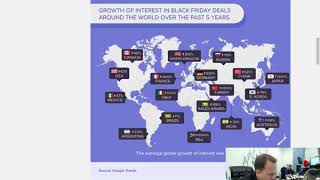
Okay, good morning guys. Friday, 23rd of November. Welcome to the Amplify Briefing. We're going to cover this morning the fact that it is Black Friday, so, uh, one of the big retail events of the year, of course. So we're going to talk about this. We're also going to talk about further and ongoing weakness in German economic data. We've just had an update literally 4 minutes ago on the German manufacturing PMIs that have disappointed Euro is under pressure as I speak, so we're going to talk about German data update on Brexit. Obviously, the Shanghai comp was down 2.5% overnight, and we're going to talk about a bit more on crude oil as it is about to notch up its 7th down week in a row, having dropped well over 30%. So let's get straight to the chart. We'll talk about, we'll talk about the Black Friday stats in a minute, but Let's get to the action straight away. As you can see here, the euro is on the downside. So we've just broken the pivot. This is a 15-minute chart just looking back over the action so far today. But if we go back to a 60-minute, then we're approaching some technicals here. First up is the low point that we had from yesterday. We're about to arrive at that. But just below that is the low that we saw back on the 20th, back on, on Wednesday. So let me get my rectangle out here. So a couple of supports coming. You can see that that low from Wednesday coincides with the S1 support, giving that price area a bit of strength. You know, for the euro, it's been relatively balanced the last couple of sessions, but certainly threatening on the downside. Further German data disappointing. So Says they have reached an agreement with Spanish colleagues and have delivered from Gibraltar. I speak on the BBC radio. Okay guys, so I'm just going to turn because we just had some news because you're getting cable on the downside here, a bit of a sympathy move. We had some volatility, um, earlier. Oh sorry, that's yesterday. But, um, we've had a bit of downside here for cable. Just getting news now that it looks like the British and the Spanish have agreed a deal on Gibraltar. so this is the Gibraltar Chief Minister, Picardo have reached agreement with Spanish colleagues, have delivered on Gibraltar. This has just been released now, BBC Radio. Not— well, no response through the value of the pound at this point. We've had a slight dip here in sympathy, really, with what's going on over on the euro. As we get further weakness from German data. So let me show you what's been going on here. So we've just had— I mean, obviously for Germany, and I was talking about Germany earlier in the week, if you remember, I pointed out the fact that Germany's Q3 GDP delivering a negative print and coming in at -0.2%. That has been reconfirmed this morning, by the way. And on a 5-year chart, that is the worst reading for 5 years. Got to go back to 2013 to cop the last time we had a movement into negative territory. Now, what's happened this morning? I mean, remember, this is quarter 3, right? But this morning we've had data about November and this is bang up to date. This is the flash PMI readings both for manufacturing and services for November. Pretty much the most up-to-date data we've had on Germany. Now here we are, November, that's, that's halfway through Q4. So if you're wondering, well, is this a temporary soft patch for the German economy, this slide to -0.2% on the GDP front, is that temporary? Are we going to see a rebound? And what's quite interesting is the ECB, who released the minutes from their meeting 3 weeks ago, answered this precise question. And this is quite key for what the ECB do in 3 weeks' time, because they've got a very important meeting where they've got to sign off on the end of QE. Okay, and the ECB in their minutes yesterday asked the question, you know, is this a soft patch? Is this temporary? Are we going to see economic conditions rebound? And the ECB used language like, we need to, we need to use a steady hand, and that They pretty much indicated that their preference was that this was a temporary soft patch, that growth rates will improve into 2019, i.e., implying they're ready to sign off, the pen is poised, QE, it's, it's the end. And so what I'm interested in is the data we've just seen, which actually indicates the opposite. So let's have a look. Germany, I'm just going to go down to the manufacturing PMI data. For— where are we? Here we go. Here's the manufacturing PMI chart. Now, you don't have to be a genius technician to, uh, identify a downtrend here. Um, quite phenomenal really. Every quarter this year, PMIs have stepped lower and lower and lower, and here we are down below 52 now. And if you go out on a 5-year time period You know, all of that amazing push to the upside and that German economic momentum we saw back in 2016, right the way through 2017, well, that has all come crashing down. And here we are back into the range that we, we had 2013, '14, '15. So this is, this is pegged back to a 2.5-year low here on German PMIs. So this is from midway through Q4. So this would be suggestive of the fact that German growth, yes, was weak in Q3. It looks like it's going to be a Q4 story as well. So certainly surprisingly bad data. That's why you've seen the euro take a hit here, especially after the ECB yesterday pretty much confirmed they're going to go ahead and end QE. So the euro-dollar just testing that, that low point from Thursday at this moment. So keep your eye on this. So that's latest hot off the press. Um, let's, uh, let's switch our attention. We'll come back to what's going on in markets in a second. Let's switch our attention to this, this, this phenomenon called, uh, Black Friday. It is of course Black Friday. It's the final Friday of the month of November. It's the Friday following Thanksgiving. Uh, this used to be a US thing. And traditionally, the, the whole reason— why is it called Black Friday? This is because traditionally retailers would move into the black on this day. It, it is the, um, it is the, the highest or the best or the largest retail day of the year in the United States. And traditionally, it's the day where retailers have made enough money throughout the whole year to pay for all of their overheads, that's fixed costs, variable costs, to pay for everything for the full 12-month period, and any money from here on is pretty much profit. Okay, so they've moved into the black from an accounting point of view. So that's why it's called Black Friday. This is a phenomenon that's kind of gone back to the 1950s actually. Used to be absolutely a, a US-only thing. We'll talk in a minute about how this has become global. But firstly, a few stats for you. So in terms of retailers in the United States, and this actually more so these days rather than just this one day, it's become a whole weekend. And actually retailers talk about, you know, Black Friday is the beginning of the holiday season shopping. You've got now one month before Christmas, and actually in this one month on average 30% of retail spending happens. So 30% of annual retail spending happens in one month. It depends on the retailer, but for some, like jewelers, on average, if you're a jeweler in the US, 40% of your revenue comes just in this one month. So of course retailers are heavily dependent on on this period. And this is why it's so important, uh, from an economic point of view, uh, when you're thinking about developed economies and their reliance on consumption. Well, you know, this, this next 4 to 5 weeks are absolutely pivotal, um, for that whole consumption-led growth story. So what are people expecting for this year? Well, God, let me show you a table. Here. So looking back over the last, uh, however many years this is, so you've got the amount spent. This is actually, I think this is for the whole holiday season, so this is over that 1-month period. Okay, uh, so we're going back to 2002 here, the total amount spent and the, uh, the percentage increase on the year before. So as you can see, spending in this period has been going up and up and up. There's one notable very negative print So in 2008, um, literally a couple of months after Lehman Brothers had gone bankrupt, right in the absolute eye of the storm of the global financial crisis, we actually saw retail numbers drop, -4.6%. The following year was pretty much flat. And so that 2008 and 2009 period, very unusual. Before that period, average growth rates per year were 3.5%. That's going back decades. After the financial crisis, the average growth rate has actually been more like 4%. But as we recovered from the crisis, you can see the retailers coming back, and nice steady annualized growth all the way through. Forecasted for this year is an increase of 4.3% over and above the spending that we had in 2017. This is a forecast, this, this bottom one. And actually this figure, sorry, in the column on the left here, this is the amount spent per person. and then the total amount. So we're expecting $717.5 billion to get spent at a grand each. Um, so this is the kind of, uh, level of spending. Of course, these days, um, it's not just about Friday, it's not just about the day after Thanksgiving. Uh, we have days like next Monday is called Cyber Monday. Um, again, this used to be the most, the biggest day of the year for online shopping, but actually what's happened More recently, retailers have been spreading their discounts right the way across November. So if you, like Amazon for example, have had their kind of Black Friday discount deals on the go for weeks now. So it's become less about specifically this day, more about generally the build-up to this day, this, this whole weekend, and then more broadly that, that kind of one-month period kind of starting from around about now until Christmas. But this used to be a US thing, not anymore. Obviously retailers love a bargain. Well, no, they don't. I guess consumers love a bargain, I should say, which is why retailers give us bargains. And so this has actually been exported now, and this obviously is a function of globalization. You know, the likes of Amazon, they don't just do Black Friday deals in the US, they do it across the world. Um, this is quite an interesting chart— growth of interest in Black Friday deals around the world over the past 5 years. So you can see in the United States, 43%. So that's actually one of the lowest on this chart, and that's because this is normal. Black Friday happens in the US and it always has for decades, right? But slowly but surely, this has become a global thing. Some of these are quite remarkable. If you check France, for example, just in the last 5 years France has properly got in on the act, and the number of Black Friday deals available in France over the last 5 years compared to the 5 years prior to that has gone up 4,900%. Italy, 3,233%. Germany getting involved, Turkey, the whole planet. China, we'll talk about China in a second because China have a bigger retail day than Thanksgiving. I wonder if you guys know what it is and what it's called. Type it in the room if you do. What is China's biggest single retail day and what do they call it? Japan getting in on that. It's an absolute global event, this, of course. You know, stuff like stats like this. This is 2017, looking at the number of downloads for shopping apps. This is 2017 data, and as you can see, as we build into that holiday period, that Thanksgiving season, then the number of app downloads just explodes. But yeah, those— Richard, you're the only person. Okay, Rishabh, no, you're wrong, Rishabh. It's actually not that. Richard is right. Just looking at anybody who managed to type in the room the answer to my question. Uh, the answer of course is Singles' Day. This is the Chinese stats. Singles' Day, this was on the 11th of November, and, um, this is looking at the stats over the last, whatever, 5 years. And Singles' Day yet again set a new record in China. What's interesting, if you compare the amount of money spent in China on Singles' Day to the amount of money spent just on the 2 days, Cyber Monday and Black Friday, then it's 3 times more. So Chinese shoppers spend 3 times more than US shoppers during the kind of big single kind of day, shopping day of the year, $30.8 billion. Now what's interesting about this Chinese chart though, because if you're thinking, whoa, well hang on a minute, trade war risk, Chinese growth deceleration, all the rest of it, well yes, we set a new record, but look by how much the growth— so we went from $25.3 billion to $30.8 billion, which is a much smaller increase than we saw between 2016 and '17. So yes, new record set, but, um, growth rates have slowed here. So that's something to factor in. So certainly what we're going to get over this weekend and perhaps into next week, when we hit next week probably Tuesday really when we'll start to get the stats of the retail and the amount of money spent. And this is always a really— as I go back to the kind of economics of it all, this is always a really important sort of measure of consumer confidence, a measure of— because all these consumer confidence data readings that we get, it's a pretty narrow pool of people that are surveyed. For example, the University of Michigan consumer sentiment data. So that's announced monthly, and it's a measure of consumer confidence, but they only survey 5,000 people. So it's quite a small sample size for an economy that's got 320 million people in it. So actually, the number one best consumer confidence measure is the Black Friday weekend stats, you know, just how many dollars swapped hands. Okay, so let's move on. I'm gonna go and we're gonna talk Brexit now because as I do so, cable— as it's been, you know, we haven't really had any upside off that Gibraltar news. It has been one of those kind of final sticking points. I guess people were just assuming that that would get sorted, that would get resolved. We had some plenty of volatility in there on yesterday's session, but I mean, the main updates are that, you know, the agreement's been— or sorry, the withdrawal treaty text is done. And now yesterday what we had issued was the 26-page non-legally binding future commitment, you know, a commitment to a future kind of trade relationship. And the 26 pages were released. Theresa May came back yesterday, talked about it in the Commons, and just got hammered again from all sides. So certainly Labour, Jeremy Corbyn calling it 26 pages of waffle, a blind Brexit "Blindfold Brexit" and 26 pages of waffle. Theresa May then got attacked by her own party as all of the kind of Brexiteers kind of stood up in turn and slammed it. And so you still got this situation where Parliament is suggesting that it's not going to vote through this deal. And perhaps that is Theresa May's strategy. She's got to be a bit careful, though. Peston, Robert Peston, was talking on ITV News last night and he made quite an interesting point. You know, it is a high-risk strategy, this of Theresa May. We talked about this earlier in the week where she actually knows it's going to fail when they vote on this in Parliament on either the 11th or the 12th of December. She knows it's going to fail, and what will happen is the pound will tank. And you know, over the last week we have been looking at— if I go to that weekly chart— we've been looking at this a few times that idea, well, where can the pound go here depending on the outcome of Brexit? And it could be down 120, below 120, and it could be up around 140. And what Theresa May probably is anticipating, that if the vote fails in Parliament mid-December, the pound tanks, it breaks that summer low and sharply moves down towards 120. And we got the, the key kind of levels are the the start of 2017 low, right on the 120 handle. If that broke, the idea is that severe pressure in financial markets would then force the politicians to actually vote it through on the second chance. But Theresa May's— it's a high-risk strategy because if the first vote fails spectacularly, I mean, if she properly loses that vote, if more than two-thirds of MPs vote against it, well then Labour are in their rights to trigger a confidence vote, or they could say that is a no-confidence vote, and it could lead to either a general election or, dare I say it, another referendum. So Theresa May, if she does want to lose this vote, she's got to lose it by a narrow margin. Anyway, she's trying to rally the troops. She's decided to give up a bit on the MPs and trying to convince them, and she's been trying to convince business leaders. So she's going to have a series of meetings. She was at the CBI last night, that's the Confederation of British Industry. She's hosting the delegation of Northern Irish business people today, and what her strategy now is to convince the business community to back it, to then basically force the MPs to back it. Unfortunately though, there was a leaked email from the head of the CBI. This is the British industry lot, and she's Nicole Sykes, said in a leaked email, no need to give credit to the negotiators because it's not a good deal. Now publicly, the CBI have been backing this deal, and now it turns out that the head of EU negotiations at the CBI thinks it's rubbish. They kind of countered this by saying, "The deal is not perfect, you know, we admit this. It involves compromise. Hard work lies ahead. But right now it's the best chance for protecting jobs and growth." So that was their retort to ITV News last night when they called them out about this leaked email. So even Theresa May's kind of strategy of trying to get British business onside has kind of taken a bit of a faltering step. To start with. But of course, it's a key weekend because at the moment, at least, Theresa May's off to Brussels Saturday for final talks with Juncker. Theresa May is then gonna stay in Brussels but join the meeting on Sunday, and we're expecting this whole deal to get signed off by EU leaders Sunday between 11 and 12 AM with a midday press conference on Sunday. Okay, yes, the Spanish have been digging their heels in on Gibraltar. But as the news flow this morning has indicated, it looks like we've had a breakthrough on that. So right now, as it stands, keep your eye on this over the weekend, obviously. But right now, it looks like the leaders are all going to meet. Merkel has said— she said, I'm not going to Brussels unless everyone's going to sign that piece of paper. If there's any hint that someone's not going to sign it, I'm not going. Okay, if definitely is— that Sunday meeting isn't a negotiation opportunity. That's literally turn up, sign, smile for the cameras, go home. So that's, that's what we're expecting at this point. So that's the update on Brexit. Other stuff then, let's check in on stocks. China had a bad session overnight. Chinese stocks down 2.5%, and I, I spoke this week at length about the trade war risk, so I'm not going to go over that. But something, an update on this overnight which perhaps helped Chinese stocks on the downside, apparently the US government is said to ask foreign allies to stop using Huawei equipment. This is the, you know, the Chinese giant kind of smartphone manufacturer. So the US government is said to ask foreign allies to stop using this equipment. So this is a clear sign that obviously this trade war risk is not going in the right direction. It's not reducing. And after the APEC summit last weekend, and kind of this kind of news flow, it's certainly indicating that we're going to go into the G20 summit with, with still this, this, this trade war risk, you know, elevated. However, US Trump, US President Trump did say, he said China wants a deal on trade very badly, was his quote, and if we can make a deal, we will. So he did say that, but then the US government persuading foreign allies to stop buying Chinese electronic equipment at the same time. So it's a little bit contradictory. Also, China responded to recent US Treasury report, and in the recent Treasury report from the US, they'd labeled and accused China, made accusations of unfair trade practices and And China have responded saying this is groundless and totally unacceptable. And then whilst it added that it hopes US drops rhetoric and behavior that are damaging to relations. So this is overnight. Chinese stocks have suffered as a result. And so this, as it stands, as I said, this trade war risk is elevated. And I don't know whether we can get any kind of deal next week at the G20 summit or not. So that'll be massively important to find out. That'll be next week's big story. Let's look at the S&P, though, which is what I got the chart on here. Just from a— let's go to a 1-hour chart. Obviously, volumeless session yesterday because we had a shortened session. Indeed, the CME futures closed at 6 p.m. In the shortened holiday session. We did drift down and we had a little tester of the lows of the week that were kind of set through the pit— through the kind of Wednesday session. We did indeed officially set a new low for the week, but good resistance up there at the high point from Wednesday afternoon. And if I go back to that daily chart again, we're going to have a low volume session because it is— markets are open today in the US, but Of course, most people are still on holiday, so we just mark up the key low, which is down here, the low of this overall October sell-off on the 30th, down at 2600 handle. I'd expect another, a similar session to yesterday volume-wise, perhaps a touch more volume, but not much. And perhaps we should just expect another consolidation day, which is pretty much what yesterday was, consolidating what have been a couple of weeks worth of downside. So stocks, yes, Chinese markets suffered overnight, 2.5% down on the Shanghai comp, but actually Europe has started off relatively flat, not too bothered by that negative session in China. We're probably in for another day of consolidation, I would suggest. Let's just check back on the euro-dollar because as I began this briefing it was coming lower. Okay, so we're getting the European overall PMI data as I speak now. So we have the German and we had the French deliver their numbers earlier. Now the European one has been just been announced and that's worse than expected as well, which is not surprising. So all eurozone PMIs are below forecast. Okay, so but this has probably been priced in with that move off the German data specifically. But we're right down at the lows here, testing that key level that I picked out. If I go back to that 1-hour chart, then the level is the low set back on Wednesday. Okay, so we're just down there with S1 giving it a little bit of added strength. So we're just finding a bit of resistance here at— sorry, Wednesday's— so I'm getting my dates wrong here. The 21st was Wednesday, wasn't it? So Wednesday's low is here where we're finding a bit of resistance. Tuesday's low is the low of the week where we just found some support. So keep your eye on that. More negative data from Europe. Let's finish with crude oil. And are we going for 7 weeks in a row? Definitely. I mean, something quite extraordinary has got to happen to avoid a 7th down week in a row. Um, this week the price of oil opened at the price $56.72. So we've got to rally $4 today to avoid a negative week. And $4 when you're in this kind of price point, that's like 8— more than 8%. That's a big ask. So I mean, never say never, of course, but most likely a 7th down week in a row. More news on the Khashoggi situation overnight. Trump pretty much— I mean, I was talking about the CIA leaked tape and how pretty much the Trump administration know that the Saudi prince had called for this assassination but have chosen to turn a blind eye. And Trump last night said, "Yeah, so what? Yeah, he probably did it, but you know, it's done now. Let's move on." That was Trump's response pretty much. Which was quite extraordinary. But that's, that's Trump. So I think today we go to a 60-minute chart. Key technical level for today's session, you know, in the near term, obviously, is that low of the week, okay, set back on Tuesday, 5277 on the futures. We've already had a little sniff at that overnight. So that dip we had around 3 AM this morning, down to We got down there, tested it, bounced, but we didn't bounce very far. And we've been finding resistance for the last few hours at what was yesterday's low. Okay, so quite an interesting hour or so ahead. Do we get back to the low and break it? If so, $52 is probably going to get tested. Or have we had enough damage for one week for crude oil? Have we had enough damage for two months? We'll have to wait and see. But on the upside, we really need to break above yesterday's low. 53.52 to settle things down, and maybe we can drift up to the pivot as we go through the day. But then, you know, it's hard to call which way we go. Obviously we're in a very sharp downtrend, so any break of that 52.77 and we're definitely going lower, and the trend will extend into the end of the week. Right, I'm going to finish with the economic data calendar and then I'll let you guys get on. So we've had, we've had really the most important data of the day is has come and gone. That's the European manufacturing PMIs that have disappointed. Okay, into the afternoon and we got nothing. Again, it's pretty much, pretty much a US holiday, um, as people take an extended 4-day weekend for Thanksgiving. So actually we got a lot, bunch of Canadian inflation numbers here. So if you're trading the loonie, then obviously look out for this stuff. Um, but other than that Um, you've got Bank of Italy publishing its financial stability report. Just to update you, I was talking about that, um, BTP Italia bond auction, um, over the last few days, which is the retail bond auction. Normally they do this every 6 months. Normally they sell $7 to $8 billion worth of this stuff to the public. Yesterday they announced the figures and they managed to sell $2.2 billion. Which is very low. Now, interestingly though, Italian yields didn't really increase off the back of that, which probably suggests upside for Italian yields— well, looks like we're done for now, because if investors were still panicking, then that was a good enough reason to sell more Italian debt, driving yields further higher. But that didn't happen, which I thought was quite interesting. So Maybe for now people have kind of priced in this deficit saga story, um, and probably that, yeah, we'll keep an eye on it today. But yeah, if that was going to flare up, yesterday was the day for it and it didn't really happen. Okay, other than that, ECB's Guindos talking, um, and that is about it. Okay, so that's the That's the wrap for the briefings for this week. Good luck for the session ahead. Make sure you stay tuned in to Brexit over the weekend. Enjoy the session. Thanks very much.
More from Anthony


Inside the Biggest Banking Stories You Need to Know This Week (Anthropic, Diageo, Private Credit)


Inside the Biggest M&A Deals You Need to Know This Week (UniCredit, GameStop, eBay, Eli Lilly)







AI Breakthrough or Hype? Anthropic’s Claude Mythos, Tim Cook Steps Down & LIV Golf Collapse