Breaking Boundaries: How I Got My Job At J.P. Morgan
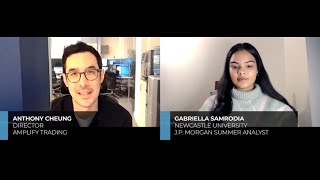
Gabriella, a Newcastle University student, landed a J.P. Morgan summer internship by applying to hundreds of finance roles, attending networking events, and treating rejections as learning moments. She credits early public speaking, 1% daily improvement, and mentorship from a scholarship winner. Banks now actively seek diverse candidates, she says, so embrace your background.
Chapters
Hey, really pleased to be joined by Gabriella, who did our Summer Analyst Training Programme back in 2021, is a student at Newcastle University, and has secured a summer internship position at JPMorgan. But Gabriella, first, how's it going? What have you been up to?
I'm well, just getting on with exams, arrangements for the summer, hoping to travel in Easter, so just trying to make the most of the sun as well. While, whilst the weather's been nice.
Yeah, 20 degrees on Wednesday, I've been reliably informed by the BBC. But, um, but look, I think what's really quite compelling about your story is the fact that, um, Newcastle University is a great university. We've worked with them ourselves as a company for a long time, but Newcastle University, I guess, is classified as a non-target uni in the traditional sense. And I'm really kind of talking more about the traditional LSE, UCL, Oxbridge type routes. I just wanted to get your take. You've obviously secured a role amazingly at JPMorgan. How was being a student at Newcastle? How did you find that experience? I guess one, getting introduced to finance and finding out about these roles, and then two, the process of applying.
Yeah, of course. I think for me it isn't really about what university you study or what course you do, it's more about how driven you are. So I remember in lockdown, I think it was the January after we were locked down over Christmas and I had nothing to do with my time and I thought, oh well, I'll make a LinkedIn profile, I'll see if I can, you know, better myself in any way and I was scrolling through LinkedIn, all the students who were in my year doing my subject at different universities and they had several different opportunities in the industry. They were doing insight programs and they'd been attending coffee mornings, they had summer internships already and I was in my first year of university and I just remember saying to my mum, well, why have they got this and I haven't got this? She said, oh, they're different, they're probably older, you know, probably at different universities maybe, and I said, no, they're at this university, they're doing my subjects, why can that not be me? And she was like, well, I mean, go on, go and do it then. I was thinking, may as well give it a go. So I think I was mostly inspired by all the students who were my year, my age, doing exactly the same thing I was. And just because they were at a different university, it doesn't mean that they were doing something completely different to me. So I applied to thousands— not thousands, maybe hundreds of roles, opportunities, anything I could in the industry to sort of immerse myself into finance. And I think the rejections definitely play a big role, but there's that image that says, um, the power of tiny gains. So if you improve 1% each day over a year, you will have improved by about 40%. So I think after each application, I was minutely improving, but that's all it takes really. So back to the topic of university, I don't think it matters what university you go to as long as you're driven and know what you want your end goal to be, then you can achieve that.
Yeah, and so, so question for me is like, I, I get— I'm in a privileged position, I guess, because I get to meet people like you every summer, uh, lots of you. And a lot of the conversation does hinge often about confidence, and it's led me to kind of do lots of reading and things like that about where do people generate that confidence. And listening to you and having worked with you I know what you're like, you're very diligent, you're very hardworking, very confident in that way, and I guess that's born out of those other things. Where does that come from, like, for you? I mean, what's the life story that's led to that? I mean, because, because some people find it difficult.
Yeah, I think I was always quite an avid reader when I was younger. I would always read aloud, whether that be in classrooms in primary school. In secondary school, I would narrate assemblies, nativity plays, and I volunteered at my local parish, in the church, I would read there. So I think I was public speaking from a very young age. I then managed to be on the deputy team for my secondary school and I went over to China to teach students about British culture and I had to speak in front of hundreds of students and it was fantastic. It was such a fantastic experience and as I said, improving 1% each day, obviously over the space of, for me, 20 years, that can rack up. So I think obviously it doesn't happen overnight. I'm not saying to all these students, one day you'll wake up and just feel completely confident. But I think if you can do something every day to better yourself, then it should hopefully come with ease.
Yeah, and then you mentioned about rejections, and it's probably been more than one, I imagine. And so I know you've talked about these kind of incremental gains, but what would be your process then after a failed attempt? What would you do to assess it? Would you spend some time digesting it and reviewing it and then moving on, or was it quite obvious each time where you fell short, so to speak?
I think that's definitely a difficult question. I would say it's all about being able to judge your character and whether that you are a good fit for the role. Obviously, as students, we become quite, um, we become quite hung up on the fact that these banks are choosing us and the firms are choosing us, whereas we are also choosing the firm. So we need to find places that align with not only our values but also our characteristics and our talents. So if I applied for a role and was rejected, I would think, well, what could I have done differently? Were my skills related to that role? Was my CV tailored to the experiences they were after? Was I not a perfect fit for a role? What was it? So I would definitely assess where I went wrong, but I also would take it with a pinch of salt because the amount of students that are applying to these opportunities— sometimes it could be the case of you've applied too late, you've missed a deadline. I know most firms apply on a recruit on a rolling basis, which I think is quite misleading as they have the position open for perhaps months. But I know for my summer internships, I was within the first 2 and a half weeks of opening, and it was open for about 4 months. And I knew when they— when there was a cutoff, and it was definitely soon. So I would say get your applications in as soon as possible. Yeah, yeah.
And then, um, did networking play a part as well for you in terms of the front door application being one attack? Was there a networking angle? Was that effective for you as well?
Yes, definitely. I would say probably nearly every single opportunity I've undergone was through networking and through the back door rather than the front, to be honest. So I was attending a Bright Network event once. This was early when I didn't know much about finance, and it was the small things. It was having my camera on, it was looking presentable, it was asking questions, and I ended up being headhunted by HSBC SBC for a Global Insight Programme, and I just thought, wow, off the back of just being inquisitive and, you know, wanting to learn, I was able to achieve this. And then from then on, I knew what I had to do. I had to reach out to different people in the industry. I also applied for a scholarship, the Miranda Brawn Diversity Leadership Scholarship, and I thought, there were hundreds of students who apply and there was only one person who would be picked for the finance and business management sector. So I thought, I'll do a bit of research, I'll see who the previous winners are, I'll get their take on things. Did they enjoy the mentorship programs as such? So I reached out to one of the winners from a few years back on LinkedIn. I thought, the worst she can do is not answer, you know, give it a shot. And anyway, she answered, she gave me advice that I would never have been able to get elsewhere. We're really good friends now. I did manage to secure that mentorship position. And I think just from me reaching out and messaging her, I have a lifelong friend, a networking connection, I have this scholarship. So back to confidence, really, you have to have that confidence and be that person who initiates the first move sometimes when you're a student looking to network.
Yeah, it's interesting, and I hear this as a recurring point, is the curiosity. And I guess that opens up so many doors and avenues of possibility. One thing I'm kind of very curious about is the fact that, I guess, when we're looking at institutions and their kind of diversity, kind of what they're trying to achieve at the moment, you are Black heritage, you're a woman from a gender perspective, and you've got a Northern accent. So How has that been as an experience? Is there anything different? Is there anything you'd like to say on that, or is it kind of— it's a moot point and you— it's just kind of you're the same as every other candidate in that sense?
Yeah, I think, I think the banks are definitely moving towards a more diverse recruitment process, and that's lovely to see. I would say that It hasn't really been an issue for me. I think I was quite confident. I knew what I knew, I knew what I wanted to do, where I wanted to go, and at the end of the day, if the banks didn't see the potential in me, then I could always go elsewhere and show somebody else. So I think it hasn't been that much of an issue, but I would say for any students who are feeling perhaps imposter syndrome or feeling as though they wouldn't belong in the industry, I would say that is completely not the case. I think it's the 21st century, you know, firms aren't looking for carbon copies of the employers they already have because what value would that have to the team? You want to capitalize on what makes you unique and add value to the team. So I think I do that in ways that others perhaps can't, so hopefully that will stand in good stead.
Yeah, no, amazing. And, um, you did do the Amplify program as well amongst HSBC and other things that you've done. And was there anything that you feel that you got out of that experience during the summer program that's been beneficial going forward?
Yeah, so there were two things. The first thing is, um, your daily briefings. Shameless promotion for you there. So for any students who aren't familiar, Anthony's daily briefings took place at the beginning of the Summer Analyst Programme almost every day, and they would consist of what happened in markets the previous day or previous evening. And I think to have that unparalleled access to the trainers, to be able to ask those quick-fire questions, you know, who is Jerome Powell, what is the FOMC, what does this hike have to do with US non-farm payrolls and market sentiment— these are questions that you can't exactly Google and get a straight response, you need to speak to somebody in industry to get these responses. And then it was interesting to also know the students' perspective on market, so the students would ask their questions, what they didn't understand, and this would help me. But also it sort of mimicked an office environment, so even though the programme was online, it felt like you could cooperate with your cohort and learn things from them, We sort of bounced off each other, which was nice. And then secondly, I would say the simulations. So Amplify are known for their simulations, and I think as a student, first year, second year, even third year of university, wanting to go into finance, perhaps investment banking, it's difficult to actually know what an investment bank is, what an investment bank does, what role they play in the whole financial industry. I think the simulations really allow you to obviously sit through that role and understand the mechanisms of the role. And I know before I'd sat the simulations, I wasn't too sure on what everything was. However, throughout the simulations, it sort of becomes clear what each position does. I think as well at university, there's a lot of theory, a lot of reading. It's not that applied, whereas this Amplify Summer Analyst Programme sort of bridges the gap between theory and practicality. You get to actually put what you've been learning to use, and I think that's really rewarding.
Yeah, amazing. I'm so happy that, um, that you like the briefing. Yeah, no, it's great to hear, um, you know, not just of yours but other people's success. And, um, look, I, I wish you all the best. I think you're going to do an amazing job, I'm sure, at JP Morgan. And, um, I'm sure there will be a return offer coming your way, as much as competition from other banks, for— for— I know you are an outstanding candidate. And so, um, yeah, thank you for taking the time out to talk to me. Um, I know you're going on holiday, so enjoy, relax, and, uh, the best of luck with your studies as well. Thank you, Gabriella.
Thank you.
More from Anthony


Inside the Biggest Banking Stories You Need to Know This Week (Anthropic, Diageo, Private Credit)


Inside the Biggest M&A Deals You Need to Know This Week (UniCredit, GameStop, eBay, Eli Lilly)







AI Breakthrough or Hype? Anthropic’s Claude Mythos, Tim Cook Steps Down & LIV Golf Collapse