Brexit: What happened & What next?
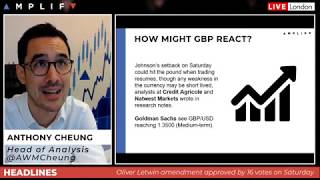
Sam North and the host break down Super Saturday's Oliver Letwin amendment, Boris Johnson's two contradictory letters to the EU, and what comes next for Parliament and sterling. GBP/USD faces resistance at 1.32-1.33 as traders watch for a meaningful vote and potential extension. The week ahead brings 126 S&P earnings, ECB policy under Christine Lagarde, and Labour's push for a second referendum.
Chapters
OK, very good morning, Monday 21st of October. Hope you are well and hope you had a great weekend. As probably you're expecting, I'm going to go through in depth what happened on Saturday in UK Parliament. I'm also going to discuss what is to look out for next and what's actually going on in the news in terms— there's been a lot of headlines that have been coming out already about the possible next steps, and most importantly, I guess, how is this going to influence the British pound and other subsequent markets. As per every Monday morning, we do a look ahead for the markets as well. So as you can see to the side of me is a calendar where you can access all of the major events that are going on today. So inclusive of not just economic data, but you can also see what major corporate earnings are coming out, if there's anything else to be aware of like market holidays and so on and so forth, which you can access on my Twitter account. You can see my handle here below. And if you're new to watching this, we are delivering this live on Monday morning from our trading floor in London. Don't forget to subscribe to the channel on YouTube and click the bell icon to get notified whenever we go live. So I can see a few of you, Kurt, Greg, Jenny, very good morning. Thanks for giving me the heads up. And the love hearts trying to throw me off, uh, Jenny. But, uh, let's get straight into it. Let's have a look at the charts this morning and then we'll talk about— I've prepared some slides for Brexit that hopefully is going to make life a bit easier for us to talk about and for me to update you. So looking at the charts this morning, um, very quiet actually. The news flow very much dominated about this latest development, what happened in Brexit. Brexit with the UK Parliament voting a latest amendment, which has triggered several other things which we'll discuss in a second. But in terms of the pound against the dollar, pretty contained move actually, just a small gap down. When I say small, it was about 1 point, so about 100 pips or so. And then we've actually, as soon as UK and Europe have come in, it's almost been an idea of buying the dip. And then after testing on the daily pivots, the S1, which was the initial kind of gap down and initial low seen at reopening of futures trade. I'm looking at the sterling future here. Markets have found some resistance near-term at the pivot level, just looking to close the gap somewhat up towards the price action that we were seeing before the pop we saw into the close on Friday. So all in all, a relatively contained reaction, and I'll explain why in a moment, and we'll come back to the sterling chart and have a look at that in a bit more detail. Um, just for anyone new to the channel though, you can see there's two people just commented in the chat room. You got Sam North, who's one of our senior traders here on the desk. He's just sitting beside me on the floor, so he can address any questions you have. Just type them in the chat. And then you've got Piers in there as well, who's our head of trading, and obviously he's here this morning eager to get stuck in, just given what's been going on the weekend. So let's discuss and let me update you what exactly happened. I've prepared— it's kind of one of those 'here's some slides I prepared earlier' job. So, so much for Super Saturday. I'm not sure if any of you did stick around. I was actually in the office on Saturday doing a few other bits and bobs, and I was watching some of the parliamentary session, but it ended up being a bit of a damp squib in a sense. And what happened? Well, the headline was that the Oliver Letwin Amendment was approved by 16 votes. So, uh, particularly close actually. Uh, you can see here 322s for the ayes and 306 for the nos. Uh, so if you were to include the DUP, which obviously voted for the Letwin Agreement, so went against the government, uh, obviously putting at great stress the working majority of what the Conservative government is supported by at the moment, then the DUP really carried the balance of power. Because if you switched it, then the government, or Boris, would have won 316 to 312, of course, if you were flipping the numbers. So it was actually very close. But what does this actually mean? Well, it resulted in the government pulling the vote on their Brexit deal. So the reason why so much for Super Saturday was that the vote on the deal if you like, which was what was supposed to happen, never happened. Because of the Letwin amendment, the government pulled that actual vote. What does it mean? Well, the PM now required to request an extension until the end of January of 2020. Letwin said the amendment provided an insurance against crashing out with an agreement on October 31st. So this was this insurance policy in order to really make sure that we avert that worse economic situation which would be crashing out with a disorderly non-transition deal, or no deal in that sense. So what's happened? Well, Boris Johnson then, per the Benn Bill, which was approved back in mid-September, meant that he then had to pen a letter to Brussels asking for an extension. I was watching out on Twitter to make sure that he did in fact 'Send that letter.' And I think he left it right till the last hour, but he didn't even sign the letter. He just photocopied it and then sent it over. But he did send it, so he didn't breach the, the law in that sense, which obviously was a lot of press coverage. I was looking at only a week or so ago. The EU then responded, and so far they've said that they are considering their next steps, and we're looking for a response early next week. And there's been a few updates on that which I'll I'll go into shortly. Boris has actually already sent a second letter saying that he doesn't want an extension, which is kind of again circumventing the, the Ben Bill, which was that he needed to say one asking for an extension, but now he sent another letter saying he doesn't want one, if that makes sense. Such is Brexit. If the EU refuses to grant the UK a delay to Brexit, then Parliament has effectively until the 31st of October to pass the deal and the associated legislation. So there is still a risk of no deal, but it is highly unlikely that the EU will not grant an extension, and they've already made noises to suggest that will be the case, which I'll show you in following slides. The only person, or one, that is pushing back in mainland Europe by quite an extent is the French President Macron. Has been quite vocal in talking about the necessary kind of political will to get a deal done and whether or not extending this for another rollover is the right thing to do. But he is likely to be superseded and give way in the end because of the economic consequence that a disorderly Brexit would have, not only on the UK but Europe as well. So all of that, I'm sure, is just political posturing rather than anything serious. So we move on then. And what is the timetable for this week? And this week, obviously, it becomes Another big week for Brexit. And in terms of timing, Jacob Rees-Mogg, who kind of dictates the timetable in Parliament, indicated the government would now seek to hold a further meaningful vote to win the Commons approval for the deal. And potentially that can happen on Monday. Now, the government wanting a meaningful vote today is one thing. Whether or not it can be heard and go ahead is another. So the process here is that— and what happened on Saturday is that John Bercow, the Speaker, must give the go-ahead. So that's the government's request to hold it today. It's in the balance of power with the Speaker whether or not he gives it approval. Now, on Saturday, he said he would ponder the matter, take advice, with likelihood to give an answer at some point today. So it could be that Bercow says actually, no, we're not having a meaningful vote. That's it. The letter's been sent, the extension's gonna come. And if that were to happen, I guess, thinking this through, I guess that would be quite a net positive for the pound, 'cause it means that the government's not able to bring back its deal. But that would be highly controversial on behalf of the Speaker. The Speaker, we know, tends to be politically aligned with the Remain kind of side of the argument. But I would say he probably has to let this go through. One of the big things here, and the reason why the Speaker could technically block this— if you remember, Theresa May's meaningful vote came forward 3 times, but the Speaker blocked it a 4th time because the legislation or the process would dictate that you can't keep bringing back basically the same deal to be heard in Parliament again and again. And so Bercow could use that as an excuse to say, well, the meaningful vote can't be brought forward to be heard once again because the lack of real substantial changes. But I'd say that's unlikely to be the case. If then the meaningful vote were to go ahead, and let's say that perhaps could happen today, then that would pave the way for a withdrawal agreement bill, or otherwise shortened to WAB, which could be put into law. And potentially that could happen on Tuesday. So it's kind of a two-part process. You have the meaningful vote and then the legislative kind of approval process, which will come under the Withdrawal Agreement Bill, which would happen the day after most likely. All of this meaning that a lot of these timings are yet to be confirmed. So this, and probably will be, a continued fluid situation. Lots of headlines coming out, lots of uncertainty about the exact specifics around it. But I'd say as a process then, the government wants the meaningful vote as soon as possible, i.e., today. I'd say the first main thing then to trigger the rest of the events will be the House Speaker coming out and giving that approval. And then probably you'll see Parliament reopen, lots of debate going on in the Commons, and then potentially a vote later on this evening would be my guess. Can the deal pass? Now this is the next thing. So let's, let's move this forward and say, will the deal pass? Well, Actually, it was a much narrower defeat for the government. Now, obviously I was watching Twitter as a good source of real-time information over the weekend to see what the general vibe was, not just from political journalists and obtaining sources, but also from the general public. And there were a lot of people saying, "There's no way this deal is going to pass because they failed again," you know, and so on and so forth. But I'd say technically you're wrong. I'd say actually this was a much more narrow defeat for the government than what we had seen in previous bills brought forward. And so I'd actually say that, yes, it didn't get heard in terms of the deal, but I actually think that the closeness of the Letwin amendment means that I actually think more now than before that the deal's got a higher likelihood of getting approved than when I was kind of dealing or delivering the briefing this last week. Now, here's a couple of ways of which Boris could get his deal over the line, and he'll be looking out to try and capture a few more ex-Tory rebels and add a few MPs from Leave seats, because what he'll be banking on is that he cannot now count on the support of the Northern Irish DUP. And that was in the Leitwin vote what we saw really was the, the real key area. So he's basically got to pick up a number of seats. You think about it, if you're a Labour MP from the Leave seats, you now could go back to your electorate and say, well, or your constituency, I've secured the fact that the worst case is not going to happen. We're not going to have a no deal. But don't forget, we are an area that heavily voted to leave, so let's get this deal over the line. Now with the ex-Tory rebels, what was quite interesting, a former cabinet minister, Amber Rudd, who walked out of the government, you'll remember about 6, 7 weeks ago, uh, and the Tory party in protest at the expulsion of 21 colleagues, said she and many among those that were kicked out are now ready to support the deal. Now I think this is particularly important and why I think there is a bit more of a belief that this deal could well get over the line when it is voted upon, because not only could you target then a couple of these leave seat Labour MPs. But also now, if you were people like Amber Rudd, well, no deal's completely pretty much off the table now, granted the EU allow this extension, which is very likely to be the case. So then you've got your deal, so let's vote it through. And that's the premise that this thinking goes along. Even Letwin himself, who brought forward that amendment, said on Sunday he is now ready to back the Prime Minister's deal. So the person who put this vote to Parliament on Saturday, which disrupted the process and allowed the government not to vote on the deal, said the day after he's now ready to back the government's, Boris Johnson's deal. The point being there is he feels his job is done, because by passing his own amendment through Parliament, he's now got that insurance policy that the worst case, no deal, cannot materialise. How might sterling react? Well, we've already looked at the chart this morning, and I did share some comments out of banknotes I saw from Credit Agricole and NatWest Markets at the weekend. They were talking about this idea that when, when trading resumed on Sunday night, then the pound could blip lower, but then actually it'd be incredibly short-lived, and likelihood is would start to rally. And that's exactly what happened. So again, if you, if you listen to these banks, not that they're always right, but it gives you a nice idea that what are the professionals, the research desks in the market who do this and analyze it for a living. I always like to get a bit of a sense for what are they thinking, because it wasn't just Credit Agricole or NatWest. Goldman's were the same. Goldman's are actually in the medium term now looking for cable to rally to 1.35. Now just going back quickly to the chart, the reason why these banks are quite bullish is the fact that no deal, as I said, could technically still happen, but it's so unlikely now that it's pretty much completely discounted. So actually, if you have a look at where— if I just draw a couple of circles here, this is when Theresa May left. So I'm looking at a chart here of sterling futures, so sterling-dollar futures on a daily continuation candlestick. Now, Theresa May exited around May-June time, and obviously you can see here the pound came under immediate selling pressure. A lot of this was based on the fact that even though you had a Conservative leadership race, it was pretty much a one-horse race. We knew Boris was going to win, and we knew Boris had a hardline Brexit stance in respect to, you know, do or die, I'd rather be dead in a ditch than delay. Well, I might remind Boris of that when we get to the end of the month and he's extended it, but that's beside the point. But the point being here is that the pound came under pressure. We hit a multi-decade low, breaking the initial post-EU referendum 2016-17 low of 1.20 briefly, but then we've seen a spectacular bounce here as we've come back. And most recently has been in the last week, this really solid push that we've had as it's looking more and more inevitable that, well, for one, Boris has managed to get a different type of deal over the line, let's say. I'm not going to say it's a better deal than Theresa May's because the research would suggest that economically, actually, it will have a worse impact than Theresa May's deal. But he's managed to get a deal that can potentially get Parliament's backing, and that's the difference. And so elimination of no deal has put us And look where we're trading, exactly back pretty much to the tick of the 130-ish area, which is where we were pricing out then no deal. So I think it's very fair pricing for where we are at the moment to have seen the moves that we've had. The question mark, of course, is where do we go from here? Goldman Sachs saying we can get up to 135. Well, 135 would put us back up here, which would put us up to levels that we haven't seen going back until really June of 2018. The first obstacle, of course, to get to that point, I'd say, looking here, is around that 133.37 area. That starts to encapsulate the kind of Q3 highs of 2018 and also the resistance that we've seen year-to-date in 2019, which we printed back in February and March, which held, which was around that similar level. So I'd say before we get to that point, kind of looking at the 132 handle, then that 133.37, 40 area, then 135 if we were to look at upside. Side, uh, levels. On a pullback though, for whatever what reason— let me just remove that ellipse there— I'd say pullbacks would be significant to the 129 handle, the 128.30 area, which would also be that 25th of high June, and then coming back down to here, which would be 126.24, uh, would be the way I'd looking at it from a more of a medium-term perspective. So this is what the banks think. Couple of headlines though to get you up to speed of, of what the papers have been saying this morning, because as soon as you kind of talk about Brexit, it's pretty much out of date, which makes my life quite interesting at the moment. But could the opposition sculper the deal? So I've talked quite positively about the prospects of potentially this deal getting over the line, but I've read in The Telegraph and the FT this morning on my way into work a couple of quite interesting things. And that is the DUP have threatened to unite with Labour to back a customs union. This would prevent the UK from pursuing its own trade policy. So the DUP are incredibly unhappy with being thrown under the bus by Boris Johnson, and actually they've talked about using guerrilla warfare tactics to ensure that this deal does not get approval. And by doing that, they're kind of flipping sides, and even though in the current parliamentary structure they're still part of this government with the Conservatives, they've said, you know what, we're actually going to team up and unite with Labour just to ensure that this deal does not get over the line. And that would prevent the UK from pursuing its own trade policy, which puts the whole thing into question then in terms of what Boris has been pursuing and what his line has been so far. If it were backed, the PM would be forced to pull the legislation required to ensure the UK leaves the EU on time. The Labour amendment— so what Labour are gunning for, and Jeremy Corbyn's been saying at the weekend, is they would put any final deal to a second referendum as well as keep the UK within the customs union. Remember, the reason why the DUP, in short, are very unhappy with this deal is that it puts the United Kingdom in a position where there's a custom union border, if you like, in the Irish Sea, meaning the likes of the UK can go ahead, or England can go ahead and negotiate its own trade deals. But it means that Northern Ireland is separate to that and would still have to adhere to certain rules that would align it with the single market. So in a sense then, splintering off, Northern Ireland kind of goes on its own, and that's the exact thing that the DUP do not want. Want. And hence the reason why under Labour the UK would remain part of the Customs Union, which would then be inclusive that the DUP would remain in the fold with the rest of Britain. The other newspaper article that I saw which gives us a bit more detail about what Europe are thinking about the potential extension is this. The Times wrote overnight that the EU will delay Brexit until February 2020 if the UK Prime Minister is unable to get his deal past MPs this week, which obviously is a distinct possibility. Diplomatic sources in that article said the delay may be interchangeable, meaning that Britain could leave earlier than that Feb 2020 being penciled in, on the 1st or the 15th of November, December, or January if the deal is ratified before the extension ends. So So actually, I think that's a pretty, that's a pretty good situation as far as the government is concerned. I think Europe are being pretty reasonable with that offer. They're saying, yes, we'll extend it out till Feb 2020, but if you can get the deal ratified, then we're absolutely fine with you leaving in either two opportunities in November, December, or January. So I think that that's probably going to be confirmed because at the moment this is just sources that have said it. We'll probably likely hear that from Europe, but only contingent once we see what happens with the meaningful vote and then the WAB going through, potentially heard on Tuesday. This is that final point. No decision likely to be taken until the EU, until they can assess the chances that A, the meaningful vote goes through, and therefore the withdrawal agreement bill gets through Parliament, which technically cannot happen now, not before Tuesday. Giving the meaningful vote needs to happen first. So a lot to take on, I know. If it does help to, to look at this graphically to make a bit more sense, then I've just seen my colleague Tommaso has tweeted an interesting diagram or decision tree from The Guardian newspaper, and it basically puts that Johnson tries to pass his meaningful vote, and we're going down the assumption then that Speaker allows it, and then just following this through, what are the potential things that need to happen as a process going forward? So the first decision, of course, today will be does the Speaker allow it or does the Speaker block it? If the Speaker does block it, then Johnson tables withdrawal agreement bill with the likelihood of Article 50 extension. And then if it fails, or we go down to the bill passing without or with amendments, there's various different different outcomes. So I won't go through all of that, I'll leave that for you to have a look at in your own time. Okay, that's it for Brexit, not going to talk anymore. I'm sure Sam will jump on in a moment and talk about a little bit more from the intraday perspective how to deal with it. But definitely, I guess, my take-home from a fundamental point of view is there's likely to be many more twists in the narrative that is Brexit. This week is a big week And it's almost as if that buildup to Super Saturday has been delayed now until now this week. The difference— and Sam made a good comment when he came in this morning, he was like, thank goodness that the markets aren't open on a Saturday because it would have been all over the place, because people try to make sense of what is quite a difficult thing to understand given how complicated the legal side of these proceedings have become. Okay, quickly for me then to wrap it up, let's go off Brexit. What else is there to look forward to this week? Well, one of the main things I wanted to say is that earnings season really starts to, to ratchet up a few notches. We've got 126 S&P 500 companies reporting this week, and we have 12 of the 30 constituents that form the Dow Jones Industrial Average all reporting, including the biggest company within the index which accounts for nearly 10% of the entire index in itself, and that is Boeing. They're reporting pre-market on Wednesday. The other big names, if I just flick over to this graphic here, I know it's a bit small, but I'll talk you through it. So before the market opened this morning, you've got the likes of Halliburton. Tuesday though, and as per usual, I would say earnings tends to hit its peak in terms of the number of companies reporting kind of midweek. Wednesday, Thursday normally is the most busy on that front. So Tuesday morning you've got McDonald's, you've got Procter Gamble on Tuesday, UPS, Biogen, United Technologies, all pretty big firms. On Wednesday, pre-market you've got Boeing, Caterpillar. Aftermarket you get the tech giant Microsoft. You've also got one of the sentiment-related stocks to look out for, which is Tesla. On Thursday you've got the likes of 3M, large company, also large representation in the Dow. Got Comcast, Twitter. Aftermarket, you get the tech giant Amazon, and you've also got Visa and Intel. With then on Friday Verizon coming out pre-market. So that's not every company, but as you can see from a very top, top level, from a tech side of things, you've got two of the largest companies on the planet, Microsoft and Amazon, reporting aftermarket on Wednesday and Thursday evening. And then you've got other big companies like Boeing, McDonald's, Procter Gamble all coming out as well. So lots more earnings, and, and definitely if you're an index futures trader, you need to be, uh, watching out and best prepared for these. So do keep an eye on your calendars. Other than that, the other really interesting day this week is going to be Thursday, and that is because we get first off the European manufacturing and service PMI data And this is one of the, the indicators that's been under a lot of scrutiny recently, just given the overall weakness we've seen in global PMIs, which have been moving into contraction in a variety of different geographic regions across the world. And that then acts as the prelude to the ECB interest rate decision, that of course being the kind of farewell for Mario Draghi, handing over to Christine Lagarde So it's going to be such an interesting time for the European Central Bank, given the disruption that the decision to recommence quantitative easing has made a lot of people upset at the Governing Council, leading to what we have seen already, the likes of senior executive board resignations in the likes of the German representative Sabine Lautenschlager just a few weeks ago. So Christine Lagarde comes at a particularly challenging time, not only is the European economy and its future looking fairly fragile at the moment, but she's also got to address what has been quite apparent distinct divisions within the Governing Council. So she's got her work cut out. Then on Friday you get the likes of the German IFO Business Climate Sentiment. So obviously interested to see what German companies think about the future, just giving how depressed their general confidence has been, as evident in the likes of the PMIs. Other earning reports outside of America just to be aware of, you do have the likes of the British banks Barclays, I think Lloyds is coming out as well. You've got AstraZeneca, one of the largest companies in the FTSE 100 and obviously a major pharma stock. You've also got RBS, and then in Germany you've got BASF and Daimler. So earnings across the board will be quite a key theme throughout the week. Okay, that is it from my side. I'm going to hand you over to Sam and let him come on and talk about a couple of the charts. But obviously, um, we're in a live chat at the moment, so feel free to ask me any questions. I'm going to swap with Sam, I can address them now in the chat room. Otherwise, have a good day and a good week ahead.
Yeah, hi guys, good morning. Hope you all had a good weekend, especially those that are English rugby supporters, as we're into the semi-final. Should be a pretty good weekend coming up, and the Welsh, of course, unlucky to the Irish who struggled a bit, shall we say, against the All Blacks. Hopefully England have better fate. Looking here at the, the pound, uh, as Ant mentioned, we're pretty much back to, to where we were after gapping lower from, from Friday.
The—
I'll just put this onto a 30-minute chart. You can see we've effectively filled the gap, uh, already. Didn't take too long, pretty much bang on half 7 we did that, uh, having gapped down give or take 20-odd pips on the, on the futures. Anyway, uh, there was talks over the weekend about being down near 70 or 100. Not the case in the futures, and we have come back. So certainly looking very intraday at this, you've got to say, uh, you're lying in the sand to the upside, 129.67, 69, that sort of area, along with the lowering, lower price on Friday evening. If we can get it back above there, certainly from a sentiment point of view, uh, we could well see a decent push to the upside. And of course, that double top, if you want to call it, from Friday and Thursday would be an obvious target for that. So that would be a pretty decent move. Uh, obviously would have to get maybe through the original high on Friday, uh, at 2988 and then the 130 handle, but certainly would be somewhere I'd be, uh, be looking at. To the downside, and if I just put this on a 15-minute, you can see already having broken through one of the highs, we came back, found a bit of support, but it is getting quite choppy. you would say, in the area that we're trading just below. So I'd almost— I would say leave it alone, uh, from there. We broke above a trend line, so if we were to come back, uh, to the downside, me keeping an eye on that, looking like that will come in on the futures around 1.2928. And then putting it back on the hour, you can see over the last few days we have been trending higher, uh, so be looking to see can we get any trend lines on. And where was the low of today? Of course it was on that trend line as well, pretty much to the tick. So despite everything that's going on fundamentally, the technicals are still providing good opportunities either way. So looking at it as it stands right now, I would be happy to look for an intraday short below the trend. I'll be keeping an eye on that trend line as well on the 15-minute as an area of support, or back above the pivot high of the day for a point to go long. So those would be the areas that I'd be looking to get involved at the moment. I see there being free opportunities for, for the week ahead for, for the pound. You can see if we just put this on the, the longer term chart— let me just clear this up a touch. Obviously from that, that 120, what a move we've had! What an absolute move! Um, looking at the, the Really, the level we traded on Friday, pretty important as a level goes, having found support back in the beginning— well, I said it's not the beginning— the 24th, 25th of April, where tested that a couple of times. And of course the 130 handle around the mix there as well. So really key level. Can we get back above there? Then suddenly you're looking, you know, up towards, uh, the, the levels from— well, I guess this is now we're looking at the beginning of May. Really key point, I guess, some people will be eyeing up. And whether we could get there this week or not, I don't know, but certainly the beginning of May, the May high, 133.03, would be a point to keep an eye on. Again, medium-term levels to be aware of, we've already found support last week on it, but you can see the, the multiple tops we had from May, June, and then the back end of June around 128.60s. That would be another line in the sand for, uh, where more consistent selling could come in. So to the upside, pretty much the highs of last week, low of 24th, 25th of April. And then to the downside, those levels from May and the end of June as well that I would be, uh, would be looking at as well. Quick look over at what stocks are doing as we enter the beginning of the week. The DAX loving life and pushing above its high from Friday quite aggressively. Actually almost getting to it towards its R2 to begin the day. As that retraces a bit, I'll be keeping an eye on Friday's high and actually almost where we're trading now, which is some initial resistance from Thursday. I think to get in around there might be slightly aggressive. And this move, you can see, really starting once we had broken out of this intermediate trend line. So I'll be keeping again like the pound, just an eye on where that trend line broke as a potential area of support. Of course, to get there, it's got to get through the level now, the R1, Friday's high. But I don't think it's, you know, too much to ask for the DAX to get back down to that level. Certainly looking at some key support for the week, the lows that we had on Friday was a really solid zone as well from the 16th lows and then the highs from the 15th and the 11th as well. So pretty important area for the DAX, 12,560 to, uh, around 12,597 or 600 as well. Looking at that elsewhere, we'll have a quick look over the euro, which in, uh, let me just put this on, in similar fashion gapped lower only slightly and then filled it quite quick. We're now trying to get back above there, so keep an eye on this euro over the last— well, if we have a look here at the 240 chart, you can see a really decent push from the October 1st low that we had, that multi-year low. We've recovered quite strongly here and up to levels not seen, uh, really since the, the 26th of August. Above there, if we can get above Friday's high, which is also a very key point from the, the 26th of August, that high as well, you would then really be looking to, I guess, really get us to 1.1250. Another couple of intraday resistance points before that, but certainly the higher that 25th, which is also around the 15th as well, that I would be looking at. To the downside, keep an eye, I would say, on the high that we had back on the 17th. It's the high of the 13th and also pretty much the 29th of August as well. So pretty key point that I would have marked up as well. Having a look over the S&P, we'll do gold and oil to wrap things. So know that the markets will be moving, so I don't want to keep you guys too long. But just having a look at how the S&P is trading here, it's not necessarily following the DAX as much, but we are pushing to, to that high. So keep an eye, I would say, on European stocks to see how we really trade today. The higher the day's been tested as a double top. Keep an eye, I would say, also on the pivot area where we found the buyers coming in this morning. In the way of trend lines, there's nothing really offering much opportunity of breaks. You can see we, I guess, had a bit of a one this morning, but it's already been chopped through to, to the downside. To having a look at those lows as well, probably, you know, worth having this on just to see if we find more support and then you could get that breakthrough. But, uh, if we have a look here, just over the last 1, 2, 3 3, 4 trading days. It's been quite choppy in some of these ranges until we broke lower on Friday, only to snap back. I've actually been pretty, pretty small. So obviously with earnings out, probably worth just being a bit patient. Uh, the last month, a couple of Mondays have been relatively tricky days, choppy days where the calendar has been quite quiet. And I think in the States that's going to really be the case as well in early trade. Gold and oil to wrap up. Like I said, another market where Direction has been hard to come by, has been quite choppy and rangy. We're back above that 1492 pretty much as we speak. That level now sort of losing its significance. Uh, we'll be keeping really an eye on 1500 to the top side and any of these lows as well. You can start to see maybe some sort of trend developing from the last two lows from Friday and Thursday, so be keeping an eye on that. But again, medium-term trades here looking at gold. I'm— I have to say I'm not too sure on overall direction, hence why I do like the, the idea of $1,500 being a line in the sand to the upside. And then can we get any trend lines from those lows that have been relatively well respected to the downside as a line in the sand for, for that there? Nothing too, uh, too exciting I would say for, for gold price price as of yet. One market where, you know, we had a decent, uh, decent push higher on Thursday, uh, oil. We've already sort of retraced a bit of that. However, just looking at $54 and, and the pivot, worth keeping a watch on that. And then we've already broken above that high, came back, so relatively nice start for, for oil. Some key levels to the upside, be looking around $54.20, and then up towards that R1 where we had the, the high from last week as well. And just looking on a 240, again with these markets that are just drifting, worth having a look to see if we can get any trends on these from these lows. As we know, oil and gold, when they break them either way, of course, can lead to a decent, uh, push as well. But the high that we had from— if I just mark this up— from the 11th, so 2 Fridays ago, still remains a pretty key point. The failure to make, uh, us another move above that was probably quite key around $55. There's also some lows that we had before breaking down on the last day of September, uh, so that is somewhere I would be keeping an eye on. Uh, any questions, guys, whether it be now or, or in the comment section after, please feel free to, to do so. Just having a, a quick look here as, uh, the pound trying to to break above that. So it would be— if we can get a confirmed break and you've got a couple minutes before the hourly close, this pivot now looks like a good level. If we can just get a tiny bit more on that, uh, to look for a long target in, I would say, 129.88, uh, 130, and then Friday's highs, uh, on the futures level as well. Any questions, like I said, please, uh, do let us know. But, uh, if not, I hope you'll have a good trading day and even better week ahead.
More from Anthony


Inside the Biggest Banking Stories You Need to Know This Week (Anthropic, Diageo, Private Credit)


Inside the Biggest M&A Deals You Need to Know This Week (UniCredit, GameStop, eBay, Eli Lilly)







AI Breakthrough or Hype? Anthropic’s Claude Mythos, Tim Cook Steps Down & LIV Golf Collapse