Choosing between offers after completing the Amplify Summer Analyst Programme
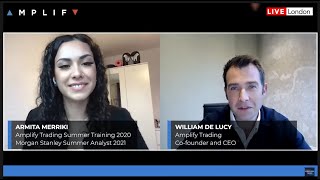
A former Amplify Summer Analyst chose Morgan Stanley after receiving offers from PIMCO and Berenberg. The three-week program's mix of buy-side and sell-side exposure clarified what they wanted, while mentorship and the alumni network made the difference in their decision.
Chapters
You've received offers from Morgan Stanley, PIMCO, and Berenberg since finishing the programme, and I wanted to know from your point of view, how did you choose which one to go for? How did you choose which firm you would like to work with?
Of course, thanks for having me. I think having done the Amplify internship and having 3 weeks, 1 week in buy side and sell side, it really gave me the opportunity to kind of think about what I wanted to do. And when I got the offers, I was, you know, very in a very good position and they're all really good companies. So my strategy was to speak to people at different firms and see what I wanted to do and find a bit more about the company, but also what the internship entails. And I think the main reason I picked Morgan Stanley at the end was firstly my experience with everyone at the company was amazing. Everyone was really nice and supportive. But the second reason was because the program is actually rotational in sales and trading, but also is rotational in equities and fixed income. And as a student, that's very attractive to me because although I've had an insight into what they are, I'm still very keen to learn a bit more about each of them. And at the end of it, make a decision of which one I'm more suited to, if that makes any sense.
That really does make sense. So I guess what you could say is joining us over the summer, it gave you an indication of what area of the industry, but not yet sort of which product class.
Exactly.
And which would suit you, so then the rotational aspect of that helps. Okay, really good, good to know. So going back to your time with us this summer, how would you— well, first of all, had you made applications before you joined us in the summer? Had you already tried to apply and how did that go?
So I had only applied to spring weeks the year before, and it was a very challenging time for me. I really didn't know what I was doing, or, you know, I didn't really know how to write a cover letter or anything like that. Before the Amplify Trading internship, I hadn't actually applied to any summer internships, and that was the goal for the summer. And I really wanted to do this program and then apply to internships because I wanted to have it on my CV. And with I was asked why, you know, this internship or why this division, I really wanted to have a genuine answer. I also wanted to have something to talk about in my cover letter and really show that interest because the program gives you hands-on experience and it's not very common to do something like that. And I think that was something that kind of kept me in rather than, you know, trying to apply to internships. So once I did the internship I got really amazing support as well with my cover letters, with my CV. You really helped me a lot, you know, going through my cover letter, making it on point, very concise. And, you know, obviously you've got experience, you've seen so many cover letters, and I think that really helped me as well. The quality of my applications, I think, was high than— higher than what I would have sent out if I did everything by myself. And what's really key for me is to this day I still receive support from the Amplify team. If I've got any questions or if I've got any concerns, I can easily come to you or any of the team, and you're really open to help me. And I think that's something that stands out to me, and it's not just a program that you do and it's over and done with. The support is continuous, and it has been really helpful for me.
Thank you, that's good to hear. And I do think, I mean, as we've been running this now for over 11 years, that, that sort of alumni network and everybody helping everyone has been a real aspect to it. And I think most people that do join us normally knows someone that's done it already and has had the experience and can see the value in that. And one thing I wanted to ask you is when you had— so great that it helped with the CVs and with the COVID letter, obviously, and making the application stand out. What about the interviews? Would the recruiters talk about the experience you had with us in the summer? What kind of questions would they ask?
Of course, sometimes they would specifically ask questions for example, what did you trade or why did you do this internship? But sometimes they would ask open questions, for example, why are you interested in sales or why are you interested in trading? And I could very easily go back to this experience and talk about what I learned, what I did, and the feelings I had when I was trading or when I was going through analyzing a company's share price. I really had a genuine answer and I think they could see that. And obviously, you know, the program was so wide in terms of the skills you could learn and also aspects of the financial industry. So for example, if I was doing an interview for PIMCO, which is a buy-side asset manager, I could easily talk about the simulations I did in asset management. And when I was interviewing with Morgan Stanley, because it was sell-side, I could easily talk about why I was interested in sell-side. And sometimes I think from speaking to my friends, they struggle to see the difference or be able to kind of share the experience, or like, you know, in interviews they sometimes struggle with that question.
It's a hard thing to make up, isn't it? It's that hard question in terms of, you know, why is it that you want to do this role? It's if you haven't done it yet.
Exactly.
Tough question to answer.
Exactly.
And how did you find it on that summer program? Obviously we were online this year and certainly from our point of view, all the simulations seem to work very well. But were you able to make connections with the other students on the cohort the same time as you? How did you find that experience?
At first, obviously it was a shame that it was online, but I still had a 10 out of 10 experience for me personally. I have made connections with a few people on the program. We're still talking. One of my friends, actually, he was going through the same experience with Morgan Stanley application, and we were really helping each other out as well. And I think hopefully we will get to meet each other in person as well. But I've been— there hasn't been any problems for me to make connections or relationships. I actually— we actually managed to— I don't know how to explain it, but we actually had Amplify Trading on campus at York this year, and it was really nice to see George and Charlie again. Yeah, and doing the simulations again, you know, memories coming back. It was a very interesting time. So for me, there wasn't any problems, and I actually really enjoyed— I think looking back, probably the Amplify Trading was the highlight of my summer. It was a really good time for me.
Great to hear, great to hear, thank you. Makes me feel good as well. I mean, there's— it's without question the most rewarding thing we do, but also when I see your type of success story where you have offers now being thrown at you, and it's the same for a lot of your cohort, you know, it makes me incredibly proud that we're able to sort of fill that gap between theory and practice. And how do you think— I mean, for a lot of students who might be thinking about joining us next summer, I think they would have, you know, experienced online learning at the university level, they might not really know what the program's about. How different would you say, and how much of an impact does our practical way of training differ to what they might have experienced at university?
I think it's very different. For me, I am a student myself, I am going through online learning. In a way, it's kind of unmotivating, but when I did the Amplify Trading, I was the most motivated person, or like, I was the most motivated I have been, you know, I know myself, and that level of motivation is very important because the reason being, I was kind of replicating the job, what I would be doing in sales and trading. At some points it was challenging in terms of, you know, wanting to learn more, the time was 9 to 5 majority of the days, but I knew I had so much learning to do when I did the first day. On the first day, it was clear for me, and I think it's, you know, very close to what the reality is going to be when I do my internship next summer. And I think with that being said, and also seeing everybody else on the program, there is a wide range of skill sets. I might be like medium, somebody's going to be 10 times better than me in terms of their knowledge, then somebody might be very like new to the industry and may not know as much as somebody else. That was also a key aspect for me, to see where I was last year and then see other people, yeah, much more knowledgeable than me, kind of motivating me even more. So I think the experience for me has been amazing. And in terms of learning, it's so different. You don't really get to kind of trade something and then have other people that have been in the industry like yourself, or let's say Anthony Cheung, analyzing your performance and telling you what you did well and where you went wrong. It was really like personal feedback as well. Sometimes, you know, in the breakout rooms or at the end when we had the mentor meetings, it was really good to kind of catch up and, you know, the feedback was amazing for me personally.
Well, it's so fantastic to hear, and I was just thinking about Anthony Cheung, and none of us are afraid to give quite honest feedback, and I think that's the same case when we look at our candidates' CVs and we help prepare their cover letters. Very often I'll see CVs and I'll just very honestly say to somebody, right, we have to start again, square one, because this is definitely going on the wrong track. But that's good. Again, if we can create that value add, it makes me very happy. Well, listen, I'm thrilled, but now it turns out not only from those three I mentioned, Morgan Stanley, PIMCO, and Berenberg, you're getting offers left, right, and center that you're now having to turn down, is that right?
Very grateful, yes. I mean, never saw myself in this situation, if I'm being completely honest. Feels like a dream. But I think I should start giving myself a bit more credit because I have been working really hard and it just shows. To this day, I'm still getting interviews and a few last rounds, which unfortunately I have to withdraw from because I have signed an offer. And it's just a shame, but at the same time, very grateful, very grateful situation.
It's a fantastic success story, but look, it doesn't come without hard work. I remember over the summer, application after application you're sending out, we're tweaking the COVID letter, and I think it wasn't a few, we had a cover letter and a CV for a buy-side role. We did a cover letter and a CV for the sell-side role. Everything was tailored, and then you had to monitor every application. So definitely do give credit to yourself. And of course, you spent 3 weeks of your summer with us, 9 to 5 every day. Trying to get your practical experience, so it's fully deserved. And all of us here at the Amplify team are over the moon. Morgan Stanley are very lucky to have you. I think they've got an excellent candidate, and I'm pleased you chose to go with them, obviously. But listen, thank you for this feedback.
No worries.
Really, really happy to see you do so well.
More from Anthony


Inside the Biggest Banking Stories You Need to Know This Week (Anthropic, Diageo, Private Credit)


Inside the Biggest M&A Deals You Need to Know This Week (UniCredit, GameStop, eBay, Eli Lilly)







AI Breakthrough or Hype? Anthropic’s Claude Mythos, Tim Cook Steps Down & LIV Golf Collapse