Ep.106: Deutsche Bank Triggers A Slide In European Bank Shares
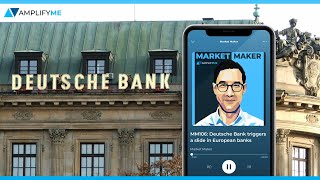
Deutsche Bank has fallen 15% and is dragging European banking stocks lower. The bank's troubles trace back to its 1989 pivot into investment banking, massive CDO losses in 2008, and post-crisis scandals including LIBOR rigging and money-laundering fines. Recent U.S. regulatory signals sparked deposit withdrawals from regional banks, intensifying European market stress.
Chapters
Okay, hello and welcome to episode 106 of the Market Maker podcast, where I'm joined by co-founder Piers Curran. And we were going to talk about the Bank of England, the Fed, you know, some major central bank decisions this week, but we're gonna park all of that because Deutsche Bank, the German bank, is down as much as 15%. European banks pretty much across the piece, they're down quite aggressively this morning. So going to focus on that. But just before I clicked the record button, Piers said to me he wants a little bit of airtime at the start because he's got something to say. So strap in, I don't know what's coming.
Well, to be honest, I'm feeling a bit nervous today, you know, talking to you in the presence of greatness, given you're, you know, you're a new kind of the BBC's new monetary policy expert Anthony Cheung, live on the BBC yesterday morning reporting on the Bank of England. Nice shirt you had on. Yeah, for that.
Fresh, literally fresh from the shop half an hour before. I didn't realize it it was, um, televised. I thought it was a phone call, radio show. So I was dressed—
you do have a great face for radio and for podcasting.
Well, indeed.
So hang on, what, you turned up at the office like quite casual thinking it's on the radio?
Yeah, yeah, because I was going out that evening with my brother for my birthday, so I thought, you know what, you know, I'll dress a bit more casually than normal. And then, yeah, the guy called up just before saying, oh, you're all set, you're good to go. I was like, he's like, yep, on TV, he's on TV. And I was like, uh, okay. So I literally went to the shop next door, and thankfully, I can't remember the guy's name, but he ironed the shirt for me in the shop. What a legend. Literally did the Superman costume change, and then out I came. And yeah. That was it.
Well, I thought you nailed it. We'll drop the link in the show notes. Everyone should have a look. I thought you were very good. So yeah, you're going to be back on there. BBC expert, like it. And actually, you just mentioned something else there. So 26th of March, 2023, 2 days' time, uh, marks a pretty big milestone in the Anthony Cheung um, life story. Big birthday, right?
Yeah, you know, 21 again.
Yeah, well, I've got, I've got a quiz for you. Okay, but you were born almost 40 years ago, right?
Almost.
23rd of March— oh, sorry, 26th of March, 1983. Here's my quiz question. What was the S&P 500 trading on the day you were born? So currently trading, for context, 3,916.
I've got literally no idea, but it's going to be not in the thousands, so I'm going to go for 6, 20.
No, 100, 153.
Wow.
So it's up 2,500% in your lifetime.
Doing— Dad, why were you not investing in just an ETF tracker? S&P, baby, all the way.
Just—
he could have put in £10 from the day I was born, every month.
Oh, if he'd have picked the NASDAQ, it would have been— the NASDAQ was trading 110 Uh, now it's, uh, now it's at what, 20— 12, 12,600? That's bit— that's up 11,500%. If you just stuck— your dad had stuck $1,000 on that on the day you were born, you'd now be worth $11.5 million. That's how old you are.
Great question then.
How— question— it's moved.
An investing question for you then.
Yeah.
You have children and they are going to live probably for the next 90 years.
Yeah.
So do you think we're gonna look back in 40 years' time and go, what was the S&P 500 trading in 2023? And everyone will go, oh, it's probably something as crazy as 4,000.
You know what, it's probably— that's a very good point. I would say yeah. I mean, long term, right? Equities have proven to be comfortably the outperforming asset class. So why wouldn't it be the same for the next 40 years? Although there are certain indexes, I always go back to the FTSE 100 to kind of prove people wrong on this point because the FTSE 100 index Uh, well, actually, hang on, hasn't really moved for, uh, 20 years. It was kind of trading not too far off where we are now back in the year 2000. So the FTSE 100 index has gone pretty much nowhere.
But yeah, US tech stocks, if you were talking like long-term like that, 50 years, how would you feel then about this transition that's happening, the growth of China and Chinese companies? Well, it's going to be— it's going to accelerate tremendously over that period. But how do you feel as a Westerner investing in Chinese-oriented equities, given it's a communist country?
Uh, yeah, I guess you're asking what, what kind of Where are my morals on the kind of spectrum?
Not even that, just how do you, how comfortable is that investment given that, you know, like Alibaba, for example, and Jack Ma. Yeah.
Oh, I see.
Tremendous story of success to the point where too successful. And then all of a sudden you're like, it's changed dramatically, but you would always be— so surely you'd always have that risk factor that's not a thing in the Western world, and that doesn't look like it's going to change anytime soon.
Yeah, I think investing in Chinese companies has definitely— that, that kind of Xi Jinping risk, if you want to call it, in terms of what the Chinese regime might or might not do at any moment, that's definitely gone up quite considerably in the last few years. I don't think it was a thing It was only really when he said, right, I'm going to change the constitution and I'm going to have a third term. And basically, I'm going to become the permanent leader. And I'm going to start to kind of really change— well, really step up and take control of this country in the way I see fit. And so that's really happened in the last few years, right? And so that is definitely a risk now. That investors have got to factor in. Yeah, but I'm not sure. I don't know. So you look back, right? China rose to become what it is today in the '90s and the '00s. Okay, those were the kind of two decades where it really kind of rifled higher and became this huge economic superpower. But that's kind of done now, right? It's now a superpower, I mean, there's plenty of arguments as to why China's rise might stall, one of them being Xi Jinping and how he takes control, but the other one, and more importantly, the demographics of China. So it's really about, right, for the next couple of decades, you know, who's going to be the next country that really kind of steps up and becomes a global force? So that's kind of what you've got to think about. Where'd you put your money now? Where'd you stick your $100 for the next 40 years? I don't know, might be, might be countries like Nigeria, for example. You know, I think it's probably an African country that will now be the next in this, this kind of supercycle chapter where you've had, um, you know, big, big economies, uh, expand and become a global player. So yeah, Something like Nigeria, I reckon.
Okay, well, I know somewhere where you might not want to park your cash for 50 years.
Go on.
Deutsche Bank. So let's talk Deutsche Bank. What on earth is going on? So they're down 15%, and we, we are just talking about one of the biggest banks in Europe, the biggest bank in Germany right now.
So yeah, Yeah, we've been chatting away on Slack all morning and I think your first message to me was, God, have you seen Deutsche Bank's down 9%? And I saw that message like 5 minutes after you sent it and it was already like 10.5% down by the time I saw it. And so I replied 10.5% and then 12% and now it's— yeah, we're clocking in 14.3% down on the day right now and below €8. Um, yeah, Deutsche Bank's in the crosshairs here and is on the slide. There are— I've got a, I've got a list of banks that I'm watching, um, and that becomes my red-hot barometer for general market sentiment right now because obviously this is a banking, well, crisis. I think we can definitely call it that when you get the likes of Credit Suisse, you know, going off the edge, you know, that, that it is a crisis. Um, whether it becomes a systemic broad-based banking crisis obviously still remains to be seen, but you know, so the banking sector is leading sentiment here. So I've got a list of banks. So Deutsche Bank are definitely the ones in the spotlight right now. Today it's now 14% down. Um, then it's in, in order in terms of the biggest downside for European banks, it's actually Nordea Bank is next. That's 10% down today. That's the Finnish, uh, big Finnish bank, Finland, that is. Um, we've then got next up Commerce Bank. So that's the other kind of German, you know, large bank, not as big as Deutsche, but Commerce Bank's down 8.4%. We've got, uh, UBS are down 6%, SocGen are down 7%. SocGen, Société Générale, the French bank. Um, so look, all these banks are, are down, you know, sharply. What I'm really looking for, uh, for this afternoon is First Republic Bank, which is the U.S. bank that may well be next, right after the SVB and the kind of, um, Signature Bank failures. So, uh, First Republic Bank could well be next, and they closed yesterday's session 6% down. Just about held up above the $12 level. $12 was last week's low off the SVB thing, and I would say it's looking like First Republic Bank's share price will open below that $12 level, making new lows. And you really want to monitor how quickly that gets going on the downside this afternoon to really kind of shape just how big a kind of risk-off day we might have, uh, today. Um, but yeah, Deutsche Bank, I mean, we were talking about Deutsche Bank last week. So in the, in the Credit Suisse turmoil, you know, it was like, right, who are the, who are the other weak banks, who are the other vulnerable banks? And Deutsche Bank right up towards the top of that list.
Yeah, so that Let's talk about Deutsche Bank, because there hasn't been one specific headline that's triggered this move, and there are some quite clear parallels almost with the journey between Deutsche and Credit Suisse in terms of recent scandals, fines of very large magnitude over the years. So perhaps give us a bit of a history lesson of Deutsche Bank and, and why it is kind of seen as a vulnerable banking name.
Yeah, all right, quick, I'll make this quick. Um, in 1989, it's quite a pivotal moment for Deutsche Bank. That's the bank's over 150 years old, right? But in 1989, they made a really key pivot on strategy, and they thought, right, let's really go after this big investment banking thing, because at that point they were Germany's biggest, like, retail bank. Okay, so they said, right, let's go out. You know, we got— we can see these American banks are starting to kind of form investment arms, and look, this could generate huge amounts of return. So they went ahead and they bought a bank, a British merchant bank called Morgan Grenfell. They bought that for £950 million back in 1989. Okay, and that was their, right, let's go let's add an investment banking arm to our business. Okay, so that then kind of paved the way for what was then a decade of quite aggressive expansion on the investment banking side, culminating in their big, big, big play, which was a move into the US. And they bought a bank called Bankers Trust in 1999. They paid £6.1 billion for that. Okay, and that was like, we've arrived in the US, were going to take on the US big boys. And actually, at one moment in time there in the early noughties, they were the biggest bank in the world. Um, but the point being is that they were really aggressive in their expansion into the investment banking side, taking lots of risk, as all the banks were pre-financial crisis. And it just meant that when the financial crisis hit they were aggressively, you know, really exposed because of the aggressive nature of their expansion into that more risky investment banking side. Okay, those who have watched the movie The Big Short, which if you haven't, I mean, what the hell have you been doing? It's the greatest finance-related movie of all time. Bar none. Um, but anyway, in that movie, um, there was a guy called Greg Lipman who was a trader. People will better know him as Ryan Gosling. Uh, so the guy Ryan Gosling was playing was, it was this big trader, Deutsche Bank trader, and he very famously went against Deutsche Bank's— so basically Deutsche Bank were in the business like they were fully wedged into this CDO craze— collateralized debt obligations— which was essentially the derivative product that enabled investors and banks to get very leveraged exposure to the US mortgage market. And these collateralized debt obligations were basically these derivative products that packaged up lots of mortgage loans And there were different tranches, and basically they were cleverly like hiding away the super, you know, subprime, super high-risk mortgage loans in and amongst loads of other loans, and no one really knew what they were buying. And actually Deutsche, I will talk about some of the scandals they've had down the years, but one of them was misselling these CDO products, not telling people what's in them. And what was in them was a, a bag of poo, basically. And as the US housing market began to collapse, well, then it kind of all unraveled, right? And Deutsche Bank were big in this field. Ryan Gosling, his character was actually telling his clients that this is crazy what my bank is doing, this is all going to implode, you should take the opposite side of this trade.
Oh yeah, this is when he goes It's my Kwan. That's right, it's the Chinese guy. I was like, oh look, there's me.
Um, so anyway, right, so this all culminated in the financial crisis and they got absolutely clobbered because they were so kind of leveraged up. Now they just about avoided a government bailout, okay? So they did not— they just about avoided it. Um, and then in 2011 we had the Eurozone debt crisis, which for European banks was like a double whammy. Okay, you had the financial crisis, '08, '09, then the European debt crisis in 2010, 2011. And again, Deutsche just about avoided a full-on bailout, okay? But were like properly on their knees. Then what followed was a series of scandals and backdated fines for shenanigans. And so there's stuff around Russian money laundering they got done for. There was— I don't know if people remember, but there was this thing around the LIBOR rigging scandal. They got fined, I think it was $2.5 billion for their part in that. There was stuff around violating US sanctions because they were— I don't know, they had a number of clients in Iran and Syria that they shouldn't have been servicing. There was the mis-selling of toxic debt in the crisis. And so lots of scandals, right? They went through this period, I'd say between 2007 to 2015 was an 8-year period of decline and trying to recover from the crisis, getting slapped by these ever bigger fines. And then in 2015, they had a change of leadership. This guy John Kryon came in to start what was a new direction, a new kind of restructuring plan. He didn't get on very well. And then in 2018, Christian Sewing came in as the boss and he was previously a lifetime employee at Deutsche, but on the private and the commercial banking side. And it was his job to go, right, let's properly unwind and exit all that investment banking strategy that we tried to do that almost killed us. And let's pivot back to what we're good at. Let's pivot back to our roots in Germany, our retail and our commercial banking and And then also they've got a big wealth management and asset management division. And it's like, let's try and restructure back to that. Let's cut a huge amount of costs. They were looking to try and cut €6 billion of costs per year, reducing the workforce, all the rest of it. And really, before all this has kicked off, like SVB, you would say they were back on the up. They had been through this multi, multi-year restructuring plan, and it was working.
Yeah, some of their earnings reports recently have been solid.
Yeah, sure, really back, like, really turned the corner and had come out the other side. Um, but you know, people don't forget, right? People have memories of the crisis. And so when you have a new crisis, it's like, right, well, who do I not trust? Well, I don't trust those guys that were naughty in the past.
Yeah, so I mean, is that all this literally comes down to then? It's like we talked about before, it's just this invisible thing of trust, and when trust is lost and everyone heads for the door and they— people see that.
So what's happened this week, right? I think, you know, because you could argue, well, why didn't Deutsche get hammered on their share price off the back of the SVB saga and the Credit Suisse saga? Well, they did. I mean, the share price has been hammered, but not it's today, it's like, right, Deutsche Bank, and now the one that everyone's looking at. So why has that happened? I'd say in a way Janet Yellen is maybe a little bit responsible for this. I mean, you were watching— well, I guess this was on Wednesday night, it might have got lost a bit in the kind of Fed meeting.
Yeah, so yeah, the— I shared a post if you want to have a look, just go on my LinkedIn account. It's one of the recent posts I did. There was this great chart of the US equity market, the S&P, and it rallied. So you had this kind of dovish hike scenario from Powell. Markets were like, it's a relief, up we go. And then, uh, Janet comes out speaking pretty much at the same time.
Yeah.
And just absolutely crushed the regional banks. They were down like 15 to 20% at the close.
Yeah. So what she said was She basically— so in the US you've got this deposit insurance up to $250,000, right? And there's been this clamor of noise about, right, we really, you know, you should increase the ceiling on that. And on Wednesday she said, at the moment we have no plans to increase the ceiling on that deposit insurance. Okay, so then, yeah, kickstart another big wave of selling for these regional US banks. Um, that's because people are going to pull their money out, right? If you've got more than $250,000 in your bank account, then you— right, you're going to pull it out. Why would you not? So, so this has kind of triggered another little bit of a wave of deposit withdrawal. And, you know, in the end, it's the deposits getting withdrawn faster from the banks that are vulnerable. So what's happened this week, last couple of days? Deutsche Bank deposit withdrawals, right? And their credit— the credit default swap on Deutsche Bank. So that's the derivative product that essentially buys you insurance against that company defaulting and going bankrupt. And that's kind of spiked aggressively, um, and that's kind of kick-started then this big move to the downside on their share price. The thing is, it's like a big boulder, right? And if you just tip it off the top of the mountain and it just starts to roll, it is very, very, very, very hard to stop that boulder. Go and ask Credit Suisse.
I was just having a quick look at the S&P right now as we're talking. I mean, the futures is at its low. So it's going to be such an interesting day and how we finish here. And we've already gone through yesterday's low, so technically it's, it's kind of ripe for some downside. And I just think North America is going to come in and they're already dealing with that regional spillover you've just talked about, and now you throw in this European drama. That's all they need.
The— I guess the next thing to say is, I mean, who's gonna Because obviously Credit Suisse, right, you had UBS, another monster giant Swiss bank, and fine, that deal, well, I've been agreed in principle. I guess the deal won't get done until later in the year. These things take a lot of time. But, um, unfortunately Deutsche do not have the same potential rescuer, right? There isn't, there isn't a second monster giant German bank similar size to Deutsche. Um, so we're in a slightly different situation here, I think. And I, I would say that if this did get out of control— and I'm not quite sure yet, I can't make my mind up— with Credit Suisse, I think it was pretty easy to predict what was going to happen, i.e., that they're dead, right? They're going to have to get taken over here. I think with Deutsche, it's just a little bit hard. I'm not as certain about that, but as I said, the boulder is rolling. So I think the only kind of obvious option here would be the German government basically steps in, bails them out, buys equity, a little bit like the UK government did with Royal Bank of Scotland and Lloyds Bank back in the crisis in '08. Um, so it— that's the only thing I can really think of. I can't see the Germans allowing a foreign bank to come in and be a rescuer. Um, so that would be my sense here. But yeah, we'll see.
Yeah, on that point, I was just having a quick look. So it was back in 2016, Germany was drawing up plans to rescue Deutsche Bank, and that was at the time you mentioned about this $2.5 billion fine that started at, to the tune of $14 billion.
Right.
So I remember this quite clearly now, it's coming back to me. What happened was, um, they wanted to— the US government wanted to use them as the kind of hazard of what would, you know, the poster child of everything that's wrong in finance. We're going to put this whopping fine on you. And it was enough to basically do serious damage to them. So that actually— this is a really interesting thing about actually a lot of these financial penalties that happen, because the politicians do that because it's in their agenda to make those sorts of noises. So that satisfies public opinion, particularly in the aftermath, quite raw, of a financial crisis. But in the end, when these things get paid, which is often several years later, The, the fine is tiny comparative to where it started, but by then the political narrative has moved on. It served its purpose for the politician, and the bank just goes on its merry old way until really kind of what's happening now. But the second part of this is, at the time then, there's already been plans being made in 2016 about a German government intervention. So just having a look here on this old Reuters article talking from the Die Zeit, German weekly at the time, and they were drawing up these plans if the bank was unable to raise capital itself to pay for costly litigation. And the draft plan would be that Deutsche Bank would be enabled to sell assets to other lenders at prices that would ease the strain on the lender and not put an additional burden on the bank. And in an extreme emergency, the German government would even offer to take a direct stake of 25%, right, is what they were saying at the time. So yeah, exactly as you, you were alluding to with the UK example.
Yeah, time to dust off that 2016, uh, action plan.
I guess the one thing is, is that, um, you know, UBS's transaction with Credit Suisse wasn't out of the blue, right? Because the demise had been for some time. Yeah. So the ability to be able to just turn around and have this deal in principle by our weekend was because all of that work, kind of a lot of it, had been done. So be interesting because, like you said, the, the playbook's probably already largely there with Deutsche if the government do need to do something. So with that being said then, if this isn't rocket science we're talking about. If then you know that, well, then Deutsche's too big to fail.
Yeah.
What's the problem?
What do you mean? What's the problem? Why are people selling Deutsche Bank shares?
So surely, let's just ride the wave down in this current hysteria, but Deutsche's not going anywhere. Wasn't this the 2016 conversation we were having in the office at the time when they were dropping €10?
Yeah. I guess, I don't know. In theory, what we've said is correct, right? The government will step in and bail them out. But I mean, yeah, I was going to say there's always a risk that they don't, but actually, I'm not really sure there is a risk that they would. Um, as you say, they're systemically important. So yeah, it's just that I guess thinking about like Lloyd's and RBS, you know, yes, the government stepped in. I mean, the government bought 80% of RBS and I think 40% of Lloyd's, I think it was, from an equity point of view. But then it took I mean, it took, um, I mean, even like a decade for the government to actually break even on that trade. Okay, so the point is that yes, the government might come in and halt the slide. That doesn't mean then there's going to be a rebound, right? And where, and where's the slide going to stop? You know, where does the share price go to? I mean, it's trading right now at €8, right? So you could say, right, I'm going to buy Deutsche Bank shares because the government's going to come in and rescue it, but the share price could be €2 by the end of the day and you've lost 75% of your money. And then the government comes in and fine, it stays at €2 and is at €2 for the next few years, right?
I mean, yeah, okay, you'd be sniffing around at €2. I know your game.
Oh, you'll see. But look, look, we've got— what are we now? 12, 10 past 12, right? So the US The New York Stock Exchange is going to open at 1:30. Okay, so we've got 1 hour and 20 minutes, and that First Republic Bank share price telling you that is the key here. And what happens to that share price in this session will tell you, or point towards, whether Deutsche Bank's going to hit a low here at €8 and stabilize, or whether there's another, another wave down. And I think there might be another wave down. Yeah, this afternoon.
Okay, well, on that somber note, we'll, we'll look to wrap. And one thing I'm going to ask for everyone who's listening is if you aren't already a subscriber to this podcast, then please do hit that subscribe button or follow button depending on your platform. There's normally a bell icon that you can hit which means you'll get a notification every time a new episode comes out every week. I'm working on a current series, a 3-part series with a former MD from JP Morgan at the moment, which I'm gonna have running in parallel with our weekly chats as well. So make sure you don't miss out on those. But with that, Piers, thanks very much.
Cheers, have a good weekend, and happy birthday, the big 4-0. All right, seriously old.
Wow.
Anyway, enjoy.
Take care, everyone.
More from Anthony


Inside the Biggest Banking Stories You Need to Know This Week (Anthropic, Diageo, Private Credit)


Inside the Biggest M&A Deals You Need to Know This Week (UniCredit, GameStop, eBay, Eli Lilly)







AI Breakthrough or Hype? Anthropic’s Claude Mythos, Tim Cook Steps Down & LIV Golf Collapse