EU Bankers Reassure On Evergrande Exposure As Markets Await Further Updates
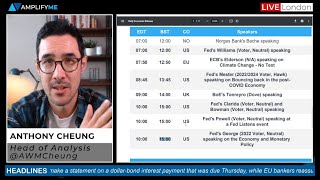
In this September 24, 2021 market briefing, the presenter provides a concise overview of recent financial market dynamics, focusing on the S&P 500 sector performance, US Treasury yields, and crude oil price recovery. The central narrative revolves around the contagion concerns stemming from China Evergrande Group’s debt crisis and the subsequent reassurance from major European banks (Credit Suisse, UBS, Deutsche Bank, HSBC) regarding limited exposure. The briefing highlights the People's Bank of China’s substantial liquidity injections to stabilize interbank funding, and discusses central bank perspectives from the Fed, ECB, and Bank of England, noting expectations of tapering and transitory inflation pressures. An economic calendar is reviewed, featuring German IFO data, upcoming US new‑home sales, and a packed roster of Fed speakers. The presenter also promotes the “Amplify Me Market Maker” podcast and notes a brief personal hiatus. The overall tone is analytical yet conversational, aiming to inform investors about current risks and potential market direction.
Chapters
Okay, happy Friday. It is September 24th. Hope you're doing well. Hope you had a good week. Don't forget, before I begin, to check out the latest Market Maker podcast. I'll be recording that later this morning with the head of trading, Piers Curran. If you haven't listened to this before, it's basically where he and I get together, we have a very informal, relaxed conversation about all of the major things that have happened in markets this week. And we give our kind of breakdown, deconstruct these topics, and also give a point of view about what might happen next. So don't forget to check it out. Just search for Amplify Me Market Maker on the usual podcast platforms— Apple, Spotify, Google, and so on. Otherwise, let's get straight to it. And yeah, I really wanted to explain using the likes of the S&P 500 T-notes, and crude oil. A little bit of an explanation of where we're at at the moment in financial markets, particularly to bookend the week. Uh, obviously the main talking point has been Evergrande throughout, and much of my update in this briefing will constitute talking about that in a little bit more detail, just getting you up to speed because there's some important announcements that could be forthcoming in the session ahead. But let's get straight to it and talk about the S&P And it will also make sense about how we closed on a sector basis within that index yesterday as well, where we did finish in positive territory again, um, following one of the biggest rallies we've had in a number of weeks in the prior session. So first off is the S&P 500, and I've annotated this chart here to show really two things. This was Friday, um, going into Monday session. So the Evergrande situation wasn't completely out of the blue. I think my colleague Eddie and I were talking about this a while ago, but then it really caught kind of peak interest in markets, and that contagion effect— fear started to really impact and reverberate out over the weekend and then into the open subsequently on, on Monday morning. And that was when we hit that low, pretty much going into the close on Wall Street. We actually saw a very aggressive ramp into the final hour of trade there, um, that marked the low. But if you actually look at where we peaked yesterday's session and where we're trading at the moment, we've had an full reversal of that move. So at least for the time being, and I'll explain why in a bit more detail, that contagion effect has dissipated quite sharply. Equity markets are back up ascending on the front foot. On the other side of things then, as kind of the, the situation there stabilized a little bit, and there's been lots of different reasons for why that has happened, and we'll go over some some of the reassuring comments that have come out of a lot of financial institutions to almost distance themselves from any direct exposure to Evergrande. But we've also seen obviously the PBOC being very active in liquidity injections as well. But the other thing was the Fed. And actually, just before I go into the Fed, if we go back to the S&P just for one second, if you actually was to look at this chart of the week's price activity, you'd be forgiven to think, well, actually, where was the Fed in all of this? And actually, the Fed, the Fed was this little momentary bout of volatility you can see here. So really, the, the move from the Fed was very tame as far as an equity response. I wouldn't say it's necessarily been a cultivating factor to really accelerate this move, but perhaps a, a variable in the mix. And probably that's explainable by the fact that if you actually look at the sector breakdown from yesterday, it really does explain that move because what we saw yesterday was stocks and yields both moving higher. Now that generally then was reflected with economic sensitive sectors. So you can see here the likes of energy, which is the most bright green here on the right-hand side, and financials, the bright green on the bottom left-hand corner, being the biggest beneficiaries of that move. Investors then— what that tells you on a sector basis Looking at the looming reduction then in Fed stimulus, i.e., with the hint towards tapering likely to come in the next meeting in November, shows confidence in the recovery from the pandemic and those particular sectors being then the most, the most to benefit in that situation. Real estate, as you'd imagine, still a lot of nervousness there, has been some of the weaker spots that we've seen. So S&P, Dow finished up 1.2%, 1.5%, the Nasdaq about 1% yesterday. Equity investors also taking heart from predictions as well that we've heard from central banks this week, from the Fed to the Bank of England yesterday, that the Delta virus strain and pandemic-related supply chain snarls will, will deal only a temporary transitory kind of setback to the economic reopening. At least that's what the central bankers are telling us. And again, that would play into the types of moves that we're seeing at the moment. So from a fixed income perspective, you're definitely not getting a flight to quality bid here. Quite the reverse. You're getting as well, following the Fed, a bit more of a definitive move in US 10-year yields higher. And so T-notes have continued to decline post that Fed event. Now, unlike the equity move here in fixed income markets looking at the US 10-year, This is the, the post-FOMC move. So that meeting definitely the trigger there for the rates market, unlike the equity market, which was already on the bounce from two sessions prior when we hit that low late on Monday. And then, you know, talking about the kind of the economically sensitive sectors benefiting energy and financials yesterday, definitely in the crude market, any kind of momentary blip that we had on Monday, Tuesday about potential demand implications if we start to see a domestic crisis in China, obviously a large consumer of energy products. That as well has continued to be reversed as we've gone through the week, in step with the equity and general risk appetite return that we've seen. And on a daily chart, you can see here now $74 handle, really the next area of resistance in sight, which would be around those late July, early August highs that we printed, given the continued bounce that we've seen very aggressively from late August when we were trading down to retest the mid-May low down just below the $62 handle. And we're now knocking on the door of $74. So it's been a really strong ongoing recovery here in crude oil. And I guess on a daily chart here, you could say still got a little room on the upside to $74 before we see the next more stern area of resistance on the upside. So let me get up to speed then, a couple of these Evergrande headlines. So European bankers have spent the last couple of days trying to reassure investors, clients, and regulators essentially about the fallout from China Evergrande Group. And this has had in turn a great deal of alleviating some of the tensions that might have been brewing about the uncertainties of exposure to some of the fallout It's kind of like when we had the Archegos situation, although Evergrande is completely different. The idea being there, it was, well, who actually had exposure to Archegos? You know, was it Credit Suisse? Was it Nomura? Who else? Whereas in this case, they're all kind of putting their cards on the table saying, not us, kind of situation. So Credit Suisse, which underwrote the most Evergrande bonds amongst international banks in the last 10 years, issued statements this week showing its asset management units' funds didn't hold much of the developer's debt. UBS risk is immaterial and limited to the execution of just collateral calls and margin loans, according to their CEO, whereas Deutsche Bank have said that we are not really directly affected by all— at all— by the events of the last week or so. Um, this follows US firms we had at the beginning of the week. We had Citigroup stating it has no direct lending exposure to Evergrande according to their spokeswoman, and JP Morgan and Bank of America also said they had no such links according to people familiar with the matter. So again, that— a lot of that has played into this, this calming over the situation, which kind of was escalating at the beginning of the week. However, there is one firm, HSBC's asset management arm, has been, according to what I've been reading, among large holders of Evergrande debt. The bank has no material exposure on its balance sheet, though there is some through client portfolios. And I was reading a statement that one of their guys was saying about second, third order exposure in that respect. So perhaps HSBC, one to watch if the things were to take a material, uh, worst turn at this juncture. The other thing then is about China in general. China have obviously stepped in and, you know, just to kind of summarize what we've been talking about throughout the week, they've injected a net ¥460 billion, equates to around $71 billion of short-term cash into the banking system in the past 5 working days. That included ¥70 billion on Friday overnight. Amid concerns about the ongoing contagion effect that that can have on interbank market liquidity in, in China. A good quote I heard in response to this, summarizing the situation, was a quote that said interbank funding— so interbank being, again, quite simply, if you think of a central bank at the top, you think of consumers, companies down at the bottom, You have your, your interbank market, which is your large financial institutions. And what is the mechanics then of a functioning economic system is liquidity in the interbank market, which keeps lending rates then low, let's say, in this current situation. What we had in the financial crisis, of course, was a situation similar-esque to Evergrande where there was concerns on a very systemically important financial institution. Lehman goes down. All the other banks panic about other banks' exposure to subprime in that, in that example. And that meant that lending rates went exponentially higher to the point where you had a credit crunch and there was no liquidity in the system, requiring authorities to then intervene to address that situation. So that's what the interbank funding is so critical to the wheels— greasing the wheels, if you like, of how financial markets operate. And the interbank funding stability is key to ensure the financial plumbing of the market remains intact. I've heard bond traders use that terminology before, that the kind of repo market is the plumbing, if you like, of how markets operate. You know, without the plumbing, there is no functioning household to that extent, i.e., the, the, the marketplace. This is especially important when there's increased demand for cash given the interplay between quarter end and the Evergrande event, and hence the reason why that liquidity injections the PBOC have done this week are so important for markets. So the end conclusion of this and something to look out for is the fact that Evergrande has yet to make a statement on a dollar bond interest payment that was due Thursday. So definitely need to be vigilant as we go through the hours ahead to see off the rest of this week. Obviously, Asian markets coming to a close now, but we're in full swing of UK, Europe, and then the US will come in later. I'm sure at some point we'll get an Evergrande update, and that could be a decisive trigger to dictate market direction sentiment for the rest of the session. So do be aware of that. As far as Europe is concerned, Europe have kind of been saying the same. As much as the banks have been trying to just be quite clear about their levels of exposure. Like I mentioned, Deutsche, Credit Suisse, UBS. Christine Lagarde, the ECB president, has also come out and said there's limited direct exposure to Evergrande's debt crisis. Also, Lagarde did say the main drivers of the recent spike in eurozone inflation, uh, she believes are temporary and will fade next year. So that transitory view very much being echoed at the Bank of England yesterday. Even though they see inflation near-term being in excess of 4%, they still see it falling back, much in a similar vein to the FOMC's projections we had on Wednesday night, where they see 2021 inflation a little bit higher, a bit more sticky, but then reverting back down as to previous forecasts in 2022 and 2023. Okay, quick look then at the calendar for today. It's pretty quiet overall. You've got German IFO coming out at 9 AM this morning. German IFO generally has been deteriorating off most elevated levels. In fact, last month the president of IFO said the mood in Germany has started to cloud over a little bit again, and they were— he was commenting specifically on supply bottlenecks for intermediate products in manufacturing in combination with worries about rising infection numbers that were putting a strain on the German market. Don't forget as well, we've got the German federal election happening on Sunday this weekend. So the number here expected to just see a minor decrease down to 98.9 is the median consensus from 99.4, continuing that downward trend that we've seen since the month of June. So I don't think that will necessarily come as a great deal of a surprise. Otherwise, new home sales coming out of the US at 3 o'clock, no major 1:30s. The main thing then is really the speaker slate. It's super busy actually, as a, as a whole load of speakers coming out from the Federal Reserve, um, later on today. So let me just adjust my screen here so you can see, um, just move it up. So you've got Fed's Williams, so they're all kicking off into the afternoon if you're based in the UK and Europe. Fed's Williams, who is a voter, very closely aligned with Jerome Powell, the Fed chair, at 12. Mester, non-voter, hawk, at 1:45. You've got Clarida, voter, neutral, at 3:00. Powell, obviously important, 3:00. And then non-voter hawk George also speaking at 3:00. So yeah, definitely be keen to keep an eye on these comments. Um, this isn't too unusual. So how the blackout period works is that Fed officials cannot talk in the week in the run-up to an event or 24 hours post an interest rate announcement. So normally it's quite strategic on the half of the central banks to litter the calendar and then when they can then speak out of the blackout period on the back end of the event, just in order to then clear the air, if you like, if there is any uncertainties or misinterpretations of what the Fed conveyed in their more formal event that we had midweek. But to be quite honest, I don't think there really is too much more to clear up for the Fed. So not expecting too much from these comments, but nonetheless, definitely worth being aware that the docket is stacked with Fed speakers this afternoon. You also have got Bank of England leaning dove Tenreyro speaking at 2 PM as well this afternoon. So that is it. Don't forget, check out the podcast later. The episode will be going live in the next couple of hours. Otherwise, have a fantastic weekend. I am actually away next week. So gonna speak to Piers, the head of trading, and I, I'll get him to cover the briefings as per normal for next week. So I won't be as active on YouTube and Twitter and things like that. But yeah, take care until I see you again, and yeah, I'll catch you the week after. Thanks very much.
More from Anthony


Inside the Biggest Banking Stories You Need to Know This Week (Anthropic, Diageo, Private Credit)


Inside the Biggest M&A Deals You Need to Know This Week (UniCredit, GameStop, eBay, Eli Lilly)







AI Breakthrough or Hype? Anthropic’s Claude Mythos, Tim Cook Steps Down & LIV Golf Collapse