Faster Fed Taper Becomes More Likely
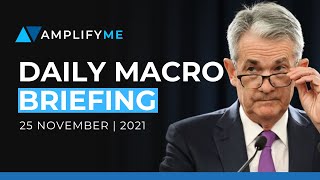
Fed officials are signaling they could speed up their bond-buying taper if inflation and jobs data stay strong. Mary Daly said faster tapering could be justified. Meanwhile, Germany hit a record 76,000 daily COVID cases, complicating the economic outlook and widening the gap between a hawkish Fed and an accommodative ECB.
Chapters
Okay, very good morning to you. Hope you're doing well. It's Thursday, 25th of November, and of course, a Happy Thanksgiving to anyone in the US that listens to this briefing. I hope you have a really great day and a really great weekend as well with your family and friends, and hopefully all is well despite rocketing food prices. I'm sure your Christmas turkey is a little bit more expensive than it normally was, but yeah, I hope you enjoy it. And, uh, see you guys on Monday. But otherwise, in terms of the briefing for today, uh, we're going to touch upon a lot of the information that came out yesterday because of the Thanksgiving closures that we're seeing today. So there's no equity or bond market trade today and shortened sessions on Friday in the US. And so we had a very concentrated day yesterday, and we'll have a bit of a recap at that, a quick look at the charts. And then there's updates on some Fed commentary, OPEC commentary, and then also the COVID situation in mainland Europe, namely that in Germany as well, now that they've named their coalition government Yesterday. So kicking things off then, how do the charts look this morning? And actually, we had a generally positive close on Wall Street yesterday. The S&P was up a quarter of 1%, NASDAQ up 0.44%, the Dow was basically flat. And looking at equity index futures this morning, generally on a firmer footing, at least for now. And actually, I just want to kick that off with a straight into the S&P 500 futures chart here. You can see yesterday we really did see a decent move to the upside. And overall, what did we have? Well, US personal spending rose in October from a month earlier by more than expected, while a closely watched inflation measure, the PCE numbers, of course, posted their largest annual increase in 3 decades. Not the most surprising thing on the latter point, given the inflation figure had done the same in the last 2 weeks. In addition, though, we had data show 199,000 people made initial jobless claims in the period ended November 20th, the least actually since 1969, while orders placed with US factories for business equipment rose in October by more than forecast, highlighting solid momentum for capital investment at the start of the fourth quarter. So overall, some, some decent numbers and, and certainly feeds into the narrative as well of, of what the, the slight pivot to a more hawkish direction for some of these Fed members, but we'll come to that in the minutes in a moment. Looking at the S&P 500 here then, we've had a bit of a breakout from late last night through the end of Wall Street and through the top end of that area that had been restricting some of the price action going back to kind of Tuesday of this week. And we've just continued that upward trend as we've gone through the Asia session. Not a great deal to speak of really of, of large magnitude coming out of the Asia news flow. And so we're now up in the futures market, up at the R1 in the S&P 500 future already. On a daily perspective, I did mark this up yesterday, and this was taking a look— so right here I'm on quite a high time frame. This is a daily continuation chart. And as we're coming towards year-end, and I'll be talking probably about this more in the coming weeks, a number of these big banks start putting out their outlook, and thus they're forecasting for things like where the S&P 500 year-end target will be for 2022. And I just thought I'd, I'd continue to populate this chart as and when these come in. And here's just a few. So as we know, I think it's Mike Wilson, who's the US strategist at Morgan Stanley, has always been the kind of perma bear on the big Wall Street banks in terms of his thoughts on US equities. And he remains that way. His year-end call for the end of next year is at 4,400, the most bearish out of these selection of names. The most optimistic is Wells Fargo. They're actually looking for a range of between 5,100 and 5,300 on the upside. So right up here. And then you've got RBC, Goldman Sachs, Jefferies all clustered around the 5,000 mark. I'd love to hear what you guys think. So drop a comment. Let me know what your end of year 2022 call is. For the S&P 500. And perhaps, uh, come 12 months from now, we can look back on this and crown our champion of who's going to be there. I'll also drop my forecast in the comments as well, so I'll keep you in suspense until you get to the end of the briefing to have a look. But the other thing, of course, we had yesterday was the FOMC minutes. And actually, again, supportive of this general rhetoric we've been hearing from Fed officials because At their last meeting, they stressed the need for flexibility on how quickly they will scale back their bond buying program as well as the timing on interest rate increases. And this came all before data has showed inflation accelerating, i.e., in CPI and the PCE yesterday. And so again, it has shifted the needle a little bit. And, you know, this lady here is Mary Daly. She's the Reserve Bank President of San Francisco, and she is generally quite dovish. And she came out yesterday and said it would be hard to argue against faster reduction in bond purchases if reports in the labor market and consumer prices due out early next month show continued strength. So I think that's a good kind of measure to go off. So basically, as we know, labor market inflation are two key metrics. And to really twist the arm far enough to speed up tapering for a dovish, they just need to see more consistency to those patterns. So the labor market is kind of falling into step now with inflation already at that point. And if that continues for another month, then as per Daly's comments, I think they're probably right. They'll, they'll start getting more serious about this. But this has already, really been the case. We've had this from lots of different officials now, and this is the kind of very slow, gradual shift that we're seeing in some of the forward guidance at the moment coming out of the Fed. So the dollar generally still remains pretty well bid. And actually, if you're looking at EUR/USD on the daily chart, we've kind of hit our target. It's a level we've been looking at for a while, a number of these briefings over the last 2 weeks, really, ever since we broke that 1.15 area. Which obviously was quite key from a technical perspective. You can see here from these previous ellipses going back to 2019, 2020 price action. And we were talking about the ultimate target being down on those shorts on a policy divergence kind of idea that would be down at the 112 handle. So we've had a nice 3-point move there as we were kind of anticipating. You know, we've talked about this, Piers and I, a lot on the podcast as well 2 weeks ago. So nice to see that move come through. And it'd be interesting to see now Does that have any more longevity for EURUSD at this point, or given the Thanksgiving holiday now, does this kind of run out a bit of momentum for the time being and perhaps we just consolidate around these levels and that holds for the time, for the time being, for now? Otherwise, it's pretty light overall on major news flow. The other things to mention would be OPEC. Obviously quite a lot of people just looking out for any potential response that any OPEC+ members might have to the news that we've had this week about the US tapping the SPR in step with some other Far East partners and Asian partners. The UAE has been probably the most vocal, but they haven't really given away a great deal. They've said it would not take a stance on OPEC+'s oil production strategy before the group's meeting next week. And again, this is in context of the fact that their current strategy for OPEC+ is that they're going to return 400,000 barrels per day more of crude oil on a month-by-month basis. But there has been some rumor-mongering on the fact that given what the US have done, well, they might hold off for one month to compensate for that, for that news that's come out. Yeah, the funny thing here is, is that OPEC, which generally is very bad at having a unified approach, is probably the most unified that they've been in a while. But such is the fact that then when external market forces start to compete with you and target you, like what the US is spearheading at the moment, funny how then that brings them all together again. So yeah, at the moment, nothing really a great deal that's really market moving for oil. I'd say from a technical perspective, short term, looking at a 30-minute candle here, we're just seeing a bit of a squeeze in price. Things will probably be pretty quiet today just given the Thanksgiving holiday. But from a technical point of view, I'd be keeping an eye on the downside at around the $78 handle, which defines the low end of some of the recent price activity following the rally that we saw kind of this time yesterday after the disappointing signs of the SPR release that came with the US, which we talked about yesterday. And, you know, the likes of Goldman's drop in the ocean idea that it's just really not enough to meaningfully do anything. And then just descending trend line here, which has been quite well respected going back to the high that was seen this time yesterday morning, which was around $79 handle. So just keeping an eye on that from a technical perspective in terms of short-term price action, but it could be quite quiet overall. And then yeah, on the COVID side of things, what's going on? Well, there were a further 351 deaths in the last 24 hours through this morning while COVID infections surged to a record just under 76,000 in Germany and a 7-day incidence rate per 100,000 people climbed to a new high of 420. To give you a bit of perspective against mainland Europe and other nations, you can see here obviously Austria and Netherlands are the standout and, and the ones which are subject to the most onerous restrictions at the moment to try and counteract surging COVID rates. What we're looking at here from a data perspective is daily new confirmed COVID-19 cases per million. And then Germany here. But as you can see, after Austria and the Netherlands, Germany is probably the one that's seeing the fastest acceleration on a fairly consistent basis going through the month of November. And of course, comes in context of comparatively to their European peers. A lower vaccination take-up rate, which is one of the most worrying things at this moment in time. Now, one of the things here is about politics, and obviously battling the pandemic is definitely going to dominate the early stages of Germany's new government. So Social Democrat Olaf Scholz on Wednesday sealed the coalition agreement with the Greens and Free Democrats, and he's expected to be sworn in to replace Merkel during the week starting December 6th. Scholz said Wednesday he'll set up a crisis unit in the chancellery to coordinate pandemic measures with the 16 states of Germany and also raised the prospect of mandatory vaccinations for people working with vulnerable groups such as the elderly. I'm not sure why that's not already happening, but such is part of the, the problems that they've had in Germany is a lack of willingness to take up the vaccine. In addition to lots of other things that they've had along the way, some supply constraints early on and the inability to really make decisive and timely decisions given the fact of their political situation of late, which now at least has been resolved. And hopefully they can make some more fast-paced decisions to counteract this, this current situation. But again, we had things like IFO yesterday, IFO, which is the kind of business sentiment survey One of the key measures that people look at generally in mainland Europe, and obviously Germany being a key component of anticipating eurozone overall performance and thus ECB policy. And yeah, that figure, I would say most likely or not, is going to deteriorate further going forward in time, just given the fact that just reading about lots of comments as well from businesses, and particularly retail space, that if Christmas is cancelled, then it's going to be economically quite a disaster for them. So again, fuels that, that view that we've just been talking a moment ago about more hawkish US developments, meaning an acceleration potentially in tapering and more, more near-term rate hikes against now, chiefly because most recently COVID, what's going to be a greater gulf between the policy timings of the ECB, which don't have an ability at all to be hawkish at the moment. Against an ever-increasingly hawkish Fed at the moment, and consequently why that, that EURUSD trade was, was fairly directional to the downside. All right, wrapping up, what have we got for the day? I mean, it is super quiet. I mean, there really is not a great deal going on at all today, uh, given the Thanksgiving holiday, and this afternoon is going to really reflect that. So from a trading perspective intraday, I think don't be looking for too much in the way of, of large-scale moves, barring anything shockingly unexpected from a headline perspective, and it could well just respect near-term kind of range, technically consolidate in a consolidation phase. From data this morning, we've had some German GDP for Q3, no real surprises there, 1.7% quarter on quarter against 1.8% year on year, 2.5% in line with expectations. And then for the rest of the day, there really is not else, nothing else of Important's coming out. These minutes perhaps might be interesting, but probably fairly close-guarded at this point, at least in terms of timings about the, the PEP, the Pandemic Emergency Purchase Programme, how they're going to wind that down, talk about whether or not the APP, the Asset Purchase Programme, will get a temporary, temporary bump up to smooth out the transition of the exit of the pandemic. Purchase program. But perhaps, as I say, it's a little bit early for that to come out, and given the rapidly evolving COVID situation in Europe, perhaps the minutes are a little bit dated in themselves anyway. And then speaker-wise, ECB's Christine Lagarde, the president, does speak, but a legal conference, so probably unlikely to say anything specific on policy or the economy. But nonetheless, she's speaking at 1:30, so you're aware. And that is it. So thanks very much for listening. Um, as I said, drop me your S&P call for the end of 2022. Good to get your thoughts. Um, don't forget to like and subscribe to the channel if you're new and you haven't already done so. Super appreciative to have, have you in our community, and I'll see you guys tomorrow. Thanks very much.
More from Anthony


Inside the Biggest Banking Stories You Need to Know This Week (Anthropic, Diageo, Private Credit)


Inside the Biggest M&A Deals You Need to Know This Week (UniCredit, GameStop, eBay, Eli Lilly)







AI Breakthrough or Hype? Anthropic’s Claude Mythos, Tim Cook Steps Down & LIV Golf Collapse