Find out why stock markets fell overnight
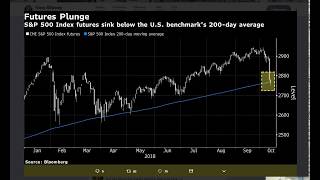
In this October 11, 2018 market briefing, the presenter walks through the sharp overnight sell‑off that began in the U.S. and spilled into Asia‑Pacific markets. He explains that the bulk of the move was driven by U.S. trading volume, with the S&P 500 breaking its 200‑day moving average and triggering algorithmic selling. He compares the correction to the February 2018 dip, notes that the FAANG basket lost $125 bn in market cap, and highlights the vulnerability of tech‑heavy indices. The discussion then shifts to macro‑level risks: a looming trade war, earnings‑season pressure, and China’s potential stimulus response. He critiques President Trump’s political framing of the market and the Fed’s rate‑hike trajectory, arguing that the political noise is unlikely to change market fundamentals. The briefing also covers commodity dynamics, especially crude oil, where recent price gains were eroded by a combination of higher U.S. yields, trade‑war concerns, Hurricane Michael’s demand shock, and a surprisingly large API build. He reviews the dollar‑yen technical picture, outlines the latest Brexit negotiation status, and finishes with the day’s economic calendar (core CPI, jobs, oil inventories, BOE speaker) as potential catalysts for the next market move.
Chapters
Okay, very good morning. Thursday the 11th of October. I'm going to discuss the kind of bloodbath that occurred, as Bloomberg are terming it, from overnight in the Asia-Pac session. I think that's a little bit overdone in my opinion, and I'll discuss why in a bit more detail shortly. But certainly, as per usual, I have a day off the desk and the whole market has one of its biggest corrections as per normal. So for any of those lovers of volatility, I'll do the briefing and I will depart if that is your wish. But statistically speaking, looking at the S&P 500 in front of me at the moment, and now obviously I, you know, one of the first questions given the fact that I wasn't sat in front of the screens yesterday was when, when did the actual selling occur? And I, I do think that this is an important thing in terms of your approach to the intraday, uh, you know, kind of strategy, in the sense that really it's not European or UK participants that are driving the kind of global narrative, it's the Americans. And when they come in, that's when you get the much more kind of clearer, I think, directional move in the market. And just given the, the time frame, the largest volume comes through, and then therefore the associated move that follows. So as per kind of the usual timestamp it gets to the cash open, and then things certainly look like they livened up yesterday. And, you know, one of the biggest down days in fact that we've had in the S&P since February. Let's just have a look on a daily continuation to put this into a bit of perspective. Now, one of the questions was, well, you know, how violent was that sell-off? Well, if you thought yesterday was, was spicy, go back to February And the move was actually, from a percentage point of view, although it was a period of 2 days combining, it was basically twice the size, February sell-off, than what we've had so far with this latest kind of, if you want to call it a correction, um, at this point. So it's nowhere near the same as yet. Whether or not we get a second down day to, to match that kind of levels, uh, obviously things Could go that way. But one of the other interesting things here, if we look at a daily continuation, of course, is if we start putting a, another study on here. So give me one moment while I add this on. If I adjust this line, it's a 200-day Moving average. And the reason why we look at this is because I'm going to take this all the way back to— basically, this was the flash kind of move that we had during the EU referendum, which obviously was a surprise for not just us, but the whole global market was very unsure of what the repercussion of that was. And we had a big down day at that moment in time. You can see was very quickly recovered. Then we had obviously the shock of Donald Trump winning the presidency, that one night of downward movement, a loss of 5% in overnight trade on Globex before we came surging back. And then you can see if I just remove the February dip, but to where we are at the moment, if I remove that one as well, we've had on various different occasions the 200 DMA has been a really key supportive level which the market, in this case the S&P, has always responded to. Thus far, uh, over the last kind of 2-year period. Now what was interesting of course is that when we start looking at the, the details here, the market actually moved below there. And this is, I think, one of what is a collection of reasons of why the market kind of came under pressure yesterday. So technically, when you see the breach of these key long-term levels what tends to happen is you get these forced-in then momentum sellers. It triggers a lot of the, the algorithms to take advantage of the move. That then kind of snowballs into other systems which will pick up on those trades as the volume comes through and so on. Other things though to be aware of, of course, is the earnings season. And a lot of people are looking at the fact that, you know, last corporate earnings season was quite spectacular in terms of the net benefit of the corporate tax cuts. And we've had these really quite crazy elevated forward-looking kind of profit expectations going forward as a byproduct of a lot of the changes that have come from the Trump administration. Question mark is though, is that, you know, if this trade war continues, if it gets gradually worsens the situation for not just China and elsewhere, but also for corporate America to sustain these quite wild trajectory profit targets, then this also is a cause for concern because a number of US North American companies have been bringing that to investors' attention. This of course comes well-timed because earnings season— the reason why people are talking about this is earnings season kicks off basically the big companies tomorrow. You get the big banks, so JP Morgan, Citi, Wells Fargo typically then will come out pre-market tomorrow, and that will commence then the latest earnings season round. So maybe a little bit of apprehension ahead of that as well. And then not forgetting the bigger picture, of course, which is trade wars. China coming back from that Golden Week holiday, and they've kind of come in, the situation is deteriorating at this point. and then the market suffering under these kind of multiple reasons. Biggest loss since February then for the S&P. The NASDAQ, of course, you know, the, the stronger you rise, the harder you fall, you could almost argue, with the FAANG stocks had their worst day yesterday since at least 2012. Collectively across the FAANG basket, $125 billion wiped off market caps, just to give it a little bit of a, a real context to it. You can see here last time it was down this kind of 6% region, way off the charts here. You've got to go back multiple years, but I don't think that that's again cause for concern. Let's not forget that the N in FANG is Netflix, and their shares had been up as much as in excess of 130%. For the year, way outperforming the benchmark index. And so a pullback of, you know, 6% in some of these names I don't think is just yet is cause for panic. But certainly I think it's just more susceptible, of course, the tech. So NASDAQ as an index, when you do get these big down days, does tend to underperform just given the nature of the moves that have been occurring in recent times. So even though the S&P had the biggest fall since Feb, it was the biggest fall for the NASDAQ in 7 years. Um, the selling then— this is when you get that kind of feed-through where the regional move, then the Asia-Pacific session picks up the baton, carries that through. Not that there's anything particularly new going on in Asia, it's just that they then have to reprice for this move and this carry-on of negative sentiment. This was a snapshot from the Bloomberg kind of price board a bit earlier this morning. So as you can see, the losses in Asia, kind of 3, 5, 6% if you start moving over to Taiwan. But it's the year-to-date that starts to look ever more frightening when it comes to the Asia-Pacific region, particularly that of China, under the cloud of uncertainty that is trade wars. Because the Shanghai comp now is down in excess of 20%. Shenzhen is down over 30%. Uh, the Hang Seng in Hong Kong kind of getting close to that 20% marker as well. So, uh, certainly emerging market disruption is still a key risk going forward. On that point though, one of the reasons why I think that, um, not only is a correction at this point, given the longest bull run in history. I think at some point was inevitably going to happen. The other thing that I think is quite crucial here is that China have come out overnight and in their kind of state media press— so i.e., the state-backed means it's basically the government talking— they've said that China should get ready for more powerful policy measures, possibly including large-scale stimulus packages to prevent its economy from stalling amid these trade frictions with the US at the moment. So as long as that's happening, in my mind, at least as a short-term solution, I think that, you know, China collapsing is a big problem for global financial markets. But if the government are willing, as they have done in the past, to step in to mitigate the persistency of the kind of deterioration in the economy, I think that then that holds true then that this correction won't materially worsen to the point of, you know, let's say if we look back at this S&P chart that we start pulling back down to, you know, levels down to 2600, down to the low of February. I find it really tough to think that we're going to get down to that point anytime soon. Even then, if we did I mean, it starts to get interesting of, you know, the US economy is doing well at the moment, uh, and maybe warranted some correction. I'm sure the buy the dip, uh, mantra might come back into play at that point. A few other things for consideration, uh, this, this couldn't be worse timed for our dear friend Donald. Because obviously the US midterms now are less than 4 weeks away, 6th of November, of course. And there's no better reflection for the US president— and has been clearly evident since his, his term over the last 2-year period— than defining the success of his policies by the strength of the US stock market. So the fact that the stock market is seeing these, some of the most sharp downside movements in the case of the NASDAQ in 7 years. Donald Trump is not happy, but quite the opposite of what every good trader should do, which is take accountability of a situation. Trump does the opposite, point the finger, it's not my fault, someone else's fault. So do I think that this is kind of cause for concern and his criticizing of Jerome Powell and the Fed is going to be something that could just cause the market to sell off? Absolutely not. I think that this is just purely, you know, politics. He needs a get-out-of-jail kind of angle here that the stock market is not weakening because of him. If I was Trump, I'd be saying, look at, you know, the record-low unemployment rate. 'Look at how far we've come' and all these sorts of things. It's Powell's fault for tightening policy that's causing this. So, you know, I think this is inevitable. Donald was always going to be singling out Powell at some point, given the Fed's intention to continue raising rates. At this point, at where we stand at the moment and with this sell-off having happened, The Fed, I think, will still hike in December. Whether that holds true, it depends on how the next kind of few weeks obviously play out. If we did see a continuation of yesterday's move over multiple times, uh, obviously we'd need to get a hell of a lot lower in the stock market, I think, for the, the Fed to, to create panic. And we need a big fallout in the emerging markets. I think those globalized threats in order to track the Fed from the path it's on. Because let's not forget, the Fed are gonna hike in Dec, and they're gonna hike 3 times is what they're saying. It would be a big climb down to alter that, to not hike in Dec, because you've also got 3 hikes in December. Probably, if anything was gonna happen, 2019 trajectory might become slightly more shallow. But the actual words, you know, yeah, you gotta love the US president. He called— he said the Federal Reserve are going loco for interest rate increases this year. That's not even making that up, that's actually what he said. He said the Fed are going wild, they're raising rates and it's ridiculous, termed the president. So yeah, this is all politics, this is all for him to control the kind of framework of the kind of buildup for the political narrative going into the midterms. So I don't think this is, uh, something Powell's going to be stressing about. I don't think it's something market participants are particularly fussed about either. The other thing, of course, that you'll get from Trump at this time— so this is what the Trump president does, and then his supporting cast come in to kind of cushion the blow, if you like. Steven Mnuchin, the Treasury Secretary, US markets correction is not very surprising. So then he comes out in an IMF meeting, and of course this is all just standard procedure. He comes in and massages the Trump kind of signal, don't worry USA, things are fine, a correction was warranted, stock markets go up and down, they tend to overshoot in both directions. So again, this isn't really for us as as market participants to trade or alter our strategies. This is all absolutely to be expected from the type of communication you're going to hear from them. A quick look at some of the other assets though. Another one that's particularly interesting at the moment, of course, has been crude oil. Now, flicking over, this is a daily continuation chart, and I wanted to start with the daily continuation. Let me just tidy up some of these lines because we obviously had a, a pretty phenomenal rise in crude prices through the back end of September, really the last couple of weeks up until more recently, uh, and I'm talking about this kind of area here. This is through the second half of September, and it was only, what, 10 days ago we were up there pushing, you know, north of the 70, you know, getting up to 77. Uh, this came as a couple different things ongoing. Obviously, US economy picking up in terms of the economic data. We've got potential supply disruptions with an inability to fill the gap of the impending sanctions on Iran and the shortfall that could have on one of the biggest producers within the Gulf. And we shot higher. The thing that's happening now is if we start just taking this in a little bit is, you know, we've had— so this is the rise through what I've just discussed, and then we've had a bit of a drop-off. And a couple of things to be aware of here, obviously panic about trade wars, a sell-off in the US equity market, the kind of higher yields. You know, let's not forget that, you know, the US 10-year yield in recent weeks has hit its highest since 2011. This idea then of, of kind of policy tightening being sped up has, you know, been a key catalyst, if you like, for this, this stock market sell-off. But then if the global economy has to re-alter its kind of expectations, then the demand for crude also drains, if you like, to some degree. So a little bit of a pullback then in combination with some other things that have been playing out. So the trade war rhetoric continuing, no real solution being found as yet. And if China suffers, that has a net consequence for, for the demand for crude oil as well. But then there's also been some weather patterns which have been developing, and Hurricane Michael has been the one of which energy traders have been tracking. It became the, the strongest storm to hit the US mainland since 1992. And it made landfall in Florida, slashing fuel demand in the Southeast. So this is a little bit of a visual to give you an idea of the actual path of which this hurricane is going, and it's turned from production loss to demand destruction, is what people are saying. And just looking at where it's heading here, The Factbox— and this is a really good website for these types of things— Often you'll hear me talk about specific regions in North America and pipeline systems. How I get the kind of granular detail to the actual, um, all the specifics is by going to S&P Global Platts. They're the benchmark kind of service provider for this level of detail. So they've released what's called a FactBox, and this gives you everything really you need to know about these situations. Uh, so here Hurricane Michael made landfall, Category 4, quickly destroying demand for power, natural gas, and refined oil products. And as such, then in the short term, there's had to have been a bit of a net repricing of demand for crude oil. So the severity of the storm surprised to the upside, which could mean a longer-lasting and more severe impact on demand for power. Essentially. And if you're looking at those kind of regions on the map, it'll make a bit more sense. In addition to this, last night of course as well, we had the APIs, a delay of a day just accounting for the, the holiday that we've had in the States. So the API crude oil build, 9.75 million, is the biggest build since February of 2017. So, you know, this was way exceeding the market expectations as per the, the survey, the surveyed expectation. Crushing a build of 2.3 million, so also bearish. Biggest build since March 2018. Gasoline, biggest build since June 2018. Distillates was the biggest draw since May of 2018. But you can see here a heavily tilted bearish report. So Michael causing a short-term repricing of the power demand out of the southeast region of the United States, which is very key, of course. And then you've got this cloud of uncertainty developing yesterday with the kind of sell-off, with a part being kind of a, the bite, if you like, of the trade talks ongoing. And then you've got this latest API data. And so hopefully just making a bit of sense then of the renewed pressure that we've seen, in addition obviously as well to a little bit of profit taking after what was an incredibly aggressive run of the best part of north of $10 over the period of about 4 or 5 weeks in oil. So I think it's some profit-taking there, probably is warranted to a certain extent. I guess if we continue to pull back in oil, you know, maybe an interesting point starts to come in a bit lower down. Just looking here, these kind of low points from the late September period, this kind of double top close from the, uh, late August, September point down at the 71 handle, uh, if we should move lower. Not definitely not looking for a dramatic price fall here because ultimately in the medium term there still is the impending Iran sanctions coming in. There's not really a clear idea of what's going to happen to fill that shortfall. US economy at this point is still growing, and I think once we get through the midterms you know, the show will roll on again. And so I think we'll find a bit of a floor maybe around this area. One of the other things actually, just while we're on the charts, I wanted to have a quick look at— this was the yen, or actually dollar-yen. And yesterday, obviously with the sell-off, you're getting a bit of that continuation of, uh, the flight to quality moves. So strength in the Japanese yen came down to a level here where we found the floor of the price, which was fairly interesting because it came in line with around the, uh, September 14th high and an area of some support as well beyond that point on the 20th of September. So that would be a level to keep an eye on should we see another sell-off and, uh, and a risk-off move in the session or sessions ahead. Below there though, the 111 handle I think is is pretty important for the reasons of— I'm looking at the, the DEC future here, hence the reason why the prices are fairly thin on the left-hand side. But you can see that double top and that support point back on the 18th or 17th of SEP, and I think that's a fairly solid point if we were to ever come down to that, that area. But you can see the markets gathering and capturing their breath a little bit after yesterday's quite dramatic moves. dollar yen sitting back, having recovered back to this point as well, which is quite interesting technically around that 111.74. Final thing on the news front to discuss, of course, Brexit. What is going on? And we know that the timeline for this week is important. Obviously we've had Arlene Foster in meetings, what would have been, what, yesterday? And just reading the headlines this morning, Brexit negotiators are said to be edging toward a compromise on the thorniest issue in talks, even as officials on both sides warn that obstacles still remain. So the point here being that Michel Barnier, still within reach, Irish border still is the main kind of contentious issue. Can Theresa May provide the backstop to appease the European bureaucrats? But can she get the DUP to swallow that and to continue backing her and her working government? The Telegraph reported late last night that agreement had been clinched, and EU and UK officials warned in public and in private against predictions that a deal was in the bag. I still think that absolutely the champagne should be put on ice. I think that this, of course, timings-wise, if you remember on the calendar, It's pretty much this time next week that that EU meeting gets underway, where we're supposed to be talking about then the signing off of the framework of the Brexit deal, to then be heard and voted and backed by the various European national parliaments, and for us to bring it back home to UK Parliament to be voted upon. I still think that that's quite a big ask. And then the November emergency meeting will be probably more an accurate timing of when we might get to that point. So I still would expect a little bit more Brexit noise in the coming days. The one thing for sure though is that we've had a bit of a back-off in the dollar overnight, and in combination with what seems like a little bit of positivity in some of the Brexit talks for the moment, and making some progress, seems to be keeping the cable pair elevated for the moment. So I'd still be very mindful of keeping a close eye on Laura Kunsberg, the usual kind of suspects on Twitter, to try and capture any developments on that, on that front. Okay, let's have a look at the calendar for this morning. Things are relatively quiet. I mean, just looking as we stand at the moment Uh, as I said, markets have kind of paused for breath a little bit, albeit a negative open following the, the falls overnight in Asia. Uh, the important part again I think will be what will happen when North America come in. So again, I think probably a more prudent or astute play might be just for strategizing for how to play out either continuation of the moves from yesterday or a reversal, and what points, uh, technically would be relevant on any move back to retrace some of the size of the move that we, that we sold off across the indices. Um, my overall view here is that just looking at the calendar, the CPI numbers coming out this afternoon, I guess that could be quite a key catalyst. Let's say the core CPI is expected to, to tick up by 0.1. I think if we were to get a number up at the higher bound of the range, which would be 2.6%. This is the core CPI. You can see that in recent months, uh, we've only got to 2.4%. We had a bit of a pullback. I think if core CPI comes back to 2.3%, 2.4%, I don't think that's cause for concern on this yield kind of interest rate scare. If we got to 2.6% though, that does raise some alarm bells because then we start going back to levels we've not been for for, for a long period of time. And that might then just kind of bring about this renewed fear of, uh, of, of rate rises. So I think that if there was anything that could act as a catalyst, if we were going to get a renewed kind of sell-off, a high CPI core print could be that trigger. Quite equally, on the opposite, let's say if the core CPI remains subdued and we get another kind of consistent 2.2 or even lower, well then I think, um, we might have a bit of a recovery at this point. Okay, elsewhere, weekly jobs data. I think that's a, that's a side point. I don't think that's really too meaningful for you guys to be concerned about. And then you've got the oil inventory numbers. Don't forget, because of the holiday, we've got delayed release as per normal. That'll be at 4 PM, not 3:30, London time. Speakers, we do have a BOE speaker coming up 11:45 as well, just be aware of for any sterling traders. Okay, that's it. So I'll let you get on with the day. I'll catch you in the chat room, uh, and have a good day ahead. Thank you very much.
More from Anthony


Inside the Biggest Banking Stories You Need to Know This Week (Anthropic, Diageo, Private Credit)


Inside the Biggest M&A Deals You Need to Know This Week (UniCredit, GameStop, eBay, Eli Lilly)







AI Breakthrough or Hype? Anthropic’s Claude Mythos, Tim Cook Steps Down & LIV Golf Collapse