FOMC Debrief - The Main Points & Market Moves
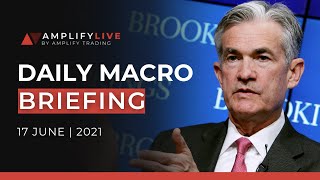
Anthony Cheung breaks down the Fed's June 2021 surprise: the dot-plot now shows two rate hikes in 2023, not one. Treasury yields spiked, the dollar rallied, and stocks fell modestly. The Fed also raised its PCE inflation forecast to 3.4% from 2.4%.
Chapters
Okay, very good morning to you. It's Thursday the 17th of June. I hope you're doing well, and thank you very much for everyone who joined me on the YouTube channel last night. I hope that was a useful live session, and all you need to do is go back and go on to the categories of Amplify Live videos, and you better see that recording if you want to go back and review the event as it unfolded. But what I wanted to use today's briefing for really was a, a bit of a debrief of what exactly happened, looking at the main points of why the market had this hawkish reaction. And as you would well know by now, that being higher yields pressing T-notes lower, weighing on gold as the dollar spiked higher, pushing major currency pairs lower in EURUSD and Cable, and stocks also coming under a bit of pressure at the close. The cash markets, they Dow down about 0.7%, S&P 0.5%, the NASDAQ was down about a third of 1%. So percentage change, not a massive move, but certainly there were some surprises in last night's announcement for sure. Um, just quickly before we get into that, an overview of sentiment this morning. And as I said, I'm not going to go into the charts from a technical perspective. I'll let Tim and the Amplify Live community on the, the private Discord feed go into that. But, um, we are keeping an eye at the moment on these dollar-based pairs because we are retesting the low that held during the Asia-Pac session at the moment in the likes of the euro and close proximity to that also in cable. Gold is also top right, just started to drift down a little bit and breaking through that APAC low. Um, we are approximately still a good $10 away from the initial spike low that we saw in the aftermath of the Fed But certainly, uh, definitely from a technical point of view, there is some scope for, for move low, moves lower. And beyond that point, the $1,800 handle has acted as a significant point on the daily chart of technical support if we were to trade heavy throughout the session. From the equity indices, um, definitely, yeah, a negative reaction, perhaps a little bit more controlled, definitely a more pronounced move as we'll look at in the US 10-year, in the currency markets, than that of equities. Um, in terms of the actual size of movement. But what I wanted to do is just have a look on the daily chart for both the S&P and NASDAQ. The NASDAQ basically is a reflection of this same kind of setup, which is, for me, we're trading at around 4,200 in the S&P. Um, there's been such a good level of support of 4,180.5, which has been that previous top for majority of May, flipped to support through late, late of that month and then early June. So for me, I think there's definitely room for downside given the hawkish surprise for the Fed. But in actuality, I mean, if you actually look where equities are and actually what's developed, I mean, we're still very elevated. So, you know, if we did move lower, I don't think that particularly is necessarily time to call it quits on equity markets just yet. But definitely, I think from a technical perspective, there's a little bit of room perhaps for a bit more downside to materialize before before finding a bit of footing. And perhaps we'll see that materialize as we go into the US session later on today. The NASDAQ, as I said, is fairly similar in to that degree. Just looking here, kind of similar in the sense of 13,737 is that same kind of May-June area, that inflection point for price. And so you can see here there is, there's plenty of room on the downside until we'd get back down to that kind of zone of what I see as kind of more firmer support in that regard. In the intraday space, targeting obviously on the downside the initial lows that were seen both in the aftermath and in the Asia-Pac session of the FOMC announcement, and then near term below the S1 today on the daily pivots, that horizontal support level seen around the 13,800 mark as well as more near-term levels to watch. The US 10-year perhaps was the most telling of a narrative, if that makes sense. And what I mean by that is on the left-hand side here was the spike higher that we saw on the release of the last Nonfarm Payrolls report, which came out in excess of 500,000 jobs. But obviously in combination with the, the payroll report prior to that being a large disappointment, the fact that jobs have just not kept pace And the fact that even though inflation was high, people still looking through it in terms of the price pressures being somewhat transitory. And last week was really— and really since June, we've seen a pretty consistent decline in US yields, which has led the 10-year all the way up north of the 133 handle. And then basically there was a little bit of kind of profit taking on that, bit of position squaring going into the Fed event because we knew it was going to be particularly important one. And then obviously they came out and, as we'll discuss, shocked the market with the dot plots for 2023, anticipating 2 rate hikes. And prices immediately moved sharply lower. And as we'll go through some of the main comments, comments on inflation as well bumped us lower again. But the point being, it's interesting where we are trading right now, which is 131.18, and of course that is absolutely flat to where we were prior to that move. So I think a little bit of context is quite key because what tends to happen in a situation like this is that you can kind of let your, let your mind run away with yourself. So all of a sudden the Fed are going to start hiking rates. That's, that's certainly not what they said. It's just as a function of market positioning. Certainly the, the T-note move was, was pretty pronounced in that respect. But as I said, let's use this as a bit of a debrief session. So what was the main thing? And the main thing definitely was that initial snap comment. If you go back on the recording, you probably hear me getting a little bit excited because it was quite an obvious thing to see straight off. If you're looking at the kind of major newswires, and it was the fact, of course, that they anticipate 2 interest rate increases by the end of 2023. Now, to put that in context, I would say on the balance, in terms of the banks on the street, probably the expectation was for one rate hike. So that would be a movement— let me just put this into a graphical form for you. So this is the June dot plot for rates on the top and the March projections down at the bottom. So what we were looking at really is the, the composition of dots moving from point A here up here to point B. In actuality, that then resulted in a move of interest rates seen at the end of 2023 on a median basis at 0.6%, which would constitute 2 interest rate hikes from where we're at, at the moment in the federal funds rate. And as I said, most were only looking for 1, but the rest then weren't looking for 2, they were looking for none. So this definitely was a big surprise for markets, and hence the reason why there was an immediate and the most aggressive move was seen on that first flash of that, that headline. This was certainly much more hawkish to bump that up to the point of where they'd see 2 rate hikes. Important though to, to also cover that Jerome Powell did go on to say, and obviously there's a press conference that followed the initial statement and all the projections, that discussing liftoff now would be highly premature and the dots are not a great forecaster of future rate moves. He definitely is right. The dots have been questioned many times in the recent past about their validity because, you know, the market assigns so much priority to the composition of these dots and that trajectory of the green line, the median dot plot. But in reality, very rarely are they accurate because what you're trying to ask the central bankers to do basically is forecast where interest rates are going to be at a period quite far in the future, 2 years and beyond. So the fact that them being accurate is pretty much impossible to that degree. But obviously we know this is kind of a channel of forward focus. But for me, it's kind of— that's a bit of management on the behalf of Powell there. So he knows for sure that a 2-rate hike 2023 change is going to spook the market. He would have known that before even the market moved. And so coming out and saying, look, discussing liftoff is totally premature, and it definitely is premature. You know, we're talking about rates rising twice in 2 years' time. So I think that warrants a bit of control in that respect. And then also him highlighting the fact that the dots are not a great forecaster is almost kind of cutting off his own nose to spite his face a little bit because it's his tool, but he's trying to use it to water down then the hawkish impact of what he's trying to convey. Play. So things are improving, it constitutes rates a little higher in the future, that isn't going to change the near term. And so he's just trying to assure the market with what otherwise is a more hawkish change, I think, in the, in the dot plot in that respect. The other things he said that I thought were very important, um, were— well, I'm going to leave it on this shot for now. He, the comment on inflation So there was really two legs to the move, um, yesterday, and they were both in the same direction, in a hawkish manner. So the, the two-rate one, um, indicative of 2023 was one. The second one was Powell said bottleneck effects putting upward pressure on inflation have been larger than anticipated, and inflation could turn out to be more persistent than they expect. That was when we got another push in in the same direction as the press conference got underway. And so this is that kind of admission that, yeah, inflation, perhaps we misjudged it. It's a little bit more punchy than we thought. It's going to be a little bit more sticky than we thought. And the market again took that as another signal to carry on some of those initial moves. Those two parts were definitely the standout in my mind to take away. The other thing then is the actual summary of economic projections, and we were anticipating movement here, particularly in GDP, but the PCE inflation number was also going to be key. Now, for GDP, they upgraded that from 6.5% to 7%. The rest remains largely unaltered, but a little bit higher perhaps in 2023, and again, somewhat then, uh, constituting the rationale behind why they would see rates higher, um, at that point. But the PC inflation one was, was quite meaningful. They obviously have seen a significant upgrade here of a full percentage point from 2.4 to 3.4. But what I did think was interesting at the time was that to me it's still kind of saying that inflation is transitory. My personal take here is that they have admitted to the fact that inflation is a little bit more stronger than what they thought, and it might stay around for a little bit longer, a few more months than they anticipated. But if you actually look at these forecasts for PCE inflation in 2022, this is the end of 2022, it's basically unaltered. Okay, it's 0.1 up from March to June, but that's, that's minimal. So they see a big increase to the near-term inflationary pressures, but they still see it pretty much easing off as they previously did do. So it's still to me, um, is, is a buy-in to the idea of, of transitory inflation, um, in that respect. Obviously that was the big figure down here at the bottom. So in reality, for anyone not used to kind of monitoring this stuff in real time, that would be one of the main first headlines that you would see on the Bloomberg or the Reuters kind of ticker tape that would stick there as a main highlighted headline. The 0.6 is definitely a large jump from where we were, obviously at 0.1. The other things then to be aware of was this conversation piece around tapering. That was obviously the other kind of sweet spot we were looking for. And he said literally, we are talking about talking about tapering. So as much as that was kind of coined as a bit of a joke, that that's kind of the phrasing that actually was the phrase that he used when asked about tapering. Have made progress, but still a ways to go, he said. It will be appropriate to consider a plan for tapering at the coming meetings if progress continues. We will, we will give advanced notice before taper announcement and provide as much clarity as we can. So that latter part's very important. That's that kind of notice, and that's that general timing the market consensus is at the moment. Is the notice will come at Jackson Hole in 10, 11 weeks' time at the end of August. That will then be formalized in September, which then gives the market 3 or 4 months, perhaps longer, to readjust, then to then see tapering actually physically commencing and the reduction of bond buying into Q1, let's say, of 2022. So on the tapering side, there definitely wasn't any hawkish shock there. That's pretty much what we're anticipating. And so again, in summary, it was really the two interest rate hikes in 2023 and the comments particularly on inflation that were most, most meaningful. When I do look at the charts though this morning, and I'm really looking forward to the podcast that we put out every, every Friday, the Market Watch podcast, just check it out if you haven't already done so on Apple or Spotify. But it's when I have a pretty informal conversation, a bit of a chinwag with the head of trading, Piers, really keen to get his take on, on what we've had here. Because to me, in the near term, I'm not sure if I personally see this as too destabilizing for markets, um, after what we had yesterday. And my general rationale there really is that, you know, rates rising a little bit more than what we previously thought, because we did think they were going to go up at least once in 2023 generally, now it's 2. That doesn't really change the near-term picture on the timing of tapering, which I think is quite key really for the short term or short to medium term. And so it doesn't alter the fact that the August SEP kind of Q1 2022 timeline remains somewhat intact. And for me then, that is a supporting hand in combination with the fact that the Fed, to me, from the, from the data on the dot plots, quite clearly see inflation still being transitory, albeit around for a little bit longer than perhaps they previously thought. But we'll get his take on Friday. A couple of banks have commented, and Goldman Sachs basically said they continue to forecast broad dollar weakness driven by the currency's high valuation and a broadening global economic recovery, but more hawkish Fed expectations and the ongoing tapering debate look likely to be a headwind to the dollar shorts over the near term. Deutsche Bank kind of adding similar types of views. There's now a greater scope for front-end real rate repricing in the US yield curve and also room for higher volatility. Both factors are bullish for the dollar, he said. Their economist— that support for the Fed was providing euro-dollar upside is no longer there. So, you know, take it as you will. What I, what I would say is is what I generally do or try to do is that after a day after an event like that, you know, if you go on to Bloomberg, Reuters, Zero Hedge, all these types of things, just try and read what other banks are saying. You know, you don't have to be this, this kind of market wizard trying to calculate and work out, you know, your own unique view. It's quite a healthy exercise I always find is you know, construct your own thoughts, but also read what others are saying and just get a general vibe for what the consensus estimate or the consensus view is on this situation and the kind of rationale behind how they've drawn those conclusions. And generally, I find that a pretty healthy exercise then for giving me a fairly balanced view without imparting too much of my own kind of preference, because I do feel from a from a Fed perspective, I do have the self-awareness at least to understand that I definitely sit on the more dovish side if I was a central banker. And I kind of base that on the fact that the Fed have always been relatively cautious. And so that's why, um, the market reacted like it did yesterday. I think most people kind of see it like that in terms of the Yellen-Powell approach. And so yesterday was quite a surprise, but Yeah, I'm— what I'm saying is have those views, but try to then kind of broaden out your, your thinking and obviously stress test it by understanding what other large financial institutions are looking at. All right, quick whip through of some other news. The Aussie has seen a little bit of a bid overnight, but it's really, in honesty, it's failed to sustain that recovery amid comes to the ongoing dollar strength at the moment. But Australia's unemployment rate tumbled, uh, overnight. In fact, this is a, a quick look at the Australian unemployment rate, and as you can see here, it's back to pre-pandemic levels already. So comparative to, say, the US and other places, the Australian jobs market is right back, uh, into play again. Um, so their unemployment rate overnight came in at 5.1%. Expectations were for 5.5%. In fact, Australian jobless rate has fallen for 7 consecutive months. And so the RBA— kind of expectations have increased now that the RBA, the central bank, will not extend the timeline on the bank's yield control measures next month, which is one of their own unique ways in order to control the yield curve to support and stimulate the economy through the last 15 months or so. So as I said, a little bit of Aussie appreciation at the point of release, but it's failed to really sustain that as all these currencies are trying to tackle the kind of galvanized US dollar at the moment. The other thing I wanted to mention, it's not really so much of a talking point at the moment but warrants putting on your— literally on your radar, because there is a disturbance being highlighted as a weather pattern um, that's in close proximity to the Gulf of Mexico. And in fact, the National Hurricane Center have said the Gulf of Mexico has a 90% chance of a tropical cyclone formation over the next 5 days, with a tropical depression likely by late Thursday or Friday when the low moves across the western part of the Gulf of Mexico. So obviously very strategically important here for oil well, gas refinery operations in the Gulf of Mexico. So it does— it is worth keeping an eye on. But in all honesty, I think we're not seeing any real reaction in energy prices at the moment. I wouldn't anticipate we would, not unless this weather pattern starts to intensify beyond what is being calculated at the moment. It needs to get up there into category hurricane status, uh, to really start influencing things. At the moment, it doesn't look like that's the case, but there's still some time to run. At this point it is going to strengthen, so it's worth keeping an eye on, on the National Hurricane Center site. All right, in terms of the day, what have we got? Um, you've got the SMB rate decision at 8:30, Norwegian rates at 9. I'm going to go into too much of that because I know a lot of you don't trade those, those particular currencies. So you've got the final HICP number at 10 from the eurozone, again, final reading. So not looking for any real market move on the back of that. So this morning really is about digestion of what's happened yesterday. Uh, and, and I think the market's going to take a bit of time to really draw its own conclusion at this point. So I wouldn't get too aggressive, not unless you start to see kind of technical breakouts. And then this afternoon, jobless claims anticipated to continue the positive trend of late, so decreasing to 359,000 from 376,000. 6, um, and you've got Philly Fed also, both figures coming out at 1:30. Speaker-wise, you've got the chief economist of the ECB at 1:30. You've also got Janet Yellen, the Treasury Secretary, she is speaking as well today. Let me just remind myself on my notes, um, I believe she's giving a testimony to the House panel on the federal budget today. Wouldn't be again expecting much in the way of any market move on the back of that, but you know, just so you're aware, she has been making quite a lot of comments of late about China specifically, but also on the coattails of the Fed. You know, perhaps just keeping on your radar that she is speaking today, she could say something. Supply-wise, coming out, 5-6 billion coming out of Spain, 9-10 billion out of France. For any fixed income traders, a 2-5 7 note and a 2-year floating rate note auction announcement of sizes at 4 PM, with a $16 billion 5-year TIPS auction at 6 PM. And that is it, gonna leave it there. Excuse me. Feel free to, um, drop me a comment if there's any questions, and I'll see the rest of community online on Amplify Live. All right, take care, have a good day.
More from Anthony


Inside the Biggest Banking Stories You Need to Know This Week (Anthropic, Diageo, Private Credit)


Inside the Biggest M&A Deals You Need to Know This Week (UniCredit, GameStop, eBay, Eli Lilly)







AI Breakthrough or Hype? Anthropic’s Claude Mythos, Tim Cook Steps Down & LIV Golf Collapse