Global Energy Crisis - Oil to 3 year high
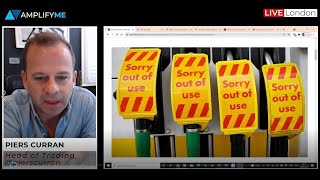
In this September 28 2021 market briefing, the presenter opens with a discussion of severe petrol‑station queues in the UK, attributing them to a sharp drop in HGV driver numbers caused by Brexit and COVID‑related travel restrictions. He then shifts to a broad market snapshot, noting weakness in US tech equities, a strengthening US dollar, and rising bond yields as inflation concerns mount. The core of the briefing focuses on the energy sector: oil prices have surged to three‑year highs (WTI above $76, Brent above $80) and are approaching key technical resistance at $77, with Goldman Sachs now forecasting $90 by year‑end. The rise in oil is linked to a dramatic tripling of European gas prices, driven by reduced Russian gas flows, low storage, a cold winter, and geopolitical tension over Nord Stream 2. The speaker explains how higher gas costs shift demand toward oil, further fueling price gains. He also outlines the UK’s particular vulnerability due to its position at the end of the Russian pipeline and a concurrent low‑wind period, compounding the driver shortage problem. The briefing then examines China’s energy crunch, noting a pollution‑crackdown ahead of the Winter Olympics, a 96 % jump in coal prices, and increased reliance on oil and gas, which adds global demand pressure. The presenter explains the US debt ceiling – its legal basis, the 2019 two‑year budget cycle, and the current political standoff between Democrats and Republicans – warning of short‑term shutdown risks and the catastrophic scenario of a US default. He concludes with a calendar of key data releases and policy speeches (ECB Lagarde, OPEC World Oil Outlook, US consumer confidence, API/DoE inventories, Powell, Bullard, Yellen) that could influence markets in the coming days.
Chapters
Okay, good morning everybody, welcome. It's just gone 8 o'clock on the 28th of September, and if you're in the UK at least, and perhaps elsewhere in Europe now, I'd be interested to hear from you guys. Drop some comments in the chat if you're from different countries. Are you also getting these kind of notices at petrol stations? Big queues. Well, I live in London and the queues into some of the petrol stations have just been crazy. It's made an absolute nightmare of the traffic situation. But this is a big topic of conversation, so this will be one of the key themes that I'm going to cover in this morning's briefing. I also want to talk about, you know, the oil prices generally, talk about gas prices. We've got a potential energy crisis. I mean, okay, fine, it's right in front of our face here in the UK, but it's not just a UK thing. We've got a potential energy crisis brewing across Europe, really. So I want to have a big focus on that this morning in the briefing, and then I also want to about the debt ceiling, that's the US debt ceiling, and as that kind of remains unresolved, just talk about, well, hang on, what is the debt ceiling? What are the risks? And, you know, will these US politicians sort it out or not? But before we kind of get into all of that, let's have a look at yesterday's heat map. So this is looking at US stocks and looking at how the market session fared. And as you can see here on the tech sector, we've got some big red blocks. Microsoft, the top left there, down, but also most of those tech stocks losing ground, including Google and Amazon and the like. Tesla perhaps bucking that trend, up just over 2%. And one of the quadrants you perhaps want to have noticed, mostly in terms of its kind of fluorescent green, is the oil and gas kind of energy sector down here, which of course is benefiting hugely from what is, you know, record high gas prices and, you know, sharp uptick. Well, for oil, we're up at 3-year highs at the moment. So let's kind of have a quick look at the charts, because what's happening this morning as we move into the kind of European session— top left, we've got stocks here, and this is the S&P. As you can see, we're just kind of moving to the downside just this morning. We just made a new low for the session. But, you know, yesterday, you know, looking across over the last week. We're kind of still up around the range that we've been in for the last, let's say, few trading days, just shy of the kind of all-time highs. If I just move that chart setting to a daily, then you can see that, you know, we're off those highs that we had back at the start of September. But I'd say this morning in Europe, you know, mild, you know, fairly neutral. What happened overnight? Well, the Evergrande saga in China, chugs on. They obviously failed to make that bond interest payment, that dollar bond interest payment on Friday. But as I said in our podcast, that doesn't mean a default yet. They've got a 30-day grace period. So that, that, that, that kind of story is going to rumble on for the next 30 days. In the meantime, what helped to kind of just stabilize markets in Asia, what helped to kind of just stabilize sentiment also, if you like, is the People's Bank of China were at it again, pumping another 100 ¥1.5 billion into the, you know, the short-term overnight lending markets to make sure that bank liquidity is strong enough to enable the functioning of the day-to-day economic system. So we're kind of moving into the European session. Obviously, we've gone through that German election over the weekend. And again, as I said yesterday, really, we'll see. That's a months-long story as now Scholz tries to form a coalition. And at the moment, markets are fairly happy with that. I mean, either way, if you get the Jamaican or if you get the traffic light coalition, either way, it's not too far off the kind of sort of government that we had under Merkel. So we're not expecting major change there. So it's not a huge risk, but something to monitor in the months to come. Dollar strength. If we have a look across at the euro-dollar chart, then what we're getting this morning is we've had another push to the downside. So we've broken below that 1.17. 1.17 handle that was key support in yesterday's session. You can see a nice little trend here as this thing is stepping down. If we just go to a daily timeframe, then you can see that we've made new lows for the month this morning because yesterday's session we hit lows, but it was testing those key, that key double bottom from last week. Well, we're down through that 1.17 handle. And so for sure now the next kind of marker in the sand is this level that we're eyeing up, which is the low in August down at 1.1668. If we go a little bit further back still on a weekly timeframe, then you can see that these are really key levels because just around, you know, down around that 1.16 handle, you know, major kind of key supports that we had at the back end of last year. So the Q4 low was at 1.16. So certainly some dollar strength kind of just feeding through here and you're, you're euro weakness. We'll talk because Lagarde's obviously got a major speech today, so that's something to keep an eye out for if you're trading things like the euro. Come down and have a look at bunds. Bunds are lower again this morning. If we just go to a daily time frame to get this into broader context, you know, we've had some pretty steep downside for bunds, and that's because yields have been driven higher. And yields are driving higher, as we know, because we're You know, well, we've got an inflation situation which is being exacerbated by what I'm going to talk about in a minute, which is that energy crisis pushing energy prices higher, which is of course inflationary. And then we're thinking, right, what are central banks going to have to do about that in terms of turning a bit more hawkish more quickly? This is helping to kind of drive bond yields higher, and of course bond prices moving to the downside as a result. If you take US T-notes, it's pretty much the same story. Again, if I go out to a daily chart for context, you know, we've had a pretty steep move to the downside here over the last few sessions, and that's a key breakout of this platform we were sat on through the summer. So certainly one of the big stories this week, and indeed back end of last week, is yields properly starting to move to the upside as we start to consider this inflation situation and, and whether it is transitory, and maybe that that inflation push to the upside might last longer than we had previously anticipated. But one big focus I want to start with here in the briefing is oil. And if we— I might just actually bring this up and make it a little bit bigger so you guys can properly get into this. I mean, this is a big sustained move. This is just a 60-minute chart, just looking back over the last couple of weeks or so. This is WTI crude, okay? If I go to a daily then what's really important for this market is this massive level that you can see right here, which was the July high at $77, and we're just shy of that today. So we're now above $76. Um, for, for Brent crude, um, Brent's up above $80, um, $80, and that actually is the 3-year high for Brent. I was talking about this yesterday with WTI. If we go back all the way back. I mean, if we get above this $77 handle that I just drew in, because as I was touching on and alluding in the briefing yesterday, it's not just this summer's high, it's also the key top from back, all the way back in October 2018. So massive level for WTI crude traders at $77. Any move above that, then for sure you can hang your hat on a move to test that 80 handle, I would have thought. And at the moment, it does look like pressures are on the upside and will remain on the upside. So let's, let's kind of have a little bit of a look at what's going on then. If I kind of flip back to my other chart, we've just got a big— just step away from, from oil prices for a second, because one of the reasons for oil prices being on the upside is actually what's going on over in the gas market. Gas prices, as you can see on this chart, have kind of trebled in Europe in the last sort of 12 months or so. And this has led to record high electricity prices. And of course, as gas prices are moving higher, of course, that kind of shifts people's kind of energy dynamic more towards oil rather than gas, which is helping to push up oil demand, which is helping to push up oil prices. But we've got— yeah, what I mean, why are gas prices moving to the upside in such a dramatic fashion? Well, we've got a global kind of shortage on the production side. So production is definitely lower. But then one of the reasons for that is this, particularly for Europe, because this gas price spike is certainly being felt in Europe more than anywhere else. And there's less supply. And that's because we had a cold winter. So there's more demand over the last winter. And countries haven't replenished their storage— gas storage facilities. So there's a now an overdemand for gas. But just at that moment in time, there's less gas coming from Russia. So Europe's incredibly dependent on Russian gas, and Russia are just holding back on pumping more. And there's speculation as to why that might be. I mean, there's kind of two sides to the fence. If you're, you know, giving Russia the benefit of the doubt, then you're saying that, well, Russia are just replenishing their own supplies after a kind of heavy drawdown over the last winter, and so there's less gas available for export. That's, that's kind of on that side. But if you're a bit more kind of skeptical about the Russian, you know, foreign policy angle, then people are saying, well, they're holding off on pumping gas to Europe to put pressure on Europe to sign off on the Nord Stream 2 gas pipeline, which is a very controversial new big pipeline that Putin has got planned, you know, to come out of Russia and supply even more of, you know, Europe's gas. The other thing that's been happening over the longer term, and it's kind of lots of things coming to a head here, but over the longer term, Europe has been phasing out the use of coal. This is part of that kind of green initiative to move to more cleaner fuels. Also, particularly in the UK, and why is it a massive problem in the UK? You'd probably say the UK is more vulnerable than the rest of Europe. Couple of reasons. The UK are at the end of the Russian pipeline. The Russian pipeline comes through continental Europe, you know, deliveries all along the way, and then we're at the end of that line, and therefore we're perhaps more at risk to that Russian shortfall in production. But also the UK is more dependent on greener energy, and particularly on wind, and as Irony would have it, just as we're having all of this production and these demand issues, as irony would have it, we've been through one of the lowest wind phases for years. So wind levels have dropped dramatically over the last 3 to 4 weeks, which has led to the output of, you know, wind power generation being sharply lower. Now, normally that's backstopped by gas. But of course, gas prices have tripled. Um, and, and so here's your problem. It's not such a problem over in the US, and in fact, over in the US, they're trying to take advantage of this. They're hoping that Europe won't sign off on this Nord Stream 2 because the US want to export more gas. Um, and this is the amount of gas they're pumping. So the US gas exports are on the up, and they're looking to try and take advantage of this. So plenty of investment going in on the US side. So it's quite an interesting sort of geopolitical sort of battle going on here as to who's going to win Europe's demand. Will it be Russia with Nord Stream 2? Can Biden's, um, kind of administration get going on, on, on gearing up? They need more infrastructure on the exporting side, that's the problem, and that takes quite a long time. So it'll be an interesting battle over, over the coming years. Um, but this is also kind of coming to a head. I mean, Obviously this petrol station thing— I started the briefing with this image— has got nothing— well, it's partly to do with gas in so much as people are using less gas because prices are too high, so then the demand for petrol has gone up, which has led to a shortage. Well, is there a shortage? Is there not? I mean, one of the key problems here in the UK is there's a shortage not of oil, there's a shortage of HGV drivers. But where did this kind of panic buying come from? Well, BP had a kind of what was supposed to be a behind closed doors private meeting with the government, and in that meeting they suggested that their forecorts were about two-thirds of normal stock levels. So they're, they're down on the normal stock levels that they require for smooth operation. And the reason they're down— there's no shortage of oil— the reason that forecourt stock levels are down is because there aren't enough HGV drivers. In the last 12 months, HGV drivers in Britain has dropped from 305,000 drivers to 235,000 drivers. We've got 70,000 less. This is partly due to Brexit, and this is also due to COVID and travel restrictions. A lot of these foreign, um, HGV drivers operating in Britain have gone back home and can't get back or don't want to come back. Um, and so we've got a major shortage, and there's obviously emergency policies that are trying to get put in place with now the military on standby and the military looking to get extra training to step in to take up the shortfall. They're also working on the visa side to get more drivers into the country. But in the meantime, of course, you know, forecourts are, you know, massive queues coming out of forecourts, and forecourts are starting to run out. Over the weekend in London, there was 6 times the normal demand for petrol. Than you would normally see at a weekend, on a weekend in September. So also, I mean, outside of Britain and outside of the kind of the UK more broadly, you know, other reasons why oil prices are on the up. And if I just go back to the perhaps the daily chart to kind of get this into context, you know, why are oil prices on the up? Well, you know, we've got a prolonged shortage of production out of the Gulf of Mexico, you know, further hangovers from Hurricane Ida. Obviously demand is now rising also just because of the fact that lockdown travel restrictions are being lifted. That's, that's being seen by looking at US inventory levels, which are actually well below average levels. And the problem here is we've got inventory levels really low just before we're about to enter into the year-end peak consumption period. As a result of all of this, you've got the likes of Goldman Sachs that are now predicting $90 for year-end for WTI crude. I'm going to go back to the weekly chart. I'm going to go to a monthly chart just to show you where $90 falls, because where if we do break $77, if, if, if, massive, because actually, well, now I go back on the longer-term chart. You had key support around that $77 handle. For example, it was the 2012 low. Also kind of a triple bottom in 2011. I can't explain how big a level $77 is to you. If you get a move above there, you're surely going to get some technical breakouts. Goldman Sachs had originally had $80 as their year-end target. They've gone now to $90. And from a technical point of view, fine, I guess you got a little bit of support here coming from the start of 2014. But the point is there's just not much in the way. There's real clear air here. In terms of technical resistance on the upside. So interesting stuff. To add to all of this, let's talk about China, which are a huge consumer of energy generally and oil. But China are also exacerbating these issues because they're going through, obviously, a pollution crackdown, which is leading from a move away from things like coal. And another problem with the coal part is that coal prices in China have jumped 96% this year. So, you know, factories and industry are trying to move away from coal anyway because it's too expensive. That's putting more demand on, on gas and oil, which is exacerbating this energy crisis. Why are they doing this now? Well, Beijing, you know, they're hosting the Winter Olympics in February, and historically any kind of major international events at large Chinese cities has led to a you know, pre-event crackdown, um, in, in pollution so that when the event happens, then the pollution levels are nice and low for, you know, international media and the international visits. Um, China, because of this issue, have also been tapping into their state petroleum reserves as well, by the way. But, you know, you're getting an energy crisis in China to the point where there's actually been homes left with no power in northeastern China. So, you know, this energy crisis is happening. It's not just in Britain. It's not just in Europe. It's, you know, China having issues as well. So this is all feeding through into this kind of oil price situation and something definitely to carry on monitoring. And it has implications for central banks because of the inflationary aspect. It'll be really interesting to see if Lagarde touches on the energy price crisis in her Sintra opening remarks. That will be at 1 o'clock today. So this is certainly the hot topic and pushed things like Evergrande off the, uh, the kind of front pages, if you like. Um, the other thing to kind of just touch on then that I wanted to just briefly talk about, uh, was the US debt ceiling. Um, what is this US debt ceiling? Um, and you're going to hear a lot more about it in the coming days. The debt ceiling, it's a legal cap that Congress sets on the amount that the Treasury can borrow. Okay, so it's a borrowing cap, and obviously a borrowing cap leads to a spending cap. Um, so what is this? This debt ceiling's been in place, you know, as a legal cap actually since 1917. But what happens is periodically, um, the way it works is the US government normally work on an annual cycle where they'll set the budget for the next year Okay, and of course that budget is the amount they're going to spend, and the amount they're going to spend then dictates the amount they're going to have to borrow to spend that. And right, how much do they need to borrow? And okay, will that new amount of borrowing lead to a breaking above the current cap on the debt ceiling? Normally it's a yes, it is going to break above the current cap on the debt ceiling. Right, so it's into Congress to try and then raise a bill to raise that debt ceiling to accommodate this new spending and then therefore this new borrowing. And this is a cycle that happens normally annually, but in 2019 they actually set in place a 2-year spending budget, and that came to an end in July. All right, so that budget that they— that Congress agreed on in 2019 has come to— it's expired. So here we are now, left with the budgeting for 2022 and therefore the need to raise the debt ceiling in order to afford it. Okay. Historically, the problem in America is this becomes a massive political battle, you know, each time this debt ceiling bill gets raised. Huge political battle between what is a very kind of polarized political environment in the US with the Democrats and the Republicans. Obviously Biden and the Democrats have, have kind of in control at this point, and the Democrats are definitely keen to spend more. They're happy to raise the debt ceiling. The Republicans are anti big government, anti-spending, anti-raising the debt ceiling. So here we have this kind of standoff. What's going to happen is— the problem is if the politicians can't agree, then actually what happens is the government shuts down. This last happened major time was last in 2012, where the government actually closed for like 3 or 4 weeks, and they closed because they don't have any money to pay staff. And I don't just mean politicians here. And here becomes the problem: can this become an economic issue? Well, In the short term, it can become a small one where the government's unable to pay not only its own staff, but they're unable to pay public sector workers, they're unable to pay soldiers, they're unable to pay state pensions, they're unable to pay child welfare, right? So it kind of prevents a lot of payments going out into the system. Without those payments going out into the system, these people that receive the payments can't consume. So it can have a short-term impact for sure. The ultra nightmare scenario is the government don't agree, and what happens in that event is the government defaults on its debt. Now yes, that is an alarming sentence. If the government of the US defaulted on their debt, we would have the monster of all global financial crises like no one's ever seen in the, in our lifetimes, okay. Which is why it won't happen. So it'll get— it'll be a Congress pitch battle, but in the end they'll agree, and we— of course the US won't default. It's just how long will it take them to agree? How long will the US government be shut down for? And I mean days, weeks here, and therefore how much of a negative impact might it have? But in the end, on the other side of the agreement and things reopening, you'll see a bounce back and there won't be a sustained economic impact. But it will be on people's radars and you're going to hear more about this in the press over the coming days and weeks. Okay, so I thought I'd just bring it up. Right, just to finish very quickly, what's on the slate for the data set this morning? Interestingly, given everything oil related, we've got OPEC World Oil Outlook. That's it, that's, um, that's at 1:30 PM. That's a key one, of course. To keep your ears and eyes on. We've got US consumer confidence figures at 3 PM. They're the kind of big data points, but definitely the— well, you've got API inventory overnight as well, by the way, as we then feed into the Department of Energy numbers tomorrow. So that'll be at 9:30 tonight. But definitely the kind of big headline event for today starts at 1 o'clock. It's the ECB's monetary policy conference with Lagarde kicking it off at 1 with some with some comments, okay? And her title for her speech, Beyond the Pandemic: The Future of Monetary Policy. She'll be giving us an economic update. We want to hear her views on the energy crisis. When are they going to wind down their PEP, which is that pandemic emergency purchase program? And what does that mean for the, the, the asset purchase program? And, um, what are her concerns about inflation and so on? So that'll be the big event. You can see there's huge number of bank— sorry, monetary policy speakers through the day, including big guns like Powell, for example. And he's speaking actually in the US Senate Committee, so nothing to do with Sintra, although he is involved with the Sintra conference tomorrow. So keep your eye on Powell, that's at 3 o'clock. Bullard's talking later on as well, so hugely— and then Yellen talking later on tonight, and that'll be key. She might be talking about the debt ceiling. So keep your eye out for that. So plenty of speakers to keep you on your toes. Okay guys, that's it for the briefing. Have a good session.
More from Anthony


Inside the Biggest Banking Stories You Need to Know This Week (Anthropic, Diageo, Private Credit)


Inside the Biggest M&A Deals You Need to Know This Week (UniCredit, GameStop, eBay, Eli Lilly)







AI Breakthrough or Hype? Anthropic’s Claude Mythos, Tim Cook Steps Down & LIV Golf Collapse