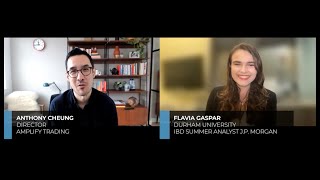
In this interview, Anthony Cheung talks with Flavia, a third‑year Chinese Studies student at Durham University who is interning at a boutique asset‑management firm in Hong Kong and has secured an investment‑banking internship at J.P. Morgan. Flavia explains how her humanities background became a differentiator rather than a hindrance, describing how she discovered finance through her university’s Finance Society, took on analyst roles, and taught herself financial concepts. She recounts the challenges of applying to spring weeks—multiple rejections and low morale—before a turning point came from intensive interview practice, including self‑recorded mock interviews and attention to small behavioural cues. The Amplify Summer Internship Programme (2021) provided a four‑fold boost: networking skills, community support, technical knowledge, and guidance on the complex application process, including CV/cover‑letter crafting and assessment‑centre dynamics. Flavia emphasizes the critical role of networking, sharing how a connection made during a spring‑week interview later led to her current Hong Kong internship. She also discusses practical workplace concerns such as appropriate footwear and attire, advocating comfort over strict norms. Finally, she shares her love for Hong Kong’s financial hub, its vibrant culture, and the importance of leveraging the city’s networking opportunities.
Chapters
Okay, hello and welcome. I'm joined by Flavia, who is joining the call from Hong Kong, but she's going to talk us through her journey since completing the Amplify Summer Internship Programme in 2021 to what she's doing today. So Flavia, how's it going?
Hi Anthony, thanks so much for having me first of all. And yeah, like Anthony said, my name is Flavia, I'm a third year at Durham University, I study Chinese Studies. I am currently in Hong Kong doing an internship at a boutique asset management company. I have secured an internship in IBD at JP Morgan. And yeah, I mean, like you said, I come from a bit of an unusual background. I do Chinese studies. So yeah, that's basically, that's basically me.
So, so I guess the first thing that jumps out to me is for people who are doing kind of untraditional disciplines at university that end up going to something like investment banking divisions. So Chinese Studies, how has that been a hindrance to applications? Has it been a benefit because it's different and it stands out? Like, what has the general vibe been with having Chinese Studies on your CV and then applying for IBD roles?
I would say absolutely not a hindrance, if anything a benefit, because, you know, most people coming from, come from economics or business background, maybe maths or engineering, and I'm usually the only person in the room who has a humanities background or languages background. And in any case, it makes you stand out, it makes your application stand out, it gives your interviewer something different to ask you about, something, you know, like, and genuine curiosity, people are really interested, why I decided to study Chinese Studies, you know, why I'm in Hong Kong, all that sort of stuff, why I was in Taiwan when I was getting interviewed by JPMorgan, for example. It's all these questions that make you stand out. And everyone— it's so hard to stand out when applying, so anything that's small that you think that will help you stand out, you should definitely mention. So, you know, Chinese studies, and yeah, actually Amplify for me, for example, did that as well. There's so many things I did through the summer program that also I was able to put my cover letter, mention on my CVs, and so on that helped me stand out. So I think it's about Yeah, just leveraging, leveraging your differences to really put you in a great stead for, uh, for interviews.
So prior to coming to Amplify, how did you know you wanted to learn more about finance, for example, like any role in finance?
Uh, sure. So I basically, my first year at Durham University studying Chinese studies, I was, I was a bit confused with what I was going to do with my degree in Chinese. Studies, I was like, am I going to become a translator? Will I become a political risk analyst? Do I become a spy? Yeah, so I sort of— yes. So I went to the Freshers' Fair and just tried out different, you know, met different people, looked at different career paths, and found the Finance Society. And honestly, I knew absolutely nothing about finance. Some people ask me like, oh, did you always want to go into finance? No, I had no idea what finance was. I went to their networking drinks, to the Finance Society's networking drinks in first year, and I just immediately clicked with people. It just— there's this environment and I just vibed with the people there. And for me, that was the first time that this is something that I could really, you know, pursue, something that could potentially interest me. And they were there, there were these two roles, market report analyst and investment fund analyst, I could apply for and do. And I applied for both of them, I got both of them, and you know, learning by doing kind of thing. The more I was putting— like, the more effort I was putting into these roles, the more I was getting out of it, the more I was learning about finance, you know, turning up to finance, to the Finance Society's events as well, and networking, that sort of stuff. So yeah, I mean, it was really, really baby steps, and I guess a lot of self-teaching. And if you're from a non-finance background, you'll know that that's really the case. Like, there's a lot of self-teaching, but you do get there. And I think it actually is a benefit to maybe not do a finance degree just because For example, I now know Chinese alongside finance, for example.
Yeah, and that's going to be— you are securing your future with learning that language and that culture, I'm sure. Being half Chinese, hopefully I can navigate my way through the coming years. But tell me about the application process. I mean, you're going to JPMorgan. I assume JPMorgan wasn't the only one that you were looking at or applying to, at least at the time. Time. So what was that experience like? Was there any failures? Was there something you did that really worked or didn't? And any advice on that side?
So for me, I guess, controversially, spring weeks were the more challenging thing than the summer. Yeah, for me, for the spring weeks, there were a lot of applications and a lot of rejections. And there were times when morale was kind of waning. And I think it's a sort of time when you want to rely on those around you to have a strong support network around you for that. And the ability to do one more application, learn from that application. Because what I like to say is that any application that you do is just not a waste of time. It might seem like a waste of time because you've spent X number of hours applying for that company, but it's still something that you learn. And for me, I guess the sort of turning point was when I started practicing my interviews. So I had an interview at Lazare, for example, and it just was an absolute car crash. I couldn't answer the questions. They asked me something, I started answering the question that I wanted them to have asked me, went on a massive tangent. And at the end of it, I was like, "Sorry, what was your question again?" So, you know, it's answering the question that you're asked. That's one of the big things. And also practicing your interviews. You can do it with someone else, but you can also do it yourself. For example, just have a list of questions. Cut them up, put them in a hat, and then record yourself answering them on Zoom, for example. And then you can see the small, the small ticks you have. So for example, for me to be playing with my hair, I'd always be playing with my hair or looking up instead of like looking at the camera. Small things like that that actually make that difference, that give you the confidence. So for me, yeah, applying for Spring was a massive, massive, massive steep learning curve. But then I think that sort of started to level off come summer. I did the Amplify program, yeah, as Anthony mentioned, in 2021. And that gave me a massive boost in confidence because I think the benefit of the program was— I mean, there were so many benefits. I like to think of it like sort of like fourfold. So for example, the networking, it taught me how to network properly. And the community at Amplify was just incredible. So everyone was happy to help each other, to leverage off each other, to leverage off their knowledge. Something else, for example, was the technical knowledge. Coming from a non-finance background, it was absolutely invaluable that I was exposed to, I mean, exposed to all the different divisions and exposed to so much technical knowledge that I could then apply in my interviews. And the third and fourth thing are sort of joint. The application process is quite long, quite complex. There's a lot of steps and I almost like to think of it as an art or craft that you sort of have to hone sort of thing. And, you know, it takes a village to get into, to get into banking, and Amplify was that village for me. So yeah, Amplify taught me how to apply, how to have my cover letter, my CV, and so on. But apart from that, there's like the soft skills that people sort of forget about. Like in an assessment center, you have group exercises, for example, and you need to know how to interact in a group. And it sounds so silly because I was like, oh, I can interact in a group, I'm a social being. But there's small things like, you know, being that person who takes lead of the conversation without being too overbearing or arrogant or that annoying person who just won't shut up. And you learn these things through the group exercises, for example, that, or I did, I did with Amplify, for example.
Yeah. No, look, I mean, talking to you, the thing that's always stood out is like your, your amazing energy. I think it's, you know, you radiate it and that's really like good to be around and have you as as part of our team for that period. And, uh, and also I'm sure in your internship now it's paying dividend and it will in the, in the future. So, well, a final thing then, and this might sound, um, a bit off tangent, but just before we came on we were talking about some ideas about potential things that we could collaborate on in the future to help other people. And I'm sure I'll drop the link in any description where this video is shared to Flavia's LinkedIn. I'm sure she's more than happy to help people, but we were talking about just little things that people generally don't talk about but are something what a lot of people think but perhaps don't know where to go. And one was about shoes. Tell me about shoes, women and heels.
Oh, absolutely, absolutely. So for me, one of my stresses going into work both in Hong Kong and also just thinking about starting to work in Canary Wharf What am I going to wear? What do people, you know, what's the sort of uniform that people have? Is it high heels? Is it medium heels? Is it flats? If people wear flats, do I stand out too much if I wear high heels? So it's really the small things that I think we should be more open in talking about because they seem so superficial, but they're genuine concerns and, you know, general anxiety-inducing sort of things. Like you want, as a human, you want to fit in. Like there's this desire to fit in. So yeah, I think it's something that needs to be spoken about a bit more.
So in your experience then, what is it? High heels, medium, flats? What's been your experience?
Oh, so for example, attire as well. General attire. So for example, I turn up to work in Hong Kong in a suit, so this is basically what I'd be wearing. But then there's other people who turn up in jeans. And then in For example, in Canada, I've heard of people just turning up in some of the companies in flats, but people turning up in small heels, maybe high heels are a bit too much. I started offering high heels, for example, here at my work here and ended up in Converse because no one really— no one seemed too upset about it. So it really depends. You have to feel comfortable in what you're wearing regardless of what the norm is. Like, if your go-to is high heels, go in high heels, you know, and other people can follow suit, I guess.
Yeah. And then how have you found just being in Hong Kong as a place, as a financial hub? I mean, what's that experience been like?
Oh God, I absolutely love Hong Kong. I've absolutely fallen in love with the city. I think it's so great. You have this financial district that it's, you know, this hub, but then you can take a 20-minute ferry and you can go on these amazing hikes on these islands with white beaches and turquoise water. And there's an energy, there's a buzz, there's incredible networking opportunities, which I've been trying to leverage on as much as I possibly can. Honestly, networking, that's another piece of advice, don't underestimate it. So for example, the reason why I'm in Hong Kong right now, the way I was able to find this internship when I didn't think I'd be able to find one is through networking. So there was someone that I met on my JPMorgan spring week who I spoke to. Carried on chatting to them throughout the summer. And then when I was in Taiwan in October looking for an internship in Hong Kong, they were the ones who recommended me to the CIO of the company that I work with now. So yeah, networking is just absolutely crucial. Cool.
Well, look, on that very good piece of advice, we'll end the conversation, but thank you very much for joining me. I know it's the evening your time, so I really appreciate you taking the time after work and yeah, Yeah, stay in touch and all the best. Thank you, Flavia.