Inside the Biggest M&A Deals You Need to Know (Meta & Scale AI, Toyota, Hulu, Dave's Hot Chicken)
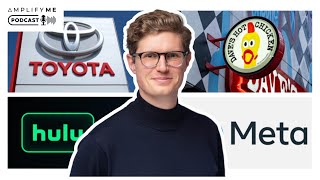
Anthony Cheung and Stephen Barnett break down major deals: Toyota's $33 billion acquisition of Toyota Industries, Disney paying $438.7 million for the remaining 33% of Hulu, Meta's $15 billion stake in Scale AI for AI training data, and Roark Capital's majority acquisition of Dave's Hot Chicken, which grew from a $900 pop-up to near-billion-dollar valuation.
Chapters
Hello and welcome back to another episode of The Deal Room, and we are going to talk about the investment banking scorecard. We like to dive into this every now and again by popular demand to see who the movers and shakers are. But there is one geographic region that is up over 400% year on year. Do you know who? You're about to find out. Really interesting stuff. And also, We've had a couple of M&A deals that we want to touch upon. One, the complex acquisition of Toyota Industries by Toyota. So how on earth has that happened and what is going on there? Definitely keeping it in the family. And then discussing Disney acquiring the final 33% stake in streamer Hulu, Meta's $14 billion investment in Scale AI, and then by popular demand as well, There was more than one comment actually, Steven, on this one. You know, people have got an affinity here for chicken wings because Raw Capital's investment in Dave's Hot Chicken, and you've made a note here saying this is a game changer. So I'm definitely interested to hear about this one.
This is an absolute game changer. I tell you what, I went on Dave's Hot Chicken's website and I'm not very good with spice, I have to say. And I kind of came out in a bit of a kind of a spice sweat just looking at the images of the website. So I don't think they're one for me, but it's definitely worth hanging on until the end of this episode because the origin story of this billion-dollar chicken company is quite remarkable. I really—
I did the same. I had a quick look and I was like, I mean, look, you have to, any US listeners will need to forgive us because this isn't within our region, but I was like, okay, what, signing waivers because of the level of spice and some people have died or something? I was like, okay. These are some hot wings.
Only in America. Yeah, America.
So yeah, but perhaps we can start then with the scorecard.
Yeah, absolutely.
Yeah.
We're going to cover these. We're going to go pretty thick and fast into these. There's a lot of stories and a lot to get through, but I really wanted, yeah, again, every kind of 6 to 8 weeks, we take a look at the investment banking scorecards, and we sometimes do a deep dive, sometimes we don't. But this one, one number, one country stood out. So I've got in front of me a chart that says year-to-date deal value in dollar billions and year-on-year percentage change in terms of M&A. And Japan, 414% increase in M&A activity. And this is something that we really, really need to be aware of because Japan was not necessarily previously closed for business from an M&A perspective, but it was deemed to be a little bit of an outlier, not necessarily even a hinterland. They just had a different way of doing things. Very, very complex conglomerate structures, not a great willingness to entertain activist investors. No real private equity involvement in it for a number of years, but there's been so much stuff, so many tailwinds that have led to this 414% increase. And it is worth noting for any students out there that we live in a global world, right? And we follow the money and the money is heading towards the Middle East and the money at the moment is heading towards Japan. So again, something to be aware of, but let's look into why the 414%. There are some macroeconomic factors, which I think we've discussed before. The weak yen, meaning that a dollar-denominated buyer would be able to buy, get more bang for their buck, quite literally. Low interest rates. Obviously, there's been 30 years of deflation in Japan, so borrowing is relatively cheap, but more importantly, more structurally, there has been a shifting of the corporate landscape. And I know we talk a lot about deals and we like, on this podcast, we like numbers and we like the big strategy stuff, but sometimes it's important to look at the legislation and the impact that legislation has on the nature of a particular industry. So there was a market, there were a series of market structure reforms in Japan Starting with a change to the Corporate Governance Code introduced by the government in 2022. And there are more initiatives, for example, the TSE and the METI. The TSE, I know, very exciting stuff. The TSE announced its action to implement management that is conscious of capital and stock price. Now, if you are an American listener or even a British listener, you would really, really hope that management is interested in the cost of capital and in their stock price. But what's tended to happen in a lot of large companies in Japan is they're still controlled by families or groups of private investors. There may be a small free float, but their interest in the oscillations of a share price hasn't really hit them. So, so this is moving Japan more to a kind of Western model and it's opening up a bunch of interesting stuff. And these companies are now in the market. You know, the game is afoot. And remember, Japan has got some of the best industrial companies, manufacturing companies, and I'll pause in a second, but I've just got a little image in front of me from a JP Morgan study that says that inbound M&A activity over the last 14 years has grown compound annual growth rate of almost 8%. That is significant growth over a 13-year period of US acquirers, Emirati acquirers buying assets in Japan.
So just finally, to close this, this conversation then for context, because obviously people will think, okay, 414%, like what is the US and Europe? So just so we are clear, what are those comparables on a geographic basis?
Yeah, Japan's still small. It's $150 billion of deal value year to date compared to Europe, double at $300 billion. The US, $750 billion. So it's, so it's still small, but the size of the deals are getting quite interesting, especially if you've got your M&A advisory hat on. I'm just going to give you a few of the biggest deals and maybe end on the Toyota deal that you mentioned at the top of the episode. So $3.3 billion deal, Bain Capital private equity acquisition of Mitsubishi Tanabe Pharma Corporation. From the Mitsubishi Chemical Group. This sounds a little bit like the splitting up of a conglomerate and a private equity buyer, right? Toyota and Daimler Truck merged their Japanese unit, $6.4 billion. Another maybe breaking up of that Toyota conglomerate, or at least restructuring. Nippon Life acquiring Resolution Life for over $10 billion. And then another take private, KKR and JIC taking a company called Topcon private, but for $2.3 billion. But the biggest one that was announced last week is Toyota acquiring Toyota Industries for $33 billion. And this is such an interesting deal because again, in normal M&A or in Western M&A, you would think about the acquisition price. You would think about whether it was a competitive process. You would think about the acquisition premium. All of these things would go into the analysis that you do and the things that we talk about. But in this case, there was only really one buyer that could ever really buy Toyota Industries, and that was Toyota, because Toyota already owns 39% of Toyota Industries. And it will happen because the voting rights are so heavily stacked in the buyer's favor. So it's almost akin to buying a subsidiary. Well, it is akin to buying a subsidiary, except that there are other— it's a listed company. So there are public asset managers, public investors that have invested in Toyota Industries separate to Toyota, the top co. So these investors are going, no, no, like you've paid a bargain basement price for Toyota Industries because there's not going to be this competitive environment because you are the only buyer in town and we are going to get screwed over here. I think the premium was a 23% premium to the pre-speculation price. So it's so interesting to see how these different tie-ups conglomerate discounts, unwinding of long-criticized cross-shareholding. It's starting to play out slowly and surely in Japan.
Cool. All right, well, let's move on and talk Disney and Hulu.
Disney and Hulu. Well, look, shout out to the Summer Analysts. We've got our first Summer Analyst cohort this week and for the next 2 weeks, and we've got 2 more. Cohorts coming up later this summer, which are still open if you want to get involved.
Link in the show notes, folks, for those interested.
Link in the show notes. You basically have to listen to Anthony at 3 PM every single day for 3 weeks. So if you want to do that as part of your summer, as part of your summer, then please do. But it's a lot more than that, obviously. But anyway, the reason why I say that is because Disney is one of our new simulations that is coming exclusively to the Summer Analyst Program. It's a 24-hour simulation, lots of interesting stuff. Some of the parts analysis, valuation analysis, some merger modeling as well. So very, very relevant that this headline popped up a few days ago. And the headline is that Disney is to pay Comcast $439 million to take full control of Hulu. Ending a lengthy valuation process. And this is such an interesting story just to get that extra layer of understanding about different M&A scenarios. So let me give you a very, very brief background. Hulu started, I think it was launched in like 2008, and it was actually a joint venture between 21st Century Fox. And NBCUniversal, which later was bought by Comcast. So effectively, 21st Century Fox owned 66% and Comcast owned 33%. In 2019, what did Walt Disney do? They bought 21st Century Fox in a mega acquisition. So they effectively gained control over Hulu, and Hulu which has now got upwards of 55 million subscribers and released shows like The Bear, which obviously was extremely popular. It's part of Disney's streaming strategy, right? But 33% still owned by Comcast. There was an agreement in 2019 that that 33% would eventually get sold by Comcast to Disney. But at a valuation floor of a valuation of $27.5 billion. So pro rata that for $33 billion. Wind back to, or actually go forward to 2023, and these discussions went live. Comcast wanted to shed the rest of the 33%. Disney wanted to fully consolidate and realize Hulu as a 100% owned entity. What Disney did is it paid the $27.5 billion prorated floor to say, look, you know, that is the minimum that we're going to pay for this remaining 33%. Let's engage with a bunch of valuers, a bunch of arbitrators to try and figure out whether, you know, as of 2024, now 2025, this thing, Hulu, is worth much more than $27.5 billion. So Disney had its advisors, its arbitrators, Comcast had, sorry, its appraisers, sorry. Comcast had its appraisers. Disney was coming out around $27.5 billion, as you can imagine. Comcast was like, no, I think this thing's probably worth more like $40 billion, which would give them a much bigger ticket. RBC Capital was engaged to do the appraisal, the third-party independent appraisal, which Disney and Comcast said, look, whatever they come up with in terms of the valuation over and above $27.5 billion, we are going to be happy with, right? That's it. So this $438.7 million is the result of the valuation over and above the $27.5 billion floor, giving the total enterprise value of Hulu somewhere in the region of $29 billion. But it's just a really, really interesting case study about how messy these things can be, right? You buy a company, it has a non-wholly owned subsidiary. What are you going to do with it? How much do you value the remaining percentage? And interestingly enough, the reason why you have to go through this appraisal process is because no one else is going to buy that 33%, right? It's a captive asset to Disney. It's already been integrated into their financial statements and into their strategy. So you've got to have a fair market valuation that isn't determined by a bidding process or a competitive process.
I can't remember all the details, but I seem to remember Disney having lots of issues, let's say, with the succession planning. And is it Bob Iger? And he was coming and going, and then there was kind of this foray down into double down into streaming, but then kind of Netflix is just such a beast. So just talk to me about what's the streaming landscape and what's the strategic implications of them now executing on that remaining stake?
Yeah, absolutely. It's a really good point. And Bob Iger's come and gone, I think 3 times now. He's back at the helm. He's one of those people a little bit like Howard Schultz at Starbucks. He just can't let it go. And Disney is an extremely complex beast. Anyone that does the Summer Analyst Program with us over the next few weeks will realize that its three different divisions, entertainment, experiences, and sports, are wildly different, right? You got theme parks sitting alongside Disney+, sitting alongside ESPN. The growth in the business quite understandably is coming through streaming. And if you've got Disney+, if you've got Hulu, and if you've got ESPN on demand, you are starting to create a pretty compelling package. And I think the way that we need to be thinking about the world of streaming is what are the 2 or 3 packages that are absolutely necessary for me to have the the best overall viewing experience. And it might end up that it's Disney with its Hulu and now, and with its ESPN and its Netflix as the two big players that continue to grow in this landscape. I'm not entirely sure, but the growth of Disney+ is outstripping everything else in that business.
Super interesting. I'm definitely keen to see our analyst output, let's say, from their analysis. But look, let's move the show on and talk a little bit about something I've seen lots of, you know, if you're part of the very niche finance memes on various social platforms, you would've seen quite a lot of Meta and AI in the last week or so. So what's this deal? Zuckerberg, it seems we've gone full board into the metaverse pivot, now AI. and now he's doubling down again.
Yeah. Can I just say, and obviously if anyone listens to this podcast regularly, you'll know that I'm not a huge fan of Meta. Can I just say that integrating Llama, its LLM, into WhatsApp is one of the most annoying things in the history of the world. I want my WhatsApp to do what WhatsApp does, which is just a chat function with my friends. As intuitive as possible. I don't need to get them to write me a story or to search the web. I've got other things that can do that. It annoys me, and I know that Meta is trying to become this everything app, but it's still a really, really frustrating and not something that I asked for. It just comes, right? Anyway, rant over. So this story: Meta plans to invest $15 billion in scale AI in a bid to catch up with rivals. So this is actually a $15 billion purchase of a 49% stake in this company Scale AI. And you might remember from previous episodes, whether it's, well, there's a lot of different case examples of the likes of Microsoft and Google. I think it was Microsoft paying $650 million to hire Mustafa Suleiman and his top lieutenants to get them away from the company that they were working with. Again, huge antitrust issues.
What ever happened to that? I remember that at the time and that was like, so, so what's he done like since then? It's gone quiet.
So, so, so Inflection, the key members of the Inflection team have joined Microsoft and it is currently being investigated by antitrust. Same goes for Google paying $2.7 billion for a similar arrangement with Character AI. Obviously, same goes for the arrangement between OpenAI and Microsoft. It's an acquisition through the back door in order to avoid regulatory scrutiny. And this 49%, $15 billion, you know, it's not a controlling stake, but the CEO of the company of Scale AI is joining the new kind of Meta Super Intelligent Labs. As part of that team. So it is an acquisition by any other means, right?
Just to be clear, this Alexander Wang character, he's what, 28 years old, something like that?
Yeah, he's 28 years old. And there's, I don't know whether there's kind of sour grapes, and I don't know enough about the industry to understand whether he's just a very good showperson and is very, very good at kind of pumping a story. Or whether Scale really is this transformational technology. What Scale does, by the way, in my mind, is super, super basic. And again, please correct me on the chat and on the comments if I'm wrong. It does the first thing whenever, when I'm researching this, first thing I'm looking at is that one sentence. And the one sentence is Scale AI does basically tagging, manual tagging for data that goes into large language models. So for large language models, it's all about the quality and the structuring and the tagging of huge, huge datasets, right? And often in order to get it 100% right, the tag needs to be done by a human. So cancer, you know, read the word cancer in a sentence and think that that relates to medicine, something really, really basic, right? Some basic tagging. And that's what this company started at. And obviously it's expanded to fill in other kind of enterprise elements, but I'm really interested to see whether this is properly going to move the needle for Meta that is well and truly behind the 8-ball with regards to the release of its Llama 4 large language model, which has been roundly trounced, A, for being terrible, but B, also for basically cheating in the kind of independent model at the independent University of Berkeley study. They cheated and basically said it was as powerful, more powerful than ChatGPT 4.0, whatever it might be. But actually that was only under certain parameters and it wasn't releasing that version of the model.
Stephen, you're talking down Meta again. I'm going to have to come on, come on. Where everyone knows when you see that chart and they release like the 4.01 issue of the software, we all know that that's, you know, they've played, they've fudged the books. They're all doing that. Surely you can't just be Meta that's doing this.
No, I don't know. I don't know enough about it. And please do put a comment in the YouTube if you know more than me. And again, maybe this is my inbuilt bias against Meta. If someone is going to control the AI landscape, I'm not entirely sure I want it to be Mark Zuckerberg. But anyway, there will be regulatory scrutiny, by the way. So this might not happen.
One thing as well, I know you're a big fan of Reddit and your base case for that was because of the fact that they're sitting on this kind of goldmine of unstructured information almost that would require systematic AI-driven labeling, surely. So isn't that like a use case of where this type of thing would be?
Yeah, it's definitely a use case. And I think the use case probably extends most saliently to datasets that are either proprietary or in some way classified or, yeah, or restricted in some way, shape, or form, right? So they've just released with their training, they've released a kind of I can't even remember what it's called. A military LLM application layer, because they've been through the process of structuring and helping to tag and organize vast terabytes of data that is held in different levels of classification. So I think that is a really interesting use case. Reddit possibly as well.
I think there's just something, there's something lurking in Stephen Barnett's WhatsApp messages that you just don't want out. I think that's the, underlying thread here.
I can tell you there's a lot of things lurking that I wouldn't want to come out. All right, let's move on.
Yeah, let's talk hot chicken, chicken wings.
Ah, this is my favorite story. And thank you for those people that said, put it on the podcast. Because we speak so often about high finance and big business and LLMs and GPTs and all this kind of stuff, which quite frankly is not my area of interest. Chicken, however, is definitely an area of interest for me. So the top, the headline is that Roark Capital, you might remember those guys from their acquisition of Subway, which we covered a couple of years ago. Roark Capital has acquired a majority stake in Dave's Hot Chicken. Now, Dave's Hot Chicken, this is a brilliant origin story. I'm just going to give you a little bit of the background. So At the age of 24, the founder, Arman Oganesyan, sorry for butchering the name, was making $50 a night as a stand-up comedian. And then he was just like, no, I think there could be a little bit of, there could be something here in this kind of chicken space. He loved Nashville hot chicken. So he pooled $900 in savings with, I think his, with his childhood friends, Dave and Tommy. I assume Dave is the Dave's Hot Chicken, and opened as a pop-up in a Los Angeles parking lot, right? $900. They begged, stole, and borrowed. I don't know if they stole, but they definitely begged and borrowed to get the truck and to get the kit. And within, at the, listen to this, at the end of their second month, they paid themselves for the first time, each taking home around $10,000 in cash. Within 2 months, they had made 10 grand each in that month.
That is insane.
That is bonkers.
Yeah. And like, so I just saw some notes here. They were selling Nashville hot chicken. I'm going to be super British here. If you're an American listener, please write me a short description. What's Nashville hot chicken as opposed to a different region of America, please?
Yeah, I can't help you with that. But they started making money and then in, this was a company that was a company, quote unquote, that was founded in 2017. In 20, so only 7 or 8 years ago, in 2019, an investor group, which includes now Dave's CEO, Dave's Chicken CEO, Bill Phelps, who's a bit of a legend in the industry, and Samuel L. Jackson bought a stake in the company. Which is, and they, and, and in order to scale and then franchise the brand. And obviously franchising for something like this is the ultimate power move. You scale up so much quicker if you can find a repeatable formula that you can franchise. And in fact, they've expanded to over 300 locations over the last 6 or 7 years via franchising. And listen to this as a growth rate. US sales grew 57% in 2024, reaching over $600 million. And although the deal value has not yet been announced, it is expected, and the CEO didn't actually deny, that it was around the billion-dollar mark. So this is an 8-year-old company that's received actually very, very little outside investment in the grand scheme of things, owned by a bunch of mates. That set up some chicken out of a van.
Oh, it's the dream.
In a car park.
Dream, Steven.
And now, and I, and I, and there's lots of other stuff that I want to talk about, but I really want to finish. I've got some great pictures of the founders, by the way, in my notes, looking extremely cool. So early Dave's investors aren't the only ones making money from the deal. Masterminded by Phelps, who's the CEO that came in in 2019, the company plans to give dozens of its employees significant bonuses. And then Ogunnaysen says he literally made 20 millionaires overnight from this deal. So what a story, right?
Oh, what a guy.
8 years. You've got your, again, is it survivorship bias? Do we cover all of the shacks and the pop-ups that just don't make it?
Question is, because you've been a founder before, as well as working in banking in your various episodes you've had. So in terms of here, they started in 2017, but they took on what seems to be a pretty experienced, well-versed person in 2019. So they're obviously making a lot of money. They could afford to do that. Do you think that was the pivot? Because I struggle to kind of see how you can have $10 in your back pocket or $900 and then take, sell it for a billion. 7 years later? Is it that, yeah, they're the brand, they're the cool guys, they've got the recipes, yes. But in order to scale to that magnitude and that accelerate at that speed, is that where that key hire, do you think, would've played the biggest difference?
Totally. Totally. And this guy, Bill Phelps, again, a bit of a kind of industry legend, put some money into the business, became CEO in 2019. And this for me is such a good learning for any young person that is looking to do something in the entrepreneurial space. There are some entrepreneurs, especially young ones or inexperienced ones, that can scale through the stages of business growth. Those are the exception. The rule is you've got something extremely valuable as a business owner or as a founder. Bottle whatever that is. And in the case of this company, it's all about the brand. It seems like these 3 guys, they're like legends in terms of marketing, legends in terms of building the brand, all of this stuff. Don't waste their energy kind of putting together a franchise infrastructure. That's not their sweet spot. Get them on the thing that they do best. Bring in a legendary CEO. They did it within 2 years. To have that level of you know, so knowing this from experience, having early success can easily make you think that you are a little bit of a, you know, a little bit of a player, right? Oh yeah, I can scale this thing. So to have the, to have the self-awareness to go, all right, 2 years in, we need to bring in someone experienced. It's super cool. It's a brilliant, brilliant story. So fair play to these guys. And And I'm going to challenge you because I know that they've released a new restaurant in, actually in London. I'm going to challenge you to the Reaper, which is the most extreme level of spice. It requires a liability waiver and it's sent at least one customer to hospital. I'm not going to be doing it, but I'm going to watch you do it.
Do you know what? It depends, like, what are the rules of the the game here, because I reckon it's not about it going in, it's about when it comes out that I'll have the problem with. So if, where's the winning post?
Well, let's just hope I'm not there for the latter.
Well, on that pleasant note, let's wrap it up there. Yeah. Let us know if there's any questions, comments. I think we did ask a few things there, which our US listeners will be more au fait with. So yeah, do drop us a comment. If you are not already subscribed to the channel, please do. More episodes coming on a weekly basis. And don't forget to check out the link as well. If you're a student this summer and you're thinking about your potential career in finance, upskilling, improving your CV, then check out the Summer Analyst Training Program. That link is in the show notes. Thank you, Stephen.
Thank you so much, Ant.
All right, take care.
More from Anthony


Inside the Biggest Banking Stories You Need to Know This Week (Anthropic, Diageo, Private Credit)


Inside the Biggest M&A Deals You Need to Know This Week (UniCredit, GameStop, eBay, Eli Lilly)







AI Breakthrough or Hype? Anthropic’s Claude Mythos, Tim Cook Steps Down & LIV Golf Collapse