Inside the Biggest PE & M&A Deals You Need to Know (KKR, Telegraph, Salesforce, Informatica)
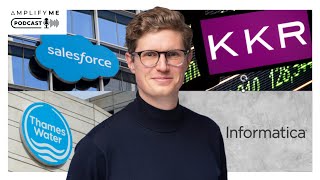
Anthony Cheung and Stephen break down PE and M&A moves: KKR pulled out of a £4 billion Thames Water rescue, PE fundraising dropped 35% in Q1 2025, the Telegraph is being sold to Redbird and UAE-based IMI, and Salesforce paid $8 billion for Informatica to push into agentic AI.
Chapters
Hello and welcome back to The Deal Room. And in this episode, we're going to go all in on private equity, starting with recruiting mania. You might have seen some press articles in the UK, at least in the FT, and it was talking about the hyper-competition, which is things like PE firms giving offers even 3 years in advance of start dates, which is pretty insane. So we're going to talk about that and how that's kind of shaking up recruitment pipelines and the investment banks and how they're operating on the hiring side. We're also going to talk about the latest with KKR and Thames Water. We did cover that in an episode just a few weeks ago. There has been some movement on that deal. And we're finishing with an update of PE fundraising and its implications. But I know a lot of you come here as well to hear about M&A deals, so can't go a conversation with Stephen without getting his latest thoughts about the longstanding acquisition of Telegraph. And then Salesforce announcing the acquisition of Informatica for $8 billion, the biggest deal last week. So Stephen, how are you?
Yeah, I'm okay, and I thought we'd talk about private equity in part because it's on my mind and in part because I was actually, I was out last week in Oxford, one of my favorite cities, judging the MBA Global Private Equity Competition. Where MBA schools from around the world had to submit a take-private leverage buyout and presentation. And yeah, we got the guys from Yale, from Kellogg, from Chicago, from Bocconi into Oxford to compete against Oxford. And guess who won?
We did. Bring it home.
Oxford. Oxford. What a deal.
Yeah.
They got, yeah, it was, look, there were some brilliant presentations and some really interesting perspectives on what makes a good LBO candidate. Because it's really, really interesting. And just before we go into this recruiting mania, there were 5 very different flavors of business. And there was a business that got discounted because it was too good a business. Where's the upside? You know, what can you actually change? There was a business that got discounted because it was too bad a business. There is no, there is not, you can't do enough to turn this company around. It's too much of a kind of a bad story. There was a business that got discounted because the model didn't work and it didn't make sense from a returns perspective. And there was a business that got discounted because the sector that it was in was in structural decline. So the only business that won was an underperforming business in a good market, which had real tangible things that you could do to improve the profitability and improve the exit multiple. So just when thinking about what makes a good LBO candidate, there's all sorts of things that don't make a good LBO candidate. And only one of those 5 companies just hit all of those different sweet spots. So maybe something to think about as we discuss private equity's recruiting mania. This is a pretty bonkers story. And I don't know about you, Ant, but when you were leaving university, were you being offered a job for 3 years' time? Because I certainly wasn't.
Funny you should say that. Because I remember in my second year at uni, I had applied for Ernst Young to do a placement year in my following year and then forgot all about it. And actually I got a letter 12 months later with a contract with full payment, bank, put my bank account details in. I even had phone calls saying, where are we? We're having some beers at the pub. You should come catch up with your mentor. And I was just like, hang about. So yes, I did get offered a job. Whilst I was at uni. And actually it turned out it was just a different Anthony Cheung. They had the wrong one. So I think I unfortunately didn't bank the other Anthony's first paycheck, but it was looking— I had a guy call me up from a bustling pub on Upper Street, he said, and I was sat in Nottingham at the time and he was going, where are you? We're all here. And I was like, yeah, I'll be there in 5.
Got the wrong guy.
Yeah.
That is a great story. Oh, the real— well, if the real Anthony Cheung is listening to this, I hope you're doing well at Ernst Young.
But no, but no, I'm not as desirable as some of— I'm about to hear some of these candidates are. No way.
So this is a story emanating out of Wall Street and out of the US, and this is private equity firms, the likes of Apollo and KKR and TPG, et cetera, offering graduates or soon-to-be graduates jobs 3 years after they have completed their investment bank analyst experience. So these are candidates that have already landed a job at Goldman Sachs or JP Morgan as an investment bank graduate analyst and are being locked in after those 3 years by the likes of Apollo, KKR, TPG, et cetera. And it is going from kind of the sublime to the ridiculous in terms of reports of clandestine meetings between, between candidates that are even on their internship, their second-year internship, nipping out in the middle of the night to go and speak to TPG about a job that is actually about 5 years in the future for a second-year intern, right? You've got to graduate. Then you've got to do your analyst, then you join TPG. And it is such an arms race and students are going to such extreme lengths to be in the right place at the right time for these interviews. There are stories of students who are, you know, celebrating their, the completion of their undergraduate college degree by going to Hawaii and then getting called back thousand-dollar ticket back to have that meeting with a, you know, with a recruiter at Apollo. It is, you know, it's a game that everyone is playing. And I would say it is a game that is getting totally out of control. You know, so it's just, you know, we record this at the beginning of June, 6th of June is when we're recording this. And there are private equity firms that are recruiting right now graduates for 3 years' time. It's not.
I can't imagine what this must do to the wellbeing of these candidates. I mean, in a positive and a negative way, I guess. I'm assuming in a negative way, just the level of stress must be insane. Like, you're in the midst of, let's say, a banking internship, you know, putting in the hours, And then you're having to also manage the stress of another shot, another process and another opportunity. But then on the other side of the coin, I can see it being a real negative in a sense of who are these students? I mean, they must think that they're like, I mean, they've not even worked a day in their life yet. And yet it's kind of like that high school prodigy basketball player. And it's like, hang about, can they play pros? And they're like, So the kid already thinks he's made it in the pros, starts acting like he's a pro, and he's not even done the hard yards yet.
I totally agree. This kind of inflated sense of self-esteem that must come by being part of this gravy train. And yeah, again, you haven't, you probably, you've never done a, you've never done a deal in your life, right? And yet you're being courted by and courting these different firms. It definitely At the end of the day, let's be totally honest. A lot of what you do in the first few years as an investment bank analyst and then as a private equity associate is grunt work, is hard labor, right? It's not, you're not using your genius in order to come up with amazing new structures. You're not a prodigy. You're just willing to work 80 or 90 hours a week doing spreadsheets. Again, obviously the upside reads through, bleeds through into the future years. But yeah, I would probably put my ego aside even if I was getting courted by the likes of TPG and Warburg Pincus.
So just to be clear to me then, like from the private equity side, why bother? Why not stick to the traditional method of let them go to school, i.e., investment banks, and then once they graduate school, year 3, they're ready to come into my company. And I therefore, I don't need to set up the structure. I don't need to get involved in all of this marketing and campus recruitment and all the rest of it. What are they getting out of going early when they can still pinch the talent later?
Yeah. And I think there's a sense that you would get the best can— you know, there's a, again, there's a bit of an arms race. You get the best candidates. Other people are trying to nab these potential superstars at a graduate level, as opposed to 3 years later, they might get the first pick of the bunch. I would really strongly refute that because the amount, you know, the, let's say these, these candidates are 21, 22 years old. A lot can change in your life in 3 years' time, in 3 years, right? You can learn so much about the person. Whether they can really cut it, whether they've actually got a kind of growth mentality, whether they actually want to do the job in 3 years' time. You know, that's an eighth of your life, right? You know, there's a lot of growing and developing that you can do. I would much rather just wait for a little bit of maturing and then get to see who the people are that are flourishing and could really be a good culture and strategic fit for my company. But it just seems that everything I think the process is broken. It's bonkers. And spare a thought for our beleaguered investment banks who are getting a little bit upset about all this, right? Yeah.
So I'm guessing, I know in the quant world, there are some pretty arduous get out of contract clauses, which means that you can't, you know, non-competes and so forth. I'm assuming a standard internship contract traditionally has not looked like that. Is that just where we are going to move to, which is just like lock-ins where they just can't do what they're doing?
Yeah, I think we can take JP Morgan as a good example. And Jamie Dimon's come out on the record and said that this private equity hiring is unethical. And I think absolutely, if you come as a student and you want to work at JP Morgan, You should not accept a future job 3 years later. You know, your foot's halfway out the door and effectively JPMorgan is paying you to get trained in order to jump ship, right? And what JPMorgan is now saying is, you know, stricter contracts, you know, the analyst program is now at least 3 years, mandatory disclosure of future job offers, and a warning that private equity job acceptances might impact staffing or employment status. Quite frankly, if I was JPMorgan and someone disclosed to me that they had a future job offer, I'd renege on that offer straight away. Just, it's a deeply flawed process. And quite frankly, people would, you know, people would cut off their arm for a career at JPMorgan. So if you've already got one foot out the door because you believe that it's just a stepping stone, I just, yeah. Even if in the back of your mind you think it's just a stepping stone, at least play the game, right?
Any solutions that you can think of right now, how to address this?
Well, so this is market failure, right? The process is broken. It doesn't work for private equity firms. It doesn't work for investment banks and it doesn't work for students. It's just, it's just a game that everyone seems to feel like they have to play. So maybe the private equity firms can get together and say, look, we're not doing this. Possibly quite difficult because there could be some kind of collusion concerns there. I would, if I was a young person and I had a little bit of an entrepreneurial streak, I would say that there's a, you know, whenever there's market failure, there's an opportunity, right? And is there an elite SAS training camp that you can provide that does the work of a 3-year analyst program in 6 months to expedite the process of joining a private equity firm so they can skip out the 3-year JPMorgans of this world, right? Because you know, these firms are using JPMorgan as a training ground. But they're also having to wait 3 years until these good people come on board. So there's got to be an opportunity there. Interested to see how this one kind of plays out.
So reading between the lines, what you're saying is they should come to AmplifyMe, they should take your full suite of private equity simulations you've created to expedite the process in 6 months, and there's your solution.
Look, I'll get them trained up. They will be the SAS of the private equity world. I'll even get them their own gilets.
There you go. All right. So KKR, I did see this headline earlier this week, but yeah, maybe just a bit of, first of all, what was the initial deal and then what's the latest?
Yeah, just a reminder, we featured this on the podcast a few weeks ago and it's very, very, I think one of the things that we sometimes struggle with in the world of finance and in the world of finance as entertainment. Is we love talking about these stories that probably don't really affect our lives that much. Whereas Thames Water, for 16 million people here in, here in the UK, it affects their lives, right? The pollution affects their lives. The cost of water affects their lives. And, you know, this is a story of Thames Water, one of the biggest water utilities in the UK, going from crisis to crisis, under £20 billion worth of debt. Only recently securing an emergency £3 billion loan from Silverpoint and from Elliott. And it got so hairy that I think the chairman went on record a couple of weeks ago and said at one point there was as little as 4 weeks' cash left for Thames Water before going totally bankrupt. And KKR, came in. There were 5 or 6 potential bidders to rescue this company. KKR was deemed to be the preferred partner and entered into 10 weeks of due diligence, really intense due diligence, hiring 100 due diligence experts from different consultancies and suchlike. And the hope was that KKR would have the structure, the strategy, the firepower to rescue Thames Water, to put in place an 8 to 10-year turnaround plan and, and, and things would be fine. But the headline, as was last week, was that KKR has withdrawn from the £4 billion rescue deal. It said in its statement, we will not be in a position to proceed and our preferred partner status has now lapsed. Now, this was interesting. Because it only, it was, it seemed like a very, very quick turnaround from KKR being the preferred partner. So it looked like it was kind of going through as soon as, as recently as the Friday before last. And then the announcement came out that KKR was withdrawing. Now there's lots of different potential reasons, you know, the difficulty over the structure, the debt burden, the amount of time that it would take to turn around. But there's a lot of commentators that are talking about the role that the Labour government and Keir Starmer played in KKR pulling out. So just going to do a couple of quotes. KKR, which only submitted its equity bid a week last Friday, harbour concerns over the scope for policy changes by Starmer's administration or future governments. So I think reading very loosely between the lines, KKR was looking for some guarantees here, right? Some guarantees in terms of the price of water, some guarantees in terms of potential subsidies and support and backstops if it was going to take on this massive liability that is Thames Water. And it felt, it seemed like The government was not playing ball. In fact, Ofwat, the, uh, independent, um, ombudsman for, for water, recently fined Thames Water £123 million for breaking the laws on its wastewater operations. So it doesn't seem like there's any leniency there or any wiggle room. And KKR were like, look, you know, we're not going to take this thing on if we're not going to have a positive relationship with the regulator. We're not going to have a positive, um, relationship with government as well.
In the end though, if they become, it becomes more precarious, the situation for Thames Water, it's a somewhat systemically important company in a sense of, as you described, it's a utility to a large portion of the country. The government will have to play ball. You could, let's make some assumptions here. So the government, when push comes to shove, has to play ball. And so does this not make then other PE firms or capital sources, does this not play in their favor where we've just got further down the precipice of like the cliff edge? And so actually now you could probably force an even better deal if you were the new PE firm coming in, having seen this one.
Yeah, it's an interesting one. And who knows whether it, this feels quite definitive. It doesn't necessarily feel like a a negotiating tactic from KKR. But there are 3 options now for Thames Water. The first is that it could fall into what's called a special administrative regime. And this is actually what the Environment Secretary, Steve Reid, said was possible, and they're ready for it. Basically going under government or national ownership. That's the first time a water company would've done that since 1989, by the way. There's still, I think there's still a kind of hope for a market-led solution. Now the market-led solution could be the existing bondholders, the owners of that £20 billion worth of debt coming together and announcing a restructuring plan that probably will involve a quite significant haircut on their bonds. But you know, that's probably the least of their worries at the moment. So that's option number 2, a restructuring from within. And then option number 3 is there were 5 other bidders. Well, there were 5 other interested parties, right? So if you remember CK Infrastructure, the Hong Kong company, big Hutchinson Hong Kong company, they were very interested. Few others that could still be on the table. So you never know, there might be a white knight that comes in and saves this thing from a private equity, well, yeah, for a kind of private equity end.
Can I just say for anyone who's watching the video version of this, Steven, you're doing very well to keep your composure as your dog runs around your feet there.
Yeah. Not only is the dog running around my feet, but it's also stolen my slipper. So there you go. Yeah. Watch the YouTube.
Look at that. You know, you said SAF in the PE world. You are the, literally, you're the corporal here. So, Well, let's finish this side of the conversation. Talk a little bit then about, just a bit, let's step back a little bit and talk about the more broader sector of private equity fundraising and what that looks like now that we are halfway through the year.
Yeah, let's, so the headline is that private equity fundraising has dropped 35% globally in Q1 2025 versus Q1 2024. Let's let that sink in, in the context of the first story, which is this mad rush to recruit investment bank analysts into private equity firms. Remember that recruitment, you might think that it's a cast-iron job 3 years hence, but think about the cyclicality, the cyclical nature of private equity. They're not beyond, it's not beyond their purview to renege on that offer. And you suddenly really upset JP Morgan, who you were working for, by saying that you had an offer at KKR. Then KKR say, we've got a hiring freeze and we can't, you know, try and think a few years ahead and just plot out all of these options because it's not looking particularly rosy for private equity, I have to say.
And just like, am I, I was just trying to think, so in investment banking terms, obviously some of the US banks have that culling of the bottom performers on an annual basis. Others have like the ebb and flow and the rug can be pulled quite quickly. In private equity, is there enough kind of precedent at a graduate level to understand whether or not there is that same boom and bust atmosphere, or could it just be assumed that PE and IBD is the same thing? So it's going to mimic the same kind of hiring patterns.
Yeah, it's a really interesting one. I think you're right to say that the precedent has not been established because the cohorts through the cycle have not been big enough. I mean, private equity firms are only really starting to recruit interns and graduates over the last few years in order to get ahead of the game. Private equity is obviously very different from investment banking in that you have a fund that is locked in for a number of years and pays a management fee. So if you are recruited to a particular fund and that fund's lifespan is 10 years or 12 years or whatever it might be, and the fees are 1.75% or 2%, there is a degree of job security that may not be apparent in the investment bank. Which goes through the oscillations of good M&A markets and not so good M&A markets. But on the flip side, there is performance and money on the line because you are contributing to the success of a fund. And therefore you need to show ROI in a way that maybe you don't quite need to show the same level of ROI in a bank. So if you are not very good, you know, if you are a bad hire, you will see the door very, very quickly. It won't be mass layoffs, maybe in the same way as you might see the investment bank through the cycle. But you need to be really, really good because this thing needs to make carry. This thing needs to make a significant return on its investments. And every contributor from the associate up to the to the fund manager that the GP needs to be pulling their weight. So yeah, definitely worth thinking about in the context of a career. And this is nothing new, right? We've known that private equity fundraising has significantly slowed. Reasons behind this. Well, again, the attractiveness of private equity, the luster, the shine of private equity has definitely come off. Because returns haven't been that good over the last couple of years. You look at any of the reports that track private equity buyout vintages through the cycle and compare it to returns on the S&P 500, even adjusting for fees, you know, from 2020 to 2019, 2020. So for 20 years, if you'd invested a pound, a dollar in private equity, you would've outperformed the S&P 500. From 2021 to 2025, you would've lost out to the S&P 500 because private equity firms bought a load of companies at inflated valuations in 2021 and before the rate hiking cycle of 2022 and are left with a bunch of companies that they can't flog and they can't make a no return on investment on. So they're trying all of these fancy things like continuation vehicles and kind of structured recapitalizations and all of this stuff. but it's not really delivering the IRR. So why would I put my money into private equity funds? The second reason is there are only, as I said at the top of this episode, there are only so many private equity targets, right? So private equity, which is now a $12 trillion assets under management industry, it can only be so big. You know, the strategies can only account not every company should be owned by private equity and the buyout strategy that underpins a lot of these different funds. So it stands to reason that there is a natural limit on the size of the private equity market relative to total assets under management. So yeah, so if fundraising is down, then hiring's going to be down because you need less analysts to fill the new funds.
Right. As you said earlier, we're recording this on the 6th of June, so it's Friday. This isn't going out till Monday, but you've had the big beautiful bust-up happen in the last 24 hours between Trump and Musk. One would think that's going to get a lot worse knowing Musk's style. So tying that back to the private equity landscape for the next 6 months, looking forward, one of the things here you talk about, you know, kind of macroeconomic volatility and Trump is kind of epicenter through his tariff policies to the macroeconomic climate globally. I don't see anywhere of that changing, i.e., could become more volatile. So is it not looking good either for the next 6-month horizon, at least sort of short term?
Yeah, this, I mean, and this kind of expands across M&A in the kind of short to medium-term outlook. Whenever I teach, whenever I teach on this subject, I always say, look, the two most important contributing factors to a buoyant M&A or a buoyant buyout market are interest rates. We always know that the answer is interest rates and stability. Doesn't necessarily need to be exuberance or confidence or whatever. It just needs to be certainty and stability because what we are doing as analysts is we're getting our Excel-shaped crystal ball out and we are trying to forecast returns out into the future. And if there is significant macroeconomic volatility, you're not going to be able to have any certainty that your returns are going to match what you've modeled, right? Your base case scenario is going to be so dramatically different from your downside case. All of your sensitivity analysis, analyses are going to produce wildly different results depending on tariff levels for input, for inputs into the product whose company that you're trying to buy. So I would be sitting on my hands and just being like, interest rates aren't particularly low, they're not particularly high. That's kind of almost a moot point to an extent, but it's this certainty factor that's going to stop deals being done and it's going to make private equity as an asset class slightly more under threat.
To finish then, maybe on this section, what if I was one of these students, had locked in JP and then locked in Apollo and left JP, and then the rug gets pulled, the PE market declines, I'm out on my ear out of Apollo within 6 months. Where does that leave me?
It's really interesting. So private equity is a very, very employable set of skills, if you've been there, I mean, even if you've only been there for a short amount of time, the advantage of being in private equity is your off-ramp is either, you know, a smaller private equity firm, a middle market investor, maybe private credit, maybe a distressed debt fund. There are all of these kind of growths, these additions that are still relatively buoyant outside of pure private equity buyout. But also you have operating experience or you are at least adjacent to operating experience. It's one thing you just don't get in M&A. You don't get to see how a company is working, operating, and being turned around. So a lot of private equity, as if you get to a kind of reasonable level, you've got the ability to go in as a, you know, as a head of strategy or head of corporate development or even CFO at a large-ish company in an industry that you might have a degree of expertise in. So the off-ramps are fine. I think if you get the rug pulled within 6 months of a job at Apollo, you might be knocking back on the door of a JP Morgan with your tail between your legs. But let's hope that doesn't happen to any listeners.
Alright, well look, we've got a couple of deals here that we need to also get through, so maybe we can move on and talk about The Telegraph.
Yeah, Telegraph. This takes me back. This is the Daily Telegraph, the broadsheet, the UK right-leaning broadsheet that we covered. I was looking back on my notes. We covered back in November 2023. So there you go. Wow. Year and a half, or more than a year and a half ago. And even in November 2023, this deal had been dragging on for quite a long time. And this was, so the deal was Telegraph up for sale, potentially being bought by Redbird, which is a US private equity firm, and IMI, which is a Middle East UAE investment vehicle. And it was proposed back in November 2023, and it has just been announced and confirmed. And the quote that I'm going to give from the FT Says after 717 days, 2 law changes, 1 election, and a revolving cast of Tory power brokers, they've finally done the sale. Might be drawing to us. It might have done the sale. There's still a few regulatory things to get over. And this is all about, and it's super, super interesting. It's all about the extent to which the British media landscape should be under the control of British owners. Is there a threat to the UK that something like the Daily Telegraph is owned in part by the US, by a US private equity firm, but also by the UAE? And actually, as part of this long-going 717-day saga, you know, the UAE's IMI Fund led by Sheikh Mansour, he's the guy that owns Man City, got really upset. He was just like, look, you know, why are all these politicians hating on me rescuing a struggling loss-making, you know, broadsheet? I want to uphold journalistic integrity. I don't want to be the editor. I just want to invest in it. You know, why do you think that having Middle Eastern ownership is going to in some way have a national security implication? Like there's something not quite right about that. You were very, very happy to take my kind of my donations to the party a few years ago. And now you're not letting me even invest in the Daily Telegraph, but it seems like it might get through. And just to give a little bit of a focus on Redbird's strategy. So Redbird's strategy, so these guys, $12 billion private equity fund, they own, I think, AC Milan, Skydance Media. They're in the process of acquiring Paramount. They want, they want The Telegraph to be a leading voice for the kind of center-right. They also want The Telegraph potentially to have a presence in the US. Which I find quite strategically interesting. The US, uh, kind of print journalism market's relatively saturated, and I'm not sure whether The Telegraph can make a significant impact or imprint, uh, excuse the pun, into the country. But, uh, but yeah, so that, you know, they've got big plans, obviously online, subscription-based, et cetera, et cetera, the usual stuff. But yeah, we'll see where this one goes. Again, if we're actually thinking about day-to-day, this one does have an impact because a lot of people still read The Telegraph.
Yeah, I wonder how many of our listeners read The Telegraph. They'll have to let us know in the comment section. Without showing too many political colours here. Yeah, and then the final deal, because actually someone did leave a comment. You have to forgive me, I can't remember their name, but they did leave a comment. Asking specifically, and we always listen, of the Salesforce deal on Informatica, which was a pretty big one, right?
Yeah. So this is Salesforce agreeing to acquire Informatica in a deal worth $8 billion. I'm going to get into the strategy pretty quickly. I just want to do a little bit of a background. So Salesforce were flirting with Informatica this time last year, April last year, when Informatica's market cap was up at $11 billion. They were thinking about potentially acquiring the company for upwards of $13 billion. Deal couldn't be— I don't think, you know, the terms weren't there. The deal fell through. And now they're back at the table picking up Informatica for $8 billion. So I don't know whether there was someone, someone on the board at Informatica saying, you're selling too cheap. For $13 billion last year, who's now got significant egg on their face having to say, all right, we'll sell for $8 billion. You know, you've just lost 40% of value right there. But anyway, Salesforce. Salesforce are an interesting company, obviously one of the world's most, well, the world's most established enterprise SaaS CRM, relationship management software. Company. They're quite acquisitive. They bought, if you remember, they bought Slack a few years ago for $27 billion. They've bought Tableau, a kind of data representation and data structuring software as well. And they are making, as a lot of these types of companies are, they're making an absolutely huge push into agentic AI. They already bought a company called MuleSoft a few years ago, which again is all architecture and data infrastructure for this move towards agent-driven AI processes. And I don't know whether— there's a load of adverts about the Salesforce agentic AI that are coming out on the television at the moment. They're making a massive push And just a bit of background, you know, Agentic AI is deemed to be, or hoped to be, the big, big, big mega moneymaker, the actual underlying use case at an enterprise level of this new wave of artificial intelligence. I think there's a general opinion that the chatbots and the OpenAIs are are good and interesting. Very, very hard to figure out really how to make, you know, multiple hundreds of billions of dollars. But within enterprises, these agentic AIs, which basically have the ability to make decisions and tie together many different processes together, uh, and react to the data that exists within these different processes, that is going to be the way that you're really, really going to see the value. Of AI. Now, I would say that there's a lot of hype here, right? These autonomous agents, very, very hypey. And, and you know as well as me and anyone that's been in a business before knows that processes are super variable. Data is very unstructured, requiring lots of different parameters. And lots of, you know, rabbit holes to go down in order to derive the right set of data in order to power the right process that will lead to another joined-up process that will lead to an outcome. It's still very, very difficult to get anywhere, even with these amazing autonomous agents. So yeah, let's wait and see. Salesforce are on the front foot. They think that this is going to be the future. We're gonna have to wait and see.
Yeah. And I'm assuming like the competitive tension would be players like ServiceNow, people of the same domain who are competing. And I know ServiceNow are heavy, heavy pushing AI themselves. It's exactly the same play, essentially the same thing. So who are advising on these deals? Because I mean, this is $8 billion. This is a pretty big fee for the year, right?
Yeah. So this is JPMorgan on the Salesforce side. And Goldman Sachs on the Informatica side. So if you look at the M&A league tables, you'll see a little spike for both of those guys. Again, by the way, there could be some antitrust concerns because Salesforce bought MuleSoft a few years ago. Feels like they do quite similar things. Is this market capture? I think it'll probably get through because it's big but not massive and the Trump administration seems not unfavorable towards these types of deals. Again, I'm not an expert in terms of the way that Informatica is going to transform Agentic AI within Salesforce, but they're certainly putting their stall out, right?
With software deals being fairly common, just not now, but generally, does the lead person from JP Morgan and the lead person from Goldman Sachs know each other? Intimately. And then so what does that battle look like? I'm just thinking maybe I'm getting carried away with like Succession in my head or something like that where it's like, you know, cloak and dagger. But how, what does that look like in reality?
Yeah, they will definitely know each other. They would've been to the same drinks parties, the same watering holes and the same conferences, and they would've heard each other speak and they would've been on the other side of plenty of deals together. And what's, what's good about that is that they know each other's, they know, they know each other's positions, they can talk kind of person to person, there's a relationship there, they can potentially take, you know, take things, to use a horrible phrase, take things offline and just have a right, okay, this is what my client is actually wanting. You know, they're saying this, but what they actually want is that they have to say this from a You know, from an optics perspective, but this is where the hard line is. And if you've got a relationship with that other side, that counterparty, you can have those types of conversations that actually smooth deals over so much more than if you're up against someone that you've never worked with, you don't know from Adam, and, you know, they might be a totally different, totally different style of negotiation or whatever it might be.
What's the formal line between like the transfer of information then? Because as you've described, I could imagine if I'm, let's say I'm Goldman's, your JP, and we've known each other a long time, we like each other. It's in both our interests. We get maximum price for maximum fee, but surely this can have a conflict of interest with then operating in and around the boards that we represent, the company we represent and so forth. Like what's the actual lines here? Or are they fairly grey?
They're definitely grey. If I was an MD working on this deal, acting on behalf of Salesforce, I would be very, very clear. I would get very, very clear approval from the board that I can discuss certain things in a person-to-person interaction. And it might— and Salesforce might say, look, you know, I am open to you saying that our, you know, our maximum price is X, and I want you to go away and make sure that you've communicated that successfully. So it— you can't, you can't take— you can't have a kind of backline conversation that is totally unsolicited and unsigned off. But part of your skill, And this is again, this move from being a producer of spreadsheets to being a really, really good human negotiator is to find that area of common ground, to know where your limits are, to know what you can and can't say, and try and find that, you know, that, that number that works for both parties. And that's where the skill comes in. That's where the fun comes in, really.
Yeah. All right. Well, look, Thank you as always, Stephen. We'll wrap it up there. And for anyone watching on Spotify, you might notice that you can see us now. We're in video, full video format. So please do drop us a message if you prefer this or just the audio. It's a new change. We're happy to do what you, you, the community like. So let us know in the comments. Otherwise, we'll see you next week. Thank you very much, Stephen.
Thanks, Ant.
More from Anthony


Inside the Biggest Banking Stories You Need to Know This Week (Anthropic, Diageo, Private Credit)


Inside the Biggest M&A Deals You Need to Know This Week (UniCredit, GameStop, eBay, Eli Lilly)







AI Breakthrough or Hype? Anthropic’s Claude Mythos, Tim Cook Steps Down & LIV Golf Collapse