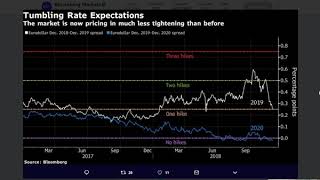
In this commentary, the presenter reviews the immediate market response to Federal Reserve Chair Jerome Powell’s dovish remarks, focusing on EUR/USD, gold, and the S&P 500, noting sizable moves on the day of the speech but little follow‑through the next day. He then examines market‑implied expectations for Fed rate hikes in 2019 and 2020 using the spread between December 2018 and December 2019 Euro‑dollar futures contracts, showing that pricing has shifted to anticipate only one hike in 2019 and none in 2020, well below the Fed’s own dot‑plot. The discussion moves to the concept of the neutral rate, highlighting Powell’s abrupt change from saying the economy was “nowhere near” the neutral rate in early October to stating it was “just below” the neutral rate, and the potential damage to the Fed’s credibility. The presenter speculates on a political motive—suggesting Powell’s dovish turn may have been timed to limit President Trump’s ability to blame the Fed ahead of the G20 summit—while also acknowledging this as a conspiracy theory. He then draws a parallel to former Bank of England Governor Mark Carney, dubbed the “unreliable boyfriend” for his rapid policy reversals, and coins the phrase “unreliable granddad” for Powell, framing it as a meme to capture concerns about central‑bank credibility. The overall narrative blends market analysis, policy interpretation, political speculation, and humor.
Chapters
Okay guys, thought I'd just jump on the mic, have a quick catch-up just to kind of— I know earlier in the briefing would have obviously covered off the market reaction to Powell and the dovish tilt to Powell's— Jerome Powell, Fed chair's comments yesterday, but I thought I'd come on and just add a little bit to it. So Um, just, just firstly reviewing the charts, and, and, uh, obviously in the main markets are still right up there around the extreme sort of area of the moves from yesterday. So, um, draw a red box here on the EUR/USD because the big explosion higher Certainly this dollar weakness driving the euro-dollar exchange rate sharply up. And here we are actually right now trading, you know, right at the top end of that range from yesterday. So, so, you know, definitely dollar weakness, but no, no real extension and follow-through yet. Today we're up here trading at yesterday's extremes, but as it stands really catching resistance back at the high point from Monday, and that's kind of just killed it for now. So no extension on yesterday's gains. Yesterday's gains were large-ish though, large-ish. It's not a massive move. I mean, we didn't even make a new high for the week, or sorry, I guess technically we did actually, but by like 5 pips or something. So You know, in the end we moved from the 113 handle to the 114 handle. It was a 100-pip move, which, you know, for a major Fed Chair speech isn't, isn't massive. Um, let's have a look at gold. So this is the gold move. I'd say relatively is bigger in that gold did make a new high for the week because Monday's double I saw that's Tuesday's high. My apologies. Yeah, so it's the same, isn't it? This is Monday's high. So gold didn't make a new high for the week either. It did spike. What is that, $16? And we hit the high point from— let me just move that line— we hit the high point from Monday and that we didn't quite get there and then that killed it. We had a 50% retracement, but here we are now trading around the highs from yesterday's spike. Okay. On the equity front, let's go to that 60-minute timeframe like the other charts. So here, you know, same, same scenario on the one hand in that the S&P is trading at levels that we were trading last night after that move. But for stocks, it's definitely the case that definitely we made new highs for the week. Clearly. And if you go to the daily chart, new high for the week, but you know, in the end it was this, this resistance. If I draw the line there, this kind of triple top that we had 14th, 16th, 19th of November. It's kind of just capped things now. So the point I'm saying here by looking across these markets is that decent-sized moves yesterday, but no further extensions today. So I wanted maybe explore the idea as to why that might be the case. Now let's talk about the current sort of probabilities of the Federal Reserve hiking interest rates in 2019, because this is the big topic. We're nailed on for the Fed to hike rates for a fourth time this year, and that's gonna happen in two weeks' time. Okay, we have 3 weeks' time. Now, that, that's locked in really. Something extraordinary has got to happen at the G20 summit over the weekend, something extraordinarily bad for the December hike to be taken off the table. So it's definitely more about a 2019 story for markets. How many times will the Fed hike in 2019? And I just as a reminder of the interest rate hiking cycle so far. It has been speeding up. So looking at this chart on Trading Economics, one hike December 2015, so one hike in 2015, one hike in 2016, three hikes in 2017, four hikes assuming they hike in December, four hikes in 2018, so that That curve's been steepening. But as that whole concern around sustainability of growth, US and globally, has kind of gathered speed, that, that whole risk that maybe we've peaked. So Powell's come on and tried to be more dovish yesterday and try to kind of steer our expectations lower for the number of hikes the Fed might put through the system in 2019. Right. So it's all about 2019 expectations. So here's a really good chart which is tracking actually interest rate hike expectations for 2019 and interest rate hike expectations for 2020. Now let's look at the, the white line first. Now the white line, look, this is the spread. It's the euro-dollar spread between the December 2018 contract and the December 2019 contract. And it's looking at the, the difference in percentage points on this spread comparing the end of this year to the end of next year. So in other words, the spread is really representing the number of rate hikes in 2019. And as you can see, this white line, ever since we kind of peaked in, in October, this white line has come sharply lower. Now it peaked up at 0.6, so that means that the spread between Dec '18 and Dec '19 was 0.6%. Now, because the Fed hike in 25 basis point increments, so 0.25% each time, well, a 0.6% spread is actually— that we— that's pricing just over 2 rate hikes in 2019. So even when things were at their most bullish, a couple of months back and, you know, the Fed were being hawkish, actually market pricing didn't get to pricing 3 hikes next year. So that's one thing to note, that market pricing here has always been a lot more dovish than the Fed have been communicating. So maybe one of the reasons why market reaction, yes, was decent yesterday but no follow-through today, is because really markets were priced for less than 3 hikes, even at the height of this growth momentum back in the summer. So what's happened in the last couple of months is this white line has not only gone down below 0.5%, it's actually— it's now down, as of last night, it's now down to 0.25%. Believe it or not, the EUR/USD market is currently pricing now just 1 hike in 2019. When in 2019? Well, that's debatable. First half would be the idea, right? So do understand that market pricing is very dovish now. Look at 20— look at the 2020 line. So the 2020 line, pretty much all year has been down, um, at 0.1 or less. And here we are now, officially below zero, but it's basically on zero. So What the EURUSD market is telling us, it's telling us they're priced for 1 hike in 2019 and 0 hikes in 2020. Basically 1 more hike in this hiking cycle. So that would basically be— well, sorry, that's not including the hike that's expected in 3 weeks. So really 2 more hikes left in the cycle, 1 in December coming up, and then one in 2019. So that would take rates to 2.75%. This is according to market pricing. That's definitely lower than the Fed's dot plot matrix. But this now turns my attention back to what Powell said last night, and perhaps the critical comment or line or sentence was that we are just below the neutral rate. Now, why is that important? So this whole neutral rate, that's the level of interest rates that the Fed think will lead to an economic system that is neither accelerating in expansion nor decelerating in expansion. It's the optimum interest rate to deliver sustained economic growth. Okay, the neutral rate. So the top of the cycle is the neutral rate. Okay, now in previous cycles, they've often got it wrong in that they've hiked rates too far, rates have gone too high, and in the end, with hindsight, it was clear that actually they hiked over and above the neutral rate. So then rates were too high, and that had a drag on the economy, and it tipped it into a recession. Um, so this is what the neutral rate means. Now, why was Powell's comment yesterday so surprising, and why did markets move quite rapidly in the way they did? It's really because of how Powell has changed his message. Because if you go back to the start of October, Powell said we are nowhere near the neutral rate. Powell's words. That is after they'd hiked in September. So he said this in October. Interest rates in October are the same level as interest rates are now in America. Start of October, he said we are nowhere near the neutral rate. And then he turns up yesterday and he says we are just below the neutral rate. That's a pretty big change in opinion from the Fed chair. He's got to be a little bit careful, I think, Mr. Powell. Now, there's a conspiracy theory that is linking his change in message to, um, due to Donald Trump and due to the G20 summit. I don't necessarily buy into this conspiracy theory, but basically some are saying that he's become more dovish just before the G20 so that it removes Trump's go-to excuse for why the stock market has dropped so sharply. Because Trump's been blaming the Fed and blaming the Fed and blaming the Fed. In fact, just this week, well, before his speech yesterday, he was saying Trump was saying, I am not happy at all with Jay's performance since I picked him. So here now Powell's turned dovish, maybe to remove that excuse for Trump so that he's going into the G20 summit knowing that if he just puts fuel to the flames of this trade war risk, and if he starts shouting and blaming and threatening, and they come out of the G20 summit with no progress, in fact, the reverse and this whole trade war risk escalates, well then yeah, the S&P is going to go down. And at that point, Trump can't blame the Fed because, well, the Fed have just turned dovish. So then the blame is entirely at his door. He's the aggressor towards China, and that alone is leading to the stock market dropping. And because he's so obsessed with the level of the stock market as a barometer for the success of his administration, perhaps he's left a bit naked, and therefore Powell has turned dovish just before the G20 so that Trump kind of has to make some kind of progress towards a future deal with China on trade. That's a bit of a conspiracy theory. I think more likely Powell's just caved a little bit under the relentless criticism from the White House and has maybe just toned it down. Maybe, I don't know, maybe that's harsh. Maybe he has looked at the data and thinks it now is appropriate. But my, my point is you can't go from saying we're nowhere near the neutral rate to then saying we're just below the neutral rate. You can't make that change in 6 weeks without damaging your credibility. So this comes to my final point. Credibility is key for a central bank. That basically means when you say something about future guidance, markets and people believe you. You have to be credible. That's actually one of the mechanisms that makes monetary policy most effective—forward guidance. It's guiding the economic system as to what interest rates are going to be in the future. And this is important when you're, let's say, a business owner, for example. You know, are you looking to borrow and invest in your, in your business's growth? Yes or no? Well, there's a lot of factors involved in that decision, but one of them might be the cost of debt. And is there any kind of visibility on how expensive debt will be in the future? And this is what the Fed's forward guidance is all about. But then, if the Fed are prone to changing their mind quite dramatically in short spaces of time, well, then our trust in their forward guidance gets eroded, and that itself can be literally in itself be a negative for economic growth. So there's one other big kind of big-gun central banker that's built a reputation for for himself in terms of changing his mind. I wonder if anybody knows who I might be referring to. Who else has been considered as unreliable as a central bank chief? Type in the room if you know who I'm talking about. I'll give you 30 seconds. Good. Not Draghi, Andrew. It's Mr. Carney. And I'm gonna— and watch this, watch this. I'm just gonna go to Google, okay? I haven't set this up. Go to Google. Just Google unreliable boyfriend. Nothing else. Just Google unreliable boyfriend and hit enter. The picture of Sam North is not the result. The second natural result is the BBC article, 'Is Carney an unreliable boyfriend?' He's built a reputation for himself— this goes back to like 2017 really, and into the start of this year where he quite dramatically changed his mind and his stance and his guidance, going from very hawkish to all of a sudden very dovish in a short space of time. So the unreliable boyfriend is Mark Carney. So just talking to Ant about this, so perhaps we should start a new trend here, and given Jerome is a little bit older than Mr. Carney, Jerome Powell, perhaps this is the beginning of the unreliable granddad. We're coining the phrase. Let's Google search that. Unreliable grandparents. When your parents suck as grandparents. Okay. I won't click into any of these just in case. But yeah, you heard it here first. Jerome Powell, hashtag unreliable granddad. Let's get that trending.