Is Joe Biden's Spending Bill in Trouble?
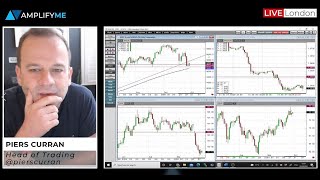
In this September 30, 2021 market briefing, the host opens by promoting the new AmplifyMe.com platform, which offers free finance simulations and market newsletters. He then provides a rapid macro‑market overview across four asset classes – US equities (S&P 500), EUR/USD, US Treasury yields, and oil – highlighting a recent steep sell‑off in equities, a dollar‑strengthening move in EUR/USD, stabilising bond yields after a steepening phase, and oil price hovering just below the $77 per‑barrel psychological level. The briefing moves to macro data: Chinese manufacturing PMI fell below the 50‑point growth threshold (both the state‑owned and private surveys), Evergrande missed another dollar‑denominated bond payment, and the UK’s Q2 GDP surprised at 5.5 % YoY, though the host notes the UK economy remains far below pre‑pandemic size. The core political segment explains the status of President Biden’s two major spending bills – the $1.2 trillion bipartisan infrastructure bill (passed the Senate, pending House vote) and the larger $3.5 trillion social‑safety‑net bill – and why internal Democratic opposition (Sen. Manchin, Sen. Sinema) and electoral concerns are stalling progress, prompting Speaker Pelosi to push the infrastructure bill forward. The host then summarises recent central‑bank commentary from the Sintra conference (BOJ’s Kuroda, ECB’s Lagarde, Fed’s Powell, BoE’s Bailey), emphasizing supply‑chain bottlenecks, inflation outlooks, and growth forecasts. Oil market fundamentals are revisited with DOE data showing an unexpected supply increase after Hurricane Ida, supporting a bullish view on oil. The pound is shown at its lowest level of the year, with technical bearishness highlighted. Finally, the host asks viewers to predict the NASDAQ level at year‑end, outlines the upcoming data calendar (European inflation, US Q2 GDP, Chicago PMI, Fed testimony), and wraps up the briefing.
Chapters
Okay, good morning everyone. It's the 30th of September, it's just gone 8 AM here in London. Welcome to The Briefing. Just before we kick off on all the macro and market stuff, just wanted to point you towards our brand new platform. We're very proud of this, just launched AmplifyMe.com. In short and without being too dramatic, our mission is to democratize opportunities in finance for all. So it doesn't matter where you are, doesn't matter what you look like, what gender, where you study, or what you study even. All of those things are irrelevant. What we're interested in is finding out if you've got natural talent to do some of these roles on an investment bank trading floor. Roles such as sales trading and market making. Also, have you got natural talent to be an asset manager? So we're making some of our simulations free. Come on to the platform, book onto a sim, zero charge. And the great beauty of this is you'll get to experience different roles in finance. You'll get to learn more about how the industry operates. But the, the cherry on top is you'll get a load of performance data showing how you performed. And actually, that very data can literally get you hired. And that's because these simulations are also used by some of the big banks like Morgan Stanley and Credit Suisse and Citigroup. All these banks use our simulations on their intern and grad programs, and they use our sims because it's the best way to get their new hires desk ready. Our simulations are the closest to the, the real thing as you can get, and so that's why they use it to train their new staff. So these banks have told us, look, we want talent, can you help us find talent? And this AmplifyMe platform is us trying to help them find talent. So please come on, it's entirely for free, AmplifyMe.com. Come on, book yourself onto a free sim and come and see what you've got. Also, part of this platform is not just the simulations, but we've got a market maker daily newsletter we email out and also plenty of other content around markets. And you can come and find the market briefing here, for example, if this thing loads up. So you can see actually that's the briefing from yesterday. So as soon as I finish this, bang, it's up on this platform. But also we— you can access our podcast through here that we do generally once a week. Here's our Finance Accelerator simulation, and then lots of careers advice and industry insights. And then we've got some other learning pathways here as well. Okay, so come and check it out, uh, be good to see you on the platform. Um, right, let's get into the mix. And actually, before I do, just want to say thank you for all of your comments, uh, in— yes, on yesterday's briefing. Uh, really great to get engagement, uh, from the audience. It shows us that there are people out there listening, and, um, we really appreciate that. So I'm going to be asking you for another comment today, but wait for it because I'm going to ask you a question as we go through this briefing and I want to get your thoughts. This is actually a markets-related question, so I'm going to come on to that in a minute. But look, let's get you up to date. I'm going to bring up the charts here and I'm just going to start on the dailies. Actually, that, that EURUSD chart is not a daily chart. Let me just change that right now. So we're going to kick off on the dailies. Um, so we've got, remember, the S&P to represent the equity asset class top left. We've got the EURUSD to represent the FX asset class, top right. We've got T-notes, bottom left, representing bonds, obviously. And then we got oil, bottom right, to represent commodities. So you've got the 4 asset classes here. Just on the dailies, you can see if I just drag this up, make it a bit bigger, you can see on the S&P, we obviously had that really steep sell-off at the start of the week. Lots of inflationary concerns, yields going higher, even stagflation concerns. Obviously we've got this energy price crisis, we've got the Evergrande saga rumbling on and that bringing up more broader concerns about Chinese growth, etc. So big sell-off back on Tuesday, sorry, wasn't it, where US indices were down well over 2%. Now we stabilized yesterday, we didn't go anywhere, but we really consolidated at the bottom of that sell-off. And now this morning we're just kind of edging back and trying to just reclaim more of Tuesday's sell-off, but Step back more broadly. Obviously, we're off the highs here from the start of September, and this is quite a classic sort of consolidation phase, you would say. It's a bit of a messy test of this key support that we have back August low on the 19th. Bit of a messy test of that. But in the end, we are kind of stabilizing, stabilizing around that area. So slightly positive, mildly positive sentiment, you might say, as we kick off today's session. But just check out what happened on the euro dollar. I was telling you about this level yesterday. It broke. We've breached it. So EURUSD has been on the downside yesterday, quite a big move to the lower. And then we tested— I'm going to go to the weekly because, yeah, this— the other level I mentioned yesterday was the one that I picked out from the end of last year on the 2nd of November, which is down at 1.1610. And so we've tested that as well yesterday. So technically very clean here on that breakout to the downside. So a little bit of dollar strength coming through. We'll talk about why that happened in a minute when I fill you in on the macro stuff. On the bonds, obviously bonds have been a key market this week and indeed last week, and you've seen yields really steepen. 10-year yields in the US up above 1.5%. This is prices going lower. And again, we're just consolidating. Yesterday was a consolidation day. We didn't add to the downtrends for the first time in, as you can see, sort of 5 or 6 trading days here. So at least that's something and a signal that maybe momentum on the downside here is just running out. So yesterday we consolidated and today we're not far off the midpoint of yesterday's range. So it looks like bonds have just stabilized for now. And to kind of complete the set, if we just look at oil, well, as you know, $77, incredibly important price point. That's just killed this steep uptrend for now. And we had that kind of Tuesday pullback as risk-off came through and stock markets were on the downside. But that's been consolidated yesterday. And as you can see today, we've gone absolutely nowhere. So super quiet here, certainly on the, on the oil market front as we sit poised just below this key price point at $77. So let me give you an update on what's been going on from a macro perspective. So we've had plenty of data overnight. I mentioned this back on Monday when we were talking talking about the, um, you know, the, the data set for the week. So let's talk China first. Um, and here is the Chinese manufacturing PMI, and this came in worse than expected. And actually, more than that, it's contracted because this number's coming below 50. And you might be thinking, well, hang on a minute, I thought, I thought Chinese manufacturing data had already gone below 50. Well, this is the slight confusing thing with Chinese data, certainly on the manufacturing side, because there's two Manufacturing PMIs, okay. This is the official government reading, okay. They call it the China MBS Manufacturing PMI. This is surveying the large state-owned manufacturing companies. This number has gone below 50 for the first time since before the crisis, as you can see here. So this is quite worrying. Obviously, we're already concerned about Chinese growth momentum. Obviously, the Evergrande situation— and by the way, on that The least surprising news of yesterday, Evergrande missed their dollar-denominated bond interest payment again. So that's the third interest payment they've now missed in the last 7 days. Okay, but that's as expected, so markets aren't reacting to that. We knew they were going to miss it, so that's fine. But look, Evergrande and more broadly worrying about Chinese growth momentum and how Delta, the Delta variant, was impacting on growth. And this is further evidence to suggest that that growth is losing momentum. So down below 50 on this key reading. Just to update you, the other manufacturing number, we call it the, the KIN manufacturing PMI. This one is, is this, this is where I think it's 430 small to medium-sized privately owned manufacturing firms get surveyed. So this is a different survey looking at the small private manufacturers. This one dipped below 50 back in the August reading. And actually, so overnight we've had both of these manufacturing reports. This Caen one actually went back up to 50. So that's a mild positive, which was conflicted by this sort of headline government reading, which dipped below 50. Net-net, I mean, neutral then. One kind of matches off the other, you might say. And that's why generally speaking, you know, this morning going into the European open, we're on a relative, a very mild positive sort of stance as traders are looking to carry on maybe tentatively buying stocks, you know, off the lows that we saw off that big sell-off on Tuesday. So that's what's going on in China. What's helping with that slight positive tilt on sentiment is the UK. And I'll load this. So the UK, we had our GDP figures reported. And so this just needs to load up. Get my GDP chart here. And this is for Q3. And so like a preliminary reading here. Oh, sorry, Q2, my apologies. This is for Q2. And it came in at 5.5%, which was much better than expected. And so a positive there. Obviously we had a contraction back here in Q1 as the UK went back into lockdown. But yeah, a faster rebound in Q2 than we had thought. And so that's led to obviously some positive sentiment. One thing about the UK, and thinking about our GDP in kind of just dollar terms or sterling terms, and have we recovered fully since the COVID outbreak? And this is something that Bailey, the Bank of England governor, was talking about at Sintra yesterday. And he was saying that actually the UK won't return to pre-pandemic levels in terms of the size of our economy until probably now, the start of next year. There was some hope a few months back that maybe we'd hit that target this year, like the US have already, by the way. So we're just lagging a little bit. And so, and actually, when you look at our GDP chart just in, in, in monetary terms, then it's actually, it does make for depressing, um, reading, I have to say, because here's our GDP figure. Just, this is actually in dollar terms, right? So straight out dollar terms. And, and whilst 2020 we had quite a big drop-off from that 2019 area. Yes, we are recovering here, but of course we're still miles off back in— if I go to a 25-year chart, actually, you know, believe it or not, we had a larger economy in 2007. So, you know, and if I go to a 50-year chart, you know, we really have flatlined here in terms of UK growth at this point. And actually the size of our economy is pretty much the same as it was, yeah, back in 2006, 2007 at this point. So, you know, plenty to do here. Still lots of slack in our system. You know, we haven't really fully recovered from the financial crisis, uh, never mind the pandemic. Um, but there we go. Anyway, in the short term, slight positive on that European sentiment, being added to by this better-than-expected Q2 GDP figures. But this is Q2, right? Actually Today is the end of Q3, so whilst that GDP figure is of interest, I mean, it's pretty old news now as we literally hit the end of Q3. Other stuff that's been going on, well, yesterday, let's talk about the US government and let's talk about Joe Biden, and that's because he's had a little bit of a— maybe hit a bit of a speed bump. So this is the headline: Biden locked in precarious talks to save landmark legislation. So this is all about Biden's spending bills, and really this— he's kind of hinged his whole presidency on these two bills, essentially. So just as a reminder, there's a $1.2 trillion bipartisan infrastructure bill where they're going to spend that $1.2 trillion on things like roads and railways and airports and that kind of stuff, right? That's already been voted through the Senate. Remember, in Congress, for any new legislation to get voted into law, it needs to go through both the Senate and the House of Representatives, okay, the upper and the lower chamber. The $1.2 trillion bipartisan infrastructure bill has already passed through the Senate, but it's got to pass through both, right? So that bipartisan $1.2 trillion infrastructure bill needs to get voted through the House of Representatives now, but they're just holding back. The Democrats are holding back on that vote in the lower house, and that's because they've got a cunning plan. But their cunning plan, they're kind of losing a bit of confidence in it. So their cunning plan actually involves the second and much bigger spending bill. This is what they're calling the $3.5 trillion investment in America's social safety net. That's the name of it. So it's $3.5 trillion. Now the thing about this bill, the Republicans hate it. So they, they don't want to— they do not want this to pass through Congress. Okay, the repub— some of the Republicans voted for that infrastructure bill, so they're happy with that one. Everyone's happy and that one can sail through. It's the bigger one the Republicans are not happy with. Here's the Democrats' cunning plan. The Democrats are basically saying— and don't forget, the Democrats are in control here, just about there's a Democratic White House with Joe Biden, um, there's a 50-50 split in the Senate, but the vice president gets the deciding vote. So effectively, the Democrats do have that slender majority. And in the House of Representatives, the Democrats have a slender majority of just 8. Okay, um, so the cunning plan is the Democrats are— want to— they're basically saying to the Republicans, we're not going to vote through that smaller infrastructure bill until we vote through the larger $3.5 trillion bill. Okay, this was their strategy. So then the Democrats can get both bills through and you get this absolute monster $4.7 trillion spending double whammy. Okay, this is the deal. Now, the Democrats, there's some Democrats that don't like the bigger bill. All right, and this is the sticking point. And those, the chief, The chief amongst them is a guy called Joe Manchin, who's the West Virginia senator. You've also got his ally, Kyrsten Sinema, who's the Arizona senator. And so these guys are anti this bigger bill. So even though the Democrats have a majority, some of those Democrats are not happy. So this is why they haven't voted on it yet, 'cause they're worried they'll lose. Now, what did Manchin say yesterday? Well, he said, "Look, I can't support the $3.5 trillion." of more in spending when we've already spent $5.4 trillion since last March. He said, at some point, all of us, regardless of party, must ask the simple question: how much is enough? So here's the problem. The Democrats are worried that if they try and get this bill voted through and they lose, then this is going to be a big problem on two fronts. Firstly, there's a really hotly contested Virginia governor's election that's coming up, and then there's next year's full-on midterms. And both— and because the, because the, the, the majorities are so slender, like if they lose that Virginia race, they're really worried this will threaten their slender majority. And obviously next year midterms, everything's up for grabs. And what the Democrats are worried about is if they vote on this and lose, that will show that they're weak and this will play out really badly at the polls. So they're a bit nervous And this actually led indeed to Pelosi going to the White House for kind of last ditch, well, not last ditch, but further talks with Biden yesterday to try and kind of sort this out. The press secretary after their meeting, that's the White House press secretary, said, "We're obviously at the precarious and important time on these discussions. Our objective here is to work towards unity." were not there yet. So this has just put a bit of a spanner in the works. And indeed, now the chief Democrat Nancy Pelosi has even gone ahead yesterday and said, you know what, let's forget our cunning plan, let's just get that infrastructure bill voted through. She only said that, that hasn't happened yet, but again shows you that the Democrats are losing a bit of faith in this larger $3.5 trillion. So that's going to be delayed at the very least. Some might argue that's a good thing if we're currently worried about inflationary pressures. Well, how do you stoke inflationary pressures? Well, vote for a massive spending bill and start spending it. Obviously, that would only exacerbate any upside inflation pressures. Some might argue that this bill getting delayed isn't actually a bad thing at this moment in time. So that's an update on, on all things on Capitol Hill. Let's talk about monetary policy. As I mentioned to you yesterday, we had a big lineup in Sintra. We had the four big guns up on stage: Kuroda, Lagarde, Powell, Bailey. That's Japanese— head of the Japanese central bank, ECB, US Fed, and then obviously the Bank of England. Okay, so these guys were up on their pedestals. I'll just run through a few of their comments so you can kind of get a flavor. Um, Kuroda said the Japanese economy is recovering gradually and could reach levels seen before the pandemic either late this year or early next year. Lagarde said, while not out of the woods, euro area is back from the brink and should be back at pre-crisis levels late this year. Kuroda's forecasting growth of about 4%, uh, for 2022 in Japan. Lagarde said while bottlenecks may be worsening in some areas, they should fade in H1 2022. So that's obviously a reference to the inflation situation. It's those bottlenecks that are causing some of that inflation upside pressure. Bailey, Bank of England, said the economic effect of COVID is fading though recovery is uneven, blah blah blah. Now from Powell, outlook is quite positive in the medium term but highly uncertain. He said supply-side constraints are really holding back US economy at this time, and that was perhaps one of the kind of big takeaway comments. He said household and business balance sheets in the US are quite strong, but he said inflation will run well above target for the coming months before it eases. And the outlook for next year in the US is quite a strong year, growth well above trend. Okay, but yeah, that big kind of takeaway from Powell was it's frustrating that bottlenecks and supply chain problems aren't getting better. So that's, you know, reference to that stubbornly high inflation. But he mentioned they're expecting this to drop off next year, and they will. And certainly when we get into the spring, for, you know, when we get onto a year-on-year comparison for these inflationary measures, then when we get into the spring of next year, then those year-on-year comparisons should drop off because in spring of 2021 is when prices start to surge. Okay, so that's from Cintra. And then the final one, and if I go back to the charts whilst I talk about this because I'm going to talk about crude oil. And we had the Department of Energy data yesterday, and as was kind of flagged by the API Tuesday night, the numbers showed an increase in supply. And this is as the Gulf of Mexico production facilities ramp back up to full capacity after Hurricane Ida. And so actually we had a build, so an increase in supply of 4.5 million barrels. That was— we were expecting a drawdown, a decrease, remember. So that was a little bit of surprise. But as you can see on this oil chart, and if I kind of zoom in just a little bit, then as you can see, I mean, did anything really happen? Uh, the data actually was announced ironically around about here. We kind of pushed to the upside. The rest of the report, for those of you that are a bit more knowledgeable on the Department of Energy release, we had the distillate figure coming in with an increase of 0.4 million barrels. Cushing showed an increase as well of 0.13 million, and gasoline was up 0.19 million. So yeah, despite all of that, actually the immediate price reaction was to push higher. We then kind of came off a little bit. And look, this is just a choppy consolidation of the pullback that we had on Tuesday. I think actually this bodes quite well for the bullish camp. You know, there was a reason to sell off further yesterday. Oil didn't take that. And that just shows you that those other kind of bigger concerns that I talked about on the briefing earlier in the week about gas prices being so high, this forcing people across to use oil more as an energy source, you know, and also then, you know, just coming out of COVID as a global entity and, you know, still, you know, growth momentum is there then. So, you know, I think these kind of more fundamental issues— personally, I expect another test of $77. Probably not, not today. We're a couple of bucks off it, but maybe next week that's something to look out for. I'm going to give you an update on the pound as well. We haven't talked about that yet, and clearly we had a big move on the pound this week. And as you can see on this weekly chart, the pound is trading at its lowest levels for the whole year. Okay, you've got to go back to December to find the last time that the pound against the dollar was at these levels, and we've had that key technical breach of the July low or the summer low. And if I just go to a— well, let's go to a daily chart first. You can see we've got two big step downs, the technical breaks helping with the acceleration lower. And yeah, so at the moment today, we're just consolidating right at the bottom, just above that 134 handle. If I go to the 60-minute chart, you might say that the GDP figures may have just held things up a little bit. But certainly this is obviously technically very bearish. And so something to look out for. Finally, I want to just go back to the NASDAQ. Right, it's the end of Q3. Okay. So that means we're about to go— obviously we're about to start Q4, which means we're going to get a lot of data about Q3. We'll start to get GDP figures about Q3. We've got really important US labor market report coming out next week on Friday with a nonfarm payrolls figure. We'll then have all the inflation updates, um, for September. They'll be kind of in the second week of October. Um, so lots of data coming and looking at Q4, and I told you about the 14,700 level being so important, and we tested it yesterday in a key doji there. That's a really interesting technical reversal right on massive support. So that's actually quite promising from a technical point of view as we now push back to the upside. But my question to you is, where do you think the NASDAQ will be trading on the 31st of December? Could you put your comment into the, uh, chat below, please? I'd be really interested to get and canvas as much opinion as possible. Where do you think the NASDAQ will be trading at the end of this year? Do you think we're going to bounce and retest the highs? Do you think we'll break the highs? Or do you think actually the upside momentum's gone, That whole inflation story is really dragging tech lower. Do you think we'll break 14,700? If so, how low do you think we're going to go? So I'd be really interested to see what your thoughts are. So please comment below. Let's see what you think. Finishing off then with the data calendar for today. We've already had that Chinese stuff overnight, as you know. So let me just— actually, I'm just going to refresh this. Um, in terms of data, um, yeah, we've had the Chinese data already. Let me scoot down here to today. Um, we've had some numbers out of Germany as well. Um, oh sorry, this is next week actually, so we'll cover next week's data, um, in the briefing. Obviously, uh, where are we? No, it's Thursday. What am I talking about? Here we go. I was thinking it was Friday. So here's the data from Europe. We've had some inflation figures that have been coming out of the likes of France and Germany and so on. Well, France, and it came in actually slightly lower than expected. The consumer spending number was very positive though, so that's quite a positive note coming out of France there this morning, which is helping with that slight, you know, fairly neutral but slight positive vibe. The US, we've got final GDP readings for Q2. That's the same figure that we got out of the UK this morning. But again, Q2 is a long time ago, so I don't see or expect this to have too much of a market impact. Chicago PMI figures will be important. The Fed's Powell testifying today, I don't think it's important. We've heard from Powell all week with that Sintra conference, so you can kind of ignore that, I would suggest. Um, a couple of other Fed speakers, but we've heard from them this week, so, so really that's about it. Obviously we've got a ongoing Chinese bank holiday today as well, just to, just to note. Um, so not too much on the data front today, I wouldn't say. So, all right guys, that's it, that's a wrap for the briefing. Uh, good luck for the session. Thanks a lot.
More from Anthony


Inside the Biggest Banking Stories You Need to Know This Week (Anthropic, Diageo, Private Credit)


Inside the Biggest M&A Deals You Need to Know This Week (UniCredit, GameStop, eBay, Eli Lilly)







AI Breakthrough or Hype? Anthropic’s Claude Mythos, Tim Cook Steps Down & LIV Golf Collapse