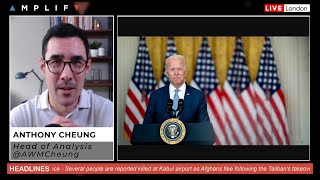
In this market‑focused video, the presenter provides a rapid briefing on the Taliban’s sudden seizure of Afghanistan’s provincial capitals and Kabul, the United States’ final troop withdrawal and embassy evacuations, and the immediate financial market fallout. He explains that while global developed markets remain largely unchanged, neighboring emerging markets—particularly Pakistan and Uzbekistan—are experiencing selling pressure on sovereign bonds due to fears of refugee inflows and possible Western retaliation against Pakistan for perceived Taliban support. The commentary then shifts to the domestic political ramifications for President Joe Biden, noting that the Afghan crisis adds a foreign‑policy headache to an already strained agenda that includes infrastructure spending, voting‑rights legislation, a massive reconciliation bill, and an upcoming debt‑ceiling vote. The presenter argues that the crisis could erode public confidence in Biden’s handling of the withdrawal, fuel criticism from former President Trump, and complicate Biden’s re‑election prospects in the 2022 midterms. This political uncertainty may, in turn, affect longer‑term market expectations, especially if a split or Republican‑controlled Congress curtails large‑scale fiscal stimulus. The video concludes that while the immediate market impact is limited to regional EM debt, the broader implications for U.S. politics and fiscal policy could shape market sentiment over the medium term.
Chapters
Okay, hi everyone, just thought I'd jump back on because I've had a number of questions this morning about Afghanistan, what is happening, implications that it might have for markets. So just thought best to just jump on and summarize the current state of affairs and give a few thoughts on, on the matter. Starting off with really two parts, I'm going to talk about the short history of how we've arrived at this point and therefore to put into context about implications that it could have for markets going forward. Starting off then with the Taliban themselves, they actually ruled Afghanistan between 1996 and 2001. And of course, you'll remember in 2001 was when the September 11th attacks happened in New York, and that then resulted consequently in a US-led invasion of Afghanistan. Now, from that point, for most of the last 20 years, predominantly the US, but also with NATO, have been providing military support within Afghanistan, trying to support the Afghan government. But US President Joe Biden announced even as recent as in April of this year the complete withdrawal of American forces out of that particular country. For context on his insistence about that military withdrawal, recent polls only at the end of July, so a few weeks ago, had showed that the Slight majority of the population in America, 55% in fact, approved of Biden's handling of the troop withdrawal. However, given the type of scenes we've been seeing this weekend, it'll be interesting to see how well that, that kind of confidence holds. Likelihood it will probably deteriorate. In early 2019, the US and the Taliban actually began peace talks, and so it's not as if it's all constantly been confrontation. There there was in fact a solution to the 17-year conflict back in 2019. That did result in, uh, the agreement of the US withdrawal from that country, handing over power to the new Afghan government. Now, over the past few months though, what has started to happen, and this has been really accelerated in the last 2 to 3 days, has been then the Taliban gaining control of territories around the country. Now Afghanistan has about 26 provincial major cities. As you can see on the right-hand side here, these are those or slightly darker orange spots. The Taliban now have full control of all of those, including of course the capital city Kabul, whereas only 10 days ago they only had control of one. And these blue areas were the government-backed Afghan government were ruling. So you can see how that's really contracted over the last few days in particular. Now what's happened here is fighters have seized the presidential palace, uh, and the president Ashraf Ghani has fled to Uzbekistan is what the reports are suggesting, albeit it's a bit light on confirmation of that exactly. And what's happened then is US troops have been deployed into Kabul, the capital city, apparently overnight, another 1,000, which takes the total to about 6,000, giving how serious the situation has become and to help remove its staff and the Afghans who assisted them with their mission. The US has now said that all of the embassy staff have reached the airport here for international— the international airport for evacuation operation. As you can see here where the UK and US embassy are situated, the UK having sent as well additional 600 troops to do the same for their staff. Meanwhile, US officials have said, and this is something to be aware of, I guess, in the months hereafter, about the increasing concerns of potential rise for terrorist threats against the US as the situation in Afghanistan starts to devolve. But what does this all mean for markets? Well, a couple things. The broader market as we see it this morning has not really reacted to this. The, the area geographically that is seeing a market reaction at the moment is in neighboring countries. So just going back to a bit of Geography, here's a map. You can see the Persian Gulf, Saudi, Iraq, and Iran. If you go further east, you then get to Afghanistan, and the south, south and southeast area of that is the border with Pakistan. Now, Pakistan's international bonds have come under selling pressure today. The debt issued by Uzbekistan here, north of the country, has also weakened. So some of the emerging markets bracing themselves for the spillover from the Afghan issue. Um, what the rationale here is, is that the likely exodus of refugees from Afghanistan could strain the finances of those neighboring countries. And fund managers have said there's also concerns the potential for Western retaliation against Pakistan for providing a safe haven for the Taliban. So in particular, Pakistan's been hurt so far today, but as I said, broader Western developed markets like US products, UK, European are pretty much unmoved by this news at this point in time. For me, on the latter of what could constitute a move really starts to come down then to Joe Biden and the market's perception and what he can achieve going forward. Now, there's a couple of things that have been happening. For one, the Afghanistan, the Afghanistan situation resets the focus in a very unwelcome way for the president, who's largely had a pretty decent run since the beginning of his, his time in the White House. And what's been happening more recently is, as we're emerging from the pandemic, a lot of his policy focus has been domestic. And so these foreign affairs somewhat pollute that mission that he has, particularly when there's an economy and the citizens of America are still finding their feet post a very challenging and tough COVID period. We know unemployment in America is still 6.5 million or so short of filling the void that was in the pre-pandemic economy. The other things then that we have at the moment, of course, is that he still needs to win congressional approval for trillions of dollars in infrastructure spending and protecting voting rights. So no surprise to hear last night President— former President Donald Trump coming out and criticizing Biden asking him to resign. This, of course, comes in context with the US midterms are only 15 months away, uh, towards the end of next year in 2022. So although it's not impactful for broader markets right now, I would say there are perhaps meaningful implications that if you think about the messy exit here that's happened with the withdrawal of troops out of Afghanistan and any potential destabilization within that neighboring countries and region, coupled with then what we've had is for the Democrats, politically, multi-decade high in border crossing arrests. We've had the resurgence of COVID and we've also seen some of the latest economic data somewhat suggestive that the economy has already hit its peak. So slowing economy, increasing COVID, increasing border crossings, and that hot political potato of migration. Now you throw in the Afghan situation, and this could be very complicated for Biden to manage. And so be expecting a lot of pressure as he goes into the coming months and particularly into a midterm year next year. So all of this as well puts a lot of pressure on the bipartisan infrastructure package still needs to pass, the $3.5 trillion reconciliation bill still has a lot to be done there, and we've also got the debt ceiling looming which will arguably need to be increased and that's going to need congressional approval as well. So that's a lot to ask for the more moderate Democrats and swings the chances back higher potentially that Republicans could take control of the House and/or the Senate next year. And if that is the case, well then these kind of, um, gangbuster huge fiscal spending, um, that we've seen from the US government through the pandemic era could be no more as his hands get tied by a split Congress, if not losing both chambers of Congress would be particularly harmful for his policies he tries to push through, and therefore very meaningful for markets in the slightly longer term. So hopefully that covers a few things. I know it's pretty short. Um, I'll tweet out some of these notes that I've read. It's basically an aggregation of a number of different articles I've read this morning, but hopefully that's useful. And yeah, I'll see you for the next session. Thanks very much.