Joe Biden Calls Xi Jinping In Bid To Reset Strained Relations
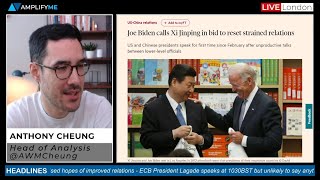
Biden and Xi spoke for the first time in seven months, a diplomatic reset with limited concrete outcomes. Asian markets rebounded after modest US losses, while the yuan hit a three-month high. The ECB slowed bond-buying and China tapped its oil reserves to fight inflation.
Chapters
OK, very good morning, Friday the 10th of September. Hope you're doing well. And before I begin the normal briefing, don't forget to check out the Market Maker podcast and the episode that Piers and I put out earlier this week. We had a special interim episode. We've got the normal one wrapping up the main market events of the week coming out in a few hours' time. But on Wednesday, we recorded one called In Search of Serena. So not just because the US Open's on at the moment, but more importantly about the changes that are happening, happening at Amplify. We've got Amplify Me and our new platform officially launching on Wednesday the 15th next week. And I would really love it if you could take some time, jump on Apple, Spotify, search for Amplify Me and listen to specifically the episode on In Search of Serena. It really explains our mission as a company me personally, my, my overall motivations for what I want to achieve, as well as the business. We talk about everything from the technology we have, but to things like diversity in the workplace, mental health in young people. And yeah, it would be amazing if you could take a listen. I think you'll really enjoy it, hopefully, but also join us on our mission. But otherwise, look, let's get back to what's going on in markets this morning. And I guess starting off in a chronological order, The US close last night was a little bit soft. The S&P was down about 0.5%, the Dow pretty similar, the Nasdaq down 0.4%. So fairly uniform in that downward move. The weekly jobless claims, of course, that we saw yesterday fell to a near 18-month low, allaying fears of a slowing economic recovery. We have been seeing talk about kind of peak recovery and things like that, and definitely this is a good situation with that number decreasing. To kind of the best we've seen since the onset of the pandemic. But here comes the fine balance between when that trend starts to emerge in such a positive way, does it stoke then the expectation further about the inevitability and more near-term timing of potentially of tapering from the Fed? And equities generally very sensitive to that. One thing I would say though is overnight that any kind of negative handover into Asia emerging from the US was pretty quickly turned around. The Nikkei in Japan among the outperformers. Still a lot of that Suga succession race helping just buoy things alongside M&A news flow, also spurring some renewed risk appetite. And also Chinese tech stocks saw a bit of a bounce, and we'll talk about in a moment. US President Biden spoke to Xi Jinping for the first time in 7 months last night, and in fact, it's only the second call that they've had since Biden took over the administration. So that in itself just restoring perhaps a little bit of calm about them being less fractious in their communication. More open dialogue is always typically well received, and that was also reflected in performance of the Chinese yuan overnight, where the yuan is headed for its strongest close in nearly 3 months. But as far as the charts are set up this morning, the dollar index is pretty flat, and that's reflected in both major pairs pretty much trading unchanged. Obviously we had a little bit of seesaw price action in the euro yesterday, and that came by way of, of course, Christine Lagarde and the ECB. So just while we're here, quick recap on that and what was said. The ECB said they will slow the pace of pandemic bond buying program in the final corner— quarter of 2021. Lagarde pushed back though against any notion of this being tapering As we were discussing yesterday, she knows the markets are ultra-sensitive to, to that word and the, the meaning behind it. And she described the ECB's decision yesterday as simply one of recalibration of their kind of emergency QE program, the pandemic emergency purchase program, for the next 3 months. Officials who revealed new forecasts showing inflation will still undershoot their target reiterated the pledge about the €1.85 trillion euro kind of envelope running until March 2022 or later if needed, signaling then that they're not yet really ready to discuss the ending of the measure, just this recalibration. So overall, just looking at the way European assets— I mean, obviously was a degree of volatility yesterday in the aftermath. Generally speaking, we saw lower yields, low euro, and stock positive. So I think there was a little bit of trepidation perhaps that Lagarde wouldn't have been able to convey what she did, which was essentially reducing their bond buying moderately from their earlier pace, but doing it in a way that didn't spook the markets. And overall, looking at how European assets are performing this morning, she, she did achieve that. So that hurdle passed for Lagarde for the time being. She does speak later on today, but I wouldn't be expecting anything from her given the fact that it was only yesterday we had that official meeting. Otherwise, back to the charts. Things are pretty flat, just given the positive tones that I said overnight in Asia. European, US equity index futures marginally positive, nothing really too exciting there technically going on. Crude oil as well has seen a bit of a, bit of a roller coaster in the intraday environment, at least yesterday. And one of the headlines that was quite interesting was, was of course, this one. This was talking about China's SPR. So let me just get up to speed what exactly this was for those who weren't in markets yesterday. China announced it will sell oil from its state petroleum reserves for the first time as Beijing steps up efforts to rein in inflationary pressures stemming from commodity markets. And so it's— this isn't too surprising. They've been doing this particularly with a lot of metals that we've had, just given the supply constraints, bottlenecks squeezing up prices. And we've seen this yesterday with the, the fact that the PPI, Producer Price Index, in China was tracking at a 13-year high year on year. And so they just want to keep those prices in check. And so hence the reason why China is looking to sell oil from its state reserves, its Strategic Petroleum Reserve, in a bid to contain those prices. As I said, since the start of the year, China has been really ramping up efforts to control this, which has pushed up costs of everything pretty much from manufacturing to power to food. And so hence the reason why they're taking that action. But I think this is not a consistent thing. It's just a reaction effect that we saw yesterday that was pretty quickly reversed. And also, of course, we've got the fallout in all of the inventory data as well that we're going to have to work our way through. From Hurricane Ida and the complications that that has created. But for the moment, prices have stabilized, and after kind of the seesaw price action from yesterday in oil, there's not really too much movement happening this morning, albeit up above pivot in the futures, up $0.50. So let's get straight to it and let's talk about these two guys. They look like best buds as far as that photo is concerned, but I'm not sure that that has been the case over the last recent few months. You remember Generally, rhetoric between the two has been quite hostile, um, particularly given the fact that all of the issues of which Biden's been facing domestically, now at foreign policy in Afghanistan. Perhaps he's just looking to steady the ship a little bit. And then also a meeting of two minds because China themselves are dealing with quite a difficult COVID outbreak at the moment. So perhaps for those reasons it's brought the two back to the table. But overnight, the Chinese yuan, as I mentioned, traded firmer as the call between Xi Jinping and his counterpart, said to have lasted about 90 minutes— it's the first time they've spoken in 7 months— has raised hopes of improved relations between the two nations. The two countries vowed to hold more regular communications, although the American leader expressed his frustration with recent dead-end talks. So if you're, if you're new to this, there's not that there's a tangible outcome to their discussions last night. It's not really what we're looking for. It's just the fact that they're talking. So instead of throwing verbal stones at each other, you know, this is a meaningful, more positive type response. And generally markets tend to have a bit of a lukewarm response to that in a more positive fashion. But by no means is this any kind of dealmaking, things like that. These are the first tentative steps. Steps to re-initiating dialogue between one another. So I guess the next thing to look out for really is when are they going to talk again and the frequency of those talks, not really focusing so much on actual outcomes at this point in time. Um, how long can this last? Just a final point on this, probably not that long, I would say. And the reason for that is you've got the midterms coming up and I think it's a difficult juggling act for Biden, given that he needs to remain pretty assertive with China and doesn't really want to be showing any type of concession going into literally 12, 13 months from now. So it's going to be interesting. It's more of a, I would say, a relationship to manage up until that point rather than one I think we're going to see incredible amount of change in the next 12 to 18 months. Okay. The other things I just wanted to mention, Fed speak. Fed's Bowman, encouraged still by the recovery, said taper is likely this year. Now that's probably going to sound very familiar, and the reason for that is that Bowman becomes the fifth Fed official— fifth in the past two days— signaling that the disappointing jobs report shouldn't stop the Fed from pressing ahead and beginning to pare down on its bond buying program, or i.e., tapering. So I think that's pretty much baked into market expectation now. Again, as we've always said, it's not about if but when, and it's fairly— neither really here or there. I think the ship has sailed on a near-term initiation of tapering. So if it does happen towards the more back end of this year, I think that's just in line with what people are thinking, and the market can manage that without any real severe disruption at this point. So yeah, just the latest on that. Otherwise, one thing I just wanted to note was the latest view from analysts at Goldman Sachs on the UK, and probably something you'll read a little bit more about perhaps when we go further forward through this month and the next fortnight in particular. And the reason for that is, of course, the furlough ends at the end of this month in the UK. And obviously there's still a particularly large amount of people who are on furlough. Irrespective of the fact that we've had the reopening and economic activity, mobility, things like that starting to open up and people are starting to go back to work. So essentially, a messier end to that furlough program from the BOE, or furlough program, than the Bank of England expects will prompt the central bank to delay raising interest rates. So Goldman's basically saying that they think the Bank of England are a little bit too optimistic about the smoothness of that ending of program and the impact that that's going to have consequently on unemployment and the economy. Um, context: investors expect the Bank of England to hike its benchmark rate in May next year with 28 basis points of cumulative increases by the end of 2022. It's kind of how markets are priced and what the recent Reuters economist survey actually overnight said. I'm as well. Economists at Goldman's though, they don't anticipate borrowing costs will rise until the third quarter of 2023. So markets at the moment are priced for 28 basis points of cumulative increases by the end of 2022. So that would be more than one rate hike, whereas Goldman's saying they're not even looking for the first one until the third quarter of 2023. So they're way more bearish in their outlook. But again, they are an outlier with that view compared to the Street generally. So essentially, just be aware of— again, this isn't impactful for the pound this morning, just something to be aware of if you're tracking kind of bank commentary and outlooks on those areas. In terms of the session ahead, we've already had some UK data and the latest GDP readings. The pound didn't even blink. I think pretty much as you would imagine, the numbers were a touch soft. The GDP estimate year on year, 7.5% against expected 8%. Manufacturing output came in flat against 0.1%. Again, none of these really dramatic enough to really change, change sterling direction this morning. Otherwise then, looking further forward, going into the morning, it's particularly quiet. Nothing really too much going on. You've then got the PPI numbers coming out the States this afternoon, and you've got the Canadian jobs data, probably worth keeping an eye on if you're in the FX market trading the loonie. But overall, it's pretty quiet. There's not really a great deal of scheduled major data today. Lagarde is speaking at 10:30, as I said, Eurogroup press conference, but not expecting too much there. And then Fed's voter daily at 2, Mester same time. Uh, but non-voter also speaking later on this afternoon. So again, that is it. Don't forget to check out the podcast, specifically the midweek episode we put out, but also there's a new one wrapping up the week and some thoughts about what's been happening that will go out later today. Other than that, have an amazing weekend, stay safe, and I'll see you on Monday. Thanks, guys.
More from Anthony


Inside the Biggest Banking Stories You Need to Know This Week (Anthropic, Diageo, Private Credit)


Inside the Biggest M&A Deals You Need to Know This Week (UniCredit, GameStop, eBay, Eli Lilly)







AI Breakthrough or Hype? Anthropic’s Claude Mythos, Tim Cook Steps Down & LIV Golf Collapse