LIVE FOMC ANALYSIS & PRESS CONFERENCE - 16TH JUNE 2021
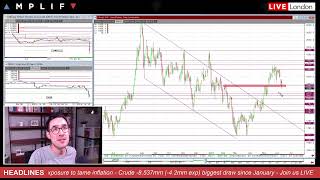
Anthony Cheung breaks down the Fed's June 2021 meeting and Powell's press conference, with markets reacting sharply to the dot-plot's signal of two rate hikes in 2023. Core inflation hit its highest level since 1992 while the labor market lagged, leaving Powell acknowledging inflation could be "higher and more persistent" but offering no tapering timeline.
Chapters
Hi everyone, I'm just getting set up, switching the feed on. We're not going to commence the, um, official broadcast till 45 minutes past. So I'm going to give it another couple of minutes and then we'll get stuck in. I'll do a preview. I'm just going to get the chat up as well on YouTube. Absolutely feel free to ask me questions as we go through. This is definitely, definitely meant to be educational in a way that, you know, I want you guys to to look at really how I'm analyzing it, as, um, as well as you guys, I'm sure, who are trading it. But I know we have a lot of students and so on that follow us, so I definitely want this to be me talking things over as much as it is me just talking about the charts and so forth. Um, so I'm going to give it a few minutes. I'm just welcoming people online now, and then we'll kick things off shortly. But, um, yeah, hope everyone is well. Thank you if you are just logging in. I hope you've had a good day. I hope you've survived the heat. I'm told it's going to start raining in 72 minutes, if I was being precise. So I hope you've enjoyed it while it lasts. But we're going to kick off in a few minutes. We're just going to get everyone up and running. Okay, who have we got? Itai, Pratik, Paul, Dion. I'm just going through the YouTube comments so I can keep an eye on any questions as well as we get them. Okay, cool. Yeah, get your questions in. I'm gonna do like a formal rundown. I'll start it in a moment. So I'll do a fundamental rundown and then we'll look at the charts. I'll talk about potential scenarios for reactions. But yeah, great to have everyone on board. Joshua, good to see you. Dion, I know you often leave comments as well on the videos day to day, so I appreciate that. Uh, and anyone who's just tuning in, if you're not subscribed to the channel, just hit that subscribe button, hit the bell icon. There's daily macro briefings I put out, and there's other cool content from the rest of the team covering different areas, so stuff you, you might get good value from. All right, well look, I'm going to kick things off because there's plenty for me to talk about. I'm going to try and keep it as concise as possible. So a couple of different things. For one, when this event happens, I know there's quite a few charts here to look at, but I'll quickly give you a run-through. So on the left, that's euro-dollar. Top center is cable. Top right is gold. I'm looking at all futures charts. Center left, Dow future. Center, NASDAQ. S&P 500 on the right. Got the US 10-year on the bottom right. And you've got WTI crude futures at the bottom. As I go through and I talk on any chart, I'll maximize the chart so you can see exactly what I'm talking about. But we've had a little bit of a dip here more recently in the last hour or so in equities, Dow and the S&P 500. The NASDAQ's sitting pretty flat at the minute. I wouldn't over-interpret that. We did have just a brief run through a technical point of support in both those aforementioned products, so This is quite usual of what we see. Liquidity gets quite thin ahead of particularly an important big scheduled news event like this, and so you get a bit of gyration in price. If anything, the pre-positioning of these equity indices I think is quite interesting, and we'll talk about that in a moment. The other products, top right, gold here is, is super range-bound at the moment. We're just kind of awaiting this main event to really make a decision now on direction. We'll talk about that in a moment. The US 10-year has literally traded at the bottom right, a 3-tick range for the best part of the last 5 to 6 hours. But again, very normal as we go into— people are waiting, sitting on their hands for this main event to kick off. Dollar index is pretty flat, um, somebody doing a great deal at the moment, as you would expect. And that's reflected in the major pairs. But what I'm going to do, I'm going to take these headphones off because I'm not going to need them for the moment given that this is, uh, just me on the, on the call this evening. But let's run through a couple of different points then to give us a bit of context for this Fed meeting and why it potentially carries importance for multiple asset classes and for the global economy. And that's because of a few things. So first off, let's talk about the economic situation. So this is the inflation rate in the US. You would have read about this, you'll already know about this. Inflation is tracking at 5% year on year, and the core reading is well in excess of what otherwise would be, in a normal sense, a 2% inflation target. And in fact, the core readings are the highest since 1992. Now, the Fed, and to some respect the market, has bought into this idea that inflation is transitory. So So the Fed have been kind of banging that drum repeatedly, telling you that that is the case. And after some initial pushback, the market seemingly has started to fall into line to some respects, because if you look at US yields, generally they were declining for the majority of last week. They've strengthened a little bit this week, but albeit they've generally eased off of where we initially were in response to fears about kind of inflation from supply constraints. Resulting in a lot of price pressures that we're seeing at the moment. And remember, if you think about commodity prices and what was causing that kind of squeeze, things like copper or lumber, you know, the latter has seen a huge retracement from some of those gains that it had seen. And kind of then when we look, you know, we start to break down CPI and you start looking at components like used car vehicles and energy prices and things like that. That's the rationale for the transitory argument. The other thing then, looking at the economy, is some of you may or may not know, but the Atlanta Fed have a model called the GDPNow model. And in summary, without going into the technicalities of the methodology, it follows a similar process to that of which how the government basically calculate the GDP figure for the US. The only difference here being, unlike GDP, which is kind of backward-looking, we're looking at Q1 growth rates, which is really quite old information now that we're about to, you know, we're in the middle of June now. So this GDPNow model gives us an indication on a more updating, on a more frequent basis of what that model estimates for the second quarter of US GDP. And it updates whenever we get significant US economic data. At the moment, that's tracking at 10.3%. So if you thought US economy was motoring on, at the moment it's about to get even hotter. And so we have a situation here where there's certainly— the economy is continuing to recover, um, and more in some respects, in certain aspects, as we continue the reopening process, as vaccination rates continue in the US. You probably read, uh, just yesterday, New York, California vaccination rates in excess of 70% has allowed them to pretty much go a step where the UK hasn't, predominantly because of the Delta variant. But in America, full reopening to the extent of dropping most of the conditions that would constitute then a lockdown, like social distancing and so on and so forth. So we can expect the economy to perform better going forward. Offsetting a lot of this positivity though is jobs. There's still a huge gap between recovering the lost jobs through the pandemic, several million in fact. And the last, last two non-farm payrolls, as you will know, have been particularly disappointing, more so the former than the latter one that we saw. I mean, we were talking, I remember doing the briefing, it was like, okay, we're talking about 1.5 million, what if it's 2 million? And it came in at 278,000. So it was a huge miss. And that's been then enough comfort for the markets to buy into the idea that, look, tapering is on the agenda, but it's not going to happen anytime soon. And so that shifts then the conversation onto tapering. Now, for me personally, and obviously I might be wrong, but I can't help but feel that the market has got way too far ahead of itself on this notion of tapering. You know, coining this event as kind of like the moment to taper, I think is inappropriate. I think you've got to understand the sequencing of the incremental steps via forward communication that a central bank takes, like the Fed, to be ultra-cautious and, and have awareness of the sensitivity markets have to this issue. So this meeting, I think, could carry the ability where not a lot of mention in the opening statement about tapering could actually cause a bit of a relief reaction in assets. And what I'd be looking at if that were the case is actually a bit of recovery from these recent sell-off we've seen the last 2 hours in US indices. If anything, the NASDAQ might well outperform because it tends to— tech tends to be a benefactor of a lower yield environment. And so therefore, although tapering is coming, it's not a problem now. We might see some relief. In the equity market. Um, the idea here then is that at the moment, the kind of Fed perception is that inflation is peaking. And so if it is indeed transitory, it's going to ease. We're seeing some signs of that in some of those commodity prices, as I mentioned. And the jobs market is a million miles away from where it needs to be. And the jobs market, they've been explicit, is a key focus of policy decision-making, and it's also definitely a key political point for the administration at the moment. And so the pressure is coming as well from that angle. So for me, this is about management and carefully doing it in a way that doesn't destabilize markets. But as I said, I think market kind of perception and thus positioning is erring on the side of looking for something more concrete on tapering. And I don't think you're going to get it, um, definitely not in an official communication, i.e., in statement. What we're looking at here is the Goldman's timeline. Not that I think that Goldman's is particularly special or unique, but I think it's a consensus on the street that's definitely forming at the moment. And that is we get the first more detailed hints on tapering at Jackson Hole, which is happening at the end of August. So if you think about the end of August, that's actually like 10 weeks away. And so that gives plenty of time in my mind for the central bank then to get equipped with more information about vaccinations, reopenings, inflation, and jobs, as much as other things as well. So it makes sense to me to not say too much now, to basically just keep that idea that they are talking about tapering, but look, we haven't got to the point where definitive action or timelines are going to be set out. So it's going to be quite loose in that respect. So that means then that the kind of gun gets fired, if you like, on the signal in August, and it gets formalized at the next time projections are outlaid, which is in September. So remember, we're getting an update tonight of projections from March, and then that buys the Fed time then to formalize it in Sep to then start the commencement of tapering, most likely at the beginning of 2022. So that's the kind of sequence. So a few other things I wanted to share is from the opening statement. This was a preview that I saw from TD Ameritrade, and in the statement there's, there's kind of a phrase that gets used at the moment, which has been coined by the Fed, which is this idea about, um, the economy is a long way from our goals and is likely to take some time for substantial further progress to be achieved. This is kind of quite dovish in context of where we're at economically now, because obviously this is going back to a meeting that happened quite a while ago. So what some people are looking for is to pay heed to the fact that the economy has improved and things have got a little bit more optimistic that the word sometime might be dropped. I don't actually see that as hugely hawkish. It's probably appropriate, but it's something I'd be looking out for in the statement. The other things then is the dot plot and the kind of summary of economic projections. Some of you might not have looked at this, but this is what we're definitely going to be looking at when the information comes out. We've got about 4 and a half minutes, and this looks at real GDP, unemployment, PCE inflation, core PCE, and then obviously the dot plot. So I'm going to talk about two of these, or three of these, in fact. First off, inflation and growth. I think inflation and growth definitely have exceeded their initial projections that they issued back in March. So we are expecting both of those to see an uptick, and perhaps an inflation, a meaningful one. How far they see that could well be indicative then of perhaps putting a little bit of pressure on them to react to something like inflation. So it could be perceived as hawkish. What will be key for me is I think the market can swallow the fact of inflation forecasts being lifted for 2021. If they alter drastically upward 2022, that would suggest then that the Fed are probably seeing something that's a little bit more long-lasting than just transitory pressures. And so I would actually look for the size of revision to upward and how large in PCE inflation, core PCE, and GDP, but I'll also look at what are the changes to 2022 as being quite key. And actually, I think they'll probably be minimal, and the more minimal they are, the more the belief is that inflation is transitory, and they're holding that view. The dot plot, of course, is important. The likelihood is when we look at the kind of composition of dot plots— this was the last time out— we're going to see a couple more of these dots at the lower bound move up, and that could well shift the median dot plot up to the first rate hike in 2023 rather than after 2023. Again, I don't really think that's particularly going to be perceived as hawkish by the market. The market's pricing is much more aggressive than the current March projections from the Fed, so then bringing forward a rate hike, it's going to be pretty split. There's going to be a lot— a large group of people still sitting there at zero. So I don't think it's, it's particularly that hawkish. What I would look for then is the composition of dots and how many of these guys are actually jumping up. it's only going to take 2 to shift the median. So if it's 2, that's more dovish than if it was 7, for example, which is like a more unanimous move that indeed rates should be higher sooner rather than later. This was the final thing I wanted to look at because we've got a few minutes now. This is a quick look at the S&P 500 intraday, and I thought it was quite interesting because it's something we talk about, but this is a visual graphic to express that kind of view. And it's talking about the most recent Fed governors and how the S&P 500 intraday tends to perform between the period of the statement coming out and then the press conference beginning. And Jerome Powell has had a pretty distinct pattern to how he delivers his press conferences. Now, you know, definitely you've got to take each event for its, for its merits of what it contains and in context, but I think it could happen once again. In that if what I'm saying does materialize and that actually they keep the language fairly uncommitted in the statement and the market perceives that as then a bit of a relief that there isn't something more definitive, then equities might rally only then for the press conference to begin. And I think that's where they've got more flexibility then in the Q&A for Powell to start addressing, as he will be definitively questioned on, tapering, the timing, the conditionality, all of these things. And that's where we might get a bit more of an insight as to really where are they at with these discussions. And if they are more advanced, the more he kind of gives on that front, the more I think that could have a weighted impact on stocks, that it could fuel a bit of a dollar bid and therefore weigh on some of the pairs and also see yields kind of climb a little higher, reversing what might be an initial easing move. All right, going to put the squawk on. There's just under 1 minute to go, so I'm going to hand it over to the announcers now. And you'll be able to listen in. Again, I will shift the charts, make them bigger as I go through them. 30 seconds. He kind of gives on that front.
10 seconds.
Okay, that's the Squawk on now. I'll repeat anything substantial if it jumps out, but I'll leave it to them.
Unchanged, 0 to 25 basis points. IOWE are hiked to 15 basis points from 10 basis points. Looking— medium view of Fed funds rate at end of '23, spot 6%. That's the first hike since COVID That's right there for 2023. 7 out of 18. See, Liverpool—
gonna switch them off because that median projection shows 2 rate increases by the end of 2023. So just to repeat, that's the dot plot that's already come out, shows 2 times 25 basis point rate hikes. Initially on the surface, that's a big surprise, and actually you're seeing the dollar sharply bid on the back of that. So you can see these major pairs getting hammered. Gold's broken down through that low. Yields spike. T-notes lows on the bottom right. And equities getting hit. So again, I've still yet to digest all the comments, but on the surface, that's a really big comment there that the median 2023 dot plot shows 2 rate hikes. We were talking about just 1. So seeing a big push in dollar strength weighing on the pairs now as it goes through.
Securities, nothing seen on the likes of tapering as expected. But again, it's our pricing in hikes on the Fed's forecast for 2023.
Yeah, I'm just going to bring up the summary of economic projections, but again, the 2 rate hike is what's moving the market here. Really big surprise on that comment.
And just 7 out of 18 see that Fed funds rate lift off in 2022. Chris, we're sitting out on a median dot plot height there, but definitely a rise there. That's up from 4.
Okay, I'm just trying to get the projections up.
Some of the commentary in the statement says indicators of activity and employment have strengthened amid progress on COVID vaccinations. Says it will maintain the current Fed funds rate until labor market has reached maximum employment and inflation has risen to 2%. and is on track to moderately exceed that for some time. Fed says it will maintain—
Okay, I'm just going to turn them down for a moment. Here's the summary of economic projections, and here's that federal funds rate. So in 2023, they see 0.6. I mean, that's quite incredible, um, that, that figure. Much more bullish in terms of where they see— or hawkish in this nature— for where they see the dot plot rate rising. Let's just have a look though on the breakdown, because this is what's super important for ascertaining now how sustained this move might be. So they've upped their GDP forecast to 7 from 6.5. Unemployment remains unchanged. Core PCE inflation has been up to 3% but remains relatively unaltered. 0.1 increase there for 2.1 from 2. GDP then fades after hitting the peak at the end of the year and unemployment starts to decrease down to 3.8. So a little bit more bullish than they previously saw. So actually on these projections, the couple of things that stick out Definitely, definitely this initial push is being sparked by two rate hikes. No one was talking about that at all. Some people were in fact thinking there's going to be no rate hikes at all and the Fed weren't even going to shift the median dot plot. Hence the big hawkish reaction that you're seeing with gold getting hit at the minute. But when you actually look at these, as far as inflation is concerned, this would kind of ratify the idea that indeed they do see um, that the inflation is transitory as far as these numbers tell me. But yeah, let's have a look at this then. The, the gold market here just getting hit. So a decent move now down from around $63 we were trading, getting close proximity now to the weekly low that was printed back down at the beginning of the week on Monday. So just, just finding a little bit of support here on the bounce as we, we rocketed through that intraday range trade. Having a look elsewhere, EURUSD obviously session lows on the back of a spike in the dollar, so yields and dollar appreciating. You can see EURUSD just, just popping through both Friday and Monday's low and still remaining heavy at the moment. Just having a look on the daily chart here, probably an area that I'd keep an eye on, on the downside would be you've got a double bottom from 6th, 7th of May and also the 13th of May. And that comes in on the daily chart about 15 pips below. Says to me there's a bit more room to run here and some dollar strength just to push that euro back down session lows again. But I'll be looking for a probably a bit of response there at around that point where people short-term in the fast money move might look to exit some of those short-term trades. Equity-wise, yeah, uniform sell-off across the board as you anticipate. And the US 10-year, the US 10-year actually has got a pretty decent margin to fall, I would say, given the uptick that we saw last week. Remember, pretty much after inflation numbers came out, we've just moved higher ever since because people have believed and bought into this transitory idea. Um, downside, there's a pretty good technical level here in T-notes as a target. If I just squeeze my chart so you can see it, I'm kind of looking at around this kind of area here, so the 132 handle which encapsulates some of the late May highs and also support areas in early June, uh, as a downside target there on the yield move higher. I'm just going to have a quick skim for the statement. I'll turn the squawk back on in case they're highlighting any more color, so you'll have to bear with me. Just give me a few moments so I can just digest the full report. Just take me a minute or so. Okay, so here is the side-by-side statement so you can see the actual red removed the green added words. This is courtesy of our friends at News Squawk, who's who you're hearing on the squawk when that initial announcement came out. So here, a couple of things. So they've removed the whole, uh, kind of comment around COVID, which would— I mean, from a, from a market's point of view, was largely irrelevant anyway. They've added progress on vaccinations has reduced the spread of COVID-19 in the US. Okay, that's factual. It's not really a great deal of interest in that. They said progress on vaccinations, the ongoing, will likely continue to reduce the effects of the public health crisis, continues to weigh on the economy. They've dropped 'and' but put 'but' risks to the economic outlook remain. So pretty unaltered. The committee seeks to achieve maximum employment, inflation rate of 2% over the long run, with inflation— instead of saying running, they said having run persistently below. So they're kind of saying we're now well above that, it used to be below it. So this statement is absolutely bland. I mean, they've done nothing. So this is kind of what I was referring to in regard to a kind of relief in terms of the idea about tapering. So one of the interesting things here that I think might explain why the market is reversing here in the equity space at least is the fact that yes, it's a shock. There's, there's enough of them in the composition of the dot plots. And in fact, let's just have a look at those dot plots to get an idea of the change. So if I scroll down, so here's your dot plots. So you can see there's been quite a drastic alteration where there's some outlying hawks that are really gunning for higher rates here in the US in, in 2 years' time. But the median has gone up kind of 2 notches, if you like, up to 0.6. People were expecting perhaps a little bit less than that. So that's fine, the market has this initial reaction, but I don't know, rates were always going to rise in 2023, weren't they? I mean, yes, 2 is a bit more hawkish than 1, but does that materially alter the timing around tapering? I don't know. I mean, looking at those projections, I don't think they're severe enough to really alter the balance on the tapering timing. And so given that statement is so cut and paste from the last meeting. I actually think that we, we could— as what we're seeing, I think explains the about-turn here in the equity market. So the Dow is now reversed pretty much the majority of the move, the S&P the same, and the NASDAQ's well off its lows. What I'm trying to suggest here is that I don't think it materially alters the first sequencing of policy normalizing which is that of then tapering. And so although they see rates higher in 2 years, okay, fine, but that's 2 years. The nearer pressing point here is about when are they going to stop buying $120 billion worth of bonds in the marketplace. And I don't know, I don't think that the projections really, really shift that narrative for me. The statement certainly didn't show or tell anything. So you've had a bit of reversal, and actually Um, it'd be interesting to see. So that kind of visual graphic of, uh, a kind of a rally after the statement and then the opposite during the press conference— we might actually now get the complete opposite of that, where because of the dot plot that really took precedence, the market has had a knee-jerk reaction. I don't know, from what's been— from the information so far I'm not sure if I see this as a continued runaway hawkish move personally. And so with that being said, I'm just keeping an eye on gold, um, at that low. It's really struggling, it's having a bit of a fight at the moment at that weekly low on Monday. And the S1, uh, cables bounced pretty nicely technically from the low that we had yesterday. So I'm feeling a little bit more inclined about a potential reversal on some of the initial knee-jerk reaction, I guess is what I'm saying. But look, let's see how it plays out. And the press conference obviously will start in 20 minutes. We'll listen into that. So yeah, just let me just address a couple of questions. Um, so, so they didn't announce anything. Um, well I mean, from a policy perspective, yes, you're right. I mean, there's definitely no change in rates, uh, there's definitely no change in kind of QE, there's no hint towards tapering in that respect. But they did alter, of course, those dot plot projections, and that's what's moved the market. So they have announced something, but yeah, as far as standardized kind of traditional monetary policy tools are concerned, yeah, they've not changed anything. Um, Christian, so the statement was not as important, the dot plot now is where the traders are looking? 100%. And that was clear to see, um, I mean, straight away. The way— and it's the way that you do this in reality, I guess, is that you can kind of— Bloomberg would run and slap these headlines, and they typically have like a sticky headline that's colored in red that holds while all of the other news flicks past. And they would have known that, yeah, a 2 rate hike call for 2023 is out of line of expectations. So they've kind of ran that as their headline. Um, gold's just having another little test though down at these lows. So just starting to see another little bit of a bid in the dollar, just seeing those cable and euro just retesting down at the lows again. So still keeping an eye on that. I mean, obviously the dollar rocketed up the Dixie to 91 found a bit of a hiatus since then. Equities, Dow fully reversed now. Oil— so for any, anyone new to trading, oil is not the product to trade for these type of things. Um, you know, it's a very indirect move if there ever is one that would probably be more proportionate to something really outlying happening that would, you know, substantially move other assets, particularly the dollar, to really influence oil. So I mean, we're talking about rate hikes in 2023. From a near-term intraday point of view for oil, it doesn't really make any difference at all. Yeah, the 10-year yield spiked up, so for sure. So that's just paying heed to the, the dot plot alteration. So again, US 10-year, there's a bit of space downside, and we got that technical level we were highlighting earlier at the 132 handle, which was that low back at the beginning of, of last week, and also was also a period of range high through late May, early June. So the 10-year could press a little lower, but then could well find some support. Until then, the press conference commences, and we'll look for cues from Powell as to the tapering side of things. I mean, the interesting thing here, for the market to really kick on in a more hawkish fashion, um, Powell's going to be pressed on tapering. So if he does start to talk about that in a bit more detail, that constitutes more progressive descriptions that they're having over tapering, i.e., hinting towards they're getting to the point of where they need to kind of fire the gun on it, give the signal, then that's definitely something which could re-initiate further extension of the moves that we've seen. So that's going to be quite key to watch when he starts in about 15 minutes. Why has the Bund spiked down? Yeah, the Bund just moves in sympathy with the US 10-year. So in— it's a good question, I guess, if you're not familiar with markets. But yeah, this is definitely nothing to do with the, um, a kind of direct way, um, that's specific to the Bund market. But obviously, if yields in the US move and the US Central Bank is looking at tightening, hiking twice compared to none at all in 2023, then this is going to reverberate given the interconnectedness of markets. Central banks typically follow one another's leads, and so to some respect then, it's more of an in-sympathy play in the Bund led by the move in US yields rather than it's a Bund-centric move, if that makes sense. The German Bund has just eradicated its day's gains. So from a range perspective, we've just gone through the low that was seen through yesterday's session. So just trading a little heavy here. The 10-year is now at that 1.32 handle. So yeah, interesting. Now you are getting a bit of a secondary push. Equity is not, not buying it at the minute, but definitely yields and gold. So 10-year, now let's see how it responds at the 132 handle, as well as cable retesting that previous low that we mentioned on the week on the 15th. And so at a point of support now, and see how it can get a head of steam or not through there. For the euro, let's go back to that daily look on the higher time frame. We're at that level now that we were looking at a moment ago, so it will be interesting Perhaps now we see the move just get a bit exhausted on this second push, as people typically tend to then exit and await then the press conference to commence because they don't want to carry that, that initial risk over what then could be a comment that he makes that might trigger a counter, a counter move. Let's have a look. Gold, definitely another push lower now. So yeah, definitely starting to see actually the market pushing on with this kind of hawkish, hawkish view. Um, from a technical perspective, it's quite a key level for gold that has been broken. So from a technical perspective, gold doesn't have a lot in its way until we are potentially $20 lower than where we are at the moment. So from a technical perspective, gold is quite susceptible now to downside. Because there's not a lot of recent technical levels to suggest then a near-term point of support. So here with that break, you get a bit more of an extension move comparative to other asset classes. For example, yeah, equity is still a bit indecisive. Uh, the 10-year is just sat on the 132 at the moment. Someone wants to look at the Bitcoin chart. Okay, yeah, sure, let's get Bitcoin involved. Bitcoin reacting to the Fed. To be honest, I don't really look at Bitcoin enough, and I've not really done enough analysis to track Bitcoin over a Fed announcement. Perhaps it does move. I don't really honestly know because I don't really look at it that often. Let's have a look from a technical perspective. There's a kind of trend line I've been looking at in Bitcoin that goes back to— you're at quite a technical point actually in Bitcoin. You've got, you've got these areas, so trend line going back to the 21st of May, kind of close areas of retesting on the rebound recovery on the 26th, 27th, reacted nicely to it. Um, at the beginning of June. ASTU did it on the 10th, and that horizontally as well is an area that the market has responded to in some of this near-term volatility. So after what was quite a decent push in Bitcoin— this is looking at Bitcoin futures— after the gap up seen at the recommencement of trade this week, kind of hit a bit of a hiatus at that 40,000 or 41,000 mark, which in the futures space is is the R1, but also the previous high we had on the 26th. So I'm not going to necessarily draw too many conclusions about what this means for, for Bitcoin, to be quite honest, um, because, you know, if I'm being open and honest, it's not a product that I know particularly well. But looking at it from a technical point of view, it's a pretty big area of support that we're trading at the moment. A breakdown of here, I'd be looking for a move down to through $38,000 to $37,697. And the reason for that is because this is looking on a 30-minute futures chart. You start to draw in some of that near-term price action from going back to the mid and latter part of last week. Quite a key area that we're trading at the moment for Bitcoin, short-term intraday, that is. So yeah, I'm, I'm definitely not the crypto guy, but yeah, happy to comment on it from time to time for sure. So this is my first time seeing news trading. Have people made the entry yet or still waiting for a kind of announcement? Yeah, so that's a good question and a valid one. And so definitely, you know, I'm mindful of a lot of people that join these feeds are, are kind of new, uh, to trading These types of events, I would say successfully navigating a monetary policy event is probably— I'm going to switch charts— probably one of the most challenging events that you could possibly choose to trade. It is very difficult because of the nature of the subject matter that you're looking at, which is— I'll put my Twitter handle here if you want to follow me on Twitter. But one of the points here being that monetary policy is very complicated, it's very multifaceted. Trying to pick through it, um, if you're brand new, is a highly volatile situation which requires very quick, very measured execution and risk management. It's definitely not an event that you should take lightly or come into ill-prepared. I would say on average, if the traders I've always worked with over the years— and you know, I've been doing this for nearly 15 years now— um, I would say it's definitely the minority who are very good intraday macro headline-driven traders who could digest and trade this type of event. Um, definitely this amplifies kind of trading pedigree is in that space. That's where our edge is. You know, people talk about edge in trading, people talk about technical edge and execution edge, whatever it might be. Our edge is these types of events because we're very much a macro, fundamental, cross-asset kind of focus. So the tips I'd give around it are quite simple. I would say basically watch these events, prepare for them thoroughly. You know, hopefully feeds like this are useful. There's tons of good resources. I mean, I did a, I did a good video explaining Twitter a few years ago. If you search how to use Twitter for trading, and you know, if you follow the right people there, you can get some really good quality value information of bank research and stuff like that. So just listening and understanding what other people in markets are focusing on, what they're listening to, and then preparing, strategizing, watching, reviewing, and then repeating that process and not trying to take shortcuts. And then introducing sim trading, then start trading it with small size, and then build your way into it. You know, this is a very complicated, high-risk event to trade, and when you're new, obviously you're trying to establish consistency, you know, these types of things where you need to earn yourself some screen time. And so trying to jump in front of a freight train is not necessarily, as tempting and high-risk and thrilling as that might be, the most sensible decision. So I always say to people who are new to trading, definitely, definitely, you're not going to learn unless you watch. And you've got to accumulate experience. That's how all good traders have earned their stripes. And then you start to bring it into your game. But do understand as well, and I know plenty of traders who will quite frankly avoid these types of situations, there's absolutely no harm at all in just simply observing this event, coming back tomorrow morning, and quite often you see then, having slept on it— and I'm talking about the market in general— rational kind of digestion allows a more cohesive, more structured kind of interpretation of what we've just had. And instead of trying to trade this super volatile, jumpy price action, you see a much more uniform, progressive move in the market. And quite frankly, that's often a way easier opportunity to trade for most. So hopefully that gives a bit of color around it. Yeah, as Davidson saying, these type of events are the ones that brokers will push on you as a retail trader, um, but quite frankly they can be devastating for someone who's in a development phase of their trading kind of journey. So I definitely would not be trading it live if you're new, and if so, if you're several months down that track, you know, just super small exposure to get a taste of it to get some of that execution down, get your fundamental analysis improved, and then start to bring it in. So it really depends as well on your trading strategy and your style. Obviously some people don't even really look at fundamentals at all, and so therefore it's just about avoidance of these types of high volatility periods. All right, got a couple minutes, so I'll take a few more questions. While I do, um, there's a couple of other things you're— many of you might be watching this on YouTube. If you are, I'd massively appreciate it if you could subscribe to the channel. Um, I do a daily macro briefing that goes up here, and so every morning before the European Open, um, you know, I'm up at 6 doing my analysis. I, I then share that, um, to our community. It then goes up on Amplify Trading's YouTube channel. I'll say this now and you can hold me accountable to it for future. 100%, I'll try and reply to everyone who leaves comments on the videos because, you know, why we are here is to help, you know, genuinely help people learn about markets, whether you're a trader, whether you're a student, whatever the case might be. And I'm absolutely happy to spend part of my day engaging, responding to people on any of these videos, you know, even if you disagree with me. That's what makes a market in terms of what I'm analyzing. So happy to, happy to help if I can. The other thing is, um, the head of trading, Piers, and I, we have a podcast where every Friday basically we summarize the main events of the week. So definitely on Friday we will be talking about this very Fed event. But obviously, having had 2 days to chew over it, I'm sure there'll be some additional analysis about what this means for tapering and when and timing and how markets are going to move in future. So check that out. It's available on Apple Podcasts, Spotify, Google Podcasts. Just search for Market Watch by Amplify Live. You can follow, subscribe, and then you'll just get your podcast updated every Friday. We do drop in ad hoc ones as well. So me and Eddie, Eddie Dommez, who's the head of Amplify Me, which is our student-focused division, he jumps on and he's got a much more of a focus on the corporate finance side in particular, but intertwined with a kind of macro view. And we have great conversations on that kind of more capital markets side rather than global markets, but what I'm kind of covering. And yeah, feel free to follow me on Twitter. My handle is @awmchung. Every morning, something you might find useful is I do like a morning note. This goes out at 6:45 a.m. London time, so ahead of the European Open, and it's my synopsis basically of all you need to know for the trading day ahead. So it's great if you're a trader because it's just a snapshot, takes you 2 minutes to read, and you're pretty much on the news side of things. My job is to aggregate and pick out and talk about what's important. Then obviously you've got the, the video that goes in more detail, but this is just a text piece that goes out every morning, and it's a good little thing for your routine, perhaps if you're day trading or you're swing trading, just to keep an eye on what's going on in the markets day to day. And then if you are interested, Amplify Live, click on it here. This is our community. We have our own kind of private community. You just need to go to AmplifyLive.com. We have private video feeds like this that go on throughout the trading day. There's lots of recorded content, lectures and things like that. Everything is driven through a portal, and that portal can be joined for free to access certain elements of that portal. So just absolutely feel free to go for it and check it out. I would love to have you in our Discord room. And then for any students watching, is very much our kind of division that deals with our corporate clients. So we work with tons of business schools from Oxford and Cambridge to Nottingham, Manchester, LSE, UCL, and so on. They bring us in to run our proprietary simulation technology to allow students thinking of a career in finance to experience different roles on the buy side and sell side, as you can see on the screen. So we have, as you can see, we work with the likes of JP Morgan, Morgan Stanley, Goldman Sachs. We're part of their graduate recruit, um, graduate training programs, their recruitment process. The guys need to go through our simulations to get hired. Uh, and so at the moment we've got some summer analysts listening who are with Amplify at the moment. So shout out to those guys. I hope you've, um, enjoyed the session so far, and we'll, we'll debrief tomorrow, I'm sure. But check out amplifyme.com if you're a student interested in experiencing not just trading. We have an IPO simulation, equity research, we have a programming algorithmic simulation. Tons of stuff that's all geared around people learning, learning more. So look, the press conference is about to begin. I'm going to stay on for about another 15 minutes to cover that, and then yeah, happy to take a few more questions at the end. All right, I'm gonna see if I can tune in to the press conference, and let's have a listen to what Jay Powell's got to say. So he'll read out a scripted part, and then he will go into the formalized Q&A, which is what we're quite keen to listen to. Okay, he's yet to begin, so should be the next few minutes. Christian, come on JP! Uh, yeah, um, obviously day traders definitely prefer volatility. So let's see the main key points here in the press conference. He's going to manage is he's going to be really pushed on the idea of tapering. How far have the talks gone? And basically, if he lays any hints that tapering is going to happen sooner, um, i.e., queuing it up in the coming weeks or then for Jackson Hole, these are the types of things we're looking for. He might put it off, and if he avoids all questions on it perhaps they've not progressed that far at all, and perhaps the market's a little bit ahead of itself thinking about August Jackson Hole for the, the kind of starting gun to be fired, to be formalized in September. If that happens, it could be perceived as dovish in that, that extent. He's going to be questioned as well about inflation. That's obviously going to be a key one. They're probably the two main things that the press will be, will be pushing him on. So it's this kind of idea of like, what would the threshold be to what the point would be where it would be considered that inflation is not transitory? That would be the type of question that, you know, if I was a journalist, I'd be asking him, you know, at 5% and core the highest it's been since '92, how do you feel about that? And what would constitute you moving the goalpost and moving away from your transitory view? Something like along those lines. And then how committed is he to that transitory view? If he sounds like he's maybe moved and become less confident and that they might alter that, that would be perceived as hawkish, and you might get extension of the yield-dollar gain that could weigh on T-notes, gold, and equities, um, in a similar vein to the initial moves that we've seen. Okay, okay, he's on now, so I'll play it through the mic for the moment.
Housing sector is strong and business investment is increasing at a solid pace. In some industries, near-term supply constraints are restraining activity. Forecasts from—
if you could just pop me a Y in the YouTube chat if you can hear that okay when he's on.
Economic projections. Even so, the recovery is incomplete. And risks to the economic outlook remain. As with overall economic activity, conditions in the labor market have continued to improve, although the pace of improvement has been uneven. Employment rose 419,000 per month on average in April and May, with the leisure and hospitality sector continuing to post notable gains. Employment in this sector and the economy as a whole remains well below pre-pandemic levels. The unemployment rate remained elevated in May at 5.8%, and this figure understates the shortfall in employment, particularly as participation in the labor market has not moved up from the low rates that have prevailed for most of the past year. Factors related to the pandemic, such as caregiving needs, ongoing fears of the virus, and unemployment insurance payments, appear to be weighing on employment growth. These factors should wane in coming months against a backdrop of rising vaccinations, leading to more rapid gains in employment. Looking ahead, FOMC participants project the labor market to continue to improve, with the median projection for the unemployment rate standing at 4.5% at the end of this year and declining to 3.5% by the end of 2023. The economic downturn has not fallen.
Just while he's on at the moment, a couple of things. Someone said he sounds very robotic. Yeah, that's kind of his job really. He's got to be very— yeah, such a difficult job being in his position because one small word out of place can throw, you know, a big episode into the market of volatility. So Generally, he's very neutral. Powell is, I'd say, one of the top dogs delivering this type of pressurized event and not really making a mistake. Again, at this point when he's delivering this kind of opening part, it's not too market-moving normally. What we are looking out for then is the Q&A, which will start in a few minutes' time. I've just been sent by the team, there has been quite a few questions as I've been kind of going over things. What I would say is that, let's do this, if there's any remaining questions, just jot them down and then when this broadcast is, we finish this in the next 15, 20 minutes, submit your question as a comment on the video. And then what I'll do is I'll pick it up tomorrow morning and I'll get back to you. As I said earlier, absolutely happy to spend an hour or so replying to people tomorrow if need be. There's a couple of corporate finance questions as well, happy to take those. If I can't answer them myself, I'll hand them over to the guys in the team who cover that area. So yeah, any questions at all on anything in finance, just let us know. Okay, I'm going to turn up Powell while I come off the mic.
Be higher and more persistent than we expect. Our new framework for monetary policy emphasizes the importance of having well-anchored inflation expectations, both to foster price stability and to enhance our ability to promote our broad-based and inclusive maximum employment goal. Indicators of longer term—
so one of the things that Powell has said here is the inflation current could turn out to be higher and more persistent than we expect. So again, on the inflation side specifically, we're seeing upward pressure from rebounding and spending. Bottleneck effects putting upward pressure on inflation have been larger than anticipated, and as such, then inflation could turn out to be higher and more persistent than we expect. So that's quite hawkish. So if we quickly leave, leave JPY for a moment, T-notes fresh session lows. We've broken through that 132 handle now, so yields seeing further bid. The dollar's also just moved back up to the highs. That's just weighing on some of the pairs. Cable here just touching fresh lows. And then if we look at the equity markets, starting to see a bit of weight come in now to the equity space as well. So T-notes, fresh lows, equity bit of weight, dollar bid weighing on EURUSD and cable in the top left-hand corner. So worth keeping an eye on gold here as well. So it's kind of an omission here that, um, or a statement of the fact that yes, inflation will likely remain elevated in the coming months before moderating. So it's a bit of a dual-fold comment, but he is saying that he agrees supply constraints are creating bottlenecks. These are larger than they initially thought, and it is going to be more persistent than they thought before. However, they do see it moderating thereafter. So that's why you've had that mild kind of hawkish reaction there across assets.
Employment and inflation has risen to 2% and is on track to moderately exceed 2% for some time. As is evident in the SEP, many participants forecast that these favorable economic conditions will be met somewhat sooner than previously projected. The median projection for the appropriate level of the federal funds rate now lies above the effective lower bound in 2023. Of course, these projections do not represent a Committee decision or plan, and no one knows with any certainty where the economy will be a couple of years from now. More important than any forecast is is the fact that whenever liftoff comes, policy will remain highly accommodative. Reaching the conditions for liftoff will mainly signal that the recovery is strong and no longer requires holding rates near zero. In addition, we are continuing to increase— continuing to increase our holdings of Treasury securities by at least $80 billion per month and of agency mortgage-backed securities by at least $40 billion per month. Until substantial further progress has been made toward our maximum employment and price stability goals. The increase in our balance sheet since March 2020 has materially eased financial conditions and is providing substantial support to the economy. At our meeting that concluded earlier today, the Committee had a discussion on the progress made toward our goals since the Committee adopted its asset purchase guidance last December. While reaching the standard of substantial further progress is still a ways off, participants expect that progress will continue. In coming meetings, the Committee will continue to assess the economy's progress toward our goals. As we have said, we will provide advance notice before announcing any decision to make changes to our purchases. On a final note, we made a technical adjustment today to the Federal Reserve's administered rates. The IOER and overnight RRP rates were adjusted upward by 5 basis points in order to keep the federal funds rate well within the target range and to support smooth functioning in money markets. This technical adjustment has no bearing on the appropriate path for the federal funds rate.
So just starting to see a little bit more weight come into that move now. So T-notes still remaining a bit heavy here as yields continue to appreciate. I don't find that too surprising because it's more of a function of market positioning. If you actually look at where we were, this was all based— this initiation of rally— he's in the Q&A, we'll go back to that momentarily. But if we go back to the chart for a second, this initiation of the yield decline, so T-note being bid, was triggered by a lot of that data that we've seen more recently from the US being about this idea of the job— this was the jobs report that came in fairly moderate underwhelming, followed then by the additional kick on the transitory inflation number. So for the 10-year to come back down, I think, you know, that's not that surprising a move in context. We're only coming back down to where we were prior to those events unfolding. So yeah, the two rate hikes on the dot plot, 0.1, and now the kind of admission— I should say not omission, admission— of the fact that inflation is a little bit more sticky than they thought and a little bit larger, created from those supply bottlenecks. So 10-year low, dollar still getting a decent bid here. And in cable, we're just coming down to around the 140 handle. 140 in cable is quite, quite a key one, uh, this downside level here that we're coming up to. I'm just looking here on a daily chart and this goes over the year-to-date price action. And you can see here cable at these levels. So let me just remove these ellipses so this is crystal clear. This is where cable is trading at the moment on the back of falling on dollar strength. You can see what a key level this is going back to February, March, April, May, and June. So 140 here is key for, for sterling. So let's see how it performs, again being weighed on by the strengthening dollar. Powell did say on the point of around tapering here, that would provide advanced notice before adjusting bond buys is what his comment was.
Okay, I didn't think that it can return to high levels, although it may take some time to do that. But overall, this is, uh, this is going to be a, you know, very strong labor market. In terms of the near term, you ask as well, as well. So we see a couple of things, a few things that seem likely to be holding back labor supply. There are very large amounts of job openings and there are a very large number of people who are unemployed and the pace of filling those jobs is somehow feels slower than it might be. So I point to a number of things. The first of which is just that most of the act of sort of going back to one's old job, that's kind of already happened. So this is a question of people finding a new job. And that's just a process that takes longer. There may be something of a speed limit on it. You've got to find a job where your skills match what the employer wants. It's got to be in the right area. There's just a lot that goes into the function of finding a job. So that's sort of a natural thing. In addition, I would say that we look at For example, a significant number of people still say that they're concerned about going back to work in jobs where there's a lot of public-facing because of COVID So that's clearly holding back some people, and that should diminish as vaccinations move ahead. There's also the question of childcare. Many are engaged in caretaking, and as school schools reopen and childcare daycare centers open in the fall, or not in the fall, then we should see, we should see that supporting labor force participation by caretakers. Finally, unemployment insurance for something like 15 million people will either end or be diminished as we move through the summer and into, into, into the fall by the end of September. And I'd like some of, some that may also encourage some to go back in and take jobs. So you would think that that would add to an increase in job creation as well. So you put all those together, I would expect that we would see strong job creation building up over the summer and going into, going into the fall.
I'll also say though, the last thing I'll say is this is an extraordinarily unusual time Yeah, just having a look at the, the T-note, we are at that range low now from where we were trading at the point of when the previous payroll report came out at the end of the week of the 1st of June. So this is quite a key area of support now. So obviously a pretty powerful move in US yields on the back of this event, and we've eradicated that entire move that we had going into this. Next question on the Q&A.
Thank you.
Paul Kearney. Hi, Chairman Powell. Thanks for the question. Your— the Committee's median forecast on inflation seems to assume a pretty tame outlook for the rest of the year. As you know, the 3-month annualized rate rate for the past 3 months was, I think, 8.4% in the CPI. And I'm just wondering sort of how much longer we can sustain those kinds of rates before you get nervous. Thanks. So inflation has come in above expectations over the last few months. But if you look behind the headline numbers, you'll see that the incoming data are consistent with the view that prices the prices that are driving that higher inflation are from categories that are being directly affected by the recovery from the pandemic and the reopening of the economy. So, for example, the experience with lumber prices is illustrative of this. The thought is that prices like that that have moved up really quickly because of the shortages and bottlenecks and the like, they should stop.
Yeah, just seeing a bit of a further pushdown here in the US indices the NASDAQ now started to see quite a bit of weight. Perhaps now not too much in the way of a great deal of support here for the NASDAQ until we get really down to this level of the 13,800 mark, which was that initial low print briefly on the last Thursday, and also that range low that we saw through the middle of last week. So US indices, again, that kind of trigger effect really for this continuation of the first move on the statement coming out of his comments on inflation early on, on that first question, or during the end of the press statement. Gold as well remaining heavy. Did see a question about that, you know, why is gold falling? Well, yeah, no, you know, when we talk about inflation, people often think that it's an inflation hedge, but in this sense, gold is really moving on the basis of yields, dollars strengthening, and that's conversely weighing on the metals space. And so silver is also declining, gold is declining. From a technical perspective, we're looking at that gold level. So, you know, this is looking at the last 2 years' worth of price— year and a half of price action in gold. And you can see this area here was very significant for gold over the course of the last couple of weeks. It was an area of resistance through early May before we saw the breakout And then as we faded back down, we responded to it really nicely as an area of firm support on some price activity on Monday. And now we broke through that. You can see the market's traded fairly heavy, and we're $10 now through that level. So as I was saying earlier, technically there's a couple of spots on the way. Perhaps I'd probably look at this kind of area here first, around $18.19, followed by $18.11 as downside targets in terms of from a technical support point of view. Okay, he's just taking the next question now. We'll do one or two more and then we'll wrap things up.
Thank you, Mr. Powell, for doing this. My question for you is that you mentioned that your colleagues did have a discussion about the progress that you're making toward your goals in order to consider tapering your asset purchases. In that discussion, you said that you didn't— haven't made substantial progress yet, but that you expect to continue to make progress. In that discussion, did you guys talk about a timeline for when you expect to see that progress be made and when you might consider starting to reduce this?
Okay. So directly on tapering. Is the question now expected.
We'll be able to say more about timing as we see more data. Basically, there's not a lot more light I can shed on that. But you can think of this meeting that we had as the talking about talking about meeting, if you like.
Okay, so it's the talking about talking of tapering. He actually said that. So that's a pretty light touch on tapering progression.
That since we adopted that guidance in December, the economy has clearly made progress, although we are still a ways from our goal of substantial further progress. Participants expect continued progress ahead toward that objective, and assuming that is the case, it will be appropriate to consider announcing a plan for reducing our asset purchases at a future meeting. So at coming meetings, the committee will continue to assess the economy's progress toward our goals and will give advance notice.
Yeah, I think that's— he's just kind of batted that away and played a pretty straight hand there. So they're talking about talking of tapering. He said absolutely really nothing about it in terms of timing. So any of those who were looking for a little bit of a nod towards a change in rhetoric, that hasn't materialized. So that's the first, a little bit more kind of less committed comment. The rest, the two hikes on the dot plots, the factor stickiness of inflation being a bit bigger than they thought, on the supply constraints. These are all quite clearly hawkish developments, which explain obviously a large portion of the moves that have occurred. But the tapering front was pretty uncommitted there in that response. All right, what I'm gonna do is— I've been going for an hour, and that was my allotted time I was told to go for, so I'm gonna wrap it up there. Hopefully that was interesting. If you're trading this, good luck. There's still plenty more to play for. The market's still moving at the minute, but I'm going to come off now and focus on that. But hopefully this was a good insight as to how this, this type of information is digested, how markets react. Hopefully from the preview, the analysis, and, and now for you to take away, um, you will do more of these and and hopefully we can, we can help along the way and help you improve. Remember, final things, feel free to add me on Twitter. Remember, I put out that morning note pretty early in the day, so unfortunately there are a couple of fake me's that do exist where people copy my profile on social media, so just make sure you're following the right @awmchung on Twitter. Remember to subscribe to the YouTube channel, hit the subscribe button, then click on the bell icon. You'll get notified whenever we go live in future sessions. And then check out, remember, AmplifyLive.com if you're a trader interested in either intraday or swing trading, and then AmplifyMe if you're a student student. As I said earlier, if there's any questions, I apologize if I've missed quite a lot. Normally I'd have one or two people here sat beside me in normal non-COVID times in the office to try and do all this stuff at once. So yeah, a bit difficult for me to see everything, but thank you. I appreciate it's the last nice day before it starts raining if you're based in the UK. So I appreciate you spending some time with me tonight, and yeah, thank you, and I'll see you, see you in the morning for the analysts, bright and early. No rest for the wicked, I'm afraid.
More from Anthony


Inside the Biggest Banking Stories You Need to Know This Week (Anthropic, Diageo, Private Credit)


Inside the Biggest M&A Deals You Need to Know This Week (UniCredit, GameStop, eBay, Eli Lilly)







AI Breakthrough or Hype? Anthropic’s Claude Mythos, Tim Cook Steps Down & LIV Golf Collapse