**LIVE** US Non-Farm Payrolls
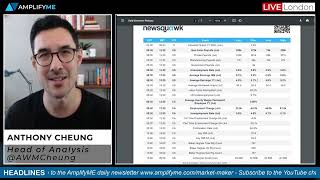
In this live YouTube session, host Anthony Cheung (Speaker A) and co‑commentator (Speaker B) walk viewers through the upcoming US Non‑Farm Payrolls release, explain how the data is structured, and outline trading considerations for news‑driven events. They discuss pre‑release expectations, including a 60/40 split favoring a 50‑basis‑point Fed hike, and the range of payroll estimates (75‑325k). The mechanics of the release are described, emphasizing disciplined post‑release entry rather than aggressive pre‑release trading. Key labor components—private, manufacturing, government payrolls, unemployment rate, average hourly earnings, weekly hours, and birth‑death adjustments—are highlighted, along with precursor indicators such as job‑cut reports, initial/continuing claims, ISM surveys, and ADP figures. When the data arrives, the actual numbers (5.28 M jobs, unemployment 3.5 %, earnings +0.5 % MoM, 5.2 % YoY) beat expectations, prompting a hawkish market reaction: US dollar strength, equity declines (NASDAQ, S&P), Treasury yields up, and gold down. The hosts analyze technical levels on EUR/USD, GBP/USD (cable), gold, NASDAQ, and 10‑year Treasury, noting support/resistance zones and potential short‑entry criteria. They also discuss the impact on Fed rate‑hike probabilities, now shifting toward a 75‑basis‑point hike. The session concludes with promotional mentions of newsletters, podcasts, LinkedIn, and training programs, and a reminder to follow their channels.
Chapters
Okay. Hello and welcome. Test, test. Just getting things all set up. We'll do a bit of a rundown starting in the next couple of minutes. Just going to get everyone on board for this latest release of US nonfarm payrolls coming out in just over 15 minutes. So welcome, welcome everyone. Okay, George Backhouse, good to have you on. Andrew, hope you are well. I haven't seen your face appearing in any other adverts recently, Andrew. What's the latest? Samsung?
Apple?
Okay, we'll give it a few minutes, get people on board, and then we'll have a bit of a run-through about what we can expect from the upcoming payrolls figure. Okay, hello. Hey Finn, hope you well. Okay, yeah, just getting everyone else on board, people logging in. We'll give it one more minute and then we'll have a bit of a discussion, look through the charts and talk about what's been going on. And then what we can potentially expect coming up shortly. Okay, hello, just joining us. Hope you're well. Yeah, a bit of an impromptu live session, non-farm payrolls, but I know that we are Amplify working with a few different groups at the moment, so just wanted to do this live. As a, as an exercise to go through a major news-driven event. And I know a lot of people actively trading this day to day, so more than happy to jump on. We're going to have the squawk on throughout, so So should get the audio announcement as well when the news lands, but I'm going to turn them off for the moment and let's get straight into it. So yeah, thanks very much for joining me. I'm going to be live probably between— from now for half an hour. So the run-in, the live release, we'll do some immediate post-market analysis. I'll try my best to pick up questions as we go along, but definitely towards the end more than happy to help while I'm on if I can. So what is in store? Well, the release of typically what is traditionally one of the major data points coming out of the US, and particularly at the moment in the context of everyone asking the question about what is the state of the US economy, what is the speed of the slowdown, are we in a recession? And all of this essentially is shaping then the discussion of what are the Fed going to do come their meeting. Their next meeting is actually quite a way off. It's not until the 21st of September. I must stress then that even from the onset, given that exact reason, I am slightly more leaning on the side that this data probably won't have a lasting impact, not unless it's surprisingly shocking for whatever reason. And the reason for that, the rationale, is that we're going to get another labor report, obviously the September one, before then the Fed decision. We've also got CPI reports to come and other very important information as far as the Fed are concerned, as well as market participants, which is going to really shape that expectation for the September meeting. You know, such as like the saying in politics, you know, like a week is a lifetime. In markets, you know, a day is a lifetime. So if we're talking about speculating, are markets right in their positioning and what does that positioning look like at the moment? Well, if you're looking at the federal funds rate futures, so the short end to get an idea of that, that's most kind of ultra-sensitive to interest rate changes in expectation. At the moment, probabilities reside with a 50 basis point rate hike. But only leaning in really a 60/40 split. 60 in favor— this is current market positioning— of, uh, 50, and the remaining 40 going still for a 75 clip, which would be in fitting with the back-to-back 75s that we've already had. So obviously this is all very important for how the market might react right now. How important or how accurate are these figures for September? I I think you need to take it with a large pinch of salt from where we're at at the moment in time because of the time difference, as I've said. So as far as nonfarm payrolls is concerned, let's talk about that in a bit more detail. There, there are a number of things to be aware of if you are going to ever trade this as a news-driven event. The first thing is, is the mechanics of how this information comes out, um, and that is that there's a lot of information and And so therefore, trying to be super aggressive, hit market at market price is never really a sensible strategy. I don't think when it comes to non-farms, I think you've got to be much more disciplined and pick your spots thereafter the initial noise that you typically see. The common question then is, well, how long do I need to wait to pull the trigger? It really depends. It really depends on the quality and composition of the numbers you're about to see. So as far as the numbers are concerned, and I always talk about payrolls in an algorithmic first in, first out type system reaction because that typically is what the initial move is based on. You will see if you're new to watching payrolls, which I know some on the call are, is that going into the release you start to see lots of jumpy price movement in your kind of main US products. So S&P or the T-note or the US dollar, so euro-dollar, something like that, you'll start to see in the seconds just before the data comes out lots of jumpy price action, which is just a byproduct of the illiquid nature of the bid offers going into the release. So the market starts to jump around a bit. You almost see this instantaneous lift in prices, or the opposite, as soon as the number hits. And that's the kind of The algo is plugged into like the fire hose, which just snap, pull the trigger, and they fire dependent on the first input. And the first input is the headline change in nonfarm payrolls. So again, just covering all bases, non-farming to extrapolate out the kind of seasonal jobs that we get in the US. And looking at the employment situation on a national perspective gives us the kind of lifeblood, if you like, of how the economy is performing and likely to perform will give us some insight about the future. And so here you're looking at a figure of 250,000, which is a quite a marked slowdown in the number of jobs that were created in the prior month, which was 372,000. To have that, to have a bit of perspective, we've been kind of hovering around this 380,000 mark quite consistently. So this is a leg down from that to some degree. And I guess a lot of that is conditions are cooling amid the tight labor market that we have at the moment. And as you can see, it's far lower figures than what we were seeing during the period of kind of Q4 of '21 and Q1 of 2022. So ranges are super important and something that should not be downplayed. And what I mean by a range, it's the subsequent figures here. So 75 and 325. If you try to think of it in your mind's eye as a normal distribution kind of curve, and these are of Wall Street estimates, so straight down the line the median estimate is 250. On the outer extremes, this gives you then your kind of framework of expectations. So on the extremity of the most optimistic, 325, most pessimistic, 75,000. This is important because then breaches of these outlying extremes of that distribution of expectations subsequently creates a much larger initial knee-jerk reaction, certainly as far as an algo is concerned. You know, basic rule parameters, it breaches top level of this, exercise position size more larger of that. So key here, and And the reason why not to get too involved in the initial spikes, if there are any, is that nonfarm payrolls is more than just one number. If I just make this a bit bigger, you can see here there are private payrolls, manufacturing payrolls, government payrolls, unemployment rate, average earnings month on month, year on year, average weekly hours. The list goes on, and then you can double down and you've got Canadian data here as well. One thing I would suggest. Is personally I'd recommend never trade the CAD currency on the release of non-farm payrolls. The Canadian jobs data comes out at the same time, and it's like trying to catch hot, hot knives— like, uh, a falling knife, I should say. It's like, it's impossible. It's so volatile if you're looking at the CAD. So if you're looking at US instruments, I'd say just focus on the US figures. First one being then The headline changing on farms, the unemployment rate that is expected to remain constant at 3.6%, and then keep an eye on the average hourly earnings numbers. They're expected to be at 0.3% and 4.9%. 4.9% year-on-year is a leg down from what it was previously, which was north of 5%, giving us some indication about this inflationary, uh, perspective, if you like, of the current economic situation. They're the, the main ways to interpret this. You've then gotta look out for the revision to the previous. So if you get a headline beat, let's say, what if the revision to the previous is down? If in a sense then that neutralizes any positivity on more jobs being created in the prior month, cuz the month prior to that was revised down. So net-net, it's a neutral reaction. So this is where you get lots of two-way price action and you've gotta be super careful of that. All right, got a couple minutes. So final things I was looking at. I think there's a crib sheet here. Yep. So, well, this is the old crib sheet, in fact. So I don't have the latest one. But to give you an idea here, from an educational point of view, what people will do ahead of non-farm is you will look for indications of the state of the labor market ahead of the official government report. Now, that could come from Challenger Job Cuts, which is just a measurement of private sector job cuts in different areas like technology, finance, healthcare, and whatever. Then you've got benefit claims. So initial and continuing claims. And we generally track these on a 4-week moving average, which allows us then to see if there's any unusual patterns there which might indicate more people, less people claiming benefits. You've then got ISM, so the Institute of Supply Management. You have a manufacturing reading and a service reading. When you break those down, they have component kind of constituents of which include things like the state for purchasing managers in manufacturing for new orders, for inventories. These all give us different types of information to help us, I guess, substantiate our view on where the economy might head in the future. But it also gives us an idea about the employment situation for those two key sectors that make up the economy. Uh, you then have other ones like more confidence-based on the consumer level. So in Michigan and the Conference Board, uh, the ADP figure, um, not so much available this time, but typically is seen as quite a, a main precursor. That's private payroll measurements in America, and statistically speaking should be fairly correlated in a way um, albeit it's not always the case, to what the Labour Department's report would suggest. So this is kind of the overall summary. So in terms of reaction, um, as I said, the overall range on the headline is kind of from 75 on the low to 325. To be quite honest with you, a number on either side of that I'm not really that fussed about in terms of shifting meaningfully the market's expectation about what it thinks that the Fed is going to do, and subsequently then creating a large or indeed sustainable impact on market prices. That doesn't mean we can't— we might not see some short-term price gyration. We probably will to a certain extent. The way this would typically work, I guess, from a reaction function, is if we get a lowball number— so let's say we get a step down in, in jobs into a negative print, which is not expected even at the most pessimistic estimate, and then you get average hourly earnings also down, which is kind of lowering that inflation argument, then that means that the Fed are probably going to have to slow down even more on their future tightening. And that would be probably, um, NASDAQ equity, US equity positive. It would probably be dollar negative, so euro-dollar cable positive. T-notes would probably move up because yields would move down, and gold may appreciate under that scenario. So just to give you some, some kind of context as to how short-term market mechanics might work. But again, with payrolls, as I showed you on that initial kind of list of data. There's a lot going on. My best advice always with payrolls is just remain disciplined and interpret and then look to take action accordingly. The more uniformity there is to the numbers pointing in one, um, direction, the easier it is to trade. The more mixed signals you get, the more reason to stay out of the noise and not get involved unless you get an extreme scenario. All right, I'm going to turn the squawk on. And then we'll listen in. Under 1 minute.
The US reports, which includes private, manufacturing, government, net and the birth death adjustment. 30 seconds.
Okay, just under 30 seconds. So on my chart, I'll make them bigger as we talk through them. I've got EUR/USD left, cable, gold, S&P and NASDAQ. I can bring in oil, T-notes, US dollar index and the rest as we go through it. Okay, it should be about 10 seconds now.
10 seconds. 5.28, that's 5.28, but expected over 2.50. The unemployment rate, 3.5%, below expected 3.6%. The prior was revised higher to 398. And for the earnings, month-on-month 0.5, both expected 0.3, year-over-year 5.2.
So it's a bullish report across all major headlines. Forecast beating, top of the estimate busting headline, the unemployment dropped more than expected, and average hourly earnings are up. So more inflationary. So higher jobs and more inflation. So dollar immediately catching a, a bid. Stocks not liking it at all. This is the opposite of that scenario we just discussed. So this is where you've got really healthy job creation with inflationary pressure. The Fed are going to have to tighten faster. So dollar appreciation, yield appreciation— stocks don't like that scenario. And so we're getting downward pressure on the NASDAQ 100, S&P down, currency pairs down, and gold down as the dollar's popped on the back of that information.
—34.6. So just, so just in terms of the overview of that report then, so that was a substantial beat on the headline there, 5.28 above expected 2.50, an unexpected decline in the unemployment rate, and the earnings components were firmer than expected. So we are seeing some immediate downside here in Treasuries. Downside in the equity complex and appreciation of the dollar, which has ripped through the 106 mark, which had been capping the index to make a high of 106.51.
Yeah, so the Squawk just kind of reiterating what we were just discussing there. So it's surprisingly strong and it's all, as I said, there's a uniform direction to the data which makes the directional movement in assets much more clear. Um, so as you can see here, the NASDAQ's at quite a critical level now short-term, cuz we're just approaching the low that we printed in yesterday's session. So be interested to see how the NASDAQ responds here. Finding— and you can see there, those initial speculative shorts on the NASDAQ hit on the back of the number. You can see just some bailing out of that as we've initially touched that low that we had at 13,185. Um, in the futures market. So that would be a key level. Any further breakdown in the NASDAQ there, then it could trade quite heavy down to that double top that we had on the 1st and the 2nd of August, which would be a decent run lower. Um, elsewhere, looking at cable, it's quite an interesting setup as well. So the dollar— the dollar movement on the back of that So just coming down to, in cable, the low that we had on the trough of the Bank of England kind of doomsday sterling-led weakness from yesterday on the back of a prolonged deep recession. And that lines up, marries up nicely with that low that we had on the 29th. So for me then, there's some key technical areas here we need to watch from, uh, a support perspective. So you've got this level here in cable and really want to see what it's like when it's testing. If we start to see the NASDAQ break out and cable break that level, you've got gold also similarly just testing it around those lows. You can see here, this is quite a key level for gold as well around this current level. You've got that high that we had to some of the price activity. On the 3rd, it was an inflection point through yesterday's session, came back, found nice support there yesterday afternoon. We're right there at the moment. So now it's about— if it's the ship has sailed for the short to hit at market. Now it's about now decision time. You can either play the market back up and fade the move, but that would be counterintuitive of the fundamentals we've just seen. So to initiate the short here, if you were that way inclined, I would have to see these levels— gold, cable, NASDAQ— they've got to break and then come back to the pullback on the break level to then want to get in and, and get into that short position. So only then, under those conditions, I would say, would you really feel a bit more comfortable with conviction to want to enter that market. So here, just marking up, this is the key level. See, the NASDAQ's just sort of testing it at the moment. And then as we come further down, the next level in the sand would be here, and that would be a nice execution on the short. But again, I'd want to see the correlation play out to give it a bit more momentum, that, that could then add to what already is a pretty decent initial snap on the move. Just a quick look at T-notes. I'll make that big. Here's the US 10-year. So as you would expect, yields popping on that kind of hawkish report. That doesn't look too interesting at this point in terms of technically where it's sat, not unless we start to get quite a bit further lower. So I wouldn't be using that so much as a technical cue on those support levels like those other products, but here certainly I'd look at it from a momentum momentum perspective to just see how that downside is shaping up. Yeah, the NASDAQ's having another little look at that level. Gold though, not playing to that tune. So gold's had a decent bounce now off that low, and that Just keeping an eye elsewhere in terms of the other figures to be aware of. The birth-death adjustment, um, in terms of net birth-death forecast, 309,000. The 2-month net revision was a positive 28,000. So it's pretty much across the board a very, a very hawkish report, and it's definitely going to fuel the flames now back towards 75, away from 50. So that 60-40 split that we saw, that will already be in flux right now. And obviously we can revisit that just before we come off to see where the land lies. Yeah, in terms of the yield curve, the 2-10 yield curve inversion has uh, is now to -42.5 basis points. Now, to make this make sense, essentially this data would suggest then that they've got to hike more aggressively. That then is going to create then, uh, a bigger economic slowdown. So you're going to get higher yields in the short term decreasing yields in the long term, further inverting the curve essentially. So it would mean then that the market's kind of reacting in a sense to the fact that, you know, in an aversion type play, that things are going to get worse because the Fed are going to have to be more aggressive in the short term. Hopefully that makes sense. Yeah, just looking at it at the moment, it's losing a bit of appetite now. See the NASDAQ holding here in that bottom chart, cables holding, gold is holding. What you tend to see when you start hitting these, these key technical areas is the market comes in kind of waves. You start to see like the order flow come in, the momentum, the shaping up of the candle in a very short time frame. And you can almost judge then the waves of when we're attacking these, these substantial levels. And so at the moment, this— we still need to observe it. It— everything is still in very close proximity to these key levels. You just need one big order to come in to snap through in one of these levels. And then it could get quite interesting again. Yeah, an interesting point as well, I guess, to, to keep in mind is that in the run-up to this release, I was talking about the nature of the fact that the Bank of England or the Fed, they would have— they've kind of kept the language of data dependency. And why do central banks do that? They do that because of the reason of then they have not pre-committed to a certain course of action far out in the future, which is highly uncertain. So then if you say we're only going to react to however the data suggests at the time, well, then this data suggests the Fed should be hawkish. And so again, hence the rationale behind the type of market moves that we've seen. So, you know, importantly, and this comes then the test, if the Fed's going to really live up to that credibility and be data dependent, we probably are going to see a meaningful shift back to 75. But as I've said before, there's a long time to go and a lot can happen between now and then, including another payroll report. So that's not to say that a 75 is a shoo-in just because of what we've just seen materialize. But for sure, the readjustments, the recalibration in markets is what we're seeing in a, in a short-term intraday reaction. Yeah, in terms of the Canadian numbers, um, the employment change minus 30.6 thousand. Expected was for a +20K, so big miss. And their unemployment rate, 4.9% against expected 5%. Okay, just while I'm on, a few things if I may. For one, don't forget to follow us on the various social media channels. If you're new to the YouTube channel, don't forget to subscribe. We put out videos, live sessions, things like that, which definitely might be of interest to you if you're interested in markets. There's the AmplifyMe LinkedIn, my LinkedIn profile, if you'd like to connect with me. There's a new podcast episode that is about to drop any moment that I recorded earlier this morning. In fact, it is already live. So feel free to check that out. If you just subscribe to the podcast channel, turn on the bell, you'll be notified every Friday when our new episodes come out. If you're not on the newsletter, then feel free to get involved. At the end of every European trading day, I put out a newsletter just wrapping up some of the major news and events, job tips as well, things like that for any students looking to work in finance you might find useful. And then also our Finance Accelerator. I've put the link there as well. You might find interesting if you've not done one and you're in the early part of your career or you're a student still kind of figuring things out, then that is the simulation for you for sure. Our final internship program, our Summer Analyst Training Program, takes place on the 22nd of August. For anyone interested. All right, unless there's any questions, we'll look to wrap things up. I'd love to stay on all day, but I got tons of other stuff I need to tackle. And definitely just keep an eye on the newsletter and stuff like that. That will all go out at 5 PM today as per normal. But yeah, thank you everyone for joining us. Yeah, nice, nice reaction actually, pleasing if you're observing markets. It's always nice to see a bit of market movement. To give— to finish things off then, just to give you the market reaction. So remember, before we were going into the Fed meeting, the split was 60/40 in favor of 50 basis points. That split has now flipped, and it is now 60/40, if not more, leaning in favor of 75. Cool. All right, we'll wrap up there. Thanks everyone. Take care. Have an amazing weekend. And, uh, yeah, check out the podcast, latest episode just recorded. So hopefully you might find it a useful summation of the week and, uh, I'll see you next week.
More from Anthony


Inside the Biggest Banking Stories You Need to Know This Week (Anthropic, Diageo, Private Credit)


Inside the Biggest M&A Deals You Need to Know This Week (UniCredit, GameStop, eBay, Eli Lilly)







AI Breakthrough or Hype? Anthropic’s Claude Mythos, Tim Cook Steps Down & LIV Golf Collapse