Morning Briefing - 17th July 2018
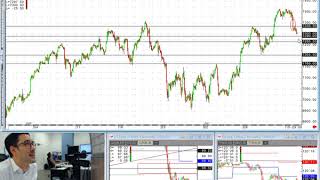
In this 20‑minute live‑room briefing, the presenter opens with equity sentiment, explaining how Netflix’s Q2 subscriber miss and a 15% share drop sparked a pull‑back in the Nasdaq and broader tech‑heavy indices, dragging European futures lower. He reviews technical levels on the Nasdaq, Dow and S&P, noting key support/resistance zones and the limited impact of Jerome Powell’s upcoming testimony. The briefing then shifts to macro‑policy news: the Reserve Bank of Australia’s minutes signalling a possible rate hike, the Reserve Bank of New Zealand’s inflation hitting a seven‑year high, and the resulting moves in the Aussie and Kiwi currencies. A substantial portion is devoted to UK political turmoil – Theresa May’s narrow customs‑bill win, the Chequers amendment fallout, and the risk of a confidence vote – and how these developments influence sterling, with a focus on upcoming UK wage, CPI and retail‑sales data and technical price levels. The presenter analyses a sharp 4% drop in crude oil, attributing it to Saudi extra supply, rising Libyan output, and large inventory draws, while highlighting key technical support zones. Fed‑related commentary includes a dovish remark from Neel Kashkari and expectations for Fed Chair Powell’s semi‑annual testimony. The briefing concludes with a quick calendar of upcoming data releases and events. Throughout, the tone is analytical and measured, with cautious optimism about market direction despite the volatility.
Chapters
Okay, good morning. It is Tuesday the 17th of July. Hope everyone is well. Just going through then into the briefing, next 20 minutes or so discussing some of the news items from last night and starting straight off with the equity sentiment where you can see European index futures are on the back foot. This following a drift lower seen late yesterday and overnight in the US indices, predominantly that of the NASDAQ. And so just getting straight into some of the reasoning behind this, you probably saw, uh, last night you had not the biggest company you'll come across, but certainly one that really epitomizes, uh, the kind of growth stock picking mentality. And that is of course Netflix, because earnings season does pick up a pace this week. And Netflix reported after market yesterday, and this was the reaction, as you can see in their share price. A couple of different things here. The most notable one being that the video streaming company added 5.2 million net new subscribers in Q2 instead of 6.2 million that its executives had predicted 3 months ago. Now, one of the important things here is context. Their previous earnings report to this one, their shares rocketed higher in the opposite fashion. And so this kind of pumped up expectation, it failed to deliver on that front. Now Netflix missed targets both in the US and overseas, so it was disappointing on both fronts. Looking at it, what Netflix have said is that they've blamed to some degree their own internal forecasting for disappointment. Rather than any change in demand for its services. So they've tried to kind of downplay it. For the last 4 quarters, Netflix had substantially beaten its own subscriber forecasts, you know. So as the, as the saying goes, you know, a good thing can't last forever. And it was outperforming so substantially that obviously moving the goalposts then is that people's expectations get ever and ever and ever higher and higher. And it somewhat fails to deliver. The other thing, of course, and quite rightly as Jimmy is saying, is that, you know, the subscribers— you've got to think about the time of year. Of particular, you did of course have a World Cup, which isn't broadcast on Netflix. And when Netflix does base a lot of its stock pricing and optimism over new subscribers, the fact of the matter is when you have such a global high-interest sporting events such as the Football World Cup. Well then, actually, does that have a read across, say, into people picking up things like Netflix, for example? So certainly I think this could be part and parcel of some of the reasoning for sure. The other thing is as well about the popularity of new shows. And actually there wasn't much in the way of new content coming online, and some of the longstanding kind of more popular programs are due to come out over the next quarter. So that's probably as well. Netflix's strategy, I'm not sure if you've ever really looked too much into the company, but it spends a phenomenal amount on content budgeting every year. To give you an idea, they spend about $8 billion into new programs on spending per year. Their marketing as well, I was reading, is phenomenally large, so a lot of it is based on drawing in new customers because of the churn kind of rate of people then canceling. So new content is absolutely pivotal to the key of their success. Executives have insisted that investing in yet more new films and TV shows is vital then to keep attracting and retaining subscribers. So Netflix, as I said, not a big company in itself, and you know, these types of percentages, you know, although this is kind of looking in the 13, 14, 15% fall in their stock price, just check this out to put things in some perspective. This is Netflix's shares over the course of the last 7 months, and as you can see, their shares are up about 100% over the course of really half a year. So the fact that they've come off 15%, you know, this is a a big move on an immediate effect, but their share price has absolutely outperformed the market, uh, so far. Nonetheless though, given that this is one of the classified FAANG names, and so therefore quite reflective of market sentiment in that respect, then it's quite interesting to see how this has had a bit of a follow-through effect this morning. So if I just look at— this is the NASDAQ future on a slightly longer time frame, and This is when the information came out last night. So you can see, you know, Netflix, it's, it's read across for then other relatable names of these growth sectors like, you know, your kind of Amazon and Google and so on. And so the whole index future weakens on the back of that. And so you can see as Europe's come in, a little bit of further downside pressure. So just bringing into play, you'd say, the high that we printed back on the what, the 11th. That would be at 7290. Other levels then of interest being the low point of the morning of the 12th, just below there. And so a little bit of weakness just coming through. This did kind of feed through as well into some of the sentiment from overnight. Uh, just a quick look at the other indices though. I was just looking at the Dow, and obviously the Dow— this is a daily continuation chart, so each candlestick obviously represented of a day. If you look at the size of that candle there that we had for yesterday, I was reading a statistic last night. Yesterday's performance of the Dow was the second most narrow range of the entire year so far. So you do have to put these things into a bit of perspective. Talking to the guys here, you know, if you're looking at the Dow yesterday, you know, you've got Jerome Powell, he's going to be speaking a bit later on And with the semiannual testimony being such a kind of historically important speech, although as we'll discuss in a minute, we're not expecting too much, and it's kind of little need to really trade that market at this point, particularly when we can see you've got to quite an interesting point of technical resistance anyway, defining the kind of mid to late May highs. You can see when we did breach that at the beginning of June, it was also acting as a bit of a floor for then the subsequent bounce on the 8th after the break 2 days before. 4, and then we've just come back up to this point now for a test. So seems a logical point for a bit of consolidation, at least waiting for the next kind of move, whether that's based on a broader macro perspective from the Fed update from Jerome Powell, or whether it's from a micro update when we start to see earnings season really start to pick up a little bit of, a little bit of pace. Looking at the S&P likewise, obviously not as aggressive as a move as what we're seeing in the NASDAQ this morning, just given that divergence with more weight felt in the tech sector on the back of Netflix. But the S&P's just broken through its— well, it's had a test on its S1 today. I guess it's the S2 on the downside of any further pullback that looks quite interesting, that being not just the S2 on the day but also the relative high that was back in the middle of last month. At this area here, going back to the 20th. Overall though, even if we did get a bit of a pullback, I'd see that as a fairly decent area of support. And granted, although Netflix was negative even here, I'd be still looking at downside levels to think that the price should still be supported. Bigger technology names like Microsoft, they're going to come after market on Thursday could be a little bit more interesting just given their larger weighting, market capitalization, and so on and so forth. So that was the kind of the story from Netflix overnight. A few other things just to have a look at though that have occurred in the news. We have had the RBA minutes, so the Reserve Bank of Australia. To give you the, the kind of headline that came out, their meeting stated the board judged appropriate to maintain policy adds that next rate move is likely to be a hike if the economy improves as expected, but saw no strong case for a near-term change. So actually, although they did raise trade war risks, overall still sounding relatively upbeat. And if you check out the Aussie future, DA6 is the— well, it's the CQG ticker, but the Aussie future did edge up overnight after the report did come out. The other thing sticking with the antipodean currencies, you've got the Kiwi firms after RBNZ. So you also had some inflation data coming out of the Reserve Bank of New Zealand where their inflation gauge rose to a 7-year high. So consequently, the Kiwi also rallying as well. Whether or not this has had a bit of a move in sympathy then, helping post the timing of the RBA minutes, but with the Kiwi also rallying, maybe just helping a read across into the short term into the Aussie as well. So those two things were happening from overnight. Moving swiftly over to our own shores though, you might have seen, um, I do apologize if you do get tweets and Facebook alerts from me at very late hours in the evening. Um, hopefully you find them useful and not annoying, but I do like to keep on top of when these things are happening and the actual debate about this customs union issue and the amendment to the various terms of the white paper from the Chequers Agreement. This went on all the way until the very late hours of yesterday evening, until when the headline being that Brexit turmoil as May, her majority cut to 3. This is because the government escaped a defeat on their customs bill by just 3 votes. So let me just run through a couple things here so you're up to speed. Theresa May will now, today, attempt to draw a line under what has been happening here, further division, more resignations, more problems here, and more risk of a vote of no confidence. What she's going to look to do today is bring forward to Thursday this week the start of a parliamentary summer recess. The Commons had intended to sit until July 24th. So basically she's trying to, to just— let's just go on to summer recess and close any potential further disruptions. Let's just shut school, if you like, about a week and a half earlier than what has been intended, so we can stop any of this potential risk materializing any further. So this is what we're looking out for potentially as a comment to come from her later today. Now, Mrs. May narrowly avoided a Commons defeat on key Brexit legislation yesterday So let's just have a quick review of what exactly has happened. Wants to close down the House of Commons this week amid fears that Eurosceptics are plotting a leadership challenge. So this comes after May caved in to Tory Eurosceptics by accepting four amendments intended to toughen up her negotiating stance following the publication of her white paper last week. But Mrs May's surrender to pressure from Tory right, chiefly led by Jacob Rees-Mogg, has infuriated pro-European Tories. Tories. So actually, it's not the Brexiteers causing the issues now, it's Theresa May has pandered to Jacob Rees-Mogg and the ERG and the more Brexit-minded Conservative members. And this has only fueled the fire, or stoked it if you like, of the Remainers. And then what you've had here is a new resignation. Pro-European defense minister has quit to vote with Labour against the amendment. So now the defense minister of a fairly senior position within the cabinet has also resigned. Now, what exactly are the amendments? So just a quick overview. One would require the UK to have a separate VAT regime from the EU, while another would require the government to table primary legislation if it wished to keep Britain in a customs union, both of which Number 10 has said really is what they— the spirit of their white paper. It already had these types of these meanings anyway. Another amendment would put into law a commitment that could not be a customs border between Northern Ireland and the rest of UK down the Irish Sea. This is— that one is— I mean, Mrs. May promised before that such a border would never have been acceptable. The fourth amendment is the subject of why the vote was so narrow. This is about that it would be illegal for Britain to hand over tariffs collected in the UK to the EU unless there was an agreement that the EU would collect tariffs for Britain on a reciprocal basis. So this is the point of which a lot of people I've been reading last night and this morning are saying this is the point of which where Europe might well go, well, this is unacceptable because of this point. So do we remain now in this kind of status quo where it just bounces back and forth between the various different lower and upper house, and then Europe rejects it anyway, and the whole thing just becomes a very long, protracted argument. Pro-Europeans have another chance to take revenge today because the Commons votes on a trade bill amendment to keep Britain in a customs union with the EU, a policy opposed by Mrs. May but backed by Labour. So if any of those pro-European Conservatives did want to make a point of the PM and this kind of change of slight positioning to a more appeasing of the Brexiteers, and they certainly do have an opportunity to be disruptive today. And so just monitoring those comments as per usual, I'll get all the times and put them in the chat for you so you're totally up to speed of what's going on. Net result of this though is the government has passed, albeit as has been the case over not just recent days but weeks and months and pretty much since the inception of a Tory government led by Theresa May. Her conviction, or her majority if you like, or I should call it a minority of sway over the Conservatives, is getting ever more narrow. I guess it's getting to a point where 3 is very much on the wire. But I think the markets are fairly comfortable with this state of play because, you know, as Jacob Rees-Mogg said at the weekend, he was not expecting the government to to be voted down. The government has not been voted down, albeit though we're getting closer to a point where, you know, these prospects of a vote of no confidence maybe has materially increased ever so slightly. But still, the point remains whether or not, even if they had the chance, would they trigger that? And would it, would it be any different than just reelecting Theresa May anyway? Would likely then restrict people going that far. And as such, I think the market is still fairly comfortable at this point with the political developments at play. So although we had a bit of a run lower yesterday, and the important thing here from a news perspective, if you're looking at the pound, is that Bloomberg and Reuters are incredibly bad at reporting this type of information because in reality they're not equipped to do so because it's the BBC political correspondent, the Sky News, the Telegraph, and so on who have the journalists literally right outside Parliament talking to these politicians and MPs as they're going in and out of the Commons where they're getting the latest sources, the latest sentiment, the latest thinking. And absolutely, Laura Kuenssberg as has been always the case through the Brexit saga, was absolutely on the money yesterday in breaking the news first. And you had a bit of a decisive edge on the market then moving post her tweets rather than something coming out on the traditional newswire. So once again, if you do have the luxury of access to, to some screen space to have your Twitter account up, I would certainly designate a column if you're looking at the pound to monitoring her and other kind of UK journalists who are covering the Brexit situation for later on this afternoon. But for the moment, cable relatively stable. Now, one thing to notice with cable though is, and if you read the weekly strategy from yesterday, this week you get a lot of economic data, and it does commence today. And today, what's going to be the most interesting is not so much the unemployment rate or the claimant count rate in the UK, but of course the average earnings, uh, the average weekly earnings expected to be unchanged from the prior month at 2.5%. Got a range of 2.4 to 2.6. So 2.4 would put us back down to the lowest level since really September of 2017. Uh, 2.6 just puts us back to where we were in March. And so we have been drifting a little lower, and then actually inflation should start to level out. If anything, there's some risk to upside given energy price rises could be factored into June, according to at least analysts at Deutsche Bank. So what the market will be quite mindful of is whether or not you start to see a move back into negative real wage growth. If wages continue this downward trend, which has been materializing since the beginning of the year, let's say we have a downside number today and then the inflation number tomorrow is an upside surprise, then again it starts to bring into question, uh, the kind of awkward situation that the consumer finds himself in with getting materially poorer, back as much as what defined then 2017, which led to a loss of a lot of consumer confidence, and then ultimately is materializing in an economic slowdown within the country amid, of course, this ongoing political uncertainty So the data this week is particularly key, and 9:30 is kind of the first of these that we'll get. So remember the sequence: you've got the wage data today, you've got the CPI then to follow, and UK retail sales is going to come out on Thursday. So if you're looking at the pound, I guess there's kind of two phases to the day to be aware of. You've got the interim period, so the next 40 minutes when you see that UK data hit I would say then you want to be kind of looking at this cable chart thinking about potential areas of where the price could move to. So you've kind of got the intraday high that was printed early this morning when we came in, which was just short of the 33 handle. The pivot level really has not provided much in the way of a— well, a support or resistance. So since we've come in, it did briefly late Asia session provide a degree of resistance. Also was around the rough high from Thursday last week, but it's been a little bit chopped up. So I prefer to be looking at the broader downside range here, X-ing out some of the movement that was seen quite violently on the back of the, uh, the Kuhnsberg tweets from yesterday. So really around that 132.59 if we were to get a weaker number. If we breach then that morning low point that was seen down at 0.6969, kind of be looking at those areas here on the back of that data set. Then the second phase of the move— so that's number part one if you're looking at sterling. Part two will be, I would imagine, much later on this afternoon then when they go back to the Commons, and we're listening out for the PM talking about further issues. Today, of course, is a vote on the trade bill amendment to keep Britain in a customs union with the EU. And so that's what we'll be looking out for later on this afternoon. Okay, a few other things though, quickly, on the, the news side of things, this being oil. Now let me just bring this into shot because oil had a really quite aggressive down day yesterday. So let me just put this on a broader chart so you can see what I'm talking about. So we've really had— well, this was— this is encapsulating May, June, July, uh, in the, the front month future. And this was some of the levels we were looking at yesterday. For one, the kind of trend line from the, the June, kind of mid-June, uh, lows printed on the 18th and the 21st. And it came up to around that same point of support and resistance around this 6920 type level. Uh, when it broke that yesterday and the 69 handle, consequently on that trend break and level, we saw a really quite aggressive move to the downside, targeted then the 58 point, which was these previous highs you can see from the rectangle, because these are all marked up from when we were tracking the price fall yesterday. And then it popped lower all the way down to then the next target, which was, uh, this low printed on the 26th, where the price kind of consolidated now. On the back of that. There's some support around that 67.70. So one of the things here is that oil has had a couple of days of, of really quite sharp movement. You'll remember what we had the middle of last week when oil just decided, with very, very really little fresh fundamental news, to really just see some aggressive downside. Same kind of price pattern happened yesterday where the market seemingly, as the losses started to mount, 2.5 getting close to $3 in one session. That's, that's pretty big for a one-day move. Now Bloomberg talking about the kind of reasons behind this, and this is what this article is talking. So, you know, this is the latter point about the halt to the current slide now, because the forecasts are out for this week's DOE oil inventories, which is expected to have fallen by over 3 million barrels per day last week. But let's get to the first things first. Oil fell 4% yesterday. Now, one of the main things here, talking— well, reading to a few articles this morning and listening to a couple of the talking heads on Bloomberg from the various different institutions, uh, one chap was noting the point that there's below average volumes were in effect yesterday. And certainly when you do start to see that type of volume profile, it can exacerbate the conditions for price movement, particularly when we breach kind of key technical levels. From a fundamental perspective, one thing that people are looking at is Saudi Arabia. As we know, Saudi Arabia has been the kind of spearhead between increasing production on the OPEC-non-OPEC agreement. But separate to this, Saudi Arabia is offering extra crude volumes on top of its contractual supplies to some buyers in Asia. Now you could say then, well then, Saudi Arabia are responding to the Trump kind of request that's been in play about this kind of mitigating a high price in the pump in North America, particularly going into an important political event, that being the midterms in November of this year. Also remember, at the end of last week we had those reports according to Bloomberg sources talking about Trump administration is said to be considering tapping into America's Strategic Petroleum Reserve to cool rising fuel prices. So there are a couple things here that would suggest maybe a little bit of a pullback. The Saudi one would suggest that they are then kind of falling into, into line as per the US's request, which when push comes to shove with a highly tense relationship in the Gulf between Saudi and Iran where you are absolutely reliant on US military support, then listening to the US is quite a reasonable expectation, I think. And I think possibly this is— explains maybe some of the weight more recently and some of the price. And then earlier this morning, I did just see some information about Libya, uh, that came out. Libya oil output has risen So Libyan oil output has risen 650,000 to 700,000 barrels per day amid port reopenings, according to sources. This was after some of the evacuations and some production was affected by kidnappings that we saw over the weekend. Secondary to that, Libya's oil production from the Waha field is set to rise to 70,000 to 80,000 barrels per day from 20,000. So some Libyan production coming back onto the marketplace. The only thing counter to this, and maybe just helping provide a little bit of a floor for the moment, is you'll remember that last week, uh, inventories had declined by more than 12 million barrels in the previous week. That was the biggest net decrease in the inventory data from the DOE since SEP of 2016. The analyst expectations are for a further drawdown. And the expectation at the moment is for 3 million. And of course, we'll get the APIs tonight, the DOE tomorrow. So be interested to see how oil responds. Such a big move seen yesterday wouldn't be uncommon. So let me just tidy up this chart so I can explain, because it wouldn't be uncommon to see a degree of consolidation, uh, if there is no new fundamental news that comes out. I.e., after that big move lower we had on the 11th, Typically what happens then for the days thereafter, you do tend to consolidate. Now this is a fairly large range, or granted, but most of the price action happening within around a dollar price band. Now that we've fallen so aggressively by 4.2% yesterday, or really we started to consolidate already, so really that downside level could be quite key. The 6770 in the futures, a breach of that, then really it's about just scaling down as to where are the next key levels. You've got that 67 handle is would be of interest. That also defining the high point from the recovery back in mid-June before then we move lower to the lowest price point we've had in several, uh, months, which would be down at that $63.43. So a few things to consider there if you're looking at oil today. Uh, finally, I'm not going to talk about this too much, but it'll wrap us into, uh, Powell later. Fes Kashkari, you'll know Kashkari by now. He's kind of the biggest dove within the Fed and importantly is a non-voting member, so does not have a vote. But just so you're aware, was speaking last night and was talking about the fact that basically there doesn't need to be any more rate hikes. But I think that this is relatively unsurprising given his policy view. Quickly to wrap up then on the calendar, moving further forward through the morning, you You do have, um, Italian CPI data, but this is not going to be a market mover. These are final readings as well. So going into the US afternoon, no major 1:30s. You get US industrial production at 2:15 alongside cap utilization, and that's pretty much it. So obviously you still need to keep an eye on Trump and any update, obviously having met Putin yesterday but still fairly vocal on the issues in military spend with NATO and this kind of fallout of the Brexit commentary that he made, and obviously the ongoing trade war situation. So still does need to be monitored with some interest. Otherwise, looking to this morning, you've got Bank of England's Carney to discuss the BoE's financial stability report. So this is when he changes his hat and talks under a more kind of, I guess, regulatory view rather than a monetary policy So we'll keep an eye out for anything from that. Unlikely to be anything too market-moving though, is traditionally from this report. This one's the big one though. Fed Chair Powell gives semiannual testimony. This is in front of the Senate today, and you get the House tomorrow, both of which are basically the same speech. So by tomorrow, the market is already armed with the information that he delivered, which we'll see this afternoon. So today's one is inherently much more market-moving, Wednesday's very little so because it's just a repeat copy-paste from Tuesday. So this speech will be key. What are we expecting? Well, we're expecting, I guess, a degree of cautious optimism. The Fed felt positive and confident enough to change their rate hiking cycle to 3 to 4 in the previous meeting, updating their subsequent projections. Not expecting really anything too dissimilar from their current party line. Obviously, questions pertaining to the trade war would need to be watched with some vigilance. All right, gonna leave it at that. 9 o'clock now, so I'll let you, uh, get on with things for the rest of the day. I'm sure Sam, if he sees any good technical charts of interest, will be sharing those in the trading live room. Otherwise, have a good day and thank you very much.
More from Anthony


Inside the Biggest Banking Stories You Need to Know This Week (Anthropic, Diageo, Private Credit)


Inside the Biggest M&A Deals You Need to Know This Week (UniCredit, GameStop, eBay, Eli Lilly)







AI Breakthrough or Hype? Anthropic’s Claude Mythos, Tim Cook Steps Down & LIV Golf Collapse