Morning Briefing - 25th September 2018
Mario Draghi hinted at ending ECB stimulus by year-end, pushing the euro higher and the DAX lower. Oil hit a four-year high after OPEC decided against more output. Instagram's co-founders left Facebook as the company integrates its major acquisitions.
Chapters
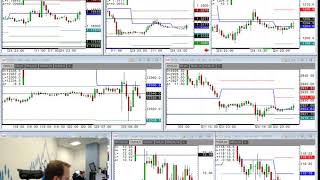
Okay, morning then, 25th of September. Let's get stuck into the action here. I mean, firstly, talk about yesterday in a second. What we have seen this morning, I don't know, seems a little bit weird. We've had quite a bit of, um, choppiness in the DAX particularly. Um, we've had some real seesaw price action, uh, really coming around 8 AM is where it kind of started. We had a two-way kind of blip, new lows, then up through the pivot, new highs, then back down, new lows, testing S1. Here we are now back at the pivot. We've had quite a, quite an extreme amount of volatility. And the weirdest thing of all, there's been absolutely zero news flow. You know, we haven't had any— it's not like we had any important data at 8 o'clock to kind of start triggering this. So just be mindful. The DAX seems to be intent on stepping things up in terms of volatility. If you have a look on the 1-hour chart, perhaps puts it in a bit more perspective, just so much as, you know, saying, okay, yes, choppiness here this morning, but it's actually all within yesterday's range. So just be careful when you're on these short time period charts. Often it can seem like you're getting violent movement, but you step out a little bit on a different time frame and actually doesn't look as kind of threatening or as interesting. But yeah, the DAX has been a bit lively, but no real news flow over the last 30 minutes of any kind of major note. So just a bit of maybe institutional volume coming through. I don't know, just definitely some volatility. So just be careful. DAX seems to be pretty whippy. Well, let's talk about yesterday, because, I mean, I would say the major event was probably Draghi's speech. And if we just bring the euro into play here, we had a spike higher in the euro yesterday afternoon as Draghi was speaking, a punch up, new highs up through R1, up through the high from Friday and, and a new high since June, actually almost touching the 1.19 handle. So euro appreciation, if you check out things like the German Bund, where the kind of circle has been drawn here, the Bund's prices dropped lower as yields moved higher. Obviously since then we've seen that unwound and the Bund's made new highs into the close last night, and we've just this morning also edged up above the high from last week. But briefly at least, a little bit of downside on Bund prices, upside therefore on yields. And when we zoom in on, on the DAX and we go to, let's say, a 5-minute chart then, and we'll go back to yesterday's Draghi speech, then DAX to the downside. Okay. And we're kind of still trading around those areas right now, bottom end of that kind of push to the downside. So You know the format here. If the currency appreciates, if bond yields move up, if stocks move down, well, then you know for sure that that is a hawkish set of comments from the president of the European Central Bank. And what did he say? Well, nothing dramatic other than saying that underlying inflation is expected to increase further over the coming months. Really, I mean, reading between the lines, just promoting even further the likelihood that the ECB will end QE as of 31st of December 2018. Currently, the plan of action, of course, is to step down the purchasing from €30 billion a month to €15 billion a month starting next week, October. And then really the last remaining small uncertainty is, do they print €15 billion a month until the end of the year and then stop? Or does it kind of actually drift and leak into 2019 as well? And Draghi's comments from yesterday would indicate the first of those. So going to December at €15 billion, then zero. He pointed towards something called, you know, why does he think inflation is going to pick up in the coming months? It's mainly because of a very solid labor market. And if we— and he made reference particularly to something called negotiated wage growth. Um, here's a chart for you. It's a little bit old. I've actually struggled to find, uh, a chart for this. Negotiated wage growth is something that Draghi made specific reference to yesterday and is one of their key metrics when it comes to their inflation forecasting process. And this is a little old, but it still makes the point. Um, old when I say this, they, they release this quarterly. This is a quarterly measurement And actually, I've only got up to Q4 last year. I do know that as of Q2 of this year, it's at 1.9%. So just around about, but the kind of spike came— 1.9% to 0.019. Thanks, Siri. The spike came at the end of last year. And the point here is up at a 5-year high. You know, we're often always looking at US wage growth, of course, and talking about how is it a 9-year high and obviously full validation for the Fed to carry on with their hiking cycle. You know, rarely have we heard any chat about European wage growth because there hasn't been any. So now actually a bit of life here, 5-year high on wage growth. If you're looking also at things like just more simple measurements, like just straightforward unemployment rate, which is always, you know, a good solid indicator of the general state of the labor market, well, nice downward trending pattern here over the last 12 months. Of course, as really Europe has started to come back to proper growth. You go to a 5-year timeframe, again, you know, really over the last 4 years, you would say from 2014, we've seen a pretty consistent improvement in the unemployment rate. And if you go 10 years, let's just go maximum. There you go. We're almost down to 8%. And actually, really, in the eurozone's history, we've only been below 8% once, and that was just before the crisis. So 2007, 2008. So actually, yeah, things are basically, you might say, back to normal. I mean, it's still more than double the US unemployment rate, of course, but traditionally you would see more— a higher unemployment rate in Europe than you would in the US. But anyway, you know, these are all factors that are pushing Draghi towards, you know, starting to properly commit to ending QE by the end of the year. So that was the kind of main feature of yesterday's session. Obviously we had that kind of trade war hangover from the weekend, and that's certainly if you're looking at, let's say, the S&P. And if we look on a daily chart, you know, we stepped lower yesterday, but of course we're still right at the top, you would say, in that high point that we had from the end of August. So the August high on the 29th of August, perfect kind of key support here. Um, but yeah, the S&P stepped lower, but not by much, and obviously nowhere near threatening what is a very solid and sustained upward trend pattern that we've seen. So, um, yes, a step down really at the open yesterday, and actually then it was relatively quiet apart from that dip, you know, the Draghi-induced kind of push to the downside, um, which was led by the DAX, you would say. What else is going on then this morning? You got little bits, it's relatively quiet I would say. You got headlines like this though: Merkel warns against harsh Brexit stance as Macron doubles down. So you know, here's Merkel saying, look, come on, let's not be too— it's not be too harsh here on Theresa. This was said kind of, you last night, obviously Macron's agenda is more sort of hard-lined towards the UK when it comes to the deal that the French are prepared to offer the UK, whereas Merkel has got more to lose. You know, Germany's economy is more, you'd probably say, more exposed to the UK. Certainly German car manufacturers at the kind of top of that list, very dependent. You know, they sell more cars in the UK than any other country. So German car manufacturers definitely lobbying in the background, of course. And perhaps this is why Merkel's kind of stepped out and said this. Of course, this helps Theresa May's cause going into the Conservative Party conference next week. And what's happening over here, this side of the Channel? Well, the cabinet have decided that still, despite the, the bit of a shocker last week, where the EU seemingly rejected the Chequers deal. Well, the cabinet have decided that actually let's stick to our guns. So the Chequers deal is still the deal on the table. As you've heard Theresa May bang on about many, many times, it's still the only deal that kind of provides a solution to the Northern Ireland, Republic of Ireland border problem. So Not too much to update you on, but slight update here on the— sorry, slight uptick here on cable. Emphasis on the word slight. Maybe helped by this kind of Merkel comment. However, also, I mean, to comfort you, just on the Brexit front, just a bit, a bit of a relief headline: Irish whiskey safe even without a Brexit deal. Okay, so we can, we can breathe easy. What else is going on? Oil obviously had a bullish day yesterday. Brent crude smashing $80, up to a new 4-year high. If we have a look at the daily chart for WTI, not yet, not there yet. Just going to tidy this up a little bit, get rid of a few of these lines. So WTI not at a 4-year high. Brent did make that move yesterday up to almost $82, but You know, obviously very nice positive session for crude, really. It would seem properly breaking and confirming the break, as I was saying in the briefing yesterday morning, confirming the break of that 4th of September and that 12th of September, and you might also say 19th of September triple top break. Big clean move, close well above that level. So you should now see oil consolidate and WTI push. Perhaps I'd say technically certainly looking for a push $75, or $75.27 to be exact, which is the WTI's 4-year high. Okay, so crude nice and bullish. That's obviously just further reaction to the decision from OPEC and non-OPEC countries at their meeting over the weekend to not, not add to the already agreed increases in output despite the, the risk that we're going to see maybe as much as 1 million barrels of Iranian crude go offline by November as a result of US sanctions efforts. So oil nice and bullish, and certainly, you know, even though the S&P finished down yesterday, the energy sector, a nice powerful move higher, definitely 1.5% around there, the energy sector punching higher. So that kind of saved the S&P a little bit, although it had a down day. It would have been a hell of a lot worse if we hadn't seen that big move on crude. Other stuff of interest then. Let's talk Trump. Here we go. Here's the headlines. Rosenstein— I mean, what a— what superlatives! We've run out of superlatives to describe Trump and his administration and how they operate. Rosenstein then is Is he going to resign? Is he going to get sacked? Or is he actually going to keep his job? I think pretty much all three of those happened multiple times yesterday. But as it, as it seems, in the end, looks like he's still in his job. The rumor mill, of course, was firing big time. It culminated with Rosenstein into the White House for a meeting. And anyway, it reappeared and it seems like he's still got his job. Why is this in any way important? So he's the Deputy Attorney General, of course, and the interesting part is that, you know, he's heading up that kind of— or he's overseeing, is perhaps the word I'm looking for, the special counsel Robert Mueller's investigation, which is the, you know, very broad investigation around the Trump administration. But of course, one of the big angles of that investigation is did administration collude with the Russians to win the election. And if he gets fired— this is Rosenstein— yeah, this is definitely— this would definitely step into the, the realms of Watergate and Nixon. You know, basically it would stink of Trump getting rid of Rosenstein because of the fear that if he doesn't, Mueller's investigation is going to power on and start revealing some pretty scandalous stuff. So this is all kind of coming to a head because there is also— well, the other thing is Kavanaugh, who's the Supreme Court nominee, Trump's Supreme Court nominee, is going through a huge amount of, well, lots of scandal being unearthed about sexual misconduct, attempted rape, and all of this kind of stuff dating back a few decades, but nevertheless. And so Trump under pressure from that side as well. And then to top it all off, the porn star who claims she had an affair with Trump is testifying as part of Mueller's investigation on Thursday. So expect the Trump headline mill to kick into full momentum as we go into the middle part of this week. Other stuff perhaps more interesting I don't know if you know who these two are. These two are— if you go up to the headline here— Instagram founders. So this is Kevin Systrom and Mike Krieger. They've decided to quit Facebook. Obviously Instagram got bought by Facebook, and I was just reminded— it reminded me of this deal back in 2012. Zuckerberg and Facebook made the decision to buy Instagram. Back in 2012, Instagram was 2 years old and had 30 million users. Okay. All right. Pretty rapid growth in 2 years, but still 2 years old. No revenue generating ability whatsoever at that point. So 2 years old, 30 million users, zero revenue, and Facebook bought them for $1 billion. And everyone was like, whoa, that is— I mean, just insanity. This is the kind of social media valuation bubble. Okay, but here we are 6 years on, and Instagram have 1 billion users and are generating huge amounts of revenue, thanks very much. And one of the fastest-growing— no, the fastest-growing kind of social media platform. And now looking back, 1 billion was an absolute steal. So it's quite interesting. This is kind of all gone, you know, a lot of people, because Facebook has been— oh, sorry, because Instagram's been kind of run at arm's length from Facebook. Many people don't quite realize that Instagram is owned by Facebook, but perhaps this realization is going to end because these two have stepped down. They've decided that's it, alright, they're gonna go off and do something else. And this is all part of Facebook strategy in 2018 to really kind of bring together their big brands, because of course they also own WhatsApp and And incidentally, WhatsApp founders, they also left and quit earlier this year. And actually last year, Oculus VR, which is the kind of other big— they're the big three purchases, acquisitions from Facebook: Instagram, WhatsApp, Oculus VR. All three companies have now seen their original founders quit. This is part of a strategy for Facebook to bring these brands under the one Facebook umbrella. Facebook have appointed a, a guy to kind of head up their— guy called Chris Cox is now product chief, and he's really in charge of the family of apps. And this is bringing and integrating these brands into Facebook a little more. And obviously the original founders of these businesses don't like it and have obviously quit and gone. So it's, yeah, perhaps the beginning of a new chapter for Facebook. Maybe in terms of their kind of big three brands and maybe further integration of those. So something of interest on the M&A side. Um, let's have a look at the calendar for today's session then, and then we'll finish off by just doing a round on the charts, looking at some of the technicals. So here's the calendar for today, and empty from a sort of European data point of view. We've had Swedish PPI at 8:30 there, which if you're interested, came in well below the previous months. So for August, month-on-month reading was 0%, last month was 0.9%. However, the annualized reading did tick higher. But other than that, really, we have no other data this morning. So certainly from a data point of view, you got two, two things to look for: Philly Fed That's at 1:30. So this is that Philadelphia Fed— oh, actually, sorry, that's the non-manufacturing. So I'm just looking here. This is the non-manufacturing business outlook. Kind of forget this then, because all we're interested really is the Philly Fed manufacturing business outlook. This is the non-manufacturing. To be quite frank, I've never actually even heard of that data point. There's no previous for it on this. So yeah, ignore that. So really it's the consumer confidence number. That's the big one. What we're expecting here, um, is 132. I'm just going to have a look at this. So I've got the wrong chart here. I'm not going to be able to get it on Trading Economics. Yeah, that's the chart they never run. All right, 132. Um, let me just go back because 132 would be slightly below, uh, last month's reading of 133.4, which was a a multi, multi, multi-year high. Okay, so this was one of those really punchy standout, uh, US economic data points that have been really firing this year and that have, you know, been indicating just how strong this, um, you know, economic momentum is in the US. Okay, so 1:32, we're looking for a slight dip. Otherwise, um, that's the kind of big data point at 3 PM. We've got packed out calendar on the speakers front with plenty of central bank comments. But I would say really dry, like most of these are ECB, but you know, really, Draghi made his point yesterday, uh, subtly just pushing that probability a little bit higher that we're going to see QEN by the end of this year. I don't see how any of these other guys— Prior, McCutcheon, um, Coeur— you know, those guys aren't really going to be able to add to that, you in any significance. We've got a Bank of England speaker as well coming at 9:40, so be mindful of that. Of course, we've been talking about inflation in the UK ticking higher, and is this going to now pave the way for a November rate hike from the Bank of England? So be mindful of some of these speakers. Uh, plenty of debt auctions going on today, um, including US 2-year. I'm just looking, no Bund auctions in here if you're trading the Bund. So again, a relatively quiet calendar, I'd say, with just that consumer confidence data, the one that kind of stands out. So let's just finish off by looking at the charts here. So keep your eye on this T-notes thing. I mentioned this yesterday. I'm going to mention it again on the, on the daily chart. If you look back to the, to the May low, because what's happening this morning is T-notes just sneaking below the low we had from last week. Okay, so you've got T-notes new lows here. So this is yields just ticking on that little bit more. Uh, technically, um, a break below that low from last week, you know, really sets out— it's got to be inevitable, a test of that May low. All right, so keep your eye on US yields. Technically, any move— I'm not suggesting today we're going to break down through through that May low. It— well, it might take a very bullish consumer confidence number, could do it. But be mindful of this for this week. I've talked about oil, certainly on the WTI front, up through $71.40, which was that top that we had the start of September. And really the next kind of barrier on that upside is that high 4-year high, but it's also— I mentioned this level yesterday, and that's what capped the upside yesterday. This level is the May high at 7283. All right, so that's the kind of intermediate level between where we are now and the 4-year high set start July up at 7527. Gold's been a bit lackluster, um, just this, this week, quiet-ish. We had a punch higher off Draghi, uh, yesterday, um, but then that kind of got unwound and we're back into the range. We had a bit of, uh, you know, sharp downside, uh, big time sharp downside back on, on Friday's session. Now I've got a little bit of a, a little bit of a chart for you here on gold. Let me just tee this up. Because Bank of America, Merrill Lynch see gold rising in 2019. Here we go, it's official. This is their forecast. The average price of gold this year so far, year-to-date, has been $1,285 per troy ounce. Obviously, we're well below average at this point, trading around $1,200. Excuse me. But the average for the year to date, $1,285. What Bank of America, Merrill Lynch are saying is that the average for next year would be $1,350. That's pretty punchy. That's the average, which means we're going to have to spend a lot of time, you know, well north of $1,350 for the average to compute at that rate. So this is a pretty bullish call from Bank of America. Just hover over here to get a bit more text. Gold is set to surge next year as concerns deepen about widening US budget deficits and tariff-driven trade war starts to damage the country's economy. Okay, this is really quite significant, a call here. They're really saying that yes, this powerful US economic momentum we have in 2018 is all gonna, you know, start reversing as we hit 2019 as tariff— see, Chinese tariffs see prices increase through to the consumer, as well as then Trump going ahead with his increase in infrastructure spending on top of the big tax cuts should see the US budget deficit widen, and that will see their kind of fiscal sustainability deteriorate. So that's quite an interesting call, those Those who are gold lovers, um, Will DeLucy, for example, um, this will be music to your ears. Uh, whether it happens or not is obviously a separate discussion. I don't know, gold's been a really— it's had a really disappointing year, of course, one of its worst years in many, many, many years. Most of the middle part of the year, you know, strong downtrend. You know, we got up to almost— what was it? $13.65, and then big, big move to the downside with bottoming out around $11.60 back in the middle of August. We've stabilized, um, for sure. Does seem like this is potentially a bottom, but whether or not we're going to get any moves higher, I mean, from a trend line point of view, um, these move, you know, were we're still within the— I'm trying to just fix that trend line there. We're still kind of within that kind of downward trend line situation. So this $1,200 area has proved to be a real kind of consolidation point, let's call it. $1,200 has not been an accurate support or resistance. It's almost been like the midpoint of this consolidation we've seen that's been going on for almost— well, yeah, for a whole month now. So something needs to give here. And I say if we are to break higher, we're going to see around $12.17 is an important price because that was the high back on the 28th of August. So that's like the top of this consolidation. And it may well be that that's coinciding with this bit of a trend line that I've very roughly drawn here. So I'd say any moves above $12.17 would be technically important. And may well then release and see gold be able to move up towards the kind of $1,250 or so on. However, you know, it's been a strong dollar that's been the killer here for gold through this year. And so, you know, is the dollar strength phase— is that now over? You know, have we kind of fully priced in the uptick and acceleration in the Fed's rate hiking cycle? And Against things like the euro, have we now priced in, have we gone through Europe's soft patch, and are we going to see European growth begin to improve again? These are the big questions, and we don't know the answer. But it may well be the case. I mean, obviously, we're going to hear from the Fed tomorrow night. So, but, you know, if you've got Bank of America saying that actually they think US growth is going to kind of weaken into 2019, well, maybe this this big dollar strength phase of 2018 has finished, and maybe we should see some of that reversing, especially if the ECB end QE. Of course, maybe we might see some of that reversing into the end of this year, start next year, in which case, fine. If the dollar's bull run is over, well, fine, uh, Bank of America may well have a point here. I do think $13.50 is very punchy though. An average price for next year, because we've got some way to go to get back up there. So, um, we shall see. But anyway, food for thought for medium to long term if you're thinking about gold. Um, right, that's it. I'll leave you on that note. Remember, uh, keep things tight this morning, patient. Uh, be careful of that DAX, which has been a bit wild, although it has kind of calmed down a bit now, it would seem. Um, but, you know, the big data point of the session won't be until 3 PM this afternoon, okay? All right. That's it from the desk. Enjoy the session. Thanks a lot.
More from Anthony


Inside the Biggest Banking Stories You Need to Know This Week (Anthropic, Diageo, Private Credit)


Inside the Biggest M&A Deals You Need to Know This Week (UniCredit, GameStop, eBay, Eli Lilly)







AI Breakthrough or Hype? Anthropic’s Claude Mythos, Tim Cook Steps Down & LIV Golf Collapse