Morning Briefing - 29th August 2018
Mark Carney's future at the Bank of England is uncertain as the UK and EU target a Brexit deal within seven weeks, though officials expect delays into November or December. The pound faces pressure from political uncertainty, while the euro weakens on Italy's QE request and speculation about Mario Draghi's successor.
Chapters
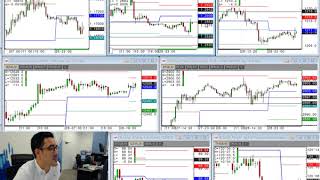
Okay, very good morning, Wednesday, 29th of August. Just give you an overview of what we're going to cover in the briefing this morning. We're going to talk, of course, about Brexit. There's been a couple of headlines about movement in kind of deadlines for the Brexit deal. It's obviously some circulation about potential extension of Mark Carney in his term as the Bank of England governor, so we'll look at that and potential alternatives and what our expectations are. There's also some reports overnight about Italy, um, said to be pushing and requesting for further ECB QE. And then we'll look at a few things that are associated with that, and then we'll look at the trading day ahead. So that's what's on the agenda. Uh, kicking things off though, let's just have a look at the, the broader sentiment and the charts as they reside at this present point. And you can see here I've got the major currency pairs, EUR/USD cable top left, gold on top right, uh, DAX S&P in the middle, and then oil and the US 10-year on the bottom right-hand corner. So overall, a fairly, fairly calm open, nothing really too spectacular going on. We're going to talk about the pound a little bit more detail in a second, but a little bit of flurry of price activity over the last half an hour to the upside to retest overnight Asia-Pacific highs. But otherwise, as I was kind of discussing in the weekly strategy report issued yesterday. Obviously, markets on Monday, when UK participants were out on the bank holiday, market sentiment was lifted, and that was emanating from the fact that US had struck this kind of new trade deal with Mexico. Some movement and progression then on this stalemate on the NAFTA talks was seen as a, as a light relief for the markets. But the point I was kind of making in the strap was was that, you know, this is just a sideline issue. The bigger ones at play, the bigger forces for broader markets, sentiment across asset class undoubtedly is that of trade wars, China, the US, and US's subsequent trade negotiations with other countries as well is the bigger picture. But the other thing is as well, Canada have not yet signed up to this agreement. And there's still a lot of question marks on whether that will indeed happen. And so revisiting then 24 hours later from what we were discussing in the briefing yesterday morning, I'd say that that positivity is kind of filtered out of the markets as to where we are at this present point. So definitely Canada commentary pertaining to the NAFTA negotiations, and there is something to look out for. I would imagine that the loonie will remain very sensitive and therefore volatile to any developments on that matter. Is there anything scheduled for today? Not that I know of, but certainly it would be— you would imagine in journalists' interest to be trying to break some comments on this issue. So something to just be mindful of if you're looking in the, the FX markets. All right, let's just get straight into some of the news then and what's in focus, and gonna have a bit of a UK spin on things because front page of Bloomberg, their kind of headline article this morning: the UK and European Union still say in public they want a Brexit deal wrapped up in the next 7 weeks. Behind the scenes though, senior officials on both sides admit that this is unlikely. So the headline: UK and EU drop their October deadline for a Brexit deal. Now, you know, this isn't an all-encompassing Brexit deal. This is about the kind of terms of the divorce, the kind of initial frameworks so then this can be heard across European national parliaments, of which then precedes the elapse of Article 50, which of course is March of 2019. The thing is, you— I think you've just got to look at the cable chart to really understand how impactful this news is. In the short term, I think it's, it's not. By that, I think it's inevitable that this was going to get delayed, and also it's been largely priced in because this type of headline was already rumored about 3 or 4 weeks ago, so it's not exactly new information, it's just more confirmation in that respect. Now, I guess from a broader perspective, I think what this does mean though is that I am very much of the view that October changing to November will quickly roll from November to December, to December to January, and then oops, all of a sudden, Article 50. And it's March 2019. And so if that were the case, then obviously the, the pressure on the pound is going to ratchet higher, and this could increase those kind of downside forces. And more heightened political uncertainty means a loss of confidence from the kind of corporate down to consumer level, and this could further accentuate the ongoing weakness that's being observed in UK economy at the moment. One thing then, a couple of things to be aware of is on this side of things. Now, to be aware of is this was the event risk radar from Nomura, which I kind of circulated yesterday. But on the political agenda, a couple of things here to be aware of that I think will be particularly key for Brexit. And one is you've got the Labour Party conference. This always front runs, the Conservative one, which happens typically in the first week of October. But 23rd to the 26th of September, you've got the Labour conference. And already, if you're reading the FT this morning, there's a lot of debate kind of behind the scenes apparently about our Labour going to kind of forge some kind of centrist split away from this very far-left Corbyn-led party at the moment. And so that's one thing from the Labour side. Can they materialize on the disruption that's been happening with the division in the Conservative Party? And could the Labour conference be the kind of platform for that type of development? Second to this then is you've got then quickly following up, beginning of October, the Conservative Party conference There's a lot of press rumour mill about how this is going to be an incredibly tough one for Theresa May to survive. You remember, she almost didn't survive, literally, the last Tory Party Conference. Anyone who was around will remember the coughing fit, the P45, the letter falling off the stage. You know, one would think it couldn't get any worse than that, but just given these divisions And given the backstory now about potential BoJo run on the leadership of the party, this certainly would be quite opportune timing to coincide it with this. Um, so on that note, of course Theresa is aware of this and she's already kind of playing the defensive, and she's come out and talked directly about Boris Johnson saying that vows to fight any efforts that he would table to challenge her leadership, said she intends to lead her Conservative Party into the next general election. Now, you know, I do, I do ask these questions to the intern when they first start, you know, when is the next general election? Because you get so caught up in all the political shenanigans, you kind of think that there must be an election coming soon. Well, it's not actually happening for about another 4 years. That's if, all being as it is at the moment, we get to that point. Certainly the risk of snap election and so on has grown as this division has become more and more apparent within the ruling party. But, you know, a couple of things here to be aware of, certainly on the agenda going forward for the pound, which I think on the balance, when you kind of collect all these different points that are coming up on the calendar in addition to what's happening at the moment economically, really hard to see much relief for the pound other than if the dollar was to weaken, uh, because fundamentally things are stacking up quite negatively for the pound. Now one thing we were looking at, this is the broader daily chart for the pound, was this area that we were defining as potential for consolidation this week. Because you would have seen Theresa May, you know, doing the Maybot yesterday, little dance move, little shimmy for the cameras. Yeah, not sure what that was about, but fair game, she's getting involved at least. But the fact that she's doing these political tours of the African continent means that there's, I would say, very little developments to be expected on the Brexit front. There's really little on the economic calendar as well from a UK data point of view. And we've had Halifax house prices, it's still not looking great for the UK housing market prospects going forward. But this is all a side point, it's not really going to be influential for the pound. So that range has been holding pretty nicely so far, what we were looking at yesterday, the kind of recovery back above that trendline break that we had at the no-deal kind of prospects were picking up. So I'm still looking at that as the broader range for the week, 129.40 in the futures to 127.83 on the lower bound to be looked at. Finally, one thing that circulated as well yesterday was about Mark Carney. We had a lot of commentary about— it was the Evening Standard who broke the news, saying that it's been, or he's been approached for a potential extension of his term. If you remember, he'd already extended his term as governor by an additional year because he wanted to facilitate the kind of passage of Article 50. However, what he didn't know then that he knows now is that we've got a transitional deal which is due to end the end of 2020. So the talk yesterday in the Evening Standard is that, you know, conversations are happening already for him to extend it, roll it out by another year, so that we can completely see through with continuity this kind of move through the transitional deal and the real crux of the trade talks of Brexit, which inherently carries the most risk sensitivity for markets. My baseline expectation is that he will be rolled over, i.e., the fact that I think it's absolutely pivotal that the markets remain confident I think politicians will be pushing their narrative as much as possible, but as much as the hard Brexiteers can talk long-term prospects of the benefits potentially of having a hard Brexit, I think in the near term it's undeniable the economic impact that it would have. And so certainly having someone there like Mark Carney, who the markets trust, they have some relationship with, at least in understanding be it the unreliable boyfriend tag that he comes with, I think better him than someone else. And very much so, I expect then in the coming weeks, months, he does get confirmed. To refresh your memories, at the moment, as you can see on the Risk Radar, he's due his existing term to expire on the 30th of June. So I'd be expecting that to be pushed out until the end of 2020, coinciding with those Brexit-related timelines. Question then was, well, no one's really been spoken about as potential replacement. So if there was a replacement for Carney, who could the replacement be? Now, this is what The Telegraph put together yesterday, which was a, uh, crib sheet of contenders who could replace the Bank of England governor. Now, you'll see here there's— not sure really how The Telegraph have compiled this because I quite strongly disagree with a couple of these names. Sharon White, the chief executive of Ofcom, becoming the Bank of England governor. Okay, she was former ex-World Bank Department of International Development. But the one that's most surprising here, the managing director of the IMF, of course, suntan herself, Christine Lagarde. Uh, no way in my mind she's becoming the Bank of England governor. It's just not the right fit. Markets, you know, in terms of her weight on the monetary policy side, it's non-existent. She's a former finance minister. It's like kind of sticking George Osborne in as the governor of the Bank of England. It's just a completely different way of looking at financial markets and the economy. So I think the most likely would be, although as I said, Mark Carney, I think, is still going to be the guy. You've got to look to really the deputy governors, but even then there's some complication. If you think of Sir Dave Ramsden, of course, he is pretty much the most dovish-leaning of all of the MPC members. Typically, the president or the governor, whether it's the ECB, the Bank of Japan, the Bank of England, they tend to take a more neutral stance rather than being very extreme— extremity of the kind of hawk of scale. So I think Ramsden, you can scratch him off. Broadbent gets a little bit more interesting, but he is a former Goldman Sachs economist. Not sure how comfortable the Treasury Select Committee would be with putting someone like him in charge of the government, of such an influential position. He's also relatively new as far as MPC members are concerned. So you kind of go throughout, go down through the list. Andy Haldane, the chief economist, maybe, but he has flip-flopped in his opinion about the economy and voting to and not to hike rates more recently. So lost a bit of trust of the market. All of this though just really points to the fact that Carney's your man at this point. Apparently the people who are trying to claim him back, of course, are the Canadians. They want him back. So this is the battle you've got on your hands. Now what does Carney remaining mean for the pound. Well, obviously this is a little bit more broader, longer term, but think about Mark Carney and, you know, this kind of key moment in time, which is really the management of the economy through Brexit. And what has his view been? Well, undoubtedly he's been kind of pigeonholed into the Remain camp because of the fact that he's looking at the economic impact of Brexit. So obviously he's come under some quite strong resistance from one half of the Conservative Party, i.e., Jacob Rees-Mogg, Boris Johnson and co. However, you'll remember that the governor reports as per, you know, when inflation goes above target on the quarterly inflation report, he reports to the chancellor. And the chancellor, of course, for the moment at least, is still Philip Hammond. And Philip Hammond sits on the exact same page as Mark Carney. You know, he is in a less direct way obviously very much in favor of Remain because of the benefits that it would carry, or at least a lesser extent would be the impact in a negative fashion of what Brexit would be if it was conducted in a soft rather than a hard way. So yeah, just a couple of thoughts on that. I know this is a little bit more longer term, I guess, but I I think the thing's worth just considering. Other news this morning, the other big kind of thing to look at is this. This is a report Bloomberg are talking about. If you look at the currency pairs this morning, EURUSD is underperforming a little bit. Cable is flat. The dollar index, it's up marginally, but EURUSD sub its pivot already this morning. Well, let's just have a look here, bring up the chart. So this is EURUSD here. We've come back down to test close proximity to the lower bound of the open from yesterday morning, so certainly worth keeping an eye on. That sits just a few pips above the S1 level, which then you bring into play the kind of Monday, uh, overnight high, which was just below that level. So being contained by pivot upside overnight, the Asia-Pacific session. So this is very much your kind of near-term range. Kind of bringing into play that 1.17 handle as well, which was the Asia-Pac opening low and also some of the more near-term point of resistance. So really quite a key area to have a look at. Any breach on the up or downside could get interesting to some of these respective levels above and below. But why the weakness? Well, the headline that people are referring to for the, the catalyst is the La Stampa Italian press Talking about, um, the Italian government is said to reach out to the ECB for a new round of quantitative easing. Um, I think you've got to take this with a little bit of context. Um, Italy have, through this quite ambitious kind of program and political policies being tabled for from, um, by the, the League and the Five Star, which ultimately requires a lot of more borrowing from Italy, which already is in a fairly fragile economic state, uh, never mind these kind of ambitious plans of this coalition government. I think it's unsurprising to hear this kind of commentary. Of course they want this. Are they going to get what they want is another matter, and I think probably lesser so. Um, but obviously this type of commentary tends to just raise a few eyebrows, and certainly it's had a bit of a look in this morning. And I don't know, I think it's a bit of a stretch to pin euro weakness on this, but certainly this is out there. With that being said, another thing that I have clocked this morning in the news is Bloomberg, um, keep every month an up-to-date basically ranking on a survey of economists on who they think is going to be the replacement for Mario Draghi. Now, if I remember rightly, Mario Draghi's term also ends, like Mark Carney, in 2019. I think it's October. And so already people are talking about, well, who's going to take over? Uh, and it's an 8-year term that Draghi's had, so, you know, it's quite an influential, uh, person. And that the change will be meaningful for markets going forward because because as you all know, ECB QE is due to kind of finish at the end of the year. As of in a couple of days' time, the QE purchase bond buying amount will drop from €30 to €15 billion. And then we're going to be looking at basically when his term comes to an end, that's about when interest rates are set to rise. Remember that comment in ECB statement, not going to raise interest rates until through the summer of 2019. Most people believe that being Q3, Q4, it's exactly when he's going to end. So quite a nice kind of bookend, I guess, to his, um, presidency for Draghi. But who's going to take over? Because you'll recognize here, this is the latest table, and this has just been released by Bloomberg. I'll share the link so you can look at the methodology, but the important thing here is that Jens Weidmann was before the head of the Bundesbank of Germany the favorite, and he had been the favorite for quite some time. But obviously he is traditionally seen as the most outlying hawkish of all of the ECB policymakers. Now we're going through a process of policy tightening here, not just in the ECB but more broadly globally, and having someone of his mindset, or at least background and and historical view could be quite, you know, worrying for markets in general, particularly having, as we've seen just this week, hit fresh all-time record highs again. He has, I must admit, reined in his hawkishness because if he is really to be seriously considered as an ECB president, he's going to have to lose some of this kind of outlying nature to his view. Hence what I was saying about Sir Dave Ramsden not being a credible candidate to replace Carney because he's too far on the dovish side. So he has reined it in. But what's been interesting is over time he's now dropped to fourth in the race and his replacement has been, uh, Liikanen, who was the former Finnish central banker who has been on the ECB board before. Um, he quite interestingly— this is his little profile snapshot— uh, highly experienced, close confidant of Draghi, has supported extraordinary stimulus. He's considered moderate and pragmatic. So just those words, or that description at least, quite different to Weidmann. And I'd say actually I could see how this would work because someone like him would be quite perfect to manage a kind of cautious exit to what is policy tightening in the form of the ECB. So, uh, just a few things to be aware of here on the broader perspective. I'm going to pop this link in the chat if you want to look at the methodologies. All right, back to the here and now. Let's have a look at oil because of one of the biggest scheduled events today that always increases volatility, at least in the short term. We've got the oil inventories, of course. Let me just mark up— this is when the API numbers came out last night. So as you can see, upon release, we've had— for transition to charts here— we had a slight dip in the price of oil, roughly about 20 cents or so was the, the trading range when the data was released. And we've kind of grinded a little lower here Pricing down about 20 cents from where we were before the numbers came out. So what were the numbers? We had a build in crude, 38,000. Expectations were for a draw of 1.5 million. Cushing build of 130,000, again slightly above expectations at 50,000. Gasoline, a build 21,000. Distillates, a build 982,000. So moderately bearish, you would say, but not nothing spectacular. Spectacular. But these are the numbers which of course we'll recap ahead of the release we'll get later on when we see the oil infantry numbers at the regular time at 3:30. Let's just have a quick look at oil, uh, I guess kind of bringing in the S1 level today, which close proximity at about 6 cents above the high that was printed towards the tail end well, kind of midweek last week, and would then breach this consolidation phase that we've been in really since, uh, what would have been Friday's session. So that would be downside levels to, to look for, S2, and then kind of looking down to that kind of price movement that we saw before then, the push higher. So certainly 68 handle as well, some interesting levels near term that we'll look at. I would imagine crude will remain contained by that lower bound of what broadly is the low print that was printed yesterday evening until we get that data, and then we move there accordingly. Upside pivots provided the first line of resistance since that API release from last night, so it's contained the Asia-Pacific range, and I'll be looking at that as well. So, you know, looking to hold this kind of 40-cent range until those numbers hit, and then we make the decision thereafter. Overall, am I expecting this to be anything other than just a short-term blip in price activity? I think that's what it will be. I think overall there's still quite a lot, as we were discussing yesterday, supply disruption risks whether it's renewed kind of political developments in Nigeria and Libya, whether it's Iran ramping up the rhetoric against, you know, retaliating against kind of aggressive commentary from Trump administration, there's plenty to keep sentiment kind of fairly bullish on the fundamental side, I would say. So it'd need to be something pretty spectacular, I think, from the bearish perspective to really bump prices in the other direction and for it to be sustainable in that, in that sense. Okay, quick look at one thing and then we'll look at the, we'll look at the calendar for today. I just quickly wanted to mention the Turkish lira because this was an important thing I was talking to some of the interns about yesterday, was actually the Turkish lira is still moving. Fairly large proportions. I think it was near on 3% yesterday. You can see here the Turkish lira has been weakening from Monday, Tuesday to where we are today. So it's still not gone or forgotten. The only thing is, is that when you're trying to measure short-term intraday sentiment, you've got to put a hierarchy of what is it the market's focusing on at that point in time. And what is it now that the markets have kind of repositioned itself for from the news that's already been baked into prices? And Turkey at this point is again still a risk that hasn't gone away. It's just that things like NAFTA caught the market attention yesterday, and all it would take is a few new comments in regards to China and the US, and that will drive the forefront, and Turkey's kind of on the sidelines again. Only if really things remain very quiet on those two mentioned topics, and if the Turkish lira keeps sliding towards then levels of which it previously depreciated to a few weeks ago, would then this become a renewed focus again and potentially a pre-indicator of kind of risk on an intraday basis. But the important point here is in how quickly and how really blinkered markets can be. On these kind of more broader macro topics, irrespective of the fact that the situation really hasn't improved. The latest Turkish lira weakening coming after rating agency Moody's downgraded 20 of the country's financial institutions. All right, calendar for today, just to wrap things up, pretty quiet for the morning, but as we get into the US, things get decidedly more interesting. You've got the second estimate of Q2 US GDP expecting minimal revisions here to 4% from 4.1% previous. You then got pending home sales, the weekly oil inventory numbers, uh, all coming out as well this afternoon at the usual time, at that latter one at 3:30. And that's pretty much it. So I'm going to leave you with that, let you guys get on with the day coming up to 9 o'clock. So have a good one. Charlie will be in the chat room for any of the backed guys. Anything, questions this morning, please go to him. Will will also be covering this desk throughout the day as well, I'm sure, sharing his thoughts in the market. So have a good one and I'll catch you later.
More from Anthony


Inside the Biggest Banking Stories You Need to Know This Week (Anthropic, Diageo, Private Credit)


Inside the Biggest M&A Deals You Need to Know This Week (UniCredit, GameStop, eBay, Eli Lilly)







AI Breakthrough or Hype? Anthropic’s Claude Mythos, Tim Cook Steps Down & LIV Golf Collapse