Morning Briefing - 4th September 2018
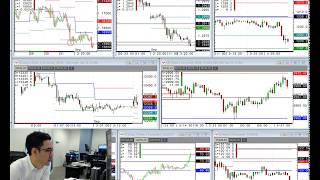
In this live morning market briefing, the presenter delivers a comprehensive overview of global financial markets on 4 September 2018. The session opens with a strong US dollar that is pressuring major currency pairs, notably EUR/USD and GBP/USD, which have broken key support levels amid negative UK economic data and mixed Brexit signals. The analyst highlights emerging market vulnerabilities, citing Turkey’s near‑18 % inflation, South Africa’s recession risk, and Argentina’s IMF‑linked financing concerns, and explains how these pressures are reflected in the Emerging Market Currency Index and MSCI EM Index. European equity exposure is examined, with a focus on Spanish banks’ large loan books to Turkey and Argentina, suggesting potential spill‑over effects on the Euro‑Stoxx. The briefing then shifts to oil, where despite a strong dollar, crude prices are rising due to Tropical Storm Gordon’s projected path toward the Gulf of Mexico, prompting pre‑emptive shutdowns of offshore platforms. The presenter walks through the National Hurricane Center’s tracking tools and the Energy Information Administration’s infrastructure overlay, linking weather‑driven supply concerns to price targets around $71‑$75 per barrel. Brexit coverage follows, covering Mark Carney’s tenure uncertainty, the Treasury Select Committee hearing, poll‑based odds of a no‑deal Brexit, and recent political statements from Jacob Rees‑Mogg and Boris Johnson, all of which add to sterling weakness. The segment concludes with a macro‑economic calendar preview, noting upcoming UK construction PMI, US ISM manufacturing, vehicle sales, and speeches by Carney and ECB’s Novotny. Throughout, the presenter emphasizes the interplay between currency, commodity, and political risk for traders.
Chapters
Okay, very good morning, Tuesday, 4th of September. Let's get things going and taking a look across the board this morning. Got dollar strength quite clearly. We're up about just over a third of 1% and that consequently weighing on both majors. You can see here top left, EURUSD just printing fresh session lows as I speak. Cable also under some pressure. Uh, if you look at cable on the day, already down 116 on the session. There certainly is some updates on the Brexit side we can go through. A quick look at the EURUSD pair, obviously a technical breach of that point that we were trading as a kind of area of support at the tail end of last week. We've broken that and you can see it came back up for a test. For anyone in that classic short, on the push down now targeting probably the S1 on the downside as an area of interest. That also not only being S1, but back to the resistance points of the kind of overnight Asia-Pacific session on 21st. And also you can see back here on the far left-hand side of the chart, so quite an interesting development already this morning. Cable likewise under a bit of pressure, and cable came under Well, if we just look at the chart here, this encapsulating— if I put it on a 60-minute— kind of sterling roller coaster of the last couple of sessions. We initially rallied obviously aggressively on the positive development and the comments from Barnier about a unique exceptional deal could be offered to the UK on the trade talks. The pound rallied last week, and then that being completely U-turned by the same person, Michel Barnier, in a weekend press. Then throw in the mix further negative economic data in the form of manufacturing PMI, a 25-month low yesterday. We've continued to remain under some pressure here, and there's some updates that I'll go into shortly. So fundamentally still looking quite negative for, for the pound, certainly. Just given the economic situation, the political one, and then in the context of the kind of strength of the dollar at the moment. One of the broader things though that people are talking about this morning, something which we went into in a bit more depth yesterday, but just to recover, is the emerging markets. We had the Turkish inflation rate up knocking on the door of 18% yesterday. Be looking out for South African growth later on today, which could technically mean that the country has moved into recession. Concerns about Argentina obviously going cap in hand to people like the IMF for financial assistance. Net-net, what we've been seeing is further deterioration and concern mounting on this particular area. And so this is a look both the white and blue line on the Emerging Market Currency Index, and then looking at the MSCI Emerging Markets Index itself. And as you can see here, coming back down to threatened levels at which we were in the kind of main episode of the volatility around the Turkish crisis. This is quite a fluid thing, and, and there's nothing kind of one point, I think, that could trigger it, but certainly it's a negative sentiment. And really, I think what's got to be monitored this week is the more people start to focus on this issue, I think the more materially it could pick up and then create this kind of cross-asset risk-off movement if that were to be the case. So it's still yet to be fully reflected in the market. I mean, if you're looking this morning, stock indices, if anything, although have given up some of the initial moves, certainly the DAX future this morning have backed off but are still positive on the day, and the US 10-year is down about 6 ticks. So it's something to be monitored, I think, going forward. On that point though, some additional color that I thought was worth highlighting for any Euro Stoxx traders. Obviously the Euro Stoxx was in focus because in terms of the composition of how that index is constructed, financials and banking stocks are particularly prevalent And of that, Spanish banks, as we know, in terms of foreign currency loans to, um, Turkey, are very exposed. The most of which is Spain, followed by then, uh, France and Italy. But what I saw here was, well, what about Argentina? A lot of people talking about that as an emerging market or risk. Uh, and one thing from German bank stocks, there's hardly any exposure to the crisis-ridden Argentina. But interestingly, for Spain, comparative to Germany, which has a dollar value exposure of $1.5 billion, Spain has lent approximately $28 billion in loans to Argentina. This is not forgetting the around circa $80 billion they've lent to Turkey. And things certainly start to, to look— mounting pressures on that particular banking sector. So for Spain and their associated names And then as a read across for the Euro Stoxx, worth just, you know, paying note of the composition and exposure as to what index could be impacted the most and where consequently the, the kind of lead indicator of that negative sentiment might develop, i.e., the IBEX and then the Euro Stoxx rather than something like the DAX, for example. So just saw that was quite interesting statistic for the morning. One thing actually I just want to jump straight to though and that's been an interesting mover straight from the off is oil prices, because oil is on the ascent this morning. This irrespective— don't forget that the dollar is rallying. Normally we'd see an inverse relationship here classically. So the dollar up quite sharply this morning has not managed to shackle the gains of, of oil, which has taken out now the high what we saw last week. So let me just extend this chart out onto a 90-minute. You can see last week's high is quite a notable value for crude oil because that $70.50 mark puts us back up to the highest price in oil we've just printed as I'm speaking since the beginning of July. So upside targets here, you've got R2, and then the $71 handle starts to get even more interesting because then we bring into context the respective highs from June and July. So why is oil rallying this morning? Well, there has been some new developments from a weather system point of view. So gonna run through a few things to be aware of and maybe a few resources that some of you aren't completely familiar with. This is the National Hurricane Center, and for the National Hurricane Center, let me just talk you through how to navigate this website. So this is the home page here. As you can see, the two— sorry, just one second, someone turn the TV down for me please. Um, just having a look here on the, the overall map, and what the National Hurricane Center do is they track with advanced technology weather systems as they develop. So you can see here, um, this is a disturbance right out in the Atlantic, and it only has a 10% chance of a formation into a cyclone over the next 2 days. There's Florence, which is a little bit more developed as a system, and here you can see exact pinpoint locations geographically with pressure and sustained wind speeds and movement and so on. Now the key one of course is over here on the left, Tropical Storm Gordon. This is the one that people are looking at in the energy market, uh, last night and this morning. If we click on Gordon here, what we get is then a projected path of the weather system in its development going forward over the period ahead. So here we are. This is where we are currently, which is offshore. But obviously, you know, anyone familiar with this part of the US, this is incredibly important for crude oil. Because here, further slightly over to the left, the Gulf of Mexico is where the predominant amount of the oil wells, gas wells, and so on, and the refineries based along the coastline on the Texan coast. Now, this is good for giving you the time frames that we're looking at, and markets, don't forget, remove or move on future expectations. So the price of oil already being lifted this morning on anticipation that as we get closer, people already trading the impact that this is going to have. So as you can see here, it's going to hit hurricane kind of strength on this particular red section, tropical storm on the blue. Now what you can do then is— this is the National Hurricane Center— if you jump over to the main kind of resource for energy which is the EIA. They have an energy disruptions page of which gives you real-time storm information tracking overlaid by every significant part of infrastructure in North America when it comes to energy. Now this looks quite blurry, but what you can do essentially is zoom in and you can see the projected path and exactly to the pinpoint infrastructure of which it going to damage. Now you can see here the one thing with Gordon which is very different to that of Harvey that we saw, I think it was Q3 of last year, which did have a meaningful impact in the price of oil and the disruption of the refining of crude, is because it hit— Harvey, if I was to look at this from a graph or a map point of view, hit on the left-hand side of the Texan coast and literally went from west to east, disrupting the entire area, whereas Gordon actually is missing quite a large portion of that. Irrespective though, we have had news overnight. Anadarko Petroleum, one of the bigger firms, has evacuated and shut production at two oil platforms in the northern Gulf of Mexico ahead of the approach of Gordon, which is expected to come ashore as a hurricane. So Again, there's obviously the, the ongoing situations in regards to Iran, and obviously at the end of the week we've got an interesting meeting between the likes of Putin, Erdogan, and Rouhani, which could be something definitely for energy traders to watch. But in the interim period, this new development of a weather system moving to a highly sensitive area of towards the Gulf of Mexico is what's giving oil the last little kick here on the upside, which technically, having breached the level, does open up some interesting points on the upside. As you can see here, we've hit right up to that R2 straight away, so quite a quick run on that technical breach. Any further upside push, 71 is going to be the level to have a look at. If we start broadening the chart horizon Um, well, let's just put it on a daily, get a better sense of upside levels. If this was to materially worsen, then yeah, you're gonna look for really the 72.83, 74.70. These are much further away levels, but once until we get up to really the higher bound of towards 75, which would be the year-to-date high and the multi-year high if that were the case. So oil definitely in focus this morning. Okay, back to the news and a few other things I just wanted to quickly have a look at and a run-through of some Brexit information. And we've got this one here, a lot of people talking about Mark Carney. This has been a discussion point over the last week or so because the question mark comes with his term due to finish in the summer of 2019. Who's going to replace him, if anyone? Or is he going to just roll over his term and extend as he has done before, now that we've secured the transitional deal to add some continuity to the Brexit kind of talks, to see it through at least till the end of 2020? Now, the rumors have kind of gone back and forth. My baseline expectation here is still that he stays on. Reading a lot of the articles that have been coming out, the biggest problem that has been is there isn't really anyone credible who can replace him. So even if there were political minds that would like a change and would like him removed, the problem is there's no one really who's a complete shoo-in to step in and take his place. This is kind of the— well, let me just quickly move my video so I can make it a little bit clearer. So here's the, the kind of history, how politics have dominated Carney's tenure as Bank of England governor. So through the Scotland independence vote, the UK election, the snap election, the obviously referendum in itself, and the emergency rate hike that happened thereafter, the taking back of that move, and then the rate hikes that we've seen and the projected ones we're due to have going forward. So is this much of a risk for markets here right now? Well, I think really sensitivity to this is I don't think we're going to get any direct confirmation at any time soon. The one thing from a headline point of view you've got to be aware of today is today the TSC, the Treasury Select Committee, is meeting. Mark Carney and some of the associated deputy governors and the chief economist Andy Haldane are appearing in front of those members of the TSE to talk about the quarterly inflation report. And absolutely no doubt they will probably question him about his thoughts on potentially staying on or not as the Bank of England governor. As I understand, I think that kicks off at 1:15. Here we go. Yep, 1:15 London time that begins. And I do think it needs to be a consideration if you're trading the pound, just in case he does let something out, however unlikely that might be for a chap as experienced as him. Very rare for him to misplace any type of comment on such a sensitive issue. And the quarterly inflation report, we know the status of that. I don't think it's going to be greatly interesting, but certainly from this afternoon it's something to contemplate if you are trading the pound. Some other things about Brexit that have come out. There's a Reuters poll, so just to give you some of the latest numbers of which surveyed analysts are anticipating according to their latest news agency poll, there's a 1 in— or 1 chance in 4 that Britain will leave the European Union in March without a deal. That's currently the kind of the odds that we're looking at according to economists. So the chance of a hard Brexit currently stands at 25%. One thing as well you might have read last night, any of those who are closely tracking the political developments on the negotiations, Jacob Rees-Mogg actually had a meeting with the EU chief negotiator Barnier yesterday, and Rees-Mogg unsurprisingly on the charm offensive, kind of fluttering his eyelids at Monsieur Barnier, saying how eloquent he is and how they're both on the same side, that Theresa May's Chequers plan is complete nonsense, or in his words, complete rubbish, and then trying to push this kind of Canadian-style deal. I don't know, I have read through this and fine, they might share the view that they both disagree with May's current plans, but what Jacob Rees-Mogg wants also is not really palatable for the European partners. So it's kind of one step forward, two steps back in that respect. But you can expect this type of headline, much like with Boris Johnson in his Daily Telegraph. Not sure if you caught the headlines. That he was saying. It's almost like he owns the Daily Telegraph. I saw someone do quite a funny tweet: "It's almost like Berlusconi running the media agencies to spin a political view has become the Daily Telegraph." But you can expect this going forward because of course we've got the Conservative Party conference coming up, and what better time to cause further division and headache for Theresa May than right now in the build-up to that key political meeting. So this type of headline, I think, is going to be coming thick and fast, and it only further complicates the near-term or clouds the near-term view for sterling currency, which at the moment is also under pressure not only from the, the political clouds forming but also the weakness in economic data. And on that front, of course, we've got some very interesting things coming up We had the manufacturing PMI particularly weak yesterday. We've got construction half-nine today, kind of a lesser point of interest. The service number on Wednesday will be quite key. And if you were reading some of the retail sales numbers from some of the other tracking data that came out overnight, what they're basically saying is what everyone has been of the belief, that now these one-time items like the royal wedding, the World Cup, the hot weather has now gone away, actually the underlying sentiment on the high street is fairly weak. And so these service numbers as well coming out tomorrow are going to be quite influential for the prospects of the pound near term. Okay, so that's the kind of Brexit side of things. One point of note, I'm not going to go in it into any detail just to keep things time efficient. But there was a very interesting article or research report that I sent out to you all from ING talking about the race to avoid a no-deal Brexit. So I'm not going to go through all the points, but there's a very neat updated timeline of the key events between now and basically the lapsing of Article 50 and the formal leaving of the EU and transitional period. And then it has another 4 potential scenarios of Brexit talks and how they're all interlinked through dealing with the EU to UK parliamentary approval and then scaling from a formal exit in a smooth and orderly fashion all the way to crashing out without a deal and going back to WTO terms. So it's quite an interesting read. I think if you're trading the pound, you'd be remiss not to take 5 minutes out of your day to have a read of that research report. I did send that out to you guys earlier. Another point to be aware of, it's gone a bit quiet on this front, so just to give you the latest spin, obviously US have managed to club together a deal with, with Mexico on the trade side, but Canada is still subject to falling in line with the agreement. Now, US President has threatened to leave Canada out of a new trade deal already negotiated with Mexico But without congressional support, he lacks the leverage basically to force Canada to make concessions in talks that are due to resume. And it's actually tomorrow that those talks resume. So risks to it are limited. But if you were following Twitter yesterday during the Labor Day holiday, Donald Trump was kind of isolating and targeting Canada ahead of these upcoming talks, which is his usual strategy. You'll kind of take the position of aggressor going into the kind of negotiating table. One key thing here though is that there's a lot of pressure to get a deal done with Canada. A former US Treasury official was interviewed last night, Mark Sobel, and he said that Canada is the main trading partner for many individual US states, so having a deal is not so much of a luxury but a necessity, and a deal does need to get done. The sticking point here is to do with dairy products still and some of the legality surrounding talks about mechanisms to challenge each other's trade rulings and so on going forward. So definitely something that's not gone away, not so much impactful right now, but something that's got to be on your kind of macro agenda, I I guess going forward. A few other points just to get you up to speed. You've probably noticed some pretty whipsaw price action for the Aussie dollar. Well, let's just bring the Aussie dollar into shot because that's been a pretty seesaw day. We rallied overnight after the RBA basically held their cash rate at 1.5% as expected, but they did sound fairly upbeat and optimistic about their prospects going forward. They forecast economic growth of a bit above 3% for 2018 and 2019. However, the resurgent dollar certainly is just putting some downside pressure right now, and also gold down about $6. So if it wasn't probably for that weather system development, then Tropical Storm Gordon and its specific location where it's going to hit when it intensifies to a hurricane in the US, probably oil would be lower right now as well. So some of those commodity-linked currencies— Aussie CAD actually weaker. So the CAD as well, not your regular kind of correlation with rising oil. The reverse is actually happening. You've got fundamentally risks surrounding the NAFTA talks with the US, which should be a Canadian dollar negative, coupled with the fact that Um, there's been a bit of a breakdown with oil for those isolated weather reasons, and so the CAD suffering with the dollar strength this morning, which has been a distinct pattern across the major pairs in the currency space. So EURUSD, Cable both under pressure as well as AUD/CAD this morning. I wasn't going to talk about this too much, but I think it's worth mention, just given the weakness that we have seen in the offshore Chinese currency of late. There's been apparent reports of large Chinese state banks' intervention in offshore renminbi forwards in recent days to ease depreciation pressure by raising the cost of investors betting that the currency will weaken. Not massively surprising. China are no stranger to direct intervention tactics. However, this type of, um, direct movement, let's say, on behalf of the government cannot last forever. And at a certain point, if it were to persist, it does raise a lot of eyebrows on how long this can continue for and its, you know, financial repercussions on having to do so. So something to just as well keep on your radar. Calendar-wise for the rest of the session today, let's just have a quick check on what we've got. So this morning, the construction PMI for the UK. I guess the question mark will be, does this just fit in suit with the general deterioration of the UK economic environment? It alone I don't think is a, is a big deal of the suite of PMI releases we get, 3 of which come out this week. Um, it's probably number 3 of the ranking, i.e., services 1, manufacturing, which we saw yesterday, 2, and construction 3rd if you were going to weight it by importance. But going forward then, beyond that, you've got the US— although you get the market manufacturing numbers, these are final readings, and it's the ISM manufacturing that has greater importance. That will be at 3 PM this afternoon. Total vehicle sales as well coming out. You'll notice there's no APIs because of the Labor Day holiday, so that all inventory data is a reminder is pushed back a day. API is Wednesday night, DOE is on Thursday. Speaker-wise, as mentioned already, Mark Carney and his team of senior colleagues are going to be speaking to the Treasury Sec Committee from 1:15. ECB's Novotny is going to be speaking, leaning hawk, at 5 PM. Uh, so that's pretty much it. That's what's on your agenda this morning. So still a little bit of concern on the EM front, uh, particular focus still on Turkey, Argentina, uh, probably the, the most out of those associated countries, causing a little bit of movement, um, into the dollar, which is up and rallying 4 tenths this morning, imparting pressure on dollar pairs, the combination of which for the euro fundamentally is a negative given some of the European banking exposure to the EMs as discussed. And underlying the pound, the economic and political negatives which are escalating, so it doesn't make sense at least for the short term, potentially for some further downside. And then the one to watch is oil. Tracking that throughout the session. Interesting as well as when the US come in, because they are— it's very much volume-wise a US-traded product, WTI. And the weather system as it develops is going to be tracked. If it intensifies and has the propensity to hit more oil-sensitive areas, then certainly there's definitely some upside room for, for really to rally in, in WTI crude. All right guys, leave it at that. Let you guys get on, have a good day, and I'll see you in the chat room. Thank you very much.
More from Anthony


Inside the Biggest Banking Stories You Need to Know This Week (Anthropic, Diageo, Private Credit)


Inside the Biggest M&A Deals You Need to Know This Week (UniCredit, GameStop, eBay, Eli Lilly)







AI Breakthrough or Hype? Anthropic’s Claude Mythos, Tim Cook Steps Down & LIV Golf Collapse