Morning Briefing - 5th September 2018
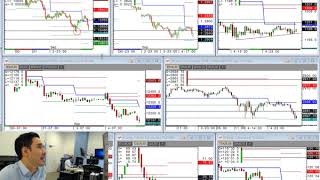
Anthony Cheung breaks down a risk-off market driven by a stronger dollar and surprisingly strong US manufacturing data (ISM PMI at 61.3). Emerging markets are under stress, with key support levels breaking for EUR/USD, GBP, and equities. The briefing covers Bayer's delayed Monsanto deal, the 10-year anniversary of Lehman's collapse, and today's key events: UK services PMI, Bank of Canada decision, and Fed remarks.
Chapters
Okay, very good morning. It is Wednesday the 5th of September. I hope everyone is well. Looking at the, the charts this morning, we started off with a relative risk-off tone to proceedings. So we've got a further bid into the dollar weighing on both the major pairs. You can see here in top left in EURUSD and Cable, but a downside as Europe's come into the market this morning. Gold, although flat, decided to just edge up a a little bit. I did see— you can see there quite a large wick there on a spike. Whenever I see that type of price activity, I always put it down to a minute time frame to see what the reasoning is behind that. You can see this really violent move. We got about a $3 pop and then a reverse. Nothing came out on the headlines. That can happen. Gold is quite susceptible to these types of price movements. Just the lack of liquidity on the time of day can often lead to it. But as you can see, it's just picking up again a little bit, moving back in towards kind of flat territory for gold. And then the US 10-year down at the bottom, kind of flirting with the pivot level, breaking above the range of the Asia-Pacific session. And this coming amid some weakness in the equity space this morning. So the DAX, you can see center left, down 64, and the S&P already as well on the back foot this morning, having declined soon as Europe came into the market. We'll look at some of the charts technically, but first of all, what is going on and why is this happening? Well, it's still a recurring theme really of what has been in play over the course of the last couple of sessions, and that is a growing negative feeling around that of the emerging markets. and we've seen this very much apparent from record lows in the rupee to the Indonesian currency at multi-year lows to now South Africa is in a technical recession. There's political, um, happenings in Brazil which is bringing into question the prospect— there's a very messy election coming up next month. So the emerging markets are struggling, and now some of the headlines are suggesting that this is kind of spilling out, out of currencies and into the equity market. Morgan Stanley issuing a note this morning recommending a remain short on emerging market currencies. Deutsche Bank, separate research report this morning. This is becoming about contagion and illiquidity. The latter word obviously can be quite detrimental to prices. When you get this illiquid situation, you kind of get the very erratic price movement like what we've seen in the Turkish lira over the course of the last few weeks. The kind of various controls that get put in domestically by the government or the central bank, and then the kind of fear of anyone really wanting to touch it. It's like trying to catch a falling knife. And so when there is price movement, it's, you know, quite wicked in how quickly and how far-reaching those price spikes can be, and it kind of exacerbates the issue. But the point here being then that we've known the EM currencies have been weakening, but now the MSCI Emerging Market Asian Index also under pressure overnight. So this seems to be still the, as I said, recurring theme, and this is continuing to dampen, at least in the intraday market sentiment, And it's this fear about kind of contagion that needs to be watched. What we're looking at here, though, is something quite the opposite. And we've got— this is the white line, a picture of the dollar spot index, and the blue line, a picture of the S&P 500. And although the S&P 500 is a little lower this morning, let's not forget we are just off kind of close to uh, record territories we printed in recent weeks. But the point being is the dollar is what I wanted to focus on, because what you'll remember is yesterday we had some economic data that came in the form of ISM Manufacturing. And whilst overnight we had, you know, just mentioned about all the stresses happening in the emerging markets, well, the biggest one of course, um, is that of China. And what's happening on China is here, their service growth is slipping. An independent survey of China's service sector showed markedly softer growth in August as input costs rose at the fastest pace in half a year. So China is also continuing to suffer. On the flip side though, this is America, and this is the key data we had yesterday. ISM, uh, Manufacturing PMI came in at 61.3 in August of 2018. That's about a 4-point beat, which is a statistical deviation I have not seen against the median consensus to that degree for the ISM figure for many years. And it is, in fact, if we start looking at this ISM manufacturing chart, let's put it on a, let's put it on a max. Here we are, we We're back to the highest we've been since basically here, 2004. So at the moment, you know, not forgetting as well that US economic growth is currently tracking above 4%, ISM manufacturing PMI, it's a kind of forward-looking— US economy by these measures is on fire. And so what's happening, and the dollar is strengthening, and you've got this kind of flight to quality feel about the risk in the EMs, but the US economy is warranting further interest rate rises, of which, as much as Trump's tried to sway the hand of Powell, the market, last time I checked yesterday, is 98% priced for a Federal Reserve 25 basis point interest rate hike at the end of the month, followed by another rate hike in December. It's 2019 that might see some more dovish trajectory or more shallow, but for this year it's all on for the dollar at the moment. So we've had a pretty decent recovery of the greenback, and that is weighing on these major currency pairs. So just having a look already, EURUSD on the back foot. So bringing into context, really you've got to be watching. So I'm just looking here at some of the near-term price action over the last 2 weeks or so. We've had a quick run down close to this level is the near support that I'm keeping an eye on this morning, 115.4850 in the futures, which is sitting just above about 5 pips or so the S1 level. So if we get this persistent dollar strength, you should see how we test up around those levels. This is a quick look at the pound. And just looking at the pound here, again, bringing into context, you know, the Barnier-inspired lift that we had mid last week. More than taken back now. And so on the downside, should we weaken any further here, then I'd be looking down to yesterday afternoon's lows around that 128.17. Then you've got the handle and 0.5 being the S1 level, which is also the subsequent low that was seen back on the 24th. There's a couple of areas of support. Now on the UK front, there is a couple of headlines to be aware of. This is one of them. I just wanted to quickly explain this because this to me is sensational journalism. And as much as you guys know I'm a pro-Romaine, I'm gonna have to talk the Romaine side down here because this data from this survey is completely misleading. The headline that Bloomberg have run— and Bloomberg is no different from any other media agency in the fact that it has a political aligning, in this case, to being very pro-Remain. But they've run a headline saying UK would vote against Brexit in a second referendum. Okay, that sounds quite interesting, and we've, we've kind of had this people's vote picking up a little bit of momentum. People unhappy with how Theresa May is executing this Brexit plan on the Chequers side, and therefore are a number of these people in potentially the North or the Northeast, which has the most impact from a no-deal situation, would be the most damaging for their local regions. Have they flipped now into thinking, actually, we'll change our vote? Well, the numbers here, let me just go over it first. As many as 59% of people said they'd vote Remain in another referendum. That's the latest stat of which this is saying. So they're suggesting then a lot of Leave voters are switching back to Remain in this NatCen findings. However, a few caveats here that I must stress was that actually when you start breaking this down, um, The actual survey in itself was conducted between June 7th and July 8th, of which does not include then the issuing of Theresa May's negotiating strategy, i.e., the Chequers paper. So I'd say since that point, people's views I think would have materially have changed. So not only is it dated, but the other thing is the same people that they surveyed pre the e-referendum itself itself showed an end result of 53% to remain. So these people were already, on balance, these 2,048 people surveyed, were already more remain-focused. That's not detracting from the point that that has grown from 53 to 59, but the point being is they're wrong in the first place. So it's a hell of a lot closer, I think, than some of these numbers from this this survey would suggest. And as we've learned, many traders who've been around long enough, you know, believe opinion polls, um, you know, if you believe them too much, you're going to get burnt at some point because they've had a historical precedence of being awfully wrong too many times. So just to put to bed what I think about this type of headline this morning, I don't think it's anything that's credible. Is the point I'm making. Okay, back to the charts though. And first of all, I just want to have a look at the DAX because the DAX is trading here. You can see continuation of the weakness that was seen yesterday. But if I put the DAX on a daily continuation, so this draws into context the last 2 years of the DAX. And what I'm looking at firstly is quite an interesting area here. I know Sam was looking at this, this kind of trend line. It's the third real significant test that we've had of the last quarter at this level of where we have found some support this morning. But a breach of that does start to make things quite interesting because it puts us back down and to lows that we haven't really seen since the end of Q1 of this year. And targeting would be psychologically the 12,000 level. Any break below there, we start looking at these previous kind of 2017 highs, then consequent support If I look at here, I just quickly mark them up here, here. These kind of areas would be the next one I'd be looking at. Not so much intraday, obviously you're talking a little bit of a more longer time frame to see some of these levels. But you can see here just some gaps opening up on the chart technically if we were to see some further weight. Now obviously there's a bit of EM-inspired risk-off But there has been some German news on an individual kind of single stock perspective. Bayer, they've— delay in Monsanto purchase has hurt their earnings forecast. Remember, this is a very big corporate deal. Delays to Bayer's $63 billion purchase of agricultural giant Monsanto pushed the acquisition past the new unit's busiest season, and the company said earnings for the year will be lower than forecast. So what's this doing to the actual share price? Well, here's a breakdown of the DAX movers. You can see here the biggest loser at the moment, um, in the cash market, Bayer down 3.5%. Now why is that important? Because you can see here they're a big outlier comparative to the performance of the rest of the index, and that's because this is the composition of the DAX from the Deutsche Börse And as you can see, and as you well know, any of the stock traders out there, pharma and healthcare is the singular largest sector allocation of the DAX index, of which of course Bayer is the third largest company within the German index. So they account for about 8.5% of the entire index, and the fact that they're down steeply, uh, way more so than any other stock, is also adding a bit of a headwind to the DAX this morning. So interesting to keep an eye on some of those technical levels on the downside. Whether or not we can breach that would be quite interesting to just keep an eye on. One thing, just talking about the DAX, we've got the— I think it's the quarterly reshuffling of some of the equity indices. And I did hear this morning Bloomberg talking about Deutsche Bank, quite a notable point, I guess, 10 years in the anniversary of the collapse of Lehman Brothers. Deutsche has been one of those banks that's really really felt the pain of the changing of the kind of regulatory environment, the kind of overexposed nature of just how diverse and spread their business was, but being quite leveraged in a sense, has seen now their company get ever smaller. And my understanding is that Deutsche Bank are due to drop out of the DAX— or the Euro Stoxx, excuse me, not the DAX— for the first time since the Euro Stoxx inception. So, you know, quite a memorable moment here. Um, other index though, let's go back to the S&P. Let's just have a quick look at the US indices because the S&P also feeling a little bit of pain this morning and testing a key level, which being then the support point from yesterday. So is it going to hold at 85.5? It is for the moment. That also being just below kind of an area of consolidation when we initially were pushing up to the record territory that we saw back at the tail end of August. So this is quite a nice area of support actually. Any break below here though start to bring into context, uh, that S1 area, which as you can see here with the previous highs that we were printing as well back on the 21st of August and holding some of the price action on the 22nd and 23rd. So some interesting kind of zones, if you like, of areas where even though I think it warrants maybe a bit of a pullback, and it wouldn't surprise me if this level did break where we're at at the moment, but I'd still be looking at these lower down levels, not so much for the short but for the long, to take the move back up again. Because I still think the, the fundamentals of the US equity space are holding in place, and I still prefer any weakness to be bought into at the technically relevant point rather than trying to, trying to sell US equities. I think it's still my, my kind of base case view. Just having a look quickly at oil. Big day yesterday. Obviously there's a weather system developing that we were tracking. This was the, the tropical storm said to have turned potentially according to the forecast into a hurricane upon hitting landfall. and we are rallying. This time yesterday when I was delivering the briefing, but as I can see, I was off the desk yesterday afternoon, but quite a dramatic fall in prices. So what exactly is the situation with, um, Hurricane— or I should say, the most important point here, and one of the main reasons for the decline in prices, the non-hurricane never quite made it, remained a tropical storm, and so the intensity never picked up, and therefore markets had to kind of reprice, i.e., the impact not being as bad. And we have made landfall now, but not really read too much into this, but presumably then the impact being to a lesser extent that maybe people were originally positioning for, for oil. Okay, a few other things here I just wanted to quickly look at. One was I did put a question in our Facebook Amplify community page last night, and it— the reason I put it in there was because last night Apple has now been joined at the top of the pile for this race to $1 trillion value, and Amazon has joined them. And I saw an interesting chart here about Amazon's journey from their inception in Can you believe it? 1997. It wasn't even that long ago. I remember '97 like it was yesterday. And they raised $54 million in an IPO, which valued the company at just over $400 million. This was in '97. And then this is quite a neat timeline just talking about, obviously they lived through, I mean, they were only around for a few years before the dot-com bubble. Burst and the stock market collapsed. But then the recovery— they actually didn't report an annual net profit until, what, 4, 5, 7 years after being conceived. Amazon Prime then began, and we went through the various different technological phases of improvements, the AWS cloud computing services, the Kindle ebook. I can't remember the last time I saw someone with a Kindle. But the Kindle was pretty much 10 years ago when that came out. Then you had the robot kind of operating warehouses. Then you've had the Echo. And this one, I think, has been, in my view, one of the biggest game changers. And I think quite interesting is their acquisition of Whole Foods, sowing up physical locations to then potentially open up this idea of, you know, really moving into what is quite a monopoly, certainly in the UK, of these major supermarket names. But if they could be more cost-effective and operate out of these store locations, this is quite an interesting prospect, um, bringing in the kind of food element outside of the other kind of consumer goods that get bought more traditionally on their platform. And then here we are, they've hit $1 trillion as of yesterday. Question then I'd like in the chat room is, and this was what I put to some of the traders yesterday, was if you were to hold on to, um, equal amount of, of stock but you had to be in it for 10 years and then exit, would you rather have Amazon or Apple? Who do you think is going to give you the better return over a 10-year period? And I'm not going to sway your opinion and what all the people in the, on the Facebook group said. But it was quite interesting, fairly split, but there was one company that edged it. So put your answers in the chat room and I'll come back to what the answer was online last night when I get to the end of the briefing. Uh, just quickly then, the other thing I wanted to wrap up, this is a little bit off the intraday, but there's a lot of people, uh, media talking about the anniversary, the 10-year anniversary of the collapse of Lehman Brothers. And this was kind of the onset then of the financial crisis. An era I remember very fondly, waking up at half 4 in the morning every day to get to work at 5, being relatively junior, only about 2 years experience, and having quite arguably no idea what was going on. And my job was people like Will, who was a client of mine at the time, used to shout at me going, "Ant, what the expletive is going on?" And I'd have to explain to him. So a blessing of fire, I'd say, at the beginning of my career, but one I think that was an excellent learning curve. But quite interesting graphics here that the FT have released. What we've got here is before the crisis, what happened, and thereafter. And I just quickly wanted to have a look at the, the composition here and focusing on Lehman Brothers. Lehman Brothers, again, I think for a lot of the, the younger guys, you might not kind of always recognize Lehman's and the kind of prestige that it had as a bank on Wall Street by being the oldest and the most profitable for several consecutive years until its downfall. But one of the things here that's quite notable across these kind of Northern Rock, the HBS, Lehman's, these kind of casualties of the subprime crisis was the wholesale funding percentage. You know, what in summary, the wholesale funding side is, is rather than banks kind of leaning on their deposits, i.e., actual capital, to then be able to use that cash to put to work, the wholesale funding market is basically borrowing off each other. But you keep borrowing and borrowing off each other, you get more kind of exposed then to kind of debt defaults and and so on, or the corporate health of different institutions. And if one starts failing, or if one goes down like Lehman did, then you start to get distrust between the various different interbank dealers or lenders. And then all of a sudden you've got a real problem in the wholesale funding market and you get a credit crunch. That's what subsequently happened. As we know, Barclays picked off the bones, if you like, of what was left of Lehman's and bought, I think, his main operations in the US. But what's quite distinctly different now is the amount that's done via wholesale funding. If you look at Barclays now, of their balance sheet percentage at the end of 2016, it's only 19%. Some of the other banks like Lloyds Banking Group, they're only 13%. These numbers were up at 60% and 40% respectively respectively. So again, this kind of idea of borrowing from one another and other financial institutions rather than raising money through deposits through retail banking customers has severely altered now the landscape. And you could argue then has made it more robust in a sense where it's not so leveraged to, to these risks. Again, another interesting thing and a graphic I think I've shown some of you before during one of my lectures is how the rankings of the world's largest banks have changed. As you'll know, for Amplify, we're trying to push into new kind of regions, and that being targeting on China, you know, the rise and emergence of China's banking community has been phenomenal. I mean, this is 2006, so this goes back to actually when I started in the market. Chinese banks— so to give you a flavor, China Construction Bank, Agricultural Bank of China, and the Bank of China itself were roughly around the 30th biggest bank in the world ranked by asset size. If you fast forward that to the present day, they are now bank 1, 2, 3, 4, 5. Chinese, Chinese, Chinese, Chinese, Chinese. And obviously there's a lot more to this. The fact that there's been an emerging middle and upper middle class in China. This kind of move away from pure exporting manufacturing into more internal consumption has meant more people with more disposable income who use financial services, and the kind of infrastructure and technology developments have meant that the Chinese economy has really been making some headway. But, you know, it's really interesting to see how, you know, things have changed even in the last kind of 12 years here. So yeah, just a quick summary, and I thought I'd leave you with— on thoughts of the financial crisis. Yep, that was me on pretty much the closest date I can find going back, uh, 10 years ago. People back then actually used to wear white-collar cuff shirts. I don't think you can get away with that in the City anymore post-financial crisis. If you wear a white-collar cuff shirt these days you get hung, drawn, and quartered by anyone who doesn't like a banker. So that— don't worry, that tie and shirt combo went in the bin a long time ago. I had rimless glasses back then as well. My God, what was I thinking? I have no idea. But I did look like a 12-year-old at the time, so maybe the rimless glasses were trying to make me look a bit older than I actually was. Who knows what I was thinking? Anyway, Let's have a quick look at the calendar for today and what's coming up. And so here we go, we have one of the most interesting pieces of economic data for the UK this week, that being of course the service PMI. This does come after we've had particular weak manufacturing construction data. This has had a bit of a dampening effect on the pound when the data has come out. But services, as we know, is the big one being the key contributor to the economy. And if the signs are being believed, I'd say market positioning is probably for a downside surprise. So if we did get a positive number, then maybe we might get a bit of a kick on the upside just to reverse some of the general downtrend that we've had in the pair. So I'd say The bigger risk would be an upside surprise because I think you might get a decent pop. But inevitably, I think that that pop, if you were going to trade it, you need to be pretty prudent in managing that trade quite actively and taking it off pretty quickly. Because overall, once it fades, I don't think that's enough to really turn the tide of which is a generally deteriorating economic situation and increasing political uncertainty. Otherwise then, looking further forward into the rest of the day, um, we've got a fairly quiet US afternoon, but we do have one interesting thing for any of the currency traders. Got the Bank of Canada rate decision. I did send out a research report this morning from the Dutch bank ING, which go over every single major interest rate decision from major central banks for the month of September. Do take a read of that if you get a second. It does have a section on Canada. Speakers, just to finish things off, you've got an ECB speaker, Prayat, speaking at 9:30. Bullard, the Dove, giving a presentation on US economy and monetary policy. Could be interesting. Is a non-voter though, does need to be taken into consideration. That's happening this afternoon. Okay guys, that's it. 9 o'clock coming up, so UK data, keep an eye out for that. Next kind of main event, that's at 9:30. But otherwise, have yourself a good day. Thank you very much.
More from Anthony


Inside the Biggest Banking Stories You Need to Know This Week (Anthropic, Diageo, Private Credit)


Inside the Biggest M&A Deals You Need to Know This Week (UniCredit, GameStop, eBay, Eli Lilly)







AI Breakthrough or Hype? Anthropic’s Claude Mythos, Tim Cook Steps Down & LIV Golf Collapse