Morning Briefing - 6th July 2018 **NFP Preview**
In this Friday morning market briefing Anthony Cheung reviews the latest US‑China tariff rollout, its immediate impact on equity markets (DAX, S&P 500, Shanghai Composite) and the broader trade‑war risk narrative. He explains the mechanics of the $34 billion tariff on Chinese imports, the likely Chinese retaliation, and how the market has already priced in a brief risk‑off rally that quickly faded. The briefing then shifts to Europe, detailing Prime Minister Theresa May’s Chequers meeting on a “facilitated customs arrangement” – a softer Brexit proposal that would keep the UK in a customs union for goods while diverging on services, and the political risk surrounding possible resignations (e.g., David Davis). Cheung outlines the implications for the pound and sterling volatility. He follows with a quick commodity update, noting OPEC‑Iran comments on $100‑a‑barrel oil, recent crude price action, and technical support/resistance levels. The core of the briefing is a preview of the US employment report due at 1:30 PM, focusing on expected non‑farm payrolls (≈195 k) and, more critically, average hourly earnings (projected 2.8% YoY, 0.3% MoM). He links wage growth to Fed rate‑hike expectations and potential dollar moves. Throughout, Cheung highlights key trading triggers – tariff implementation, Brexit cabinet dynamics, oil supply concerns, and US labor‑market surprises – and concludes with a short‑term outlook that trade‑war geopolitics will dominate beyond the day’s data releases.
Chapters
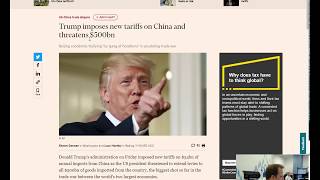
Okay guys, good morning. Friday, 6th of July. Welcome to the briefing, final one of the week. We're going to talk Trump trade wars, we're going to talk Brexit, important day for Theresa May up at Chequers, and then we'll have a little look around the markets, of course, have a look at what's happening on the charts, and then finish with a little bit of a, well, a summary summary of what's happening today. Big day from a U.S. data point of view with the employment report being delivered at 1:30, of course. So non-farm payrolls, but perhaps more importantly, an update on wage growth data. So average hourly earnings data is probably key. So this will be at 1:30 later this afternoon. So let's have a quick look at the charts first. And I want to show— I want to start with the DAX, which kind of sums up, I would say, the morning so far. Here we're looking back over the course well, July. Here is July so far. So this week, and of course the DAX has actually had a decent week. Certainly the boost higher yesterday morning was perhaps the, the big move so far. Some positive German data taking the DAX up to a new high and then consolidation this morning. Then we gapped and opened higher. Now what's key, this is up above 12,500, of course, which was that kind of barrier yesterday afternoon. If we zoom in a bit here, what we've had this morning is a nice sort of gap fill scenario. So this is where the market closed yesterday, and then we've opened higher than that, of course, opening above 12,500. But as you can see, it didn't last long, and then we closed the gap. Um, let me show you what I mean. There's this gap here is the prices that didn't trade as the market kind of jumped over these prices, if you like, as it was closed and the market reopened up here. This gap fill idea is actually quite a popular strategy. You'll often see the market pull back to trade the prices that it missed. And that certainly happened this morning. We found good support briefly around that closing point from last night, back up resistance at yesterday's high. And now we've been trending lower. And setting new lows for the session as I speak and just kind of moving down below that low point we had from last night. This kind of sums things up because what's happened today so far is that to begin with, we had a bit of positivity. This is almost now that the tariffs have been implemented. So, you know, the key thing about today, of course, this is the, the day where $34 billion worth of imports, that's Chinese goods going into America, will now be tariffed at 25%. 818 different products, things like electric vehicles, things like lathes, and a load of other stuff, right? So as of this morning, they will pay now 25% tariff on those goods. So the tariffs have been implemented, and actually Asia had a pretty positive session yesterday. It's almost like, you know, you sell the rumor and buy the fact. In this case, you know, there's been a lot of weakness. And actually, I'll show you quite an interesting chart. When I say there's been a lot of weakness— hang on a second, you don't want to look at my face that large anymore. Here we go. So this is quite an interesting chart, which is actually comparing the, the damage that's been done as a result of this trade war risk to different equity indices. And What so far has happened is that Chinese equities have borne the brunt of this, and the Shanghai Composite, which is the white line, is actually down 16.7% since the start of the year. Okay, so that's a, that's a big drop. Now, when you look at the US equity situation, well, the S&P 500 is this top line, and that's down 2 point— sorry, it's up 2.4%. Apologies. S&P's up on the year, yes, down off that all-time high set back in the start of February. But S&P up 2.4%, Shanghai Composite down 16.7%. Asia, of course, getting more negatively impacted, down 5.8%. And then the world's indexes as a whole, minor, minor negative for the year. So, so far, you know, the risk has certainly fed through to a bigger amount of downside for Chinese companies because of this risk. Now, of course, it depends what happens here in terms of retaliation. And indeed, China will retaliate, and it's just a question of how. And this is perhaps then the bigger risk, because at the moment China have said, right, we're going to impose tariffs of our own. But of course, here, here, here's where Trump thinks he's got his trump card, because in the end, the amount of goods going into China from the US is just a tiny fraction of the amount of goods going the other way. So However, China are looking at implementing tariffs on these goods. But what's a way bigger weapon for China to use? It would be increasing the kind of— or let's just say slowing down or, or making it very difficult for U.S. businesses to do business in China. We've had— even though I showed you that chart there where you're looking at the S&P up on the year, but actually some of these semiconductor firms, some of the big chipmakers like Qualcomm. So that's the US chipmaker, um, they do 60% of their business in China. 60% of their revenue is from China. Uh, their share prices are down heavily. Uh, companies like Intel, for example, these chipmakers are definitely bearing the brunt of this. Uh, the other big thing that China can do, of course, is, well, stop buying soybeans. And so this is starting to have a negative impact on US farmers. And so there's plenty of stuff that China can do to retaliate that's you know, outside of just implementing tariffs. And this morning, or I should say last night, what was Trump's response to China saying they're going to retaliate? Well, he said, well, fine, if you retaliate, we will put tariffs on all of the goods coming from China into the US. That's currently, as of 2017, that's $505 billion worth of goods taking— going from China, being imported into the US. And Trump's response is, well, yeah, if you retaliate, then we're going to put tariffs on the full monty. This is the first time he said that. I mean, it's very typical Trump, this. Not particularly surprising. It's the first time he said we're willing to tariff the whole lot. Now, what's been the response to this in the, in the kind of press? Obviously, this is an act of typical trade bullying. This is according to the Chinese Ministry of Commerce. You've got the China Daily, which is a state-run English-language newspaper, saying that the Trump administration is a gang of hoodlums with its shakedown of other countries, in particular China. So, you know, usual stuff here. This trade war thing isn't calming down. It's happening. We now have tariffs, and at the moment it's not getting better, it's getting worse. Okay, so But I think markets, of course, quite well aligned to this. And we've been used to this risk for a while now. This morning it was like, okay, finally the day's arrived. The uncertainty— will tariffs be implemented, will they not? Well, that's done. There are tariffs and it's almost like there's been a bit of respite in risk. But it hasn't lasted long. And already the DAX is down, you know, quite a way off where it opened this morning, a good 60 points to the downside. So I think that relief, in a weird way, that the D-Day has arrived, that relief hasn't lasted long. And perhaps now we're back on that sort of, sort of slightly nervous footing on how all of this stuff's going to pan out. Now, for the S&P, similar to the DAX, you know, had a positive move in the Asian session, but we've given that back and we're trading back on the levels we were seeing as we went into the close last night. Okay, for the S&P, if we look back a little further on this 240-minute chart here, you know, some of the big moves lower off the trade war risk came towards the end of June. And we've had some— we have had some big moves to the downside, but these episodes of volatility haven't lasted long. But we're right up at the top end of the range. And what's key about this morning's trade is that 2748, which is the high point from the 27th of June, That held firm. You got the other resistance coming in here from the 29th of June. You got this level which was the high of the week that we broke this morning. But it looks like top end of the range here for the last couple of weeks and first test at the top looks like that's been solid resistance and we've had a quite a clean and nice strong rejection and we've moved back lower. Okay, so that's an indication that this slight positivity in Asia hasn't lasted long. Um, so let's just call it— we did have the Fed last night, uh, releasing their minutes from their meeting 3 weeks ago. Seems to have gone fairly, um, uh, well, it's passed without too much incident. The dollar briefly strengthened last night. Here's where the, uh, the minutes were released. We had a touch of dollar strength, but then it, it didn't last. Not too much coming out of that, that minute. So there's a quite a complicated aspect to those minutes, uh, talking about how the Federal Reserve are unwinding their balance sheet. We'll perhaps talk about that later because it's a little bit complex, uh, for the briefing here. But what's happened this morning is EUR/USD rallied. We've tested yesterday's high, that's been good resistance, and we've, we've pulled back in. Okay, but of course, if you look on the longer time period, then for this EUR/USD market, we're right up at what's more important, and that is the June high set on the 26th, and that's up at 1.1794, just short of that 1.18 handle, which is our 2 today. And we kind of flirted with that this morning and we've pulled back in. Okay, but up there, anything above 1.18 and then that would be the highest since the ECB dovish meeting that they had a few weeks back on the 14th of June. Okay, so that's where we're sitting with regards to the euro dollar. Before we look at cable, let's switch and talk about the other big news for today, or what perhaps will be big news. And this is the Theresa May— well, her task. Well, here's where she lives when she's not in London. This is Chequers. This is the Prime Minister's country retreat. I don't know if anybody's ever driven up the M40. Motorway from London to Oxford. But as you're driving up, on the left-hand side you can see it out there in the, in the woodlands. This is her big country pad. And here, actually, this is, this is interesting because obviously today, massive meeting, her cabinet are turning up. It's, it's a huge meeting today. Theresa May's got a new plan and it's a softer Brexit. And she's got a massive task of trying to get her Eurosceptic— or the Eurosceptic members of the cabinet on side. What's interesting about this house is next week a certain Mr. DJ Trump will be arriving. So if you think you haven't had enough news flow about Trump, well, next week it will reach fever pitch as Trump turns up in the UK for what's going to be quite a controversial state visit. Of course, next week's huge for Trump. Not outside of trade war risk, we've got a NATO meeting. He's then coming to the UK for a state visit, then he's meeting Putin. He's got a busy week ahead. But anyway, that's for next week. This week, what's Theresa May got, got to do today? Well, she's got to convince the cabinet about her new plan. So what is her new plan? And it is a softer Brexit, and it is a plan. But don't forget that this is just the internal debate about what we want. Obviously, if the cabinet can ever decide, well, then we've got to go to the EU and negotiate it with them. So just bear that in mind. But this is Theresa May's plan. It's the facilitated customs arrangement. This is where, for physical goods— this is trying to avoid that hard border in Ireland, of course. And this is where what will happen is with goods arriving in the UK, they will be tariffed at British tariffs. So we will be able to now set our own tariffs. If goods are arriving in the UK but are then traveling into the EU, then Theresa May's plan is that, fine, we will tariff— that's the UK— will collect EU tariffs on their behalf. So we will charge the UK tariff plus any additional amount that the EU might charge over and above that. UK will collect this money and then pass it over to Brussels. This is her plan. Brussels aren't going to buy into this, um, you know, the idea that Brussels will allow a third-party country that's not under their jurisdiction to be a tariff collection agency for them, I think is very unlikely. But anyway, this is her plan, and of course they're trying to say that technology is advancing and they're going to be able to use border technology to facilitate this, but this technology is not ready yet. And is it actually even possible? And so obviously there's lots of, lots of ifs and buts, all right? But that's her plan— facilitated customs arrangement. This would then set up essentially a free trade area for goods, okay? This would essentially mean we're, we're in the customs union for goods but not for services. And this is the point— services would not be part of this. I will talk about that in a second. The other big risk for Europe here on this is that, well, what's to stop smugglers importing all their goods to the UK where maybe they're going to pay a lot lower tariffs, pretending those goods are destined for the UK only? And then once they're here in the UK, let's say they're imported into Northern Ireland, what's to say they can't just then be smuggled across the Irish border where there'll be no checks? So the EU are going to have a big problem with that aspect of this idea as well. But first and foremost, forget the EU for now. Theresa May's got to convince her Eurosceptic cabinet, because the issues they're going to have with this is that the deal Theresa May wants here to enable us to have this facilitated customs arrangement, we would have to basically be fully aligned with EU rules on goods. And this would be full alignment, but without the UK being able to have a say on any changes to the rules. So the EU could change the rules, and the UK would have to adopt those, although Theresa May is saying we would have the option to say no. But then who knows what happens if that's the case, because then essentially the UK businesses would be locked out of the single market. So, but the problem being fully aligned with EU rules means that it would prevent the UK from then negotiating effective trade agreements with other nations, and the big ones, the US. So your David Davises and your Boris Johnsons of this world are saying that the big bonus of Brexit is that the UK will be able to negotiate a trade agreement with the US. But this deal that Theresa May's talking about would actually probably prevent us from doing that because we wouldn't be able to adapt our rules on goods to align with the US's, and that perhaps would prevent any agreement being made. So that's a big stumbling block, and that's what Theresa May's got to try and convince her cabinet on today. And of course, don't forget that if the cabinet ever do make up their mind, well then anyway, they've got to go to Europe and negotiate it there, and there's big issues as I've just mentioned, smuggling, the idea of the UK collecting EU tariffs even though we're not under their jurisdiction, and so on. So plenty to talk about. Now, this will be a big meeting at Chequers all day. We may well be getting headline risk on this as we go through the session. It's hard to judge, uh, who's going to say what at what time. Uh, you're going to have, I would say, some kind of statement probably later on tonight, but there is certainly scope for news. One of the big things you want to look out for is David Davis and is he going to resign. At the moment, there's been no resignations from these hard Brexit cabinet members, which has caused a little bit of optimism because if you look at the charts, the pound has actually been— has had a decent week of it. If I go to a 240-minute chart here, a decent week. If I just draw this rectangle, what's gone on this week is actually the cable's rallied. Yes, we haven't quite got to the highs from last week, but, but still, and we're still at the bottom of the broader, longer downward trend, but this week's been positive. That's because as we build into Chequers, David Davis hasn't resigned, there's been no other resignations, indicating that actually maybe these hard Brexit cabinet members are at least willing to sit at the table to negotiate this new idea. Now, will David Davis resign today? Will he resign tomorrow? That would be the trigger point for perhaps some risk coming back into the market. So any kind of rumors around David Davis' resignation would be a tradable event, and you'd see sterling weaken off that. The longer the meeting goes on without any of those kind of noises, and if you get some positive response, and if the cabinet perhaps do come out and say they're united, Well, you're probably going to get some sterling strength off the back of that and maybe get a break of last week's high. Okay, so certainly, um, Brexit risk on the table today, uh, big meeting in Chequers. Keep your ear to the ground. All right, quickly then, what else? Um, a couple of other interesting points. I'll have a look at the oil chart in a minute, but this is the Iranian OPEC governor talking to Reuters last night, and he said that oil will soon cost $100 a barrel, and this is due to supply disruptions caused by US President Donald Trump. So, you know, this is again just war of words stuff. It doesn't necessarily mean much. Not a surprising comment given that Trump's been tweeting, well, pretty much every spare minute of the day, blaming everyone he can think of for high oil prices, blaming everyone apart from himself, of course. And Iran, I got a point here. You know, one of the big reasons why oil has risen in price— there's a few reasons, but one of the, one of the bigger ones— if I go to a daily chart— one of the bigger ones of this rally we've seen in the last couple of weeks, or the last couple of months, let's say, is actually because of the US pulling out of the Iranian accord and the risk that Iranian supply is going to come offline. So Trump certainly got a hand to play in the rise in this oil price. Let's look a bit nearer term though for oil, because we are up here, we're consolidating above that key top that we had back in May. So that, that high point there was at $72.83 on the continuation chart. And this has kind of been roughly the bottom of the range of what's been a pretty choppy week for crude, up at 4-year highs here. If we go to the 60-minute chart, uh, we've certainly had some violence coming through this market. I mean, none more so than on Tuesday with a monster $3 sell-off and a full rebound. But what happened yesterday, in the end, we broke lower. Bearish inventory data showing a build in crude. Um, in— it was choppy, but we got down to S1 where we kind of reversed off that because even though broadly crude supplies went up we actually saw quite a chunky drawdown in Cushing again for the second week in a row. So that kind of propped things up for a while, but actually towards the end of the session we had a bit of dollar strength, I guess off the Fed briefly, which perhaps helped to just tip things down below. New low for the week was set as we took out that Tuesday bottom, but as of this morning, uh, that Tuesday low coming back in as a bit of support, and we've been drifting around that 73 handle. Okay, so that's crude. Um, let's, let's, let's get on with, uh, talking about what's ahead of us rather than what's happened and what, what's behind us. Let's firstly look at the calendar for the session. Um, so this morning, well, we're pretty much non-event here in terms of scheduled data. Um, retail sales out of Italy about to hit the wires in 6 minutes' time, but this isn't going to touch the sides. Of course, the big, the big thing will come at 1:30 Um, what I've highlighted there is the raft of numbers that are going to hit us. This is the employment report from the United States, of course, uh, the big one, the non-farm payrolls reading. We're expecting 223,000— no, we're not, sorry, we're expecting 195,000 jobs to have been created across both public and private sectors in the month of June. Uh, check the chart here, we had a very nice reading last month better than expected at 223. Um, you know, this isn't that important. I'm sorry, but non-farm payrolls has been, um, of course touted as the big number of the month every month, um, going back in history. But at the moment, jobs— job creation in the US is extraordinarily strong. This is absolutely solid. The labor market is very strong. The unemployment rate's at 3.8%, a multi-decade low. Jobless claims data we had yesterday, that's a 50-year low. You know, this labor market's nice and strong from a jobs perspective. All right. So that's why the, you know, any number that's around expectation, we're expecting 195, anything between 150 and 250, to be honest, isn't really going to change anything from the angle of thinking about the Fed and interest rate hikes. You know, any numbers that are miles out of line, then fine. You know, anything up towards 300, Anything down below 100, okay, fine, that might take the market's attention and we may well get definitely short-term reaction and maybe even a bit more sustained medium term. But for me, the big number is the average hourly earnings, and this is wage growth, and that's because at the moment it's all about inflation, it's all about Fed rate hikes. How many times are they going to hike in the second half of 2018? They've more recently guided us towards the idea that we're going to get 4 hikes this year in total. So that's 2 hikes left, one in September, one in December. Now, one of the reasons for this is because wage growth has been ticking higher. We're expecting the annualized reading to tick up to 2.8% today. Uh, on a month-on-month, we're expecting 0.3% again, because if you look at the monthly chart, we had a 0.3% print, uh, for, uh, May, and we're expecting another 0.3% print for June. Okay, anything higher than 0.3% 0.3. Anything higher than 0.4 would really set the cat amongst the pigeons, um, and would really get those hawks, um, licking their lips because that would be very inflationary. And so we're going to see plenty of action on the dollar. The dollar's had a, you know, been pretty weak this week. If we just perhaps finish back on the charts here, now if you think about the dollar this week, um, looking at the euro here, this week we have moved higher I look on a 1-hour chart, this chart's a bit messy with a lot of lines now. But, you know, this week we have moved higher. But of course, when you're looking at the daily chart, we've, we've seen monster moves to the downside, dollar strength and euro weakness in here. But, you know, you can get moves either way here is what I'm saying. You know, dollar strength, we've got plenty of scope to move back towards the lows we saw last week down below 1.16 or even the lows of this year down at towards the 115 handle, you know. So there's room for dollar strength today, but there's definitely room for dollar weakness as well. And on the upside, you know, perhaps looking at targets, the June high up at 118.50, certainly well within range if we get some dollar weakness off surprisingly low wage growth or, you know, sub-100 payrolls prints, okay. That might get this dollar weakening. And of course, there's a huge amount previous dollar strength that can be unwound. So this will be the big moment of the session from a short-term volatility point of view. In the grand scheme of things though, you know, I think to be honest we're not going to get major surprises today. And I think in the end, as we roll into next week, you know, it's going to continue to be trade war risk that tops the bill. And especially with all those Trump events— Trump at NATO, Trump in the UK, Trump meeting Putin You know, this is going to be ramping the Trump fever to new levels. So that will definitely continue to be the big thing that has, you know, a dominant force on markets today. Temporary distraction at 2:30— sorry, at 1:30 with the US data. That's definitely tradable short-term volatility, but next week it will soon have been forgotten. Right, that's it. It's just short of 9 AM here, so I'll wrap up. That's it for the week. Enjoy your weekends and come on England! Goodbye.
More from Anthony


Inside the Biggest Banking Stories You Need to Know This Week (Anthropic, Diageo, Private Credit)


Inside the Biggest M&A Deals You Need to Know This Week (UniCredit, GameStop, eBay, Eli Lilly)







AI Breakthrough or Hype? Anthropic’s Claude Mythos, Tim Cook Steps Down & LIV Golf Collapse