Nikkei Rallies After PM Suga Steps Down & US Non-Farm Payrolls Preview
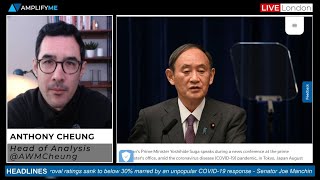
Japanese PM Suga's surprise resignation sent the Nikkei up 2% on a weakening yen and stimulus hopes. Anthony Cheung previews the US non-farm payroll report, expected to show 725k jobs added, and explains how the number could move the dollar, Treasury yields, and stocks ahead of the Fed's September meeting.
Chapters
Okay, very good morning. It is Friday the 3rd of September. Hope you're doing well. Hope you had a good week. In terms of the briefing, going to talk about this guy here, the surprise announcement of the stepping down of the Japanese PM Suga. So we'll talk about that and why the Nikkei actually reacted very positively overnight, outperforming within the Asia-Pac region. And we're also going to talk a little bit about payrolls, of course, the main focal point of the session ahead. We'll talk a little bit about the ECB and their bond buying program because there's a latest Bloomberg Economist survey that's come out about the timing of that. And then the latest headache as well for Joe Biden with Senator Joe Manchin, the West Virginia Democrat, last night saying he basically wants a pause on any talks on that $3.5 trillion budget. Well, it's been a really tough month for Joe Biden, so we'll discuss that as well. Um, so let's get straight to it and talk about the overall sentiment on the charts this morning. And things are pretty flat, but that's as you would become accustomed to on the morning of a non-farm payroll. So dollar index pretty much unchanged, that's reflected in oil, the major pairs, and T-notes. Equity index futures flat to just a touch higher. The S&P 500 in fact has touched a fresh high, just fleshed out a double top here from the Asia-Pac and early European entrance test high. So that now resides at 4545.75 in the futures. And that does come after record close we had on Wall Street last night for the S&P again. Um, so energy industrial shares among the biggest gainers, a bit of reversal from the prior day. But don't forget, we saw the energy price, oil price, recover quite sharply yesterday. We briefly reclaimed a $70 handle we're trading back to around the $70 even at the moment, trading flat on the session. So that definitely dragged up, some of the related energy names, fueled really by the sharp decline in US inventories we've had early this week, and then the persistent weakness in the dollar, of course. And, you know, a quick look at the dollar— the dollar, this is on a perspective of the last few weeks. So this, this first initial drop really goes back to around a week ago. And what we have seen, I think, is a quite a clear, distinct recalibration of people's expectations around this whole notion of tapering, because overall we've seen US consumer confidence, whether it be the University of Michigan sentiment reading, the Conference Board's consumer confidence, whether it be the big miss in ADP, the ISM manufacturing move into contraction for the employment component. The idea here is, is that data is softening. And then on a global perspective, you've also got places like China where overnight further weak data— their services number saw basically its worst figure since the onset of the pandemic, going all the way back to April of 2020. This of course coming in the context of COVID as well still being problematic in the US. And so I think for now, um, it's not, as I said before, the fact that tapering is not going to happen. It's just that the hawks, I don't think, have too much of argument now to force that early taper view. I don't really think it has substance now that the negative, um, kind of buildup that we've seen, and then throw in more, um, problem— problems on Capitol Hill for Biden to push through things like the very large budget plan, so on and so forth, and given the messy withdrawal out of Afghanistan, I think that, that hawkish argument has has left town now. And so you've seen this repriced in markets. That's not just my view. The dollar reflects this story and this narrative. The Dixie's been consistently moving lower. That has come as some reprieve for the major pairs in EURUSD and cable, but has also helped support some of the other products as well. Yields have remained— we've seen obviously movement in the US 10-year, but more broadly speaking, ever since the Powell Jackson Hole speech, yields have really done not a great deal. And equities still trade at record all-time highs, pretty much. So I think that's pretty much the status quo for the time being. Overnight, though, in the Asia-Pac session, as I said, there was some interesting news. So let me get you up to speed, because the MSCI Asia-Pac— so the broader Asia-Pac region that gets compiled by the MSCI— that actually rallied for its 6th day in a row overnight. It's the longest streak we've had since the beginning of the year in January. The Nikkei 225 was the clear outperformer, as you can see here, up just over 2%. And it came after the Japanese PM Suga plans to resign after his approval ratings have dropped below 30%. He's been marred by an unpopular COVID-19 response. Remember, of course, they just had the Olympics and in the build-up to that, there's lots of outbreaks in several prefectures across Japan. So that has really dented him. And actually, you know, when you think about politicians overall, you know, COVID really has been the defining factor. How they've dealt with that in both lockdowns, restrictions, government spending programs, vaccination rollouts has been the decisive factor for politicians. Perhaps someone like Boris has been someone who, I guess, on taken several measures, perhaps not the most effective on some of those things I just mentioned, but still has gone fairly unscathed. Um, but that's perhaps true against the opposition, perhaps not against Rishi Sunak and others in the future. So we'll see how that plays out. But let's go back to Japan. First of all, you know, why is the stock market rally? I mean, you would typically think that say, like in Germany, for example, we're seeing a surprise move to the SPD given Laschet, who's the, the CDU/CSU person being put forward to be the person to overtake Angela Merkel, who steps down for the first time in 16 years at the German federal elections later this year. That switch-up generally can be nervous in politics because people generally like to see continuity in these sorts of things, albeit actually the SPD candidate who I think has acted as vice chancellor in the current formation is seen as a continuity candidate, hence, hence he's quite popular. But the point being is that general political disruption normally for markets is negative. However, we're seeing the opposite obviously in Japan overnight, and that's based largely on the fact that the chance of LDP's defeat in the general election actually diminishes because anyone other than Suga is believed to be able to regain more popular support. And also, of course, the noises around greater stimulus are likely to be on the agenda, which definitely fires up the economy, boosts the Nikkei. On the back of this, overnight the Japanese yen weakened. That also buoyed some of the export names of which the index in itself is highly geared. So you get that secondary fold higher to give it another little squeeze on the upside. So all in all, it's to do with the fact that it's not that the LDP ruling party is being challenged, it's the fact that they can resecure that hold on government, if you like, by having— getting Suga out basically and having someone else, anyone but him, in. And so hence the reason it's reacted positively. Um, I have shared on the AmplifyMe Twitter account a fact box article. Now if you're not familiar with this, Reuters— and this is specific for the Reuters Newswire— if you just go to reuters.com, for example, Reuters have this really excellent thing that they do called a fact box. They do it for all sorts. So what this is in this case for the Japanese PM situation is it lists, um, all— well, it is a paid for website, but you can get around that, of course. Just go incognito, you're in. So just a little tip there to the wise. But one of the main things that Factbox does is— one of my questions now as an analyst, and to try to understand then the implications of Suga standing down, the next question is, well, who's going to replace him? We've had the broad understanding that anyone is better but who could these people be? Because there'll be nuances about their former background that we can use as assumptions then for the types of policies they might try to implement in future. And so a facts box basically gives you a breakdown. But Reuters do fact boxes for new vaccines, for Hurricane Ida and pipeline infrastructure damage and things like that. Really short, concise facts that you need to know to support then the understanding of these stories. So I find them incredibly useful. And so do check that out. I have shared that on Twitter already if you want to see the full rundown of the potential replacements. In short though, what's going to happen is the ruling Liberal Democrat Party— the LDP officials said Suga would finish his term as its president, meaning he'll stay on until his successor is chosen in the party-wide election slated for the end of the month, the 29th of September. Frontrunners for his replacement include former Foreign Minister Kishida, the former Internal Affairs Minister Takakashi, and the head of vaccination rollout Taro Kono, and the former Defense Minister Ashiba. So if you can repeat all 4 of those names to me perfectly, you get, you get a special prize. But yeah, as I said, those names might not be familiar to you, But the point being is who they are, what they've done before, how they're aligned politically are quite important assumptions to determine then the type of fiscal measures, COVID restriction plans, things like that that might happen in the future for Japan, which is essential for really assessing some of those products if you're trading them. So, uh, just a, something to think about. Staying with Asia-Pac and just going through the news, we did have the Chinese Caixin services PMI for August. And if you can't quite make it out, that's this little tiny bar on the right. It dramatically dropped from previous month. Uh, this is the services PMI in China, came in at 46.7. Expectations were for 52.6. The previous was 54.9. So this was the first contraction in services activity since April of 2020. Uh, the main reason being is the surge of the Delta strain of the COVID-19 virus. Um, of course. I did read some stats, and actually I'll quickly flash it on my Twitter. So my Twitter handle's here. I was sharing a really interesting Bernstein, um, note on Chinese COVID yesterday, and they were doing some analysis, and they were basically saying, long story short, that China's current COVID outbreak is more prolonged and dispersed than anything seen since Q1 of 20— of 2020, with 156 residential areas across 15 provinces experiencing varying degrees of lockdown. The chart on the right basically is a calculation of peak infections defined by a start of 5 straight days of declines in total infections. And the point is, is that's rising and hasn't— we haven't had a peak yet. So the COVID situation in China, not only is it as bad as Q1 of 2020, is it's got no signs of showing a peak as yet. So what does that create? Well, the services industry obviously is going to be impacted heavily, and this is what we've seen play out already. So again, if you think about the Fed and you think about tapering, you know, this is a global economy. China slowing rapidly also plays into that Federal Reserve thinking to a certain degree about why tapering super early and being aggressive on that front is probably not the most appropriate at this point in time, at least. So I think, I think the Street's in line with that, given the repositioning of the dollar and other assets as we've seen over the last week or so, which is why I think— I'll get to it in a minute— but I don't think payrolls is going to dramatically shift the needle too much. But I'll talk about that in a moment. Okay. The other things, I'm not going to spend too much time talking about this because we will do more next week. This is a Bloomberg Economist survey. It comes out the week before the ECB meeting, obviously happening next week, where the ECB are expected to release their latest forecasts, of which, um, we are expecting an upgrade in inflation. We've seen those higher-than-expected CPI numbers a few days ago, but also growth is likely to be increased for the forecast. Don't forget, the vaccination rollout program has been relatively successful of late. And that's been a more positive force for the economic outlook for the eurozone going forward. What it's meant is that economists surveyed by Bloomberg have basically said the ECB will start slowing its pandemic bond purchases, timing-wise, in Q4 of this year and may not exhaust the entire envelope— that's that word they use to encapsulate the whole program of €1.85 trillion— before the end of next year. So again, I've tweeted that article for the Amplify Me account if you want to have a read. We'll be talking about this a lot more, of course, next week. And then I mentioned briefly Senator Joe Manchin, the West Virginia Democrat, last night demanding a, quote, strategic pause, he said, in action on Biden's economic agenda. So potentially this puts in peril the $3.5 trillion tax and spending program the Democrats are looking to push for through Congress this fall. Uh, and of course this is quite critical to just keep that momentum that we've been seeing, which has been flagging of late. So delayment of this, um, is only going to further feed into what already is decreasing confidence overall. We talked about the facts about eviction risk as well from homeowners, uh, backdated, um, with their rental payments as well. So quite a few negative things stacking up and so there's a lot of pressure on the administration to push these things through. And why is Manchin important? Well, remember, the Senate is absolutely split, and it takes the VP Kamala Harris deciding vote to tip it over. Even on a 50-50 split, all Democrats must support a Democratic plan for it to pass through the Senate. Joe Manchin not supporting Biden means that they can't pass anything. So he really is like the, the dealmaker here. Um, Manchin's resistance, of course, to this comes in what has been a really tough period for Biden, and this is reflected in his opinion poll ratings falling to their lowest since he's taken the White House. He's had a chaotic withdrawal from Afghanistan, resurgent pandemic. There's now been a massive hurricane as well that has whipped through Louisiana all the way into New York, causing a number of deaths that we saw just the other day. So yeah, it's, it's been tough for him. But the repercussion is from a markets perspective, can he push through things like this very sizable latest spending plan? And that's looking questionable at this point. So something to be aware of. All right. Quick look then at non-farm. So the headline change in non-farm payrolls today is expected at 725,000 jobs in August. We've got a range of 400,000 at the low, 1 million at the high. It's a bit more of a moderate pace compared to each of the prior two months, but stronger than gains that were seen earlier in this year. And remember, we've still got a void of some 6 million odd jobs to, to fill until we get back to pre-pandemic levels. So the definite labor market critical to a lot of the decision-making that's going to be happening at the Fed around that tapered timing argument. The potential for volatility basically comes from the fact that officials will gather later on this month. Remember, the highly anticipated September meeting where we get the latest projections from the Fed comes on the 22nd of the month. And, and the labor market, as I said, very pivotal for that. So in terms of this report, we, we generally look at the, the kind of pre-employment kind of checklist of numbers that we've seen to get a bit of a flavor for how this report might come out. And so, a bit of a mixed bag. Probably going with the more weighted important ones as precursors for payrolls. ADP, remember just the other day was a shocker, came in at 374,000, below even the bottom end worst expectation. Uh, the second consecutive disappointment we've had there, which does not bode well for today's figure, of course. And then the ISM Manufacturing PMI, although the headline was a beat, we did see that a contraction number and a 10-month low in the employment constituent. The ISM Services PMI doesn't actually come out till today, so we don't have that intel for now. Consumer confidence, both on the Michigan and Conference Board figures, have declined, predominantly based on the back of the outbreak further of COVID and concerns in that matter. So all of these would talk to potential downside numbers. Slightly more on the relief side, I guess. You've had Challenger job cuts, corporate layoffs are at all-time lows. Initial jobless claims, the first time employment claims have restarted their gradual improvement seen for the last year, averaging around 355,000 for the last 4 weeks. So yeah, the number seems to me fairly fair. But I guess the bigger question here is what's it going to take and how's the market going to react? I actually think if we get an inline number, certainly if we get a lowball number towards the bottom end, the range of 400K, I don't think it would be shocking to see perhaps a little bit further extension of the dollar trend, equities all-time highs again at the close for the week. That would obviously support major pairs in EURUSD and Cable. and the US 10-year could test up at the weekly highs. Um, again, how true that pattern becomes will really be dictated by how bad the figure is. The worse it is, the more likely you might see those types of outcomes. On the flip side, um, I don't actually see a particularly large amount of risk really on a high number of around a million. I still don't think a million changes the game because of all of the things really of a more negative sense that I've been mentioning in this briefing. And so other than just the labor market, which before, if you think about it, if we go back a few months, the economy was kind of firing. The missing piece of the puzzle was the labor market returning. Things have changed. All those other, all those other jigsaw pieces are not now quite fitting in place in such a positive way to just then wait for jobs to return. So it's now not really just Jobs. Everything else needs to come together. So I think even a high number, I don't think rocks the boat and would really cement any type of hawkish view necessarily about tapering. I still think they'll just stick to the, to the timetable of that still really to come in the weeks, if not months ahead. And so overall, then that kind of then mitigates any substantially violent moves from today's figure, perhaps. All right, a quick review of the calendar other than payrolls. I mean, that really is the main thing. You've got some final, um, services PMI data coming out of the Europe and UK, but that really is the focal point. The ISM Services number does come out at 3 PM this afternoon, post-payrolls, so you're aware. Also, if you're interested, um, for any stocks traders, Reddit are seeking investment bankers for a potential IPO in New York according to sources last night. So the IPO said to be taking place early next year, Reddit hoping for a valuation of around $15 billion. And then for any DAX traders, the reason why I'm mentioning this is that Basically, the exchange is doing some assessments today about what type of companies could well be included in an expansion of the DAX 30 to 40 companies. And the reason why this is happening is that they want to have a more reflection of the current state of types of businesses, which now need to include more innovative businesses rather than what classically had defined the, um, the German stock index, like chemical companies and things like that. So just something to be aware of. There's more information on that you can find on my notes that I tweet every morning. Otherwise, final thing, podcast, new episode coming out later today. I'm actually off the desk going away this weekend, so I will not be here for this afternoon. But fear not, head of trading Piers Curran has got you covered. He's going to jump on the podcast with Eddie Dommez, who you might know and recognize. So those guys will put out the podcast later on post-payrolls. Okay guys, that's it. Have a great session ahead. Good luck for NFP and enjoy your weekend. Take care.
More from Anthony


Inside the Biggest Banking Stories You Need to Know This Week (Anthropic, Diageo, Private Credit)


Inside the Biggest M&A Deals You Need to Know This Week (UniCredit, GameStop, eBay, Eli Lilly)







AI Breakthrough or Hype? Anthropic’s Claude Mythos, Tim Cook Steps Down & LIV Golf Collapse