Polling Booths Open For UK General Election 2019
UK General Election voting day: polls show Conservatives with a 10-point lead. Markets are watching three scenarios with different impacts on sterling, from a firm Tory majority to a hung parliament. Gold is bullish with banks forecasting $1,600 by year-end, while the Fed signals no rate hikes in 2020.
Chapters
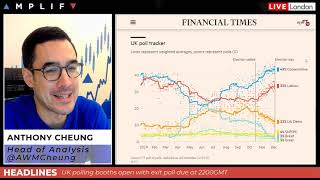
Okay, very good morning. Thursday, 12th of December, UK election day is here, and so slightly later start to the briefing this morning because we're going to be doing the all-night session later. So again, as a final reminder, um, quite course, we'll be on online throughout the day, but then we'll be back online and live via our YouTube channel at 9:30 London time this evening. And then we'll do a preview at 9:30 to just before 10 o'clock when the exit poll drops. As you guys now will be fully informed, the exit poll has been quite accurate in recent political events, particularly general elections that we've had. Going back to 2017 and 2015. And so that's going to be key. And then we'll be here throughout the night. The first and fastest constituents to report typically start coming out just around 11:00. Then it starts to obviously pick up pace as we go through the night. I think you get then a severe ramp up with about 100 constituencies from around 1:00 a.m. and overall Usually by about 3 o'clock, we should know then at that point there should be enough cumulative seats known in addition to some of the key electoral battlegrounds that we should know the end result by then. So really the main price movement is going to come at 10 with the exit poll, then with some of the first ones that come out, always garner a bit of interest, particularly likes of Sunderland. Of course, you'll remember from the referendum. And then through 1, 2 o'clock will be the most kind of frenetic, I guess, which is where hopefully someone like me can help assist you guys to help pick through the noise a little bit. I guess a lot of this is going to be in preparation of who to look out for, so I'm not going to use that brief— the briefing now to go over that because it requires a bit more detail, but that's what I'll do at half 9. So before I get into this in a bit more detail. Let's just have a quick look at the charts this morning. How are things trading? And we've got marginally higher, uh, index futures. Gold holding on to some of the gain that we've seen post-FOMC last night. I was just looking at gold when I came in this morning. There was a trend line that Sam was looking at for any of those who joined us last night when we covered the FOMC. This was that area that we were looking at, and it came down and pretty much tested to the tick before then a very aggressive rally. If you'll remember last night, those who were watching the event, the initial reaction at 7 PM was one of, uh, on the first knee-jerk move, a hawkish response. So actually the dollar saw a little pop higher and gold saw a little pop down, pretty much right on the trend line, before it bounced back and as I'll discuss shortly. Overall, the, the perception that the bar is pretty high really for Powell to move rates north. And so by default then, with rates now on the dot plot expected to see no change in 2020, ratifying how markets are priced, people came to the end conclusion that it was moderately dovish in what he said. A little bit of a pullback, but quite an interesting area here, of course, that we're just trading around at the moment. But had a little bit of a breakthrough of that trend line, but just to see how it plays out throughout the session. Any further pullback, if we did see an extension through these current levels, then I'd probably be looking at around this area here as an area of pretty firm support, encapsulating some of the price activity that we had from 2 days ago on Tuesday. And that also then starts to bring in some of the, the previous price action down here. So around 74 and then 72 on any further pullback in gold. I'd probably be keeping an eye on today should that materialize in terms of more downside. Um, that is coming with equities, as I said, marginally higher. The S&P 500 just got its head above the Asia-Pacific range high. You can see here, um, so after the FOMC had finished We had a slight dip at the open of Asian trade, and then we kind of fleshed out this, this range high around 47.5, which is kind of where we trade at the moment. Just looking at the S&P here, obviously still within touching distance of its, its all-time highs. The R1 today does line up pretty nicely with that high print that we had back on the 9th, so going back to the beginning of the week, and that also encapsulating some of the highest price activity back on the the end of the prior week as well. So some pretty decent upside resistance to be seen here in the near term in the spoos. T-notes overall, uh, pretty flat. I mean, we have actually reversed quite a lot of the moves that were seen last night. I mean, if I just blow this chart up a bit bigger to look at the 10-year, this was that initial move down, hit pivot, but then moved higher as the press conference got underway and he was making some comments, particularly around the idea of inflation, that bumped the market higher. However, if you actually look to where we are now to where we were prior to the event taking place, we're pretty much exactly flat. And so despite some of that volatility, overall I don't think the, the FOMC really yielded too much in the way of great surprises. Okay, so let's just have a quick review of some of the, some of the headlines. Obviously a quick overview of what the status is with the polls. Now we've had all of the final ones come in. Obviously no polls on actual election day, just the exit one that we'll get at 10 PM this evening. But as things change, the average poll of poll difference between the two main contenders here, Labour and Conservative, is 10 percentage points. So not really too dissimilar from really where we started. You can see we have had some fluctuation, of course. I think the biggest lead of which Boris managed to eke out at one point was about 19 points. However, it got down to as narrow as 6 at one point in one poll. And so we end pretty much as we started. Yeah, as we've kind of said before, I think overall, comparative to previous episodes of political campaigning, there hasn't really been too much in the way that's really changed the narrative that much. Obviously Boris sticking to his mandate of getting Brexit done. I was considering going on a bit of a ramble this morning on my way in on the train to try and explain to people how "getting Brexit done" is the biggest false statement of all time, and if you believe Boris and that he's going to get Brexit delivered on January 31st, you don't really understand probably what is the actual trade deal that he needs to negotiate. There's no way he's going to deliver like he said. But I'm getting— I'm slipping down that slippery slope again, so I'm not going to go down that route. So let's have a look then. The polls that came in yesterday Um, here you've got the 11th of December, so there was what, 6 polls that came out, and all of them kind of a little fluctuation between kind of high single digits and low double digits, but net-net 10 percentage points, which should still be indicative of course of the Conservative Party securing that overall majority. Now here was that scenario, um, and I'm going to use this as a bit of a template even though we did discuss it Yesterday, this is looking at the 3 scenarios. Scenario 1 being a, a pretty firm Tory majority and really reflecting the notion that because the price is reflecting a Conservative win, then the upside relief on confirmation of that will be relatively small comparative to the bigger risk, which would be given the bar is changed in regard to— it's almost like the market's fully believing of a majority, then it would be a shock event and thus a big move if they get a minority government, or in fact even if it goes down to a hung parliament type situation. Now, hung parliament, if that is scenario 3, I think that's, I think that's a little bit too bearish. I think if you're going to get scenario 3 tonight which is a full 10-point type move, I think you've got to, you've got to see a Labour majority for that to happen, and there's just absolutely no way that's going to happen. Um, so here I would say really, and let's have a look at the, the cable chart just from a top-level point of view, because I was looking at this last night and I think there's some good areas here if we do get a, a less convincing Tory majority, i.e., a small majority, I think is going to have a downside impact if that's numbers kind of sub-25. And then if we get a hung parliament, all the more negative it becomes. So here, this is a chart on a daily continuation of Cable, and these ellipses here were ones that we had marked up. So this is kind of looking at the same graphic that Bloomberg had in a slightly different way. Uh, but just looking at where if we were to move down, I think that 130 level is pretty key. That then encapsulating the high that we had on the 21st, which was pretty strong resistance before then the break higher that came the beginning of this month. There was also an area of support back in, uh, kind of Q1 of this year, also in 2017. So it's a key area there. The next target below there, I would say, then comes in around 128.33, that type of area of the bottom end of the consolidation phase that we had in October, November, the resistance point that we've had in June, and also the support point in February of this year. And you can see if you go back on the chart, back in July and— of July of 2017 and 2016, it was a key level of support. So again, we'll talk about this obviously much more later tonight, but the point being is that prudent to do different scenario building. As low a prospect it might be of a Labour majority, I would still have it prepped up as where could the market go to and obviously what type of battlegrounds are going to be the tipping point that could well give you a front run that that might materialize. But I do see that as incredibly low probability. I think the most— well, a more likely one could be a hung parliament. And a hung parliament, I think, yeah, perhaps we could get down to that 128. But again, it's the composition of the numbers really that materializes that will dictate how aggressive the sell-off is in those conditions. But again, I must stress the baseline case here is that Boris Johnson does in fact secure his majority. And if that is the case and that is proved in the exit poll and then between, let's say, 12 and 2, the results are backing off that exit poll, well then actually it's a fairly— I'm not going to say tame, but controlled event because a lot of that's already priced in. A few things though to reflect why people do not want to get burnt like they have done before. Remember, complacency is a massive potential danger for traders. And the way that markets were positioned, as we'll remember with the EU referendum, is that it was almost entirely expected to remain, and obviously the vote was to leave. So here what we're looking at is trader anxiety is basically showing up in one-week sterling volatility, which you can see peaked at around October. You'll remember October, of course, was that deadline where there was the threat of no deal actually materializing, and we're pretty much back to around that type of level. If we were to bring that out onto a 1-month perspective, the premium that investors are paying for protective puts over calls in currency options has moved to its highest since April, as you can see here, reflecting in this gauge known as the 25 Delta risk reversals. So here again, people taking protection against it. If this does go wrong, then they can also, you know, take advantage of that situation as well. So that's pretty much it. That's as far as I'm going to go with this at the moment. Obviously we'll go into it in a lot more detail later this evening. So let's, let's push on here then. A bit of a summary for Jerome Powell and what the Fed said last night. The bottom line, basically the Fed is in no rush to reverse the 3 rate cuts that it's executed in 2019, even if the economy picks up steam and the odds of recession recede. Now, that in combination, I think, with Powell said he would want to see a significant move up in inflation that's also persistent before raising rates. So essentially what he's saying here, reading between the lines, is that the bar is very high for them to change rates, to move rates higher, to continue now the resumption of the rate hike cycle after the execution of this mid-cycle adjustment. So that in itself is obviously quite dovish when you think about it. He's basically saying then if inflation, which it has, has been fairly benign, well then it's not going to change for a long period of time. Well then rates aren't going to change either. So for the moment, it's not as if it's a, uh, rates going up, a slight dip, and then back up again. It's rates going up, slight dip, and sideways for what is expected to be a fairly prolonged period of time. And that is reflected in the dot plots. Obviously, we had the, the summary of economic projections. You can see here the one that people are looking at. Obviously, you can discount 2019, that doesn't matter. 2020, rates are going to be unchanged is what they're expecting. And obviously, this was how Federal funds rate futures were priced, perhaps a slight risk that there could have been a hawkish surprise, i.e., anticipating one hike in 2020, but that did not materialize. And so you can see here, and again, the change that we've had in the trajectory of rates in their forecasts over the near-term horizon has changed quite radically if you think about it. You know, the shape, if I've move my mouse, only about 6, 9 months ago was like this, was a much more kind of traditional, let's say, typical yield curve kind of shape. However, now it's incredibly shallow and flat, so showing that rates changes going forward even beyond the biggest risks that you could say for 2020, which is the presidential election and the trade war. Rates are only going to raise at a very gradual pace is what they're saying. Okay, elsewhere, Christine Lagarde, of course, um, not forgetting we do have the ECB rate decision later on this afternoon. This is the first from the new president, and as I was kind of intonating towards yesterday, quite a few people are very interested to see how she handles the situation, particularly the press conference a little bit of added pressure, although obviously she's a bit of a seasoned veteran speaking on a, on a, on the big stage. She never has done so as the ECB president, where one word out of place can have obviously grave consequence on market prices. So I think she's going to handle it pretty well. I don't, I'm not really expecting any massive mistakes of that nature, very much really continuity of just having Draghi handed over the baton of where ECB policy is at the moment. The one thing that we are going to get here, like what we had with the Fed last night, we do have the latest updated projections coming from the ECB. But as you can see here, this is a survey of economists conducted by Bloomberg over late November, early December about what do they think that these forecasts will show. And as you can see, for GDP, it's expectation is that it's going to remain unaltered for 2020 and 2021. Do note though that given the time of year, it means that we're going to get the first projections for 2022. Inflation looking for a slight upward revision on 2020, but again, these projections overall looking for very little change. So really, I guess, if I was to sum it up, it It's more when she's doing the Q&A, perhaps, does she make a mistake? Uh, that's going to be the most possible trading event that could occur, because otherwise I think from the information that they're going to say from a statement point of view is going to be fairly vanilla in terms of where policy is at the moment. Finally, two other pieces just to bring to your attention. A lot of lot of 2020 outlooks coming out, and gold seems to be the hot topic. We've had the likes of Goldman's, UBS talking about $1,600 at the end of 2020, Citi joining that chorus of kind of gold bulls. They're saying that gold to extend rally as US rates here to stay. So very much continuation of the conversation we just had describing what Powell said last night. But also as well, given the key risk of next year is that Trump election, well then the— again, the bar to hiking rates in America is, is high. If anything, the risk is lower rates again, whether that might be a mismanagement of the campaign period leading to greater confrontation in the escalating trade war with China, or which starts to then really impact the economy, requiring the Fed to cut rates. And if that materializes, well, all the more supportive for gold. So I think when you look at the fundamentals on balance and you weigh them up, I would agree there's definitely more reasons to be bullish gold over the next 12-month period rather than the other way around from a risk perspective. And then finally, what is the situation with China? Well, Again, nothing concrete as yet to really say definitively that the tariffs on Sunday are removed. So as much as we've talked about the ECB, we're talking about the election, do not forget that, you know, time is ticking. We need some kind of concrete answer about are those tariffs from the US on Chinese goods going to happen on Sunday or not. And so here, China and the US are in close communication on trade, according to the Chinese Commerce Ministry. But it declined to comment on possible retaliation if Washington imposes more tariffs on Chinese goods this weekend. So nothing particularly new. But again, I would remain vigilant throughout today, tomorrow's session, because I would have a guess that going off probabilities, that there's going to be some kind of comment made that will shift markets one way or the other. The question is what way. Uh, it's hard to say. So that moment, I'm sure though, is coming very soon. Quick look at the calendar. What are the key things to look out for today? You've got the EIA monthly oil market report. That'll be at 9 AM. So, well, it's just come out actually. Just given the timings, I'm a bit off because we started a bit later. So let me just read you the contents of the headlines from that report. They said global oil demand growth for 2019 and 2020 at 1 million 1.2 million barrels per day respectively. They said global oil demand rose by 900,000 barrels per day in Q3 of 2019, the highest annual growth in fact in a year. The IEA report, in a sense then, in summary, aligns itself more with the OPEC report as they both kept global demand growth forecasts unchanged for 2019-2020, whilst the EIA saw a modest revision higher, 50,000k for next year. Year. So as you can see from the price of oil, there hasn't really been— the bottom of my charts here— any real movement. Uh, so nothing really of great substance coming out that report. As I said, pretty similar to the OPEC report that we had quite recently. Uh, otherwise from Europe, you've got industrial production data at 10:00. Uh, the ECB, uh, always is the case, is two-part event. 12:45 for the rate decision. Uh, no one expecting any change on rates, so it's very much a focus on the press conference. That'll be at 1:30. 1:30, we also get the weekly jobless claims in the US, PPI numbers as well. And then that's pretty much it, other than then looking forward to the UK general election. So with that, I'm going to wrap things up, and I will see you in Trading Live. And then for those on YouTube, I'll see you later on this evening. All right, thanks very much.
More from Anthony


Inside the Biggest Banking Stories You Need to Know This Week (Anthropic, Diageo, Private Credit)


Inside the Biggest M&A Deals You Need to Know This Week (UniCredit, GameStop, eBay, Eli Lilly)







AI Breakthrough or Hype? Anthropic’s Claude Mythos, Tim Cook Steps Down & LIV Golf Collapse