Stocks rally as Fed commits to dovish turn
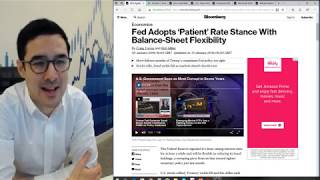
In this January 31, 2019 market commentary, the presenter walks through the Federal Reserve’s unexpected dovish pivot, highlighted by the FOMC’s new language of a “patient rate stance” and balance‑sheet flexibility. The shift sparked a broad cross‑asset rally: the U.S. dollar weakened, equity indices (S&P 500, Nasdaq) surged, Treasury yields fell, and gold rose. Technical analysis of the S&P 500 futures identifies key Fibonacci retracement levels around 2,700 and a potential upside target near 2,800. The commentary also covers political reactions—President Trump’s celebratory tweet and the Financial Times’ warning about a reactive Fed—followed by a discussion of Brexit, where the EU maintains a hard‑line stance, influencing the pound’s movement. The host reviews the first day of U.S.–China trade talks and the looming March 1 tariff reset, then provides a quick earnings snapshot of Facebook, Microsoft, Amazon and Alibaba, noting both positive surprises and emerging cloud‑computing concerns. Finally, the segment lists recent macro data (German unemployment, PMI) and upcoming calendar items (Eurozone GDP, ECB speeches, further earnings), concluding with an invitation to discuss technical questions.
Chapters
Okay, very good morning, Thursday, 31st of January. Hope you are well. Obviously, the main focal point of what I'm going to talk about this morning is the somewhat surprise announcement from the FOMC, who sounded incredibly dovish. You remember in the briefing this time yesterday, we were talking about that Bloomberg survey of economists, and really no one was expecting the type of kind of worries that the Fed expressed yesterday, and consequently monetary policy being such a key driver underlying overall market direction, you've had a good cross-asset class move. Everything from the currency weakness in the dollar and an elevation in both US equities or global equities, because it has translated into a positive Asian session, higher T-notes, higher gold. So we'll go through and explain the exact word changes, the reasons behind that in a, in a second. Other things to have a look at is Brexit. Where are we? We've obviously, we understand where UK Parliament resides at the moment, but now it's about what do Europe think and what's their appetite for any renegotiation on that backstop legality. And then we're also going to have a look at some corporate earnings. We had Facebook last night and we've had other companies of a large market cap like Microsoft, Alibaba, and we've got Amazon coming out later. And we can have a look at the kind of key area to have a look at with them, which we might have got a bit of a tip-off by the performance of a specific area in cloud computing from Microsoft last night. So first things first, let's have a look at the, the charts. And, you know, the— a picture tells, you know, a thousand words. And you can see here that it's obvious that it was a real surprise last night in a dovish sense. You can see the dollar weakness reflective on the two charts on the top left. You've got EURUSD, big pop-up at 7 PM last night London time. Likewise, cable, a little bit of a move as well here, kind of counteracting any negativity that might have come into the, the cable price action with the increased, albeit still small, prospect of a no deal given those amendments Yvette Cooper's one in particular being voted down. What's interesting here, and certainly as a refresher for any of the new guys here, if we just focus on the two charts on the right-hand side, in the middle you've got the S&P 500 future, beside that you've got the NASDAQ, below here you've then got the US 10-year or the T-note future. As you can see here, equities and the US 10-year moving in the same direction. So rather than this being that kind of classic economic theory of the inverse relationship from a risk perspective, i.e., coming out of a riskier asset being equities, moving into bonds depending on that environment and risk appetite, this is more of a monetary policy play. So this being the fact that, you know, a big component that spooked markets for a long period of time, of course, has been this idea of policy tightening and the fact that the Fed have hiked interest rates 9 times. They've communicated they can do another 2 more this year. That's what spooked markets, amongst other things as well, of course, like trade wars and Brexit and so on. But that December sell-off was, you know, very aggressive. The dovish turn from the Fed that we had in January from Powell in his speeches has helped that big recovery. But now the real concrete commitment to turning dovish more officially, you can see then that you're getting a dual move. This is supportive for equities, giving its kind of a removal of any prospect of rate hikes to come and what is a number of potential risks for 2019 and global growth concerns. So that's a positive there, but also for fixed income, yields have fallen because the prospect of interest rates rising now has been completely priced off the table. Now the Fed have, you would think given what we heard last night, now have to alter in March the dot plot projections significantly, and the prospect is, is that they're going to be willing to pause. So let's have a look at exactly what the language was and what the key phrases are, and this is it here as a headline: the Fed adopts a, quote, patient rate stance with balance sheet flexibility. I think from that Bloomberg Economist survey that we went through yesterday, it was only about 15% of the economists surveyed at all the major banks and research houses were expecting an actual explicit move to what is a big word change to go patient. And that is what materialized. So the kind of mispricing or alignment of expectations with the market is what's caused this quite knee-jerk reaction. Now just going through here, there are a couple of things. This is the exact phrase in which they used— the FOMC said will be patient as it determines the future adjustments to the target range for the federal funds rate may be appropriate. So in a separate statement, the Fed also said it's prepared to adjust any of the details for completing the balance sheet normalization in the light of economic and financial developments. And then finally, they also said Powell told reporters— remember, last night there's a press conference as well as the initial statement— and there Powell told reporters the US economy is in a good place, but it's the external headwinds, slowing growth in China, there's issues in Europe, there's unresolved Brexit, there's a risk of trade negotiations with the looming trade truce expiring in literally 4 weeks' time. There's been a 5-week US government shutdown. You know, you literally had the full monty of dovish things. So 3 key ones: moving that phrase about their current interest rate stance to being patient, also throwing into the mix the fact that they could reassess the balance sheet process, which is that quantitative tightening, which is kind of the other instrument of monetary policy. And then the external headwinds in their mind have picked up pace. So that's kind of where we stand at the moment. And markets were already priced for no rate hike next year. And actually going out into 2020, markets are now pricing in a rate cut at this point. So this has been how much the markets have now moved in their expectations. I think the likelihood now of a rate hike is, is very much bedded in that it's definitely not going to happen, at least at this point in time this year. And in fact, the next move is growing ever more likely to be a cut rather than a hike, is what the current status quo is. So yeah, that was the, the Fed. And, and going back to the equity markets, obviously US equities were loving this last night, uh, the S&P managing to just punch higher, the press conference just further cementing that dovish turn. And Sam straight away was pointing out quite a key level, and this is looking on a more longer time frame. This is a daily continuation chart of the S&P future. We've got a couple of technical tools here. You've got the fib retracement of the, uh, what was the all-time highs down toward that, you know, taking into account the big collapse in markets at the end of last year and that low we had on Boxing Day. The Fib retracement of that comes in, the 61.8, at around the 2700. So you've got the Fib, you've got the handle of 27, and then you've got this trend line from what was the, was the all-time high on the 3rd of October, and then the bounce on the 3rd of December. And that comes in, as you can see, exactly to where we're testing right now. Right to the tick almost. So some really important levels here technically that if we were to break, and let's say we do manage to close up and above these levels in the coming sessions, then on the upside the next key one is going to be this, uh, kind of triple top if you like from the price movements that we were having. That was a really strong technical trend line as well at the time, and that was also a Fib retracement of that initial sell-off for the October to November move that worked out very well. So a break of there, the obvious target moving beyond this current area would likely be a challenge then to push up to there. So we're looking then towards the 2800 mark. And so, you know, what a phenomenal turnaround we've had in the last 4 or 5 weeks. And, and remember, when it comes to real sustainable, you know, kind of, you know, the negativity we're in, if we're really going to make an about-turn in investor sentiment, it's got to come from the Fed because they're so critical, the underlying kind of driving force of market direction. So the dovish move being confirmed of what we already knew, they were leaning that way, but now they've committed to it, is a very important step in the process. Now, one person, of course, who— I saw some funny memes last night of kind of Trump and Powell running along the beach holding hands, kind of mock-ups, saying how what a lovely friendship they have. But obviously Donald Trump was absolutely over the moon with what the Fed were saying because he tweeted Immediately after the Fed, the Dow just broke 25,000. Tremendous news. Uh, he's not wrong, of course. Technically it did. Um, but obviously we know that there's much more to it than that. But obviously this fits perfectly into his political kind of narrative that he likes to, to push. One thing though that I would say is, well, that's fine. That was the reaction and function that happened. But this I thought was quite interesting as a headline, and let me explain briefly why. This is the FT, which obviously offers a little bit of a, a deeper layer of opinion and analysis, and they were saying Federal Reserve's momentous U-turn prompts puzzlement. Now what they're basically saying, and I do agree with this, is that there's a real risk here that the Fed are running that one, do they have a choice? We know that a lot of those, particularly the external headwinds and the overall global economic picture, is undoubtedly slowing and has multiple risks that could exacerbate and make that situation worse. So it seems logical to become a little bit more dovish in order to quell those concerns and restore a bit of confidence and stability to markets. The problem is though, if that every time the market sells off you're going to then change completely what you're saying, um, and the direction of which you want to take your monetary policy, that's going to become incredibly problematic in a sense that now the market will start to expect every time there's a downturn, doesn't matter, the Fed will come and save the day. And generally what's happened with these types of things that I've seen over the years is that the market wants more and more and more. It's just human psychology in that sense. It takes more to get that same bang for your buck when you're used to that kind of reaction. So this is what this article is kind of suggesting, and I do think that's quite right. I saw— and there's a nice quote here, um, by one of the head guys at Barclays saying, our main concern is that hyperdata dependence means a reactive Fed potentially whipsawed by market movements and absent clear direction, overall it just complicates the longer-term picture. You know, can you trust what it is that the Federal Reserve, the central bank, is telling you through forward guidance when if the markets were to move one way or another they can quickly change their mind? That's incredibly problematic for long-term investors and also companies actually working within economies. So it's a It's a bit of a double-edged sword, but, you know, just something from a bigger, broader picture point of view to be aware of. So yeah, that's the Fed. I'm gonna leave it at that for the moment, and let's crack on with some of the, uh, other areas that are in focus. And that is going to be this. So, EU ready to push UK near point of no return. On Brexit. So a lot of people obviously are now looking out for what is the European response. You'll remember immediately after those amendments were voted upon two nights ago, EU president, or European Council president, Donald Tusk came out and said this is non-negotiable. Macron's always been of this kind of view, and he echoed that sentiment. And now you've had you know, and this is, you know, maybe— I mean, Italy probably a slightly different case given their more, you know, populist formation of their government. But, you know, maybe this is what Europe needs to add a degree of unity, is a challenge like the one that Brexit is bringing. So, you know, it seems to be a fairly united front at the moment, and that being that the European Union are basically prepared to take these Brexit talks right down to the wire, which obviously puts an incredible amount of pressure on Britain. It's also obviously a high-risk strategy for Europe equally. Um, but yeah, at this point the EU have said they're in no rush to convene an emergency meeting of EU leaders, um, the next one of which diplomats point to a scheduled summit in March 20— 21st, 22nd, just 7 days before March 29th. Gotta imagine there's going to be a lot of movement on the negotiations and the compromises and, and so on before then. But yeah, at the moment, long story short, EU are not budging, particularly Ireland. The, the, the PM there suggesting that absolutely we can't do that because it jeopardizes the peace agreement and so on and so forth. So we're still at the same situation overall. Now, looking at the pound, you would think then, well, given what I'm saying and given the posturing from Europe, that the pound should be weaker. But don't forget, when you're trading a currency pair, of course, you're trading one currency against another. And at the moment, for the last 12 hours, let's say, the market's been predominantly driven by dollar and dollar weakness on the back of the dovish Fed. So, you know, if you look at the cable chart here, this was the amendments when actually, you know, people were hoping, if you like, the reason why the pound had been priced in and rallying over recent week or two is that they were going to put into place power to Parliament in order to avert a no deal. That didn't materialize. We moved lower. But you can see here cable getting a nice little kick back higher and essentially back to where exactly we were at the beginning of the week. On the back predominantly of the dollar weakness. So still obviously a lot more to play for. I think for me, we know how this is probably going to work out. Um, politicians tend to not really make real action or commitments and willingness to change their stance until ultimately you get closer to a deadline, and that sharpens the mind and negotiations start to kind of make progress. So I'd say at the moment, obviously keep an eye on Twitter and, and so on, but I would expect the rhetoric to continue, which is basically Theresa May sticking that we're gonna— she's now got the backing and probably the most clearest of a majority so far to go back to renegotiate. But Europe are gonna be quite standoffish. I'd say it's probably gonna remain in place for the next week or so at least. All right, the other thing of course that's happening at the moment is And this was one of the highlighted risks from the Fed yesterday, but US-China hold their first day of trade talks with wide differences remaining. Remember, this kicked off yesterday, not a great deal coming out of it as yet, but it's something which is ongoing throughout today. So certainly I'd keep an eye on the score, or an eye on Twitter, an ear out on the squawk for any accompanying updates. Remember, we are effectively now one month away pretty much to the date, uh, being the 1st of March, of when those tariffs are going to reset back up to the higher level of 25% from the current 10%. So time is of the essence here, and, and this is a, as we discussed at the beginning of the week, a key macro focus that can drive, uh, risk intraday, uh, very much so. So worth keeping an eye on. All right, a few Few other things, quick run-through of some of the earnings reports. You had Facebook last night, their shares rose sharply, big pop after their number of daily users climbed 9%. That was higher than market expectations. Don't forget as well that generally Facebook has been, you know, it's had a real roller coaster having been caught up in various different allegations on data privacy and all other manner of sins. The fact is, is that their revenues exceeded Wall Street expectations despite these privacy scandals. And also they continue to see, you know, decent new numbers, which means ultimately then there's a bigger audience of which where they're generating most of their revenue through advertising. And that's playing out well for them. at the moment. So yeah, decent jump in their shares, overnight. Uh, interestingly though, I did see that they too are also going to stop reporting specific numbers. I think it might have been around the user numbers, which obviously is the key thing that traders, investors in the short term, speculators look at, because that's the real defining factor about the potential income that they could generate from kind of utilizing that that audience. Much like Apple, who've said they're not going to report now numbers on their key products like the iPhone, it's kind of trying to move attention and concentration away from that singular thing. Because as we know, like with Apple, you know, there's this, there's this real big necessity to push away from demand for just one product that's really quite key. So yeah, Facebook overall good. Microsoft, PC market weakness holding back their revenue growth. Sales meet estimates, but cloud concerns is what hit their shares. They actually moved a little bit lower. Now cloud computing is particularly key, and while Microsoft's kind of cloud service revenues grew 76%, and that is one of the closest watch segments rates have slowed from near doubling that business posted each quarter in '27 and early 2018. And so, you know, also as well, you've got the bigger global picture about, you know, potential forthcoming economic slowdown. But, you know, once the appetite starts to— you've serviced a predominant amount of the market with certain technology and version releases and so on and so so forth, then, you know, the PC market is starting to slow down, as well as the demand on the cloud computing, although it still is a well-performing unit. It's just the expectations are so extraordinarily high. Now, a company that's reporting after market tonight is Amazon, and Amazon's kind of the other big tech name. We've had Apple, we've had Facebook, we've had Microsoft. Amazon is important That'll be tonight after the closing bell, so after 9 PM London. And I was just reading some numbers this morning, but at the end of 2017, I think their operating income as a company as a whole, something like 60% of it is derived from their, their cloud business. So that is quite pivotal for them. The signs, if there is any, is that marketplace in that specific sector is struggling, if Microsoft is any comparison. So I just wonder whether we're going to see that translate into equal kind of weakness in that area for Amazon, which given the importance for them as a company on that, will that have an impact on their shares? We'll, we'll see. Maybe markets are now a little bit more prepped for that given the, the news from Microsoft. And then finally, Alibaba, They beat estimates after a day of disaster for China earnings. Basically, you had 20 larger companies in China overnight, and they all basically reported pretty dire outlook akin to profit warnings. Obviously, we know the Chinese economy is under immense amount of pressure through the trade wars and then subsequently this kind of global slowdown. And they've all struggled, but Alibaba outperformed, and actually their numbers were good. However, it was down to a one-time gain from a service affiliate, which was basically an accounting metric lifting the numbers. And so I wouldn't read too much into the headline. Yes, they beat, but it's more of a technicality than it is something that's underlying real strength for them. They did actually highlight risks going forward, however Did that weigh on Chinese shares? No. Remember what the big macro driver is as we come in this morning has been the Fed, and consequently dollar weakness is a byproduct of that. The renminbi hits a fresh 6-month high after the dollar eases. So remember, China catching a bit of a break in the short term because it was the, the weakness in their currency that was a big concern several months ago, but dollar weakness with this dovish turn is helping mitigate that. And we've got a 6-month high now in their local currency, and the Asian markets actually moved higher despite those negative micro stories that were happening. We did have some Chinese data overnight as well, just so you're aware. Chinese official manufacturing PMI contracted for a second month running, albeit relatively stable at those levels. So again, markets kind of digesting that focus on the bigger narrative from the, from the Fed. Okay, let's have a look at the calendar. And we just had some German economic data out, uh, that is the unemployment change and rate. The unemployment rate 5%, in line. The unemployment change -2,000 as expected, -10. That data is of no consequence, I would say. Um, in line— I mean, the unemployment change, if you were to look at it on a historical chart month to month, it does tend to have a large degree of swing. So as you've seen, if you're looking at European assets, no real movement, and that's as what I would expect. Looking at the calendar, other things coming out to be aware of, you got a couple of preliminary GDP figures coming out, culminating in the European one. That obviously will be of some interest, just given the situation that we've had and the evidence in things like PMIs that, you know, kind of service and manufacturing is on the downturn. Then looking forward to the afternoon, still, I guess, yet to be confirmed with some US data about the catch-up on government shutdowns, the keep your ears peeled for any updates on the squawk. Otherwise, you've got Chicago PMI that is scheduled at this point, some Canadian data, your regular weekly jobless claims because it's Thursday, a couple of ECB speakers of a more hawkish nature, particularly Weidmann, as we go into the afternoon. And then you've got a kind of batch of earnings. The other earnings reports of a larger market cap maybe to be aware of General Electric, ConocoPhillips, UPS, and Amazon are probably the ones if I was just to select a key, a key few. All right, I'll leave it at that. Obviously, any technical analysis questions or trade setups, feel free to message Sam. Otherwise, I wish you a good day. Thanks, guys.
More from Anthony


Inside the Biggest Banking Stories You Need to Know This Week (Anthropic, Diageo, Private Credit)


Inside the Biggest M&A Deals You Need to Know This Week (UniCredit, GameStop, eBay, Eli Lilly)







AI Breakthrough or Hype? Anthropic’s Claude Mythos, Tim Cook Steps Down & LIV Golf Collapse