Sunday LIVE session - 17th March 2019
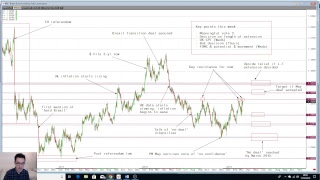
In this 20‑minute live YouTube session, host Anthony Cheung (Twitter @awmchung) walks participants through the key macro events shaping the week of 17‑23 March 2019. He outlines the Brexit timetable – a possible third "meaningful vote" on Theresa May’s deal, UK CPI data and the Bank of England rate decision – and explains how each could move the GBP/USD pair, providing technical targets (1.35 upside, 1.30‑1.28 downside). He then shifts to the US side, reviewing the FOMC meeting, dot‑plot expectations and the impact on the S&P 500, highlighting support around 2800 and a potential rally to 2835‑2860 if the Fed is dovish and trade talks with China stay positive. He analyses WTI crude technicals, noting a near‑term target around $60 and a downside floor near $55.75. He mentions Deutsche Bank/Commerzbank merger talks as a European banking story. Throughout, he promotes Amplify’s training programmes – a 9‑week career program, 1‑week intensive courses, summer internships and live strategy reports – and answers live chat questions about the pound’s reaction to a passed vote, broker recommendations, and which data releases may be market‑moving. The session is recorded for later viewing.
Questions this video answers
A passed vote would be pound‑positive, generating a relief rally. The main risk would be if Europe does not agree to the technical extension, which could still trigger a no‑deal scenario.
Amplify uses RJ O’Brien; the main contact is Oliver Coombs. Mention Amplify when reaching out for a referral.
Key releases include US factory orders (Tue), US manufacturing & services PMI (Fri), the FOMC (Wed), and the European Council meeting (Thu). These are the likely market‑moving events.
Chapters
Okay, hello and happy St. Patrick's Day. Just testing out my feed. I'm just going to wait for a couple of minutes, let anyone else get online, but hopefully you can see and hear everything. If you can give me a "why" in the chat if you can see everything. There should be a chat box on the right-hand side. Even if you're on your mobile, you should be able to leave comments as well. So if you can see and hear everything, just drop me a "y" in the chat and let me know if it's coming through. Hey, Will, how's it going? Had to wait till a bit later in the evening to do the briefing today. But hopefully the, uh, the internet will hold up and we can have a bit of a look ahead for the week. There's certainly a good week ahead calendar-wise. Jose, how's it going? Always a pleasure to have Jose with us. Okay, just going to give it a few minutes. We'll wait for everyone else to come in line and then we'll, uh, we'll get things running. Just while we're waiting, um, and before I begin, obviously I've got a chart of cable, uh, up here. And what I wanted to do was, obviously this week coming up is quite a big one for Brexit. Um, we've got basically, is she going to bring— that's Theresa May, the Prime Minister— meaningful vote 3 on Tuesday? Um, is she going to do that? Is it going to pass? If not, or even if it does, how long is this extension going to be? So what I've tried to do with this chart is put a whole backlog of some of the key, uh, fundamental events that have, that have happened during some of the price action that we've had, all the way from the EU referendum. You can see here on the left. So I'll leave that on the screen for a second just while everyone logs in and gets up and running. We'll give it about another 2 minutes and then we'll get cracking. Otherwise, everyone else— Andrew, Doug, Zineb, woman with hairstyle— you need to tell me your name, otherwise I'll have to refer to you with your page title. André, hello, good to have you with us. All right, well, look, let's get going. What I will do is after I finish this session, um, it gets automatically recorded. And let me just transition my screen for a second. So yeah, after I film this, it does get automatically recorded I will put this in a, in the category, the Sunday live session on our YouTube channel, so you can watch this even if you don't catch it live. You can watch it later on this evening. I try and keep things short. I kind of want to keep it to about 20 minutes max because I know we've all got things to do on a Sunday evening. But the purpose of this is just to give you a real quick look ahead for what I think are some of the real pivot points of the week. Potentially then could be direction-changing for different assets, whether it be equity markets, the pound, gold, oil, so on and so forth. So the first thing I'd like to do— well, before I start, Andrew from Australia, thanks very much for joining us. And then we've got Oliver in South Africa. So yeah, good stuff, great to have you tuning in. So yeah, this is what I always do on a Sunday. I as part of practice, I put together this calendar. I do tweet this. If you are interested, just follow me on Twitter. My handle is @awmchung. I'll bring it up afterwards and show you. But essentially what I like to do is on a Sunday night, I like to look at this calendar, and this pulls together a few different things. This is economic data. There are central bank speakers. And government speakers or government events. So things of course like Brexit, for example, keeping on top of exactly, uh, kind of when are the key meetings happen— happening, when are the speeches happening, uh, as so as to ascertain when potential market volatility might occur. So looking at this week as a whole, I kind of underlined, um, and bolded a few things. So I think best thing is, is just to focus on those because not everything of course on an economic calendar is always important. It's good to isolate and see the kind of roadmap, if you like, and where the peaks and troughs are for that given week. Now, as you can see here, Monday is pretty quiet overall. There's a couple of headlines which I'll run through shortly, but Tuesday is when— well, let's just start with Brexit to get things going. And of course, it's a big week. I know we say this every week, but it really is a big week for Brexit because it's coming down to real decision time now. Obviously, at the moment, we had last week with some amendments votes about eradicating no deal, but that's removal of no deal contingent that Europe come back and we go to them and say we want an extension because of this reason. Because we want to plan for a no deal. Because we want to have a general election, a second referendum. Because we want to enforce Theresa May's deal and we need the relevant timeframe in order for Parliament to approve these processes. So we've got to make a decision now, and Tuesday is what's being penciled in, as I can see here, as the possible meaningful vote 3. I think numbers-wise, she lost the first vote by 230, she lost the second vote by 149. Now the key being is, now that, you know, we're coming right up to the deadline, and as we're going to see with some of the headlines, it's almost become a reality for these MPs now. Do they need to back her deal, even though it is exactly the same deal The point being is that they're at risk, mainly the Brexiteers, of potentially having either a no-deal reality, which I'd say is quite firm to believe there's enough cross-party support to avoid that economic worst-case situation. And for the Brexiteers, they don't want the risk of a no Brexit at all. They would see that as a real kind of going against what the democratic vote would have suggested. So at this point, do they now have to just take Theresa May's deal as it is? And that's what some of the headlines this weekend are suggesting. And we're going to have a look in a second. Otherwise, from the UK, Wednesday, you get UK CPI data, so some inflation data. And then you also get the Bank of England. So away from Brexit, you've also got the Bank of England interest rate decision coming up on Thursday. So in terms of the order of play, you've got the meaningful vote, potentially 3 on Tuesday. UK inflation data CPI on Wednesday, and then you've got the Bank of England interest rate decision on Thursday. Now, the latter one I would say largely will take a bit of a back seat, and that being that I wouldn't be expecting too much, um, of a move off the back of that. We've just had the quarterly inflation report, of course, in the month of February where we get the latest outlook from the bank. Um, given the overall uncertainty and the quite severe different economic, uh, kind of prospects that either the worst case no deal or taking May's deal or a long-term extension can have on the economy. What the Bank of England has to say now needs to be taken with a large pinch of salt because it's probably subject to quite, you know, firm revisions going forward. So yeah, that, that's the kind of UK slate, if you like. So let's just get into a couple of Brexit headlines and let me show you a few things, then I'll show you the pound chart. So this is some of the headlines out of Bloomberg coming out this weekend. May's deal is gaining supporters. This was Philip Hammond, who's of course the Chancellor. He said that, well, look, these are the key developments in the weekend. May says there could be no more potent symbol of Parliament's collective political failure than the UK having to hold elections to the European Parliament. Remember, these are happening. We need to make a decision by essentially the middle of April. Whether or not we're going to take part, if there's going to be a long extension, in European parliamentary elections, which are going to be happening, I think, in June. So what May is saying is she's leveraging up and just throwing out there to MPs the challenge, basically saying that if we vote to stay in the European Parliament, that's ridiculous. We voted for Brexit. We need to deliver this. This is a way of her then forcing the MPs, particularly the Brexiteer ones, to support her deal this time round. Potentially on Tuesday. Third Brexit deal most likely on Tuesday, as we've discussed, though Liam Fox and Philip Hammond say it will only happen if the government is confident of victory. Again, you could say, even though Theresa May's proven to be quite robust, that there's only so many times you can fail. Don't— you know, the first meaningful vote was the worst government failure ever in the history of UK Parliament. I believe the second one, which was a slight improvement, was the fourth worst. So how many times can Theresa May keep doing this without then Corbyn potentially triggering another call of no confidence in the government? Corbyn himself has said that he might vote to leave in a second Brexit referendum if the deal is right. So yeah, this kind of throws another spanner in the works, and I would say actually goes some way to suggest again, I think that there's a growing likelihood that I think May's deal could pass. How much that was unbelievable a couple of weeks ago. I think now we're coming to the kind of cliff-edge scenario again. It's amazing how it's sharpening people's minds to get a deal over the line. Hammond said significant numbers of Tory MPs are switching sides and will back Theresa May's deal when it returns to the House of Commons, but they're not there yet. So Corbyn Leader of the Opposition said he would vote to leave in a second referendum if the deal on offer would deliver a trading relationship with the EU that protected British jobs and industry. So yeah, there's a— quite a lot has been going on. This was the Labour one who also was quoted on Reuters as saying that would force a confidence vote in Theresa May's government if the Prime Minister loses another vote. So yeah, there's a lot riding on this week, I feel, uh, as towards the outcome. And on that note, let's just flick over and have a look at the sterling chart. Um, obviously right here on the right-hand side is where we are at the moment. You can see we found some quite key resistance, um, last week, the week what would have been the end of two weeks ago, end of February, and that also coinciding with the 18th that kind of week of September of 2018. So you can see here how the market's been just kept at that level for the time being as we kind of await now this, this decision. Now if you look at it, cable's actually rallied quite aggressively last week. And with that being said, let's not detract from the point that, look, this is cable last week. The pound rallied this week, that being last week, after lawmakers voted to ask the EU for Brexit extension. Now, it was actually the best percentage rally, just short of 2%, that we've had in cable, pound-dollar, on a weekly change since going back to the last week of January. So although it might seem in the media that, oh, you know, Brexit's falling apart and there's loads of uncertainty, the one thing that the market seems to be quite sure of at this point is that the market— the pound keeps going higher as it looks more and more likely that a deal is going to get extended, essentially. So if that does happen, I thought I'd look at a chart and say, well, where do I think it's going to go? And that's kind of the normal question that I'll have on a Monday. And certainly there's a couple of key risk factors for the week. I've kind of listed them up here in the top right-hand corner. You've got the vote, you've got the decision on the length of extension. Typically the longer it is, the more pound positive it would be because more of the chance then that Brexit doesn't actually materialize at all. You've then got the UK CPI data on the Wednesday, the BoE on the Thursday. Let's not forget that you are trading cable, so you do need to take into consideration the movement of the dollar. And on Wednesday night, you also get the FOMC. And as we're going to discuss in a minute, the FOMC meeting this week is a big one because this is the March one. This is the update to the Summary of Economic Projections. So we're going to get, you know, how dovish have they become in those kind of infamous dot plots, which we'll look in a second. So a couple things here. If then the deal from Theresa May gets accepted, then I would expect the pound to appreciate from a directional basis. I'm looking technically, I think then a logical target would be up for me around the 1.35 handle. So we'd break through this area that has held around 1.3350 more recently as resistance. I think we push up. If then, let's say, it goes the way of which she doesn't bring the vote, but then we go to Parliament mid kind of week and it starts pushing about very long extensions— and this is going beyond this week, maybe more medium term, albeit this needs to be wrapped up, a decision, before the EU summit on the 21st of March. But do we get to 137? The longer the extension, well then, the more I think an upside potential there is. Now, one thing for sure is going from January where we were when we were down at 1.25 kind of the end of last year in cable to where we are now at 1.3350, the market has built in the fact that we're going to avert a no deal. If it wasn't the case, then the pound would be much lower. The point is, is that most people are of the belief, and that is reflected into market prices and positioning, that an extension has to happen. It's just a matter of for what reason. And then that being then that no deal, the worst case, does not materialize. Now, that being said, it still could. It's what we'd classify as a tail risk. So that would be— statistically, it would need to be 3 deviations away from what is expected, and so a very rare occurrence. But if it did happen, the markets are not expecting that, and so the downside potential would be much more violent if a no deal happens. Let's say we go through this week and, I don't know, let's say Theresa May's deal comes forward and gets voted against, um, and then it goes, you know, back and forth. There's complete disagreement in Parliament about the best next steps. We kind of stumble into a no deal. That could be a possibility, albeit a very small one. If that happens, the pound's got to come back down. The 130 handle or 129.95 I've marked up here, then going down to the kind of February low 128 handle, and then the prevailing kind of December low 125 handle. I mean, if there is ultimately a no deal at the end of this month, then the pound's got to come back down to that level, I think. And if not, even further. A break obviously of 2018 lows starts to bring in the 2017 price action. That takes us right down to the kind of post-EU referendum double bottom that we printed down at the 120 handle. So again, I think this is very unlikely, but the reason why these downside levels are much deeper, if you like, than the potential upside markets is because the market largely has priced in these positive outcomes. Okay, one other thing, I did post this on Twitter, so if you did want to have a look at it in more detail then just jump on my Twitter account rather than me talk you through it. But basically this goes through if they, you know, does the deal get agreed this week? So that being Theresa May's deal. If it does get agreed, let's say the Meaningful Vote 3 does go through, and I think that if I was going to pick a side, I actually think that will be the case, then Theresa May needs to request a short technical extension because now there basically is not enough time to do all the ratification needed in the lower and upper house of parliament. If all 27 members agree, and this is very important, all European members of the euro area need to agree that they're allowed an extension, and what's been already agreed upon last week was that extension would be until the 30th of June. Now, if Europe does not agree Well, UK does not revoke Article 50, then we crash out with a no deal. So that's where those potential very low outcome scenarios could happen, even if May's deal gets accepted, is if Europe do not agree to that technical extension. But they've already suggested that they would, so I think that really this is a— this is— you can pretty much discount this particular part of the, the diagram. If Theresa May's deal then fails, we then go to the EU summit on 21st-22nd. She then needs to request a much longer extension, up to— some speculation about how long that will be at this point. Europe then either agree or not, and again, if they do not agree that extension request, and if no change in the UK position, i.e., if she can't get her deal done then, maybe a fourth time, then we get a no deal again. If, though, it gets accepted, We go down, UK to take part then in the European elections, they would need to do so, and then comes the question, as you can see down the bottom of the graphic, what happens to Brexit in this situation? Again, a long extension, do we have potentially still a no deal, did a further vote on PM's deal, renegotiation under potentially this Norway style, a second referendum, a general election, vote of no confidence, or no Brexit altogether. So yeah, it's quite a useful graphic Again, I'll, I'll show you my Twitter account where you can grab that if you need it. This was just looking at the, I guess, a more economic point for the UK economy. One I was kind of looking at was UK inflation is the black line. If you remember, as you can see from this dotted line here, 2% of course is the Bank of England's inflation goal. And then what we have here is dipping from all the way since we, the e-referendum happened here Given the sharp depreciation of the pound, obviously the price of goods rocketed up. We peaked at 3.1% and since that point, since the economy has started to slow down under the weight of this Brexit uncertainty and households have kind of decided to put off spending, demand has kind of diminished. If you look at that, the easiest way to see the drag on inflation, and we're going to get this update in the UK on Wednesday, is look at the green one, which is goods inflation. You can see that has rapidly declined over the recent few months. That is the real headwind for UK inflation. Um, the core inflation rate is kind of static, if you like, has stabilized just under 2. The service inflation has also stabilized a little bit higher, but it's really the goods inflation which has dropped quite substantially. So it'd be interesting to see that data when it comes out. Okay, the other thing we're looking at this week, this is a chart here of the S&P 500. And, you know, a couple things here are quite interesting. We kind of— we had that area of profit-taking after that monumental recovery that we've seen off the lows since the beginning of the year. We've discussed this many times, the progress on the trade deal with China in the US, the dovish turn from the Fed. Stabilization in oil prices have all led to a very severe recovery. However, a bit of profit taking after we hit that kind of trend line and the 2800 level, but we've come, you know, storming back in the last week and we sit right up, you know, technically above 2800. I do think that's going to provide a pretty good floor for support for near-term price action up until we see the FOMC. Now what I've put up here is this rectangle This is the, the area of which brings in the early February 2018 all-time highs. And you can see this area of resistance and support going back into late 2018, because I think once we breach, if we can, these levels where it's just trying to in the last couple of sessions, then I do think it opens up a bit of upside potential to run another 30, 35 points on the upside. And I'll be looking at that kind of area as a zone of potential resistance resistance there as the kind of next area of potential consolidation. Now to get up to that point, a few things need to happen. That being, you need predominantly the FOMC on Wednesday night to sound not just dovish but very dovish, to a point where they're kind of very much backstopping current economic decline in US conditions. For me, that would need to be akin to them changing their dot plot to 2 rate hikes for 2019 to now 0. Now, just to be clear, I don't think they're going to do that. I think they're going to go from 2 to 1. I don't think they're going to go to 0. I think if they go to 0 though, I think that gives the equity market another good shot in the arm because that's probably more dovish, I'd say, um, than maybe some are thinking. And the other key catalyst here that you would need to have is positive developments on the trade talks. Between the US and China. Now last week we did see Donald Trump come out, I think this was on Thursday night, and he was saying about how he's in no rush to make a trade deal with China. That kind of commentary is counteractive to getting us up to these levels, another punch higher. What you need is, there's been a lot of talk about potentially a state visit of Xi Jinping to the US. If both sides agree to that, because it's not being put into place officially as yet, I think that would be the type of positive news in combination with a very dovish Fed that could push us up to there this week. If though, let's talk the opposite side of the book, we get a breakdown of trade talks, this would be not a surprise given the way Donald Trump tends to be quite volatile on the issue. Um, he himself, I think with equity markets sitting where they are politically, I think Donald Trump's earned himself a little bit of room now to be up the ante on China a little bit, because even if the equity market does come off, it's obviously substantially recovered from where it was back on Boxing Day, uh, of 2018. So I still think Trump's gonna kind of play it out a little bit, and hence not sure whether that upside will be seen. And if it isn't, then I'd expect potentially some consolidation around the present levels where we are at the moment. The FOMC, as I say, I don't think it's going to be super dovish. I think if anything, potential for me is that market's a little bit disappointed. We've almost, you know, looked at this economic data readings that we've been seeing and been so shocked by them that we just assume that the Fed are going to be ultra dovish. And I'm not sure if that's going to be the case. And the reason for that is, let me show you something. This is US price and wage growth. Now, what we've got here are a couple of things. The kind of brown area, if you like, is the CPI headline year on year. And of course, the white line is the central bank Federal Reserve 2% target. So you can see here the reason for the rate hike sequence commencing when they began in late 2015. This was because the first time inflation really started to materialize. It really started to pick up there in 2016, the back end of which then they started to hike again, and they've been on the rate hike process since that point. However, inflation has dropped a tiny bit, uh, PCE, but core PCE still remains relatively stable. Now the reason why I think actually, um, will the Fed stay on pause is, well, look, average hourly earnings have been persistently gradually, granted, have been rising. Not only that, but PCE core has been relatively stable at target. So for me, I don't know, I don't as yet see a reason for them to really go into panic kind of dovish mode from a Federal Reserve point of view. I think that they would be right in changing 2 rate hikes for 2019 to 1, to kind of in fit with the, the new dovish view and outlook that they've got. Um, because they could potentially push that rate hike, right, rate hike out further in time. It doesn't necessarily need to happen right away. I just think that way they keep themselves open to more options down, down the line. So that means they could pause now, and that fits with the commentary what we've heard from Jerome Powell recently. But a pause might just be for a couple of months. Let's see how this trade war plays out, and if it does become positive of which I think Donald Trump needs it to be as we go into 2020, if he's going to run for reelection again, he needs that deal to go through because he needs the equity market propped up. So I think the Fed could be right to pause now, but hike later, if that makes sense. So keeping one on the table for 2019, for me, makes, makes a lot of sense. These are the dot plots. So again, for those who are not familiar with this, each one of these little yellow dots obviously is a member of the Federal Reserve and the green line just takes a rate trajectory over time at the end of each subsequent year, 2018, '19, 2020, '21. So this is the last dot plot matrix that we saw on the 12th of December of last year. And actually what we're going to anticipate this time round is a slightly shallower trajectory, i.e., maybe one more rate hike and then we've kind of hit the peak, the neutral rate, and then we start to ebb lower again over time in the long term. So how aggressive that, the flattening of that curve becomes, will define how dovish obviously markets will perceive this to be. Okay, so that is those markets. A few other markets from a charts point of view, just wanted to show you. This is WTI crude. So looking at oil, it's been holding that, that trend line quite nicely from the low that we hit when the equity market was selling off. That was obviously that 45% bear market move that we saw from October down to the December 24th low. And we can see we've touched it once, twice, briefly broke below it but didn't manage to sustain that move. And then we've touched it again right at the end of Friday session. I think that's quite a nice little level there. Uh, you can see you've got the 9th of Feb low, you've got that high point that we've seen, and 16th of November, 22nd of Feb, and the retest as well um, in 1st of March and then the end of last week on the, on the 15th. So I do think near term, $57.88 in the futures, that and bang on with the trend line, I think it's quite a nice level, um, if we do continue to move higher. Now one of the reasons for this, or things to look out for, will be last week we heard Saudi Arabia basically saying that they're going to ignore the US requests if they come because they're very upset with how Donald Trump gave lots of exemptions to the Iranian sanctions, which were very light in the end, and that upset a lot of the Saudi government officials. And so they're pretty stern on the fact that they want oil prices higher. Remember, to deliver their, uh, fiscal, uh, implementation of that Vision 2030, the diversification of their economy, they need oil way higher than this. So as long as they remain committed to that and Russia are on board, and if the trade deal with China and the US doesn't break down, it continues to move forward in a positive fashion, I do think there's potential room for further upside. If that is the case, I think the next level to be looking at, it's a really big one, is 60. Uh, you've got 59.95 is the 50% retracement of the multi-year high we printed on the 4th of October to the December low that we had. So that's the 50% fib with that low point that we printed back on support on the 8th, 9th of March and the psychological 60 handle. I think that's the real big marker in the sand. So I think potentially a bit of upside there, and I wouldn't be too surprised if we got up there this week. If we broke the trend line, I'd be looking at decent level of support to come back down to the 38.2% fib retracement of that same move, which would be the area of that bottom of the range of consolidation that we had for the best part of February and the high that was tested, um, kind of early Feb, late Jan there. So 55.75 would get a break, otherwise we continue to push up. 60 is the big one to be watching as the week goes forward. All right, other news, and then I'll have any questions if there is any. As, um, you've probably read about this Deutsche Bank, Commerzbank poised to announce merger talks. Now, this isn't that new, but it does push this, um, talking point forward. So worth keeping an eye on both market shares when open on the Deutsche Börse on Monday morning. Deutsche Commerz poised to formally announce the start of exploratory merger talks after the German government signaled it would allow job and cost cuts, according to people familiar with the matter. So yeah, what does this mean? I guess you could look at this in twofold. One, it's really no surprise that Deutsche Bank has had to go to these, this kind of measure in order to, to quell what had been a growing uncertainty surrounding the bank. It's been kind of pigeonholed ever since the financial crisis as one of the European weak spots, if you like. But if you think about it, you've got Deutsche Bank and Commerzbank. I think I read in the article here, I think that would make it the fourth largest bank in Europe by assets. Um, yeah, it was in the article. I think that was the stat. But it does bring about that conversation again about are these banks becoming too big to fail again. Uh, the German government obviously is getting involved, insisting on some of these measures to be, to be taken, given how systemically important Deutsche is and how precarious the situation has become. All right, otherwise, before I move on to talk about a little bit about Amplify, please feel free to put any questions in the chat room now because that is all I'm going to cover for the moment because Monday morning I'll go through everything again and we'll look at everything in a lot more detail. So does anyone have any questions? Please put them now into the, the chat room. I'll be happy to address them. While, um, while you do that, I'm just going to run through a couple of different things to show you. So this is the Amplify website. It's a brand new website. We rebranded recently. We're now Amplify rather than Amplify Trading, but still do all the same things, just a kind of new upgrade. So when you come on our website, this is the first page that you see. It's got a drop-down bar, and essentially it's targeted at 3 different Audiences. So depending on which one is yours, you've got people who are looking at professional trading, whether you're already trading and looking to skill up, gain more experience, or whether you're a complete novice and looking to take on one of our, our training programs. Then you've got summer internships. This is very much for students in particular. We have a summer internship, happens all the way through the summer. We go through a whole holistic approach to financial markets from market making, sales trading, hedge fund trading, portfolio management, proprietary trading. We do M&A simulations, IPO, the full kind of spectrum of everything in finance. So very different from what our trading arm does, which is global macro-led specific intraday strategies across asset class. That's what I'm very much involved in. But the other side of our business is utilizing a lot of technology, which is using that summer internship. If you click on the trader one, this is what you'll find. And a couple of different points here that I can show you. For one is we do have a— if you're close to London and you can make it in on an evening, then we do have a seminar happening. I think it's the 27th of March. But basically, if you click on this box here, you can book yourself in, come meet myself in person, and This gentleman down at the bottom is Will DeLucy, who's our Managing Director. He will also be there, as will our Head of Trading, Piers Curran, who you might have seen on CNBC or other TV networks before. So we'll all be there with some of the other members of the team. We're going to talk markets and we're going to talk a little bit about what Amplify does and so on. Otherwise, if you're interested in, in some of our courses, if you want to find out more information, you've got all the different ones here. You just click on that Learn More button You've got our career program. So just to give you a quick summary, our career program is a 9-week program. It's either based physically in the City of London, just around the corner from the Bank of England in the office, or you can do it what's called hybrid, which is remotely. So you can access if you're in Australia or in South Africa, as long as you can work around the London timings, you can do it as well, just tuning in using our chat room software. So that's 9 weeks. That is kind of our flagship program. It's an accredited program. If you did that, you'd get a couple of things. You would get an advanced Level 5 diploma, which is an accredited program. You'd also get the chance to trade live funds backed by Amplifying, the final part of the program. And those who finish successfully will be offered to continue trading our funds going forward in future as part of our proprietary trading arm. The other course here is a 1-week course. We've got a 1-week course happening on the 1st of April, so just coming up actually in about 2 weeks' time. I've got another one at the end of April. This is basically an intensive Monday to Friday program, 8:30 till 5 PM. It's kind of based on using our proprietary training software in the morning and then lectures based with all the members of the team crossing lots of different subjects, all the key competencies to make you either aware of global macro fundamentals, like what I do. It's typically something which a lot of people are not that familiar with, so that would be covered, as well as trading psychology, risk management, and technical analysis, and everything else. So even if you are completely brand new but interested in markets, that would be the program for you. A couple more things, and then I'll just quickly show you the— I'll answer your questions. So if you scroll down on the— so if you go on the home page, click on the trader one, this is the page you will get presented. If you scroll down, you'll see here this red part in the middle section. Um, myself and my colleague Sam North, who's an associate at Amplify, we do a weekly strategy report on Monday. Um, if you wanted to receive that at no cost, it's absolutely free. If you wanted to receive that every Monday then all you need to do is just put your email address in here, hit subscribe, and you'll be added to our distribution list. That will be kind of me doing something similar to what I've just done now, but in a written form, in a bit more detail. Here's a couple of our traders, uh, people who are still actively trading within Connected2Trading Live, which is our chat portal. So Will, for example, did our course, used to work at Goldman Sachs in hedge fund sales, but never had any real kind of buy-side proprietary trading, kind of taking risk positions before. So he's now trading full-time for himself. Same case for Mike. And Dina has now got a full-time job working in the Treasury Department in a US firm. So yeah, people come to the course for different reasons, whether it's to make a— in Will's case, a career transition, if you like, into a different role where his ambition is to move into the buy side on portfolio management, from the sell side working in the investment bank kind of framework, Mike trading his own capital, to Dina kind of utilizing the experience to then pivot as well in her role to be a little bit more market-facing. Yeah, more information on the courses down at the bottom if you, if you need them. All right, questions. Let's have a look what we've got. Okay, Raimo. In case the M— the Meaningful Vote 3 gets accepted on Tuesday, which way will that move the pound? Could it be downside pressure because it eliminates no Brexit and a softer Brexit? So just to be clear, remember, um, well, let me switch over my charts so we get the pound back in because it'll make a lot more sense when we're looking at the pound. So Remember, if the meaning— if Theresa May's deal gets accepted, um, that's not technically it. Now, with that event on itself, I think would be a pound positive. You get a bit of a relief rally that, you know, we're moving forward now, we've got a deal that we've decided on as UK, as Parliament. However, Europe need to also then agree, uh, as to the extension. Otherwise, if they don't, we risk then having a no deal. So I think you get— when on Tuesday, if there is the vote and it passes, I think you get a decent kind of relief rally. I think then it's about ratification of Europe coming back, uh, and this will probably be on the Thursday and the Friday when we start holding the European summit as to the reasoning and acceptance of that. And if we get that, I think further upside would, would probably materialize. Um, what UK broker would you recommend? Um, the broker we use at Amplify is someone called RJ O'Brien. Let me see if I can bring them up and I can show you. So we use these guys, absolutely professional, been around a long time, based out— well, they have offices all over the world, in Chicago, have a big presence. Our main account holder, or the person we deal with at Amplify, is called Oliver Coombs. So if you ever did— were interested in RJ O'Brien, you just need to, to mention his name, mention Amplify, and I'm sure he'd be happy to help. But they're the guys that we work with, so they would come highly recommended. Um, Andrew, do you think any of the data on Wednesday or Thursday will be market moving, seeing as everyone is watching, um, where Brexit is heading? Do I think any of the data on Wednesday or Thursday will be market moving? So let's go back to the calendar. This is what we've got. So let me make it a bit bigger. Monday, um, unless something comes out tonight, I don't think it's going to be particularly too exciting. And I think with quite a busy and, and a really quite important week, not just for the pound, but if you notice there on Tuesday, you've got US factory orders on Tuesday. If you look down to Friday, you also get the US manufacturing and service PMI. So definitely interested see that. Um, and you've also got the FOMC, of course, as we discussed on the Wednesday. Um, the European Council meeting on Thursday. So yeah, if I was going to be plotting the week, I'd say Monday's quite quiet. I'd say Tuesday afternoon interesting for factory orders, and then evening, if the meaningful vote happens, it'll probably be in the evening, early part, 7 PM is what's been the normal case. And then Wednesday, again, the US clock change is still there, so it'll be 6 PM for the FOMC. I'll be there covering it. Um, and just to be clear as well, we will be doing a live YouTube session on Wednesday night for the FOMC. So just put that in your diary. We'll probably go live, um, I guess at about half past 5 London time, and we'll run all the way through the FOMC decision. Myself and Sam will guide you through So absolutely welcome to join us on, on Wednesday night. Um, so yeah, it depends what you're trading, Andrew. I guess if you're trading, um, uh, the pound, you're in for quite a volatile week. Tuesday is going to see big pound movement, Wednesday for the dollar, and then Thursday back to the European Council meeting, throwing in then the Bank of England rate decision, which I think is a lesser point And then on Friday, um, could be quite interesting for the point of the manufacturing service PMIs out of Europe. All right, unless anyone else has any questions, I'm going to leave it at that. Um, I will deliver full briefing on Monday from the office anyhow, so I hope that was useful and, uh, have yourself a good rest of, uh, St. Patrick's Day. If you've been celebrating, I hope you can be well rested this evening so you're fresh and ready for Monday. It's going to be a good week ahead. All right, thanks guys. See you tomorrow.
More from Anthony


Inside the Biggest Banking Stories You Need to Know This Week (Anthropic, Diageo, Private Credit)


Inside the Biggest M&A Deals You Need to Know This Week (UniCredit, GameStop, eBay, Eli Lilly)







AI Breakthrough or Hype? Anthropic’s Claude Mythos, Tim Cook Steps Down & LIV Golf Collapse