Sunday night LIVE - 24th Feb 2019
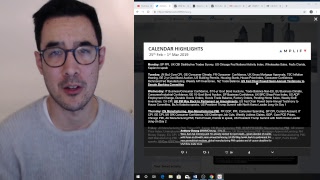
In this live Sunday‑night briefing, Anthony Cheung greets a roughly 30‑person audience, explains the purpose of the session as a pre‑market roadmap for the coming week, and then walks through the key macro and technical drivers that traders should watch. He starts with the latest Brexit headlines – a delayed vote by Theresa May and the EU’s suggestion of a 21‑month extension – and interprets how these developments could affect sterling, outlining specific GBP/USD price levels (support around 128‑130, resistance near 131‑132.5, and a longer‑term target around 132.5). Cheung then shifts to the United States, highlighting the Fed Chair Jerome Powell’s semi‑annual testimony before the Senate Banking Committee (and its repeat before the House) as the week’s most market‑moving event, and discusses the dovish tilt in recent US data (weak retail sales, poor manufacturing) and the implications for rate‑cut expectations. He also notes the US employment calendar, pointing out that ADP data will be released early and that the non‑farm payrolls report has been pushed from the usual first‑Friday schedule to the following Friday (March 8) due to a government shutdown. Throughout, Cheung offers practical trading guidance – when to be conservative, where range‑bound moves may occur, and which technical levels to watch for breakouts or breakdowns – and invites live questions via the chat moderated by Piers.
Chapters
Okay, testing out. Getting a bit of a buffering on my end. Let me know whether you guys can see and hear everything okay or not. Am I coming through? Testing 1, 2, test. You want to type something in the chat? On my side, I'm getting constant buffering at the moment. I've checked my internet speed. Looks okay, but I just wonder whether or not you can see me okay. Am I moving all right, or does the screen keep buffering at this point? Okay, Will, Dennis, John, Joe, thank you everyone. We'll probably give it a minute or two, wait for everyone else to come into the room. But just while we're waiting, can you see everything okay is the main thing. I'm going to try and get this up on my phone now, actually, just as a test. Just bear with me. Let me see if this is all working okay, and then we'll get, we'll get going with session. We see if this is all working okay, and then we'll get, we'll get going with session. Okay, it seems okay. Vincent, Warren, Kevin, hello, good evening. Okay, seems like it's coming through okay. Give it one more minute and then we'll, um, we'll get going. Hope you guys are well though. Have you had a good weekend? Hope you've enjoyed the sunshine. And thanks for joining us, Liam. Hope you're well. I haven't watched any rugby this weekend, but presumably I guess Ireland must have been playing. How did they get on? Okay, Nick from New Zealand. Hello. Okay, Piers, thanks for joining us. Can you see everything all right? Um, it's a good job Piers is in the chat at the moment, so Hopefully while— when I get going in a second, hopefully he can also man the chat. So any questions that you've got about anything I'm covering, anything about what's happening this week, anything about Amplify in general, then obviously Piers is in the chat as well. And for any of those who haven't joined us, that chap there, you can see the one, the only person with the photograph apart from Rez, he's Amplify's head of trading. And so obviously very well placed, of course, to talk about Amplify or answer any questions you might have. Okay, we've got about 30 people in, so well, let's get going. Let's talk about a few things then. So let me just flip my screen. How this probably works easiest is— the real reason for doing this is that I got a lot of feedback from our traders, and they were saying that As much as Monday morning's great to get a bit of an update, what would be really good is to use a bit of downtime on a Sunday night, which is typically quite quiet for most of us, to just kind of get ahead in gear after a relaxing weekend and think about what it is that we've got coming up. So if you follow me on Twitter— if you don't, then here's my handle— @awmchung. You just search my name, actually. I think I come up as the first hit. Now, what I do at the weekend— some of you already know about this, but for anyone new joining us— is I post this kind of summary of the week ahead. Now, I always do this kind of by religious practice, if you like, on a weekend. It gives me a really nice feel for what it is that I'm expecting for the, for the upcoming sessions. I think what's really important for you guys when you're, when you're trading, for me when I'm strategizing, is about— I want, I want to give myself is a bit of a roadmap of where the peaks and troughs of market activity might occur. You know, a classic case might be there's a really big event at the end of the week, and so already you know that it's quite possible that perhaps the market will be fairly quiet through the beginning of the week. Perhaps there's a US bank holiday on the Monday, as there was last week. And so with no major scheduled events or no big kind of macro, uh, events happening, if something really big's on a Friday, well then you know that it could be quite range-bound. It might be more prudent to be more conservative with your trading strategies and then waiting really for the pivot point to come on the Friday. So this is why I like going through this, um, at the weekend already. What I like to do is kind of visualize what I think that the week is going to entail, where the key points are going to come, and as a consequence then just to have a quick look on a slightly longer time frame at some of the charts for potential areas of significance from a technical perspective. Now for Sunday night, probably I'll talk more about the fundamentals and just talk over really this calendar here in more detail, my thoughts thoughts. But on Monday, of course, Sam will come on and he'll give you a full technical analysis overview as well. So let's kick things off then. Monday, it's as per usual. This is nearly always the case on a Monday. And Monday, the calendar is pretty quiet. Um, nothing really major is coming out. Probably the only thing of real significance is going to be, uh, Fed's Clarida and Kaplan are due to speak, Federal Reserve Board members. Probably the biggest thing actually when markets open in a couple of hours, electronic trade, is going to be some Brexit news which has come out over the weekend. So with that in mind and just given the timing of things, let's just jump straight into that. Now there's two headlines really to be aware of with Brexit that have come out today. So this is the first one: May delays Brexit vote to buy time as ministers threaten revolt. Now actually, I feel that this is absolutely completely as expected. What this article is basically talking about is we're supposed to have on this Wednesday, February 27th, Theresa May coming back to Parliament in order to— well, she's failed so far to bring back a meaningful vote ahead of this point. That's unlikely to happen. Now the schedule was to go back to Parliament this Wednesday for new amendment hearings or motions to be voted upon for the next best course of action for the government. One of the key ones of this, of course, was Yvette Cooper and Oliver Letwin, I think his name is, from the Conservative Party, who have teamed together essentially to talk about this plan and cross-party support to eliminate the risk of no deal. This was something which failed the first time and now coming through the second time is likely to get a bit more popularity as the timeline obviously to March 29th gets smaller and smaller. Now, what this article is suggesting, and I think this is absolutely in fitting with what my expectations were, was that Theresa May has confirmed she won't bring a new divorce deal back to the House of Commons for a final vote this week. So we already— there was a very small chance that that was going to happen. For me, as we've talked about in the morning briefings again, again, um, there's just even Although it seems awfully scary that nothing's been done and we're only literally days away from a no deal possibly, there still is time, and as long as there's time, politicians will push this right to the 11th hour. And I think that's just what's happening here. So instead, Theresa May is asking already skeptical members of Parliament to give her more time to renegotiate, promising they'll get a vote. So basically, she said on Valentine's Day 'Let me come back on February 27th.' February 27th is this Wednesday. Now she's saying, 'Not Feb 27th, give me until March 12th,' 17 days before the UK is set to leave, obviously, the European Union. Um, again, I think this is, you know, pretty much to be expected. I don't think this is the bigger story of this weekend, and actually I think the bigger story of this weekend is this one: The EU considers 21-month delay if May can't get Brexit done. So this actually is quite interesting. So we've got here, the European Union is considering telling Theresa May that if she cannot get her Brexit deal through Parliament and wants to delay the departure date, the country will have to stay in the bloc until 2021. So that's extension of 21 months. Now originally they've been talking last week about a 3-month extension towards May in order to get ahead of the European-based MP elections that are happening, I believe, in June. Now they're saying— and Europe obviously will want to tie in— well, think about this two ways. If Europe can get Britain to commit to departure not happening until 2021. Imagine what this is going to do then over that period of time. Not only will the Brexiteers be highly frustrated, annoyed with this outcome, but it probably gives the more Remainers or people like this new Independence Group more time in order to stop Brexit essentially. So I definitely think that this would be a If that was the outcome, this would certainly be a relief rally in the pound, and you should see sterling appreciation on the back of that. That was an idea. But I think when we reopen for trade, could well be the case that you do see some moderate pound upside, because this is the first time that I've heard such a punchy, um, number put on the table— a 21-month delay if she can't get Brexit done. That's tying in the UK for such a considerable period of time that it eliminates any of that kind of tail risk of the economic consequence of a no deal for sure. Nick, you've just posted in— well, let me see if I can bring this up. BBC News have an article as well talking about Prime Minister May could signal taking no deal off the table, you know, and that is basically one of the contentious issues that she'll be facing this week. So again, this is the Bloomberg article. BBC running, it looks like, something very similar here. Let's see if we can— if there's any immediate headline to hand about this other one. But yeah, what Nick was saying was that BBC reports UK Prime Minister May could signal taking no deal off the table. So I think that, that's the one that you've got to watch on Wednesday. Although Theresa May will probably most likely get asked to continue the negotiation until March 12th, the point being is that this idea, the seed now is out there of potential, a long-term extension. And now if that Cooper Amendment did go through and we eliminate a no deal, and that stops then the kind of growing resignations where we had Tory members in addition to those Labour splintering of the party, uh, forming this independence group. She's going to be very mindful of having to want to counteract that. So here's a look at Cable. Where are we at the moment? Well, 130.71, pretty mid-range actually from some of the, the extremity of the high and the lows, uh, from last week. I mean, last week we saw a really powerful move actually right at the— what would have been Tuesday when we shot higher. I'm not forgetting some dollar movement as well, a pretty sharp degree last week. Deterioration of quite a lot of US economic data saw some volatility there. But going forward, I think, you know, come Wednesday, although there's definitely no resolve yet for what she's going to do, the point being that if no deal is removed and now it— what could be the case of being a very long protracted Brexit deal, then that's got to be favorable for the upside. Now, near-term price targets, well, you've got the high that was seen on Friday, which is just short of the 131 handle. Going to be looking up at around kind of this area here would be particularly interesting. So kind of here, that being, uh, the previous high that was seen, what, last Thursday, with the trend line going back from the end of Jan. And also what it touched briefly on the 20th. Uh, breaks higher then do start to bring into question a reversal and move back up towards the high that was seen in January. I mean, the peak of that price activity is basically 132.51 on a longer time frame. So on the 90, yeah, 132.50, that January peak puts us up here in the bigger perspective. A move above that point then will start looking to target and challenge up around the kind of Q3 area of 2018. So that would be pretty punchy on, on the week, I would say. That would be in the most bullish setup. Obviously, if that no deal is not eliminated, then any retest down lower, I'd probably be looking at this descending kind of trend line to the downside. The other obvious targets being down what would have been Friday's low from the current price action, just up the 130 handle, and then further down towards the 128 handle. So yeah, that's kind of the Brexit story. Um, so actually, come the open in a few hours' time, electronic trade, it could be quite interesting to see whether you get a bit of a gap up of sorts in the pound on the back of that. Particularly that latter point about the extension of being 21 months. Tuesday then, let's move through this calendar. Uh, what else have we got? So highlights, definitely, definitely the highlight on Tuesday, US Fed Chair Powell giving a semi-annual testimony to the Senate Banking Committee. So for any of those new to markets, um, this is outside of the 8 interest rate decisions that the Federal Reserve hosts every year, the, the next most significant platform where the Fed Chair speaks and gives a direct insight to monetary policy thinking and the kind of reflection then of what the Fed think about the economic activity at the moment, then this is it, the semiannual testimony. Now this takes place over 2 days. Now, as you can notice on the calendar here, you have on the Tuesday Powell speaks in front of the Senate Banking Committee. Then on Wednesday, you can see here the semiannual testimony is rerun, however, to the other chamber of Congress, the House Committee. Now, first things first, the reason why I've underlined and bolded the first, not the second, is because the first and the second event are exact repeats, just to different politicians of the different chambers. So the first one is always the market-moving one, the latter one isn't because he just repeats what he said before. Now, a couple of broad stroke rules with this. One is, from an economic or monetary policy point of view, the data in the US has been very weak of late, super weak. And that was kind of personified in things like last week, the retail sales data was an absolute disaster for, for the US. Philly Fed's manufacturing was way below expectations. And so lots of these economic indicators being particularly weak, which gives plenty of support for that understanding of why the Fed have turned so much more dovish more recently. I guess given that this will be the latest point of where we're at at the moment, any more updates onto the balance sheet runoff, when exactly is that going to, to stop, this idea then about the fact that interest rates in terms of federal funds, short-term interest rate futures are actually pricing in a rate cut this year, even though the Fed, on their official projections which were issued in December, are still saying they're going to do 2 rate hikes. We know that's basically going to be absolutely taken away come March meeting. And so here we're looking for how much risk do they see, how dovish are they becoming, how worried are they about external, uh, effects. Things like the trade war, although that's looking quite positive at the moment, how much risk can they take with just taking that on board at this point? Or with the economic situation, is that now taking precedence? If it is, well then US economic data in itself starts to take on a bit of a whole new realm of importance. So that's going to be really key. What typically happens here is the semiannual testimony, it's usually either 1 or 3 there's pre-prepared text, it hits the Bloomberg terminal, all the comments come out, and you see an immediate reaction on the back of that. So it's kind of like a traditional tier 1 release in that sense. Then Powell will give the speech live, but by that point it's redundant because you've already seen it on all the major newswires or Twitter. And then he gets questioned essentially by everyone on the Senate Banking Committee. And the whole event probably lasts anything from 4 to 8 hours where he, he— it's a bit of a mockery really. It's the politicians just basically having a bit of a go at Jerome Powell, what used to be Janet Yellen, asking really quite irrelevant questions when it comes for us as market participants for its impact, maybe what it might have on monetary policy. They come at it a much more political angle in order to suffice their needs rather than that of something that could be market moving. So that's a really big event. That's actually one of the biggest events that's happening. So it's going to be in the afternoon on Tuesday. Going forward into Wednesday, um, and then guys, any questions you have as I go through, absolutely drop them in the chat. Piers is there and he can pick things up as I'm talking if you have anything specific, uh, while I'm just going through. So Wednesday, um, what else have we got? So I'm just looking. Obviously we've got US ADP employment change because obviously the change of month kicks in and we start to go into March. But ADP, it does come out actually earlier than normal because non-farm payrolls— there's one thing you'll notice here that Friday is the 1st of March. Now traditionally, non-farm payrolls comes out the first Friday of the month. Not this time. Payrolls comes out on the 8th. I've already checked this on the Bureau of Labor Statistics website, the BLS, uh, just to confirm it. This often does happen. Just think, in the US you've got really a couple things that we're trying to tackle here. You've had a government shutdown which has delayed quite a lot of the BLS's data anyway, so they're playing a bit of catch-up. You've also got the first day of the month is a Friday, and sometimes there's not enough time to accumulate all of the data. And so lots of different things meaning that Nonfarm Payrolls actually has been delayed. It's not coming out until next week. Does
More from Anthony


Inside the Biggest Banking Stories You Need to Know This Week (Anthropic, Diageo, Private Credit)


Inside the Biggest M&A Deals You Need to Know This Week (UniCredit, GameStop, eBay, Eli Lilly)







AI Breakthrough or Hype? Anthropic’s Claude Mythos, Tim Cook Steps Down & LIV Golf Collapse