The Most Important Thing That We Have Learned After 20 Years of Trading
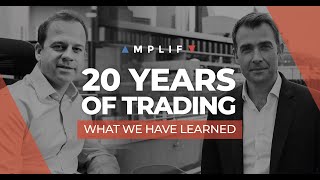
Will De Lucy and Piers, co-founders of Amplify Trading, discuss what they learned from 20 years in markets. They started at Goldenberg Heymeyer, where new traders spent three months locked in a room before being judged on survival. Psychology and resilience matter more than technical knowledge; they built Amplify to teach that.
Chapters
OK, good evening and welcome to the latest masterclass on Amplify Live. So this is a weekly format that we do. We get guest speakers in from industry, have some really great speakers. We get members of the team to go through very specific stuff in an interactive weekly format. But I wanted to change it up a little bit this time, so I've I've got two probably quite familiar faces, Will and Piers, the Amplify Trading co-founders, and wanted to take a bit of a different approach to the next 45 minutes or so and not go into anything really technical on trading specifically, although definitely we'll talk about that. But I wanted to talk a little bit more informal. Amplify was founded in 2009. It's gone through a great deal of change. And even since I joined in 2015, And so I wanted to just strip it right back, go back to the beginning. How did it all start? A little bit about your guys' kind of individual stories, how you came together, what's happening now, and what do you guys see for the future. So with that, I'm going to start with something that might come as a surprise to maybe one of you, because one of you supplied me with some material, which is this. Where was this? And have you got a time machine? Because what year is this?
It looks a lot longer ago than it was. So that was in Canary Wharf. We're obviously trading for Canary Wharf back really from 2000 onwards. And this is under the trading floor where there was a bar. And yeah, this is everyone that we were trading with. We're trading with Goldenberg, Heimay. You can see one of the chaps there on the left in a rugby kit. And then Piers is there just above the guy with the cap. So, uh, yeah, is that you?
Is that— yes, it is.
You know, it's obviously a coincidence that Piers and I, our paths crossed. Um, I think Piers's approach, uh, to securing a career in trading was a bit more structured than, than mine. Um, so to cover mine, I mean, finance student, economics, always liked markets, um, and was able to, to secure a role with Goldenberg as a futures trader in the bond market. A pretty harsh interview process, but I was put in what we call the fishbowl, which was just, if you like, a room with all the other candidates that were taken on at the time to try and learn about, you know, trading and how to trade the yield curve, how to trade across fixed income products. And Piers was in that same room, and it was, yeah, the way one of the big reasons behind starting Amplify was about that initiation really, is you know, we were thrown into a room, really the door was shut for 3 months, and they went, Schatz, Bobbel, Bund— that's 2.5, 5-year, 10-year government bonds. They all kind of work in the same way. Here's a bit of money, door closed, good luck. And the door was opened again in 3 months' time, and you could see who survived and who didn't. And it was a pretty hands-off way of developing someone. I think that really sowed the seed for, you know, almost a decade later trying to start Amplify and get things going. Piers, the way you got to JH was a bit more structured though, wasn't it?
Well, yeah, I mean, I started a mechanical engineering degree, so I'm a non-finance student who, you know, my degree taught me that I didn't want to be an engineer. I was at a London uni, we were being courted by the big banks who were really keen on hiring engineers and science and maths, and as they still are, these subjects are great for anybody who wants to get into finance. But so yeah, I got wooed by the banks. I applied to all of them and got rejected from all of them apart from one. So I got a job at HSBC. So I joined the HSBC grad scheme started in their asset management division, essentially. And anyway, I kind of, as we say to the students that we work with, we work with so many students these days, you know, I was definitely in the category of I didn't really know what I wanted to do. I knew it wasn't engineering and I knew it was finance, but I didn't really know about this world of finance. And it really took me getting into the world of finance to then say, all right, okay, this is what, this is how it works. Oh, there's these kind of jobs, all right, fine. And it was only then that I realized actually trading That's me. And so I was quite impatient. I could have stayed at HSBC and transitioned internally to a more trading role, but they told me it would take 3 to 4 years before I'm running and managing my own book. And I was like in my early 20s, 3 to 4 years felt like a lifetime. And I was like, fuck that. So I started applying for trading roles and one was Goldenberg Heymeyer and yeah, joined. And Will DeLucy was there with that, there were 15 of us. As Will said. And yeah, it was a bit like, it was a bit like a grad scheme, just with none of the training. Um, and as Will said, there was a room, as we called the fishbowl, but there was a big trading floor with all the traders, and then the side room was for the newbies. And the newbies weren't allowed on the trading floor, and it was very much separated and shoved in there. And then open the door 3 months later, right, which of you lot have got what it takes? Okay, here you come. Into the trading floor, take your seat. And I think in that it was a weird little bubble, such a sort of almost like a parallel universe in that fishbowl because we were all in it together. It felt more like a kind of student union at times.
Yeah. So what was the— I mean, people watch films nowadays and they, you know, the world has moved on from probably where it was in late '90s, the kind of transition from the screens to the floor or from the floor to the screens. So what were the characters like back then? Was there anyone that stands out? I know some of them.
I know what they were like. And it was, yeah, I mean, it was so interesting because you had a real sort of clash between, you know, because this was screen-based trading really took over from the live floor just before we started. And obviously the characters that did well on the live floor, so that was open outcry, hand signals to trade futures just off Cannon Street. Big guys, burly guys, East London lads, you know, the more you could shout and the more you could boss your physical space, the better. And then when we moved to screen-based trading, you know, then the companies were looking to hire more graduates. So there's definitely a bit of a clash there, but I, you know, the characters, I mean, it was a big change in the financial markets. I mean, I I thoroughly enjoyed it. And actually, I know there's that new show on TV at the moment, isn't there, that's talking about the trading floor for new graduates?
Industry.
Industry. There's— so I think in industry, those new grads have it very light compared to how we had it. Right. So an industry doesn't even touch the sides. It was brutal. On the trading floor there with the clap. But I— it depends who you were. I mean, I really enjoyed it. I mean, I got, you know, called everything under the sun, as did everyone else. Everybody got it in the neck all the time. But I think if you found it, you know, you could take it and laugh about it. It was good fun. There became a point— sorry, but there became a point though where, you know, it was no longer good enough for who were the characters that were performing well in the futures market. You It got to a point that actually, no, you really needed to know your stuff. You really needed to understand how things work. It wasn't enough now to boss prices and move. You had to understand the fundamentals. You had to understand what was going on. And that's where I think there was that sort of sea change of people, which also created the change in culture. And a big thing about Amplify is actually really knowing how can you— it's really important that you understand the products that you're trading. And I think that's what— we felt certainly wasn't there in the institution when we started, something that we wanted to address.
So going back to just the Goldenberg days, just to wrap up this part of the conversation, when you went into that room, that side room, there's all these new faces and you go in there and you're with each other for 3 months, you said. Would it be quite obvious to see quickly who was going to make it and who wasn't? I mean, how much can you tell someone can trade? I mean, is it, is it quite clear early on, or is it something that you— it just happens over time? Or what was your experience of that with others?
I think, I think you have to see people trade live with real money, right? Otherwise it doesn't count. It just, it's vastly different. One of the reasons why obviously on our program, we want to back people even with only a small amount of money first. It has to be real. And yeah, I think the way that you could tell who was going to be able to do it or not, and I think it's still the same now is how people deal with failure, not how good their updates are and not how, you know, whether they've caught a perfect trade or their technical analysis or their fundamental knowledge. It's just how candidates would and colleagues would deal with a poor result. I think you could start to see that, and those that would take it incredibly personally and then start— so, you know, you'd see physically their shoulders drop and, you know, their And it was almost like a self-fulfilling result after they'd taken a loss. And I think, again, a big thing behind starting Amplify is, can you better help someone in their self-awareness to address those issues? Because I think everybody can do this, but it needs to be in their own way. And it needs to be with an understanding of who they are. And I think certainly when we were going through that initial training, that was just left. You either did have the resilience and self-awareness or you didn't.
So the background of these collection of people then was quite different. And then therefore, is there a stereotypical person that's made for trading or is it more complicated than that? And actually there's a lot more to it and anyone could enter this with the right training.
Well, I think at that time, let's timestamp this by the way, you haven't mentioned this was like at the end of 2002 when we we joined Goldenberg together. In that group of 15, just trying to think now, were there 3 or 4 females, I think. Is that right, Will? And then the rest were males, obviously heavily male, which is unfortunately still the case in the industry today. People at the big banks are trying to resolve their diversity issues, which is something we might touch on later because we're helping them do that. But so certainly heavily male. Then you've got lots of different backgrounds. Some had been working like myself. Some had just come straight out of uni like Will. You had different degree types, you have people coming from arts, you know, I was engineering, Will was like economics. You had people, they were recruiting people that had a good sort of successful sporting background coming through school and university, so sport was something they were quite interested in. And then, and so I guess the point is they, and it's true today, it's almost impossible to know from a CV or from an interview even whether someone can trade or not. I'd say it's impossible. And it's also not the case that you've got a stereotype, okay, if you studied this and you're from here and you're good at this and this, then you'll be a good trader. It's just not true. So they kind of— they were experimenting to an extent. They just bunged a load of people together from lots of different walks of life, and it's like, right, get on the trading platform then we'll see. And that's because in the end, it just comes down to, you know, it's definitely a psychology game. Anybody who's traded knows that for sure. And so how do you know if someone's got that psychology, that kind of resilience? And you can't, you can't know that until you put them in a situation that tests it. And, you know, financial markets to do that is—
I think it's quite relevant, uh, facts that, you know, one of the reasons why you know, we were sort of one of the last two standing of that group, obviously, of that original group, but actually had almost opposite trading styles, right? Our trading styles are opposite because our personalities are very different. You know, Piers thinks the way that I would trade is really quite random without, you know, process and control, and I think the way he trades isn't entertaining enough to suit my activist nature. So, you know, it I think what was quite interesting is as we were going through our careers as traders is having a mutual respect for each other's strengths and weaknesses and being able to then grow more as a partnership together. And I think, I think that isn't just true for our trading at Goldenberg, but something that's showing through with Amplify as well.
And just before, because I definitely want to talk about Amplify, because as I said, even since I joined 5 years ago, it's evolved immensely over that time and Just to wrap up this kind of trading-specific element, to talk about you guys specifically and about your personal development on that side, two questions here. One of those is, has your trading style changed over the years? And if so, how? Is the first one. So if we go with that one first before I present the second.
Yeah, that's a good question. I think it has to change. Well, yes, to a certain extent, yes, because markets change. So the way that markets behave, the way that price behaves, that market functionality has changed. And certainly in our lifetime, because we went from 2002 where there were no algorithmic trading systems, for example, to now 2021 where, you know, the market, you could say, is almost dominated by them. And I think when we started out, we were using a strategy that was very much geared around the inefficiency in the relationship between correlated markets. And you, you could say it was easier back then, but then if you look at the stats of how many were successful, then actually that would suggest it wasn't easier back then. But because like for Will and I, there were 15 of us, and basically a few years later there's only 3 left. And so they keep the 3 and then they bin the 12. And so you work out the percentage success rate from that. But yeah, back then in the day it was inefficiency. Like we were trading the 2-year, the 10-year, 5-year, and the 10-year bonds, and they were— they had a relationship. And like, literally, sometimes it was as easy as, look, one goes up, okay, buy the other one, because that needs to go up as well because it's correlated. But it doesn't go up straight away. Like, nonfarm payrolls is a good example. You know, back in 2003, you could pay— you could trade nonfarm payrolls like this. Wait for the number. Oh, okay, that's better than expected. Okay, buy.
Yeah, great.
And then the market goes up.
Great, great.
There's a profit.
Great example I have of that is, so the Squawk desk I worked on before the company existed, there used to be an internal analyst desk for Refco back in— it started actually in '99, I think. And the guys used to have pagers, the analysts. And at Bishopsgate, just Liverpool Street Station, there used to be, um, a pie shop, basically pasty shop. So you could obviously— traders are just there picking out all the time. And so they used to go down and they said they'd get an alert on their pager outside the entrance to London Liverpool Street. They had enough time to make it back into the building to the third floor, squawk it, and the market still have time to trade it. This was back in '98, '99.
Oh right, I mean that, that, yeah, that, that, and now it takes a microsecond. For the market to react, right? So that, that's an obvious example of how things have changed. So if the strategy I was using in 2003 is completely obsolete now, so you have to evolve, and that's about your understanding about markets and the fundamentals and how things are shifting. But at the same time, I think the upper half of your ability to trade isn't actually about your strategy, it's just about you, and it's about how you take risk, and are you able to take risk, and are you able to manage that, and are you able to deal with those those ups and downs. And I'd say that's more than half of the game, more than half of the battle. Yeah.
And so on that, the final thing, question here is, and I think would be a useful thing for people to hear from you guys and your own experiences, obviously trading entails loss on a regular basis. So how did the losses in terms of P&L impact you at the beginning to how now 15, 20 years later? I know you guys perhaps not so active intraday, but you're still skin in the game. How do you deal now with loss compared to how you did 20 years ago? If you were going to meet the 21-year-old you, I think, I think that's a really good question.
In fact, I was giving a psychology session today to our newer traders talking about, you know, using failure to improve and to progress. And, and I think failure is incredibly important to get better at anything, right? If you're the type of person that can fail and can review and reflect. A couple of things I'd say about this. I don't think you can change who you are, right? We're all too old and ugly enough to change your personality, right? At your core. So at my core, I'm quite an emotional person and that's never going to change. That's just, just, just who I am. I think what happens as you get more experience is you are able to manage and deal with it better. So I think on this one, me and Piers are very different. I always find that Piers, you know, you, you could never tell whether Piers was having a fantastic up day or getting ironed out. But, you know, someone in the building next to me would know whether I was having a good day or not. Just different ways of dealing with it. I think what changes as you— as I find you get— when you start trading I think you see, certainly for me anyway, I'll see every mistake, every poor trade, every, every trade that got stopped out, or whatever you want to— how you have— what you want to define failure. I would see that as absolutely critical and detrimental to the long-term future. You know, it was almost like the, the ups and downs were wild, right? Because I was right in the moment, in the present. This trade had to work, then this trade had to work, then this and it was so much more intense emotionally then. I think what's happened as you more experience, you know, you realize that if a position goes wrong or an investment goes wrong or trade goes wrong, it isn't the end of the world, right? You can deal with it if you can trust yourself to do the right thing should something go wrong. Then it really smooths that type of roller coaster, and I think that's the— been the difference for me. I still emotionally feel the same when a position goes wrong, that doesn't change. But I feel much more able to sort of smooth the impact that it then has on my forward decision-making.
Yeah, I mean, you said I, I, you wouldn't be able to tell if I was making money or losing money. I mean, that's, that's, I've heard lots of people say that, so I guess that's true.
But you're just, you're moody all the time.
Well, I, I was going to say this, I was going to say internally I'm feeling it, but I guess I show it— well, I don't show it, right? So I internalize everything, but it doesn't mean that it's not hard to— you still got to deal with it is what I'm saying. And I guess the way I would do it is, you know, I would have knowledge that I've traded really well in the past. And then in the past, that might be last week, it might mean last month, it might mean 2 years ago, right? Because I've got some experience now in this this is why experience is so valuable. I know I can do it. I know I can definitely do it. But I also know that sometimes it's not going to work out. And those days where it isn't working out, it's like, all right, well, let's get this in perspective. It's not the case that I can no longer do it. If I'm riding my bike and I fall off, doesn't mean I can't ride a bike anymore. So that getting into perspective is key, but that can be really hard if your kind of— your emotions are on fire and inflamed and you're angry and you just can't think logically. I also think, especially for younger people and like coming into the industry, not necessarily trading now, but generally young people trying to get into the big banks, for example, to start their career, I do think that failure is really valuable and often something that younger people haven't experienced before, especially if they're successful sort of academically. Let's say they did well at school and I don't know, they were in the sport team and then they got the uni they wanted and they got their 2:1 and what have you, and it's kind of— life's going really well. Well, actually, that's not necessarily a great thing to prepare you when it comes especially for life on the trading floor where life is just— it's not going to be plain sailing.
You're definitely going to get some That goes back to the point is when, you know, we can't tell a good trader if all they've ever done is make money. Yeah. Do you remember, Anthony, on the trading floor, you know, you'd get someone swagger in— actually, sometimes it would be me— after having like 5 good days in a row, head like this, and we're all just, we're just waiting for it to, to, to go wrong.
Well, you know, the stat is Michael Jordan got cut from his high school basketball team and it worked out pretty good for him. So exactly. Let's move on then to a different chapter. So you guys have kind of cut your teeth at Goldenberg, had a few years trading at a big prop firm, and then, I mean, by the sounds of it, you'd identified there's a— it's kind of a lack of structure to perhaps the way that they were going about this. So I know that there's an interesting story as well about involving New York and, and so on. So why don't we talk about then the inception of Amplify as an idea, and how did it start?
Well, it's interesting you mentioned New York because I think that goes back to like a bit of a fundamental point here. Coming from a trading background, both me and Piers, although very different personalities, different people, but both comfortable with taking risk. And I think that's really important to establish when we talk about the starting of Amplifyers. So for example, when you said New York, the reason why I went over to New York— this is January and it's, you know, going back to 2009— was because we thought that was where the bigger opportunity was. So it's like the complication of moving families and moving life and everything else, well, that comes later. So we said, right, go to New York, start office searching. And, but, you know, we're just looking at options. And that was dead set until we got the opportunity for the office in Canary Wharf in London, which then sort of was too good an opportunity to miss and changed everything. But yeah, it was interesting with starting Amplify. I think, look, going, if you imagine markets at that time, right, they were changing. Changing in the way that we were trading in terms of spread trading across government bonds. So that was— the environment was changing, the markets were changing, and we thought there was more of an opportunity here to— after you've been relying on your own proprietary trading in that way for so long, I think it really— we really thought we've got something quite valuable here, thinking about what we've learned, thinking about what was missing from how we were developed. So we took the plunge and took the opportunity, and then it was just— me, Piers, just me and Piers in a large office to start off with. Um, I started to fill out that team, but I think one of the crucial things was, is obviously markets were volatile, there was a lot going on there in the news all of the time, and that created a good platform for us to create a name as a very credible provider in this industry. I think anyone in this room and anyone watching, you know, you know that there's a lot out there in terms of supporting people in making trading and investment decisions that is far from credible. And it was actually, you know, the same— it was still there in 2009. I said, well, there's a really— there's a— there's an opportunity here to set ourselves up as something that's meaningful and provides great value to bridge that gap, the theory-practice gap in finance, number one, but also to help people find what— how can they perform in this environment of uncertainty and risk. And it really kicked off with— then we won our first corporate contract with HSBC not longer after we started because it took It turns out it wasn't just us at GH that had realized there are these gaps that exist. Actually, a lot of the world's largest financial firms still have these issues that Piers has mentioned. How do you know whether someone can do the role until they've done it? How do you get someone desk ready for the job until they've done it? How do they even know that they want to do the role that they've applied for until they've done it? And it all came down to this sort of practical approach to training. So I think one of the best things that happened with us in 2009 was We started to win contracts with HSBC, Credit Suisse, Morgan Stanley, did a lot of work with JP Morgan. And establishing that quality of practical training and experience, I think, was really the bed that led to everything that Amplify is now. And I think this is where we are now. Just to talk about what's happened in the last couple of years, obviously, we've got 3 different areas of specialization. We've got Amplify Live on the trader side with you, Anthony Cheung, Amplify Me, where we, you know, make a big impact to students' lives, helping them find their, their finance career. And then we've got all of the corporate clients that buy our, buy our technology. I think what's happened in the last year is a bit, you know, we almost doubled our team in the last 12 months during COVID because we responded to everything moving online and we responded to the demand for the training technology. And yeah, it took a big investment and it took a big risk again at a time that it was hard to take risk. Actually, the last 12 months has been hard to take risk if you start, you know, looking at the news and thinking about what potentially could be. But the opportunity was there, and I think it's, you know, it's a profound change in the last couple of years now. And I think actually we've been able to use COVID as a catalyst to do a lot of good. That now actually seems, you know, should have happened. Anthony, you might not realize, but when we started from the Canary Wharf base, actually it was all online back then. It was only when we got the trading floor opposite the Bank of England that we started filling those desks, filling the seats. So it's come around in a circle, to be honest.
More from Anthony


Inside the Biggest Banking Stories You Need to Know This Week (Anthropic, Diageo, Private Credit)


Inside the Biggest M&A Deals You Need to Know This Week (UniCredit, GameStop, eBay, Eli Lilly)







AI Breakthrough or Hype? Anthropic’s Claude Mythos, Tim Cook Steps Down & LIV Golf Collapse