The Trading Week Ahead: 11th-15th Feb 2019
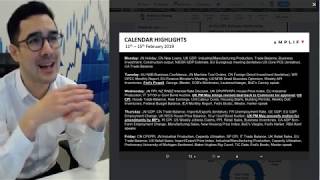
In this live market briefing, the host (Speaker A) provides a macro‑economic calendar and risk overview for the week of 11‑15 February 2019, followed by a technical market scan from Sam North. The macro segment covers the return of Chinese markets after Lunar New Year, the resumption of US‑China trade talks (including the Vice‑Premier’s meeting with U.S. Trade Secretary Lighthizer), and the impact of major holidays such as the Japanese holiday on market liquidity (noting a recent mini‑flash‑crash in the Swiss franc). The week’s speaker lineup is highlighted – Fed Chair Jerome Powell, ECB hawks Jens Weidmann and Sabine Lautenschläger, Bank of England Governor Mark Carney, and UK political events (Eurogroup, finance‑minister meetings, Brexit negotiations, UK GDP, retail sales, CPI, PPI, RPI). The briefing flags a looming U.S. government‑shutdown risk tied to border‑security funding, and its possible knock‑on effects on U.S. data releases. Commodity updates include a bounce in WTI crude after a refinery fire in Illinois, a rise in U.S. oil rig counts, and record‑high Chinese iron‑ore futures driven by a dam disaster at Brazil’s Vale. The host explains the upcoming SOMA “liquidity‑shrink” day, where $40 bn of Fed‑held bonds mature, potentially boosting the dollar and pressuring equities. The dollar’s 7‑day winning streak is linked to dovish Fed communication, global central‑bank outlooks, and safe‑haven flows amid Brexit and trade‑war uncertainty. Sam North then walks through key technical levels: DAX resistance around R1, oil trend‑line resistance near $53, euro and pound support/resistance zones, gold’s recent support around the 2019 high, and the Aussie/New Zealand dollar trend‑line tests. The session ends with a reminder to watch these macro and technical signals throughout the trading day.
Chapters
Okay, good morning, Monday the 11th of February. I hope you all had a fantastic weekend. Uh, week ahead, so usual for Monday morning, I'll run through the fundamental kind of view for the week. As you can see here, we've got all the calendar events to the side of me, which I'll discuss some of the key points of which we're looking out for. And then Sam North is going to come on and have a look at some of the levels from a technical perspective. So as per usual, just giving a quick overview of the week and a few take-home points before we get into the nitty-gritty of each individual thing. And first of all, Monday, China's back. So Lunar New Year holiday, they were out for the entirety of last week, and that did have a direct implication for kind of traded volumes throughout last week. And one very important thing was, although we saw a bit of a breakdown in the China-US trade situation. Really, that was put a little bit on hold given how kind of important from a calendar year perspective Chinese New Year is in that geographic region. It now means that those talks recommence. So actually, you've got high-level talks happening today, and then actually you get— then the, the main kind of key players will be speaking on Thursday and Friday. So an additional factor for these calendar events I've got listed here is is undoubtedly trade talks, progression, lack of, or can kicking. Those three scenarios could well be pivotal for the overall direction for the week, but certainly that's going to be back end of the week focus given, as I said, uh, it's the Vice Premier of China meeting Trade Secretary Lighthizer of the US. That's going to happen on Thursday and Friday. As of today, actually It is a Japanese holiday, and I read quite a funny comment from an interview from one of the NAB, which is an Australian bank trader, and he said on their desks now they have in big bold font letters to every FX trader: Beware the Japanese holiday. And why? Well, this happened overnight. We had a— I'd call this a mini flash crash We're talking about a percent move in the Swiss franc. This is just a drop in the ocean compared to, say, the 8% flash crash we had in the pound a few years back. But this is very typical, and the reason why that trader was making that comment was because whenever there's a Japanese holiday, you're essentially removing such a large portion of market participants that it's so incredibly illiquid. And what happened here actually was Well, what they're suggesting was there was a fat finger, a human error, of which then an algorithm jumped on the back of immediately. And just given the lack of bids and offers in the market, the market just accelerated, and within a couple of minutes we'd spiked the best part of a percent, only to then come all the way back down within a matter of minutes. So yeah, just something to be aware of. With these calendar holidays of major kind of trading hubs, Japan being one obviously quite key, and then China as well. When those markets are closed, you do have to be mindful of this type of thing if you were ever to be considering trading overnight. Um, going on then, looking at, um, the rest of the week, Tuesday, um, I've kind of bookmarked a couple things here. You can see with the bold and the underlined and and particularly I've got Jerome Powell. You'll notice here throughout the week you get a lot of Fed speak, and I think the Fed are very conscious of the fact that they've made this quite radical change towards communicating in quite a dovish way. And I think they're kind of massaging that into markets' expectations by just communicating and being as transparent as much as possible. So Fed's Powell though is kind of obviously the The Fed chair is going to be speaking on Tuesday alongside— you also get George Mester. Interestingly, then you get the kind of full suite of speakers because the ECB, you get Jens Weidmann and Sabine Lautenschlager, the kind of more hawkish-leaning members of the ECB. And then you've got Bank of England's Mark Carney. And obviously, it's always interesting to hear from the governor just in the context of where we are at the moment with this impasse with the Brexit negotiations with Europe. So very much a speaker-led kind of session across Monday, Tuesday. You can see here as well, you've got a tentative eurogroup meeting on Monday, and that's typically then followed by a finance minister meeting of Europe on Tuesday. So something else to consider. Wednesday and Thursday, then things start to, to get a bit more interesting from the Brexit side, but we'll get into that in a second about the details of what this means for, for Theresa May and her her kind of period going forward, um, to get some kind of solution around any movement on the backstop. We'll look at what the likelihood of that is in a second. But outside of that, you'll notice that from a UK economic data point of view, there's a lot of key things happening this week outside of the political kind of forum. We've got UK GDP today, you then get Carney speak on Tuesday, You've then got UK retail sales coming out later in the week. That'll be on Friday. And you've also got UK CPI data, PPI and RPI all coming out on Wednesday. So throughout the week, you kind of get not just a political but an economic update of, you know, what currently is the situation and how much of an impact is this, this current kind of uncertainty prolonged of what the outcome of Brexit is having as a real effect on the economy. We're about to find out in the forthcoming trading sessions. Other things that could be interesting, we get to the latter part of the week on Friday. From a US point of view, you've got retail sales, preliminary University of Michigan, and something we're going to talk about in a second. You've got another threat of a government shutdown at the end of the week. And we'll look at why that's happened and what the, the reaction effect could be. And then finally, from a data point of view, you also have as well some US data coming out later in the week of significance, um, from an inflation perspective as well. So US CPI is coming out on Wednesday. So they're kind of the main things that certainly I'm looking at. One distinct difference from this week to last is not only, uh, China fully back into the market— Japan will also be back as of tomorrow— but the calendar of events and risk factors is much more higher than it was last week. Last week was a bit fairly quiet from a scheduling point of view. This week we return back to normal, if you like. So plenty to go at for the week ahead. Um, okay, let's Continue then, a few things looking out for. This then, just as a reminder of the fact that with China back from holiday, the new round of trade talks begins in Beijing today. So as I mentioned, Robert Lighthizer and Treasury Secretary Steven Mnuchin will be meeting their Chinese counterparts at the end of the week on Thursday and Friday. And really, I think from a, from an equity direction point of view, from the dollar, pretty much all global assets. I think the outcome of these talks is, and will continue to be so, is really quite pivotal. So any rhetoric coming out of Trump tweets, any kind of source comments that we get, I guess it's going to come towards the back end of the week, could really be telling to see how from a slightly longer term, so from a week as a whole, where we end things. The point being is from a risk perspective, any progression to de-escalate the situation would be a read across as a real positive. But the most likely, and I think consensus is, is that they're going to agree to essentially keep talking, kick the can down the road, delay tariffs, and then we kind of muddle through. The worst-case scenario would be a complete breakdown and we just get confirmation that those tariffs are indeed going to kick in and go up as of the 1st of March, that would create then flight to quality. So probably then usual risk assets— gold would be supported, equities under pressure, so on and so forth. Okay, this is a quick look at the situation on Capitol Hill. So talks to avert a new government shutdown over funding for border security funding broke down late on Saturday this weekend. Democrats, Republicans at loggerheads over detention policies. And essentially, I think 9 specific federal departments will again shut down as of the end of the week if they do not make progression over the coming days. So again, from a practical point of view, this has knock-on implications for the release of US economic data. But from an economic point of view, and also political one. It's a return to the, the risk that we could see this dent short-term into US gross domestic product, but then also popularity of Donald Trump, given the fact we've already just come out the back end of the longest US government shutdown on record, of course. So something to keep an eye on. And not that I would expect then markets to all of a sudden be spooked and going to immediate kind of equity weakness and so on. But it's just another risk factor that inevitably at some point I think markets' patience will run out if we're going to go for this short-term stopgap funding for only a period of 2 weeks. At what point does the market turn around and say, you know what, this is just not good enough? Layering in then uncertainty as we get closer towards the end of March of a no-deal Brexit, if a lack of progress, economic kind of slowdown in Europe, and then you get the worst-case trade tariffs go up and they fail to find an agreement on the trade war side. It's kind of a perfect storm for a rerun then of kind of testing the Fed's hand from the— for the December sell-off. So plenty, plenty of risks elsewhere. And again, just covering off the headlines, uh, WTI crude, a little bit of a bounce off the initial lows. I'll let Sam Sam go through the charts obviously in more detail, but we're down about 50 cents at the moment. Quite a few people looking at two things. One, there was a refinery fire in the US state of Illinois at the weekend which resulted in the shutdown of a large crude distillation unit that could cause crude demand to fall. This— that unit is about 120,000 barrels per day at Phillips 66 Wood River, which is one of the biggest ones in that area. Baker Hughes as well, from a rig count point of view, which we look at at the end of every week on a Friday. So if you weren't around, that came in on Friday and showed an increase of oil rigs operating in the US. It went up for the second time in 3 weeks. I think they made an addition of 7 rigs, bringing the total to 854, pointing to further rises obviously as a knock-on effect or delayed effect in US crude production, which already stands at just shy of a record, just short of that 12 million mark. Just to add a layer of context for anyone who's not really that familiar with the numbers with US oil production, I found this chart here, and this is looking at— it's mapping the blue on the top, which is the level of barrels per day as US output as a total and as you can see, just short of that 12 million and currently is at a record. And then you've got the rig count, which obviously accelerated dramatically through the period of 2016-17 but has kind of petered out and plateaued, if you like, since, uh, I guess the second half of 2018. But just wanted to cover that just so that you're aware of these kind of rig count numbers and what is the pattern of the last few years. So it has started to level off but production has continued to move higher. Elsewhere, sticking with commodities, you probably would have noticed that China iron ore futures overnight, if you're reading any of the news this morning, is at a record high. This isn't surprising. It does come after a real issue faced in Brazil, which is the country's second largest ore supplier. This is Vale, the company. They had a fatal dam accident which killed 300 people recently. You've had another 500 evacuated within a similar area. And, and so overnight, this is as a byproduct leading to record iron ore prices in the futures market. Have a look at Brexit then. What's the current state of play? Well, actually, despite the fact that Theresa May is not going to bring forward a kind of meaningful vote— why? Well, that's not going to happen on Wednesday, which means we're going to roll into Thursday when we get the— we go through that process again of going back to Parliament. What's the state of play? State of play being she's made zero progress, which is absolutely, I think, to be expected. Europe not buckling as yet or blinking. And then as far as internally within Britain, although there's been some cross-party kind of appreciation from Theresa May from Jeremy Corbyn's letter about some willingness to discuss potential options, the fact is there's not a lot has happened. And so I think the base case that what we're expecting from Thursday is if the weekend's press is to be believed, is that Theresa May is going to ask for a 2-week extension to go back to Brussels to basically renegotiate on the same terms of the Brady Agreement, which was the legality on the binding element of the, the backstop. And then that will take us through, I believe, until the 27th is what's being mooted as the timeline then for her to bring back some kind of qualified deal with a concession that Parliament can then vote upon. So as far as this week goes, you're going to get a lot of media attention, particularly Wednesday, Thursday on Brexit, uh, the latter being when it all kind of, uh, peaks of interest. But I just think that there's not much— you're not going to get massive swings on the pound, I feel. Certainly, uh, the implied volatility I think will be much lower than it was when we had that vote 2 weeks ago, just given the fact that it's so baked in that all that's going to happen is Parliament will back her to give her a little bit more time. But obviously, from a bigger picture point of view, time is quickly running out. But such is, and as we've discussed many times, the way that politicians operate. I truly do think that this is going down to the wire before then you get the necessary movement on both sides. To then extend Article 50, which I think still is the base case. Another thing to be aware of, and this was something called SOMA. We've talked about this in a training live room. Some of the new guys, this might be new terminology, so I'll see if I can give you some, some basic kind of background to it in the chat room after the briefing. But there's a big SOMA day coming up towards the end of the week, and what this is, in summary, is when the Fed let bonds and notes mature on the Fed's balance sheet. So if you remember this process of quantitative tightening, the Fed own copious amounts of bonds of different duration, but what quantitative tightening is, is when these bonds expire, instead of reinvesting the principal of that bond, they're now letting some just mature. And as a net effect, the Fed's balance sheet starts to decrease, albeit at a very slow rate. This is a form then, outside of just a normal interest rate hiking cycle, of also tightening, i.e., reducing the amount of quantitative easing in the system. Now, from time to time, you get a situation like this, as this paragraph would, um, describe, which is just over $40 billion dollars of bonds and notes mature on the Fed's balance sheet, and the Fed will allow excess liquidity to shrink by $23.3 billion that day. Now, what the data suggests is, uh, whether they've looked— and this is Nordia Bank— at the daily or weekly, it looks as if SOMA days can be good news for the dollar. And the bigger the shrink, i.e., we're looking at liquidity shrinking by around $23 billion, The larger the negative effect on equities and the greater positive effect on the dollar. So that's the kind of the long story short, is that bold part. Now with that, and with the dollar, just mentioning that currency, I just wanted to show you this. And that's because the dollar— don't worry, lights have gone out, it's, uh, it's just Sam North so focused in. Anthony Cheung is getting ready for his part. I think he just caused a momentary power outage. But yeah, just looking at the dollar, and this is the dollar rides a 7-day streak to the biggest weekly gain since August. So if you remember, everyone's been so kind of infatuated with the fact that the Fed have turned dovish. For me, we talked about this I think almost 2 weeks ago. I think that's been priced in now. The markets are comfortable with that. We know what the situation is here. The Fed have taken this new course. The dollar at the time weakened, but now it's kind of back to a risk assessment, I think, from one of the key drivers for the dollar. Now, as you can see here from this, this chart where we are now, we've come all the way back up to where we were at kind of December time. So US dollar notching a 7-day winning streak as global central banks dial back economic outlooks. So, you know, as people's confidence about the future almost gets worse at this point— and again, looking from a risk perspective, I think that's supportive as a global reserve currency for the greenback. Now, if you think about what's happening, we've just talked about Brexit. There's obvious risks around this, and this week with the economic data, we're likely to get a further, uh, confirmation of the fact that the UK economy is materially worsening. So these are all negative sterling fundamentals. So as a net result, supportive dollar. Now if you look at last week, what we had out of Europe, well, German factory orders data much worse than expected last week. Also last week we had 2019 eurozone economic growth forecast downgraded by the European Commission. So euro weaker. So all these factors, and then you throw in a trade war risk, are kind of supportive of safe haven dollar flows into the reserve currency. And so I just think that the dollar has a little bit more— with the SOMA effect as well coming in this week, it could be something to just be aware of and to factor in. So yeah, I mean, that's pretty much it. From a calendar point. I'm going to hand you over to Sam now, so hopefully that gives you a bit of a view of what's going on, and I'll see you all in the chat room a bit later on. Thanks very much, guys.
Hi guys, good morning. Hope everyone had a good weekend. Have a quick look over to how the charts are. I'm Trading from a technical point of view, and actually just during the briefing, you can see equities in the US are on their highs of the day following the lead in the DAX here, which has pushed on through some levels of resistance we had back on Friday afternoon. You can see here, really quite a key area to keep an eye on just from a support and resistance level in the DAX would be around that R1 today. Should we continue to push on, that would be an obvious target. Potentially before that, uh, you could have a bit of, a bit of a resistance point around here on this sort of third test of that, uh, that trend line. And we had a bit of a bounce, didn't we, in equities, uh, the back end of, of last week. A strong push to, uh, push again above quite a key area, and that pivot which held, uh, or the area I should say, held on the retest following Thursday night. We're above there and And it will be quite a key one to keep an eye on, obviously, with China back in the market. Some, some interesting technical points. And I think with oil as well, as Anthony Cheung mentioned, we did have a bit of a bounce from those lows, but the— that trend line that we had broken was still obviously below that. And you can see what's happened since then is this— those highs are getting progressively smaller. So while the trend line probably, well, you never know, it will or won't get tested today. Definitely one from the top that you would almost want to have on your chart. And if it was to get tested today, you've got a really key area in the fact that it's been a couple of lows in recent times, uh, you know, 1, 2, you know, 2 tests on, on that day. And again, the resistance weren't broken through. So around $53 is a definite line in the sand for this market if we were to see a, a push higher following that trendline break from the, the low of last year. And when that happened, uh, sort of Tuesday, Wednesday, uh, last week, you saw equities continue to come lower from that. So quite a key one to keep an eye on for, for oil there, uh, just before that R1, the higher from Friday, and that trendline that's been coming down since then. Definitely an area I'd be keeping aware of to the upside. Having a look at the euro, and you can see see this is just the last— well, going back to the 31st of January, just the clearest trend there is. Well, not necessarily the biggest moves each day, it's just continuing to come lower. Really important point in this area where we're trading. I'm just going to put it onto a longer term chart and just remove the pivots just to clear things up. And you can see this point of interest around where we're trading now. And, and those lows has offered great support historically, going back to, uh, well, as an area of resistance at the back end of 2016. So you can see really a key price action area which offers either support or resistance. So a breakthrough all these lows— and obviously you'd have to go through the 2019 low— would be quite key. But the amount of, uh, sort of mystery buying, um, rumors going around last Friday. Uh, wouldn't be too surprised to see this eventually hold, but it's still in a bit of a tight range when it— even when it's downtrending. So want to keep an eye on there, that area, for, for the euro. And the pound, we, we talked last week when we had the, uh, the push lower on the— I think it was the Thursday, we came into a very interesting point, almost tested That's just a very interesting, interesting point, which is another one that I would absolutely still have marked up. You can see each time we come here, similar to the euro, either a key resistance or support area on those daily candles. So if you were looking for that opportunity to get short, um, you know, to test maybe the lows of the, uh, December last year, this area really has to go. For those that like their Fibonacci, the low from last year to the higher, the 50% one, it also matches up around there as well. And, uh, so, you know, definitely, uh, definitely have that on the charts when looking at the sort of the end of the days and, and whatnot. And if we have a look back maybe more short term, let's have a look with, with the sort of strength for the dollar that we've seen this morning, uh, along with euro, that's also pushed a bit lower. The, the yen is, is weaker against the dollar at the moment as as well as having a look in gold with that strength of the dollar has been pushing lower as well there. So, uh, you know, while this doesn't necessarily mean it's going to carry and continue for the rest of the day for the euro and the pound, which have been under pressure recently, it wouldn't be too surprising to see that gold, which has found really good support last week on a level which you can go back— if I just bring this in, it was a previous high of 2019 for a few weeks, came back and found support there. So obviously a key level for the bulls. I still think we could get a test of 1,300, but at the moment the buyers are coming in on these, these previous levels of resistance. So there's a few areas perhaps to be aware of before we get to 1,300. Aussie dollar, I know a few people were looking at this last week when we had broken the, uh, the trend line from that low of the year. And there's been a couple of opportunities. Let me just move the camera out the way to get that trend line in for you. The couple opportunities last year on Aussie dollar were unfortunately, uh, quite early in the morning. And, and this was no, no different. You can see the, the fourth real big test of this trend line, and that's when you you got that breakthrough. So for now, I think you've got to prefer the downside and looking for opportunities to, to short higher up ideally, uh, or, you know, continuations of that. And just having a look, you've got a bit of a trend from those lows that got a bit messy. We, you know, haven't really closed until now, but that with the pivot might be, uh, an area of support before we retest that trend line higher up at some point as well. New Zealand dollar sort of following suit there. As well. Let's have a quick look over just how the bigger picture lies before we can come back on. And Will, I'd have seen your question about those mystery buyers and in euro, and I'll post the sort of the tweets. There was a couple of rumors going around of, of, uh, big institutional buying around 1.13 spot market for euro. And, uh, yeah, we obviously pushed higher the couple of times that we did test that area. But yeah, just having a look, you can see stocks in the US now at the, the highs of the day. The R1s, definitely points to keep an eye on, on this as well, with the DAX coming up to probably that trendline area that we talked about before, R1, where you'd expect a bit of resistance as well. Should be an interesting week, obviously, with China back in the market. And as usual, any questions, please please do get them in there in the chat. We'll be posting the, the report around midday where we'll, we'll take a look at some of the charts on a more longer-term basis as well. But if I don't speak to you, hope you have a great trading day. And if you're a Chelsea fan, it can only get better.
More from Anthony


Inside the Biggest Banking Stories You Need to Know This Week (Anthropic, Diageo, Private Credit)


Inside the Biggest M&A Deals You Need to Know This Week (UniCredit, GameStop, eBay, Eli Lilly)







AI Breakthrough or Hype? Anthropic’s Claude Mythos, Tim Cook Steps Down & LIV Golf Collapse