The Trading Week Ahead: 18th-22nd Feb 2019
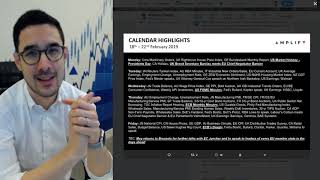
Anthony Cheung breaks down the trading week of Feb 18-22, 2019. The S&P 500 faces resistance at 2,800 with potential upside to 2,850-2,900, while the pound could swing between 127.9-130.0 on Brexit developments. Watch Walmart earnings Tuesday, UK bank results, and ECB President Draghi's Friday speech.
Chapters
Good morning, Monday, 18th of February. Hope you've had a good weekend. Straight into the briefing then, and as per usual on a Monday, it's a bit of a look ahead for the entirety of the week. So as you can see to the side of me here, this is the, the calendar of events that we're looking out for. These are— it's not an exhaustive list, but these are some of the highlights, and we're going to talk through a couple of the key points which may well drive market kind of sentiment and direction for the week ahead. Before we jump to that though, let's just have a look at the general kind of setup and how the different asset classes are trading this morning. One thing to be absolutely clear about today is a US bank holiday. It's President's Day. It's also Family Day in Canada, which means the respective markets are closed. So there is electronic trade in the futures market, but that's going to close early. But it does mean that, you know, volumes are radically lower than normal. So you probably get some movement this morning, but then as we go further into the afternoon, unless there's something unexpected that comes out, it's kind of a dual fold of the fact that the economic calendar for today specifically is very quiet, certainly in the US side of things. And then this afternoon will no doubt be particularly quiet. So for any new traders, just as some advice, not to get too caught up in market conditions that are very different during a bank holiday season, as you would imagine. All right, so looking at the charts this morning, a bit of a reflection of that— there's not a great deal of major or breaking news from the weekend, and as such then we've kind of got a little bit of a follow-through from what we had at the end of last week, where if you remember, one of the main focal points was the trade talks between US and China, and I'd say that went through 3 kind of distinct phases. Phase 1 was general risk appetite, which meant that equity markets were kind of persistently moving higher. Then we had Thursday when it felt like all of a sudden there was a lack of progress and a bit of an impasse was hit, and a bit of risk came off the table at the time. But then we finished the week, everything back to normal again, kind of rationale returned. The fact that they committed to continue talking. It looks like the major heads of state, Trump and Xi Jinping, are going to meet in the coming days or weeks, and that's a net positive. So overnight in Asia, uh, oils continue to track higher on the back of that kind of story. Equity markets, US index futures at least, still holding on to some of the moves that were seen at the end of last week, and we remain pretty flat there. If I look at the— this is a daily continuation of the S&P 500, and it's quite a key area that I think certainly warrants quite close monitoring this week, and that is the 2800 handle. And really, this is defined by the rectangle that I've got highlighted on the chart here. So we've got the, the trend line of the triple top, the resistance that really was a good level, uh, back in Q4 of last year, and within close proximity of that, which would come in right in line with that 2800 mark in the futures. This of course comes after a technical break of quite a key area, managing to, to close then, you know, strongly above that 200 DMA, which had been such a fantastic level, uh, going back through the last 2 years before really got little chopped up during that Q4 volatility. But that price now closing above there substantially at the end of last week, I think, is a, is a bullish signal from that respect. And with the trade talks, as long as they continue at this point as they have done, it's looking more likely or not that although the March 1st deadline is obviously looming for when the trade tariffs would reset on $200 billion worth from 10 to 25%, it's looking more and more likely that essentially that's going to get rolled over and extended. So instead of those coming in, we just get prolonged delayed, if you like. And in a sense, that's not that it's outright positive, it's just an aversion of the worst case. So upside level to really watch is going to be 2800. Uh, Sam, who obviously you know well, is looking for if the market were to break above these levels, well then that really opens up the door for a real push-up to levels which we haven't really traded. I mean, the first squad of targets from a longer-term perspective, you'd be looking up at 2850, then 26500. Here you can see previous resistance and support, and then you've got the all-time highs of course way up here. I guess we'll see a couple of stories that need to really play out here. The trade war situation, and then the Federal Reserve really committing and changing through March when they have their next key meeting to eradicating any idea of interest rate hikes in the foreseeable future. If that was to materialize, these could be supporting factors for this to play out. The economic data we had last week, of course, was particularly poor, and is that, you know, if it gets exceedingly weak, is that almost back to that post-financial crisis era where you get fixed income and equity valuations both rising simultaneously on the back of a highly accommodative Fed at that point, if the situation has become so bad— so bad equals actually good from an equity point of view, if that makes sense. So yeah, S&P, uh, kind of things we're looking at this morning. European equities, the Euro Stoxx is flat, the DAX just a little dip, um, again just tends to be a little volatile, just taking back a little bit of the price gain that we've seen on Friday of last week in the afternoon. Currency-wise, we have a pretty flat dollar really, marginal weakness, currency pairs pretty flat in the euro, cable, quite a few headlines to just get you up to speed on this morning, so we'll get straight into that. Um, here we go then. So Monday, let's go through this day by day. As I said, US market holiday today, so please do take that into consideration if you were thinking about your kind of strategies from the element of how aggressive or not or conservative you should be. It should definitely be the latter in a day like this. So, you know, picking out good solid technical levels, not looking for too much in terms of ambitious targets within your trades would probably be the most prudent approach. The one thing notable though from today is UK Brexit Secretary Stephen Barclay meets with the EU chief negotiator Michel Barnier. What I'm going to do is rather than go through each one line by line, I've got basically an individual Brexit calendar. This is what this has got down to. So I'm not— no longer do I have to do a normal calendar, I have to do a Brexit calendar because that's got so many events that are happening this week. I think it's a lot more cleaner to look at if you are trading the pound, for example. So I'll skip over that for a second. Let's have a look at a few of the other events. Tuesday, uh, RBA minutes, they will come. So basically tonight if you're in London, that could be interesting just given the fact that if you remember, the Aussie was quite volatile. Um, it was the case that nothing to do with interest rates, this is all about Federal Reserve communication and the idea then that not that they were outright hawkish, they just weren't quite as dovish as maybe some were expecting. And then the Aussie appreciated on the back of that. So the balance of their conversations I think could be quite interesting if you were trading the FX live and then the Aussie overnight. UK data, we get some wage numbers actually coming out on Tuesday. Now if you remember, we had a softening in the CPI, which I don't think was any real surprise. We obviously had quite a fall in oil prices over the last couple of months, and then you've also got the looming situation with Brexit still unresolved. So demand ebbing away, I think, is not that unsurprising. And inflation falling in a CPI measure back below 2% for the first time in 2 years, what we saw last week. We also had the, of course, the UK retail sales report as well. Which although maybe can be seen as robust in some sense, I think one thing that needs to be taken into consideration is that January is a quite a seasonal month, and when December in the UK retail sales was so shockingly bad, a little bit of a bounce back is quite, quite normal. I think February is going to be more telling. Wage data though, this is one of the more sterling upside surprises, if anything. Because if you remember, unemployment in the UK is, is particularly in a good state of health, actually. Unemployment is very low. And so typically then this leads to more demand for competition over workers and then an increase in wages, which we have been seeing materialize. So, um, it'd be interesting to see how that plays out. I think the same message needs to be repeated though with UK economic data other than causing quite short-term volatility in prices, I wouldn't be looking for some outright quite continuous move throughout the session because there's obviously a much bigger story at play, and that of course is Brexit. So if there is a trade, again, I think it needs to be taken consideration for the unique period that we're in. Wednesday, let's move on. Well, actually, just to, just to finish off Tuesday, uh, US earnings season is from an index trading point of view is pretty much done from US corporate earnings. There's one though that I think definitely from a US perspective you need to keep an eye on, that is Walmart. Walmart will come out pre-market on Tuesday, one of the world's obviously biggest retailers. They do act, you know, there's a little bit of a bellwether of sorts, and definitely I'd say it's worth being vigilant for their results when they do come out. So that would be Tuesday pre-market. Wednesday, and we can combine Wednesday and Thursday for the same kind of event, if you like, and that's central bank minutes. So you've got the FOMC minutes Wednesday night, you've got the ECB minutes coming on Thursday day. Now, for the FOMC, obviously we've had quite a severe about-turn in Federal Reserve kind of guidance, moving to almost reinstill confidence into a market that's created this quite phenomenal bounce in equity and oil markets, and that's come from the Fed turning dovish. So the line-by-line minutes will be interesting to see, you know, just how much have they tilted in that direction, how much do they, and how do they describe the external risks such as the trade war and Brexit and so on. Now, ECB minutes similar kind of thing. I guess with that, so far they've been a little bit reluctant to really follow the Fed's lead so definitively. They've kind of said, well, we'll keep things like long-term refinancing operations on the table, but they're really uncommitted as to as and when are they going to use that. So again, it's going to be monitoring or not how dovish towards neutral are they at this present point. Now, one thing to bear in mind with both the FOMC minutes and the ECB minutes, obviously these are dated events. And one thing we're going to discuss in a second, and I'll show you a separate kind of calendar crib sheet, there's an awful lot amount of Fed speakers this week, and also ECB's Draghi is speaking on Friday. So as much as these events, these minutes releases, might cause some short-term fluctuation of prices. Actually, I think the Fed speak, in addition to the ECB president speaking on Friday, ultimately is going to be more of a telling sign of where exactly they're at right now, given the current conditions since that time has passed when the minutes of the meeting were held from a central bank perspective. Finally, on the calendar, if you look at Thursday, that's the most busiest day. Any Bund traders, and there's a couple of guys in the live room, you do have a whole batch of supply coming out of Spain and France, so do be aware of that. You've also got the Treasury Select Committee inflation report hearing from the QIR, most recently from the Bank of England earlier in the month. That normally not so much of a market-moving affair, it's more carny justification of the decisions that were made, and largely they've been priced into the the market, but just so you're aware, a few US pieces and earnings as well. There's a couple of UK FTSE-related earnings littered in the week that I think you need to be aware of. Probably the biggest one from a market capitalization point of view is HSBC. They're coming on Wednesday. It's very much a bank FTSE-related week, so you've got HSBC, Lloyds, Barclays reporting on Wednesday, Thursday. You also get people like Centrica, BAE Systems, so a couple of larger names that I think you just need to be aware of if you are trading FTSE, maybe more on a technical perspective. I think just from a risk— should be keeping your risk low, being aware of these kind of fundamental events could well, you know, safeguard any potential factors that could affect those prices. Finally, on Friday, as I said, apart from Draghi, you'll see there's a whole list of Fed speak, and we're gonna, we're gonna get into that in a second. So let's just go through some of the other headlines and look at the state of play of things. So first off, Brexit. Usual headlines across all the major newspapers at the weekend, and this is kind of where we're at at the moment. May asks the EU to help save Brexit as ministers revolt over no deal. Pro-EU cabinet ministers said to press May to prevent no deal. So if you remember, it was Yvette Cooper that had that amendment originally. It's expected that that amendment will return to the lower house on February 27th, when it's going to be probably unlikely that Theresa May is going to make much progress over the coming period, resulting in then the next course of action. And now you're getting pro-EU cabinet ministers supporting this, this kind of sentiment as well, the aversion of a no deal to be just taken off the table completely. So I said this last week and I'll say it again, although I think if we get closer to the 29th of March, then a no deal does need to be priced in, I still think the reality of a no deal occurring on March 29th I put as incredibly low. I'd say as low as 5%. I know bigger banks are giving it a little bit larger than that, and I think, you know, there's two things to distinguish here that are quite different. Market pricing is one, and I think that number does need to go up. And ultimately, the closer we get, without taking that away, then that has to weigh on the pound. I still think then that the actual event unfolding in that way is incredibly unlikely, and if it did, then and the market's positioned itself as in sterling weakness up to that point, you're going to get quite a wicked relief rally in the pound if that does materialize. Um, the thing we're, we're looking at here, and this is the kind of timetable for the week. So as I said, you've got the various— well, you got the two kind of major Brexit secretaries themselves, uh, meeting today. Um, then you've got the Attorney General Geoffrey Cox, who's delivering a speech specifically on the legal elements of this binding agreement on the backstop. You know, he's quite a key player in this, and I think that speech is going to be worth monitoring tomorrow. Jeremy Corbyn meets Barnier on Thursday, and he's also meeting EU Parliament members as well. So quite interesting seeing Corbyn getting involved, but Anthony Cheung, you know, as much as Corbyn technically is obviously the opposition, so he's not kind of steering the ship, so to speak, but ultimately his party and how they vote is going to be very important for the eventual crossroads that we're going to have to make a decision on in the coming weeks. So it could be quite interesting to monitor. I don't think it's gonna be a market-moving thing just yet, but he is going to Europe as well. Theresa May is basically going to be in Brussels meeting Juncker and all the other major heads of European state throughout the entirety of the week. So there's going to be plenty more, I'd say, Brexit headlines. The one thing I would say, my base case view here, is that we'll end this week really no further along than where we are at the moment. These meetings, of course, are taking place and there's lots of conversations, but behind closed doors and so on. But, you know, let's just have a look at the pound here. This is the pound on a daily continuation chart, and I've put in a couple of annotations here so you can see where we were and, and where we have been, where we are right now. And you can see that post-EU referendum recovery high, that was when we got up to 1.44. This is when we secured the transition deal, the the dollar actually was trading at a 3-year low. You remember Trump was initially really trying to weaken his own currency, and that was when we had inflationary conditions in the UK. So quite a distinct different economic setup right now. Obviously growth is slowing, inflation is falling, but wages are high, as I've said previously. The, the point here is we've got, you know, there's a trend line that we're watching here that comes back through Q4 of last year, and we're not too far from there at the moment. I guess the key area on the upside would be the 130 mark. We can see we defined the recent low back on Valentine's Day, which was when we had that, uh, the previous last parliamentary vote. So yeah, I'm kind of looking at that 130 area on the upside. Any push above there potentially starts to just basically drift up higher. On the downside, last week's low, I think 127.91. So that kind of range near term I think is quite key. I'm not looking for that explosive move either way because I really don't think much progress is going to materialize at the end of this week. So I guess don't get caught up is what I'm saying in a lot of the headlines and the kind of Brexit euphoria that the press tried to push on us. It's quite easy, I think, to fall in that trap. With that being said, one thing that's, that's actually going to be happening later today is there's been rumors this morning according to party sources at Labour that several MPs are going to resign. Now This isn't a totally new concept, and just to follow this up, Paul Brand, who's the ITV correspondent, has been saying that names he would expect to see at 10 AM— leading the list obviously is Chuka Umunna, who basically is a kind of poster boy behind the People's Vote and has for long been against that, then of the view of Jeremy Corbyn's kind of more leftist approach to Labour politics. So all of these members being more centrist and by default then typically more EU-friendly. What does this mean? Well, there's a lot of talk going on about, you know, is the Labour Party about to fracture? And then is Labour going to team up with the Liberal Democrats, and are we going to get this new kind of formation of a centrist party? Could it happen? Well, I don't want to put my own political biases in. I wish it did happen. I think the world needs something a little bit more down the middle rather than being totally Brexit on one side and then, you know, the most leftist party policies going back to the 1970s in the form of what Jeremy Corbyn's been tabling. You know, is this what happened in France through the the movement that was Macron, where a political party was in existence for the best part of, what, 18— was it 18 months? And then managed to win an election. I don't think we've got to that point yet. I don't think there's enough appetite there personally for this fracture to become anything with any substance in time, possibly. But I think things have got to get economically a lot worse before then we create that kind of new narrative. But just the next thing that's happening at the moment, and certainly something to be, to be aware of. Um, so yeah, that's the kind of the pound situation and Brexit. Let's move on. This is the ECB. I talked about the minutes are coming out on Thursday, Draghi speaking on Friday. I think that's probably much more important. This is where we're at at the moment. Villaroy spoke at the weekend speaking in Spanish press, saying that question is at the moment, will the weakness last? And what he's referring to essentially is the economic weakness we've been seeing in both hard and soft data for Europe. And the central bank, though, has extremely efficient instruments if needed. So they're eyeing the data as slowdown proves, quote, significant. So we're really at a point here of, are we getting Do the ECB now need to follow the Fed's lead and start sounding dovish? Because at this point they haven't quite committed in the same way, I feel. You remember their official line is they're going to hike interest rates after the summer. Now we know markets are priced radically different to that in a much more dovish positioning, but their official line is hiking at the end of the year in Q3, Q4. They've already ended quantitative easing and they haven't yet committed to doing long-term refinancing operations. So if anything, they're still holding a kind of relative neutral stance, and you kind of get the opposite play then to what you could have materialize in the US, where you've got rising in tandem equity and T-note prices, whereas in Europe this morning, you've got DAX and Bund both falling. It's almost the flip reverse of that. So, uh-huh. Could be an interesting week to see whether or not do they now concede. If not, well then I'd say things like the DAX do need to come down and the euro possibly need to strengthen in that respect. With the Fed, I mentioned there's a whole host of Fed speakers. Just very briefly I'll cover this, but I'll put it in the chat room so you guys have it to hand. So here I've done you a list of the Fed speakers and when they're speaking. So you can see Friday is the real busy day. You've also got, apart from Draghi, Bank of England's Haldane, the Bank of Canada and the RBA senior people are speaking as well. So with this, for any of the new traders, what I want you to do is when I post this in the chat, I suggest that you Bookmark it, print it, take a photo of it on your phone, write it down in your notepad, whatever it is you need to do. Because, you know, one of the absolute kind of competencies, if you like, of trading intraday is being able to understand when central bankers speak whether or not it's going to A, create an opportunity, or B, change sentiment or direction of an asset based on they've said something really that was the opposite of their monetary policy view. So what we've got here in this table, it's broken into 4 sections: the Board of Governors on the left and the voting regional reserve presidents. So you basically have like an executive board, and then you have your reserve presidents, of which there's 12 districts in the US. Now instead of there being everyone in there at the same time. Essentially, the Fed operate on a 12-month alternating basis for the alternate voters, which is on the right-hand side, and they switch with the non-voters on the bottom right. So point being here is Bloomberg have assigned a scoring system to how hawkish— so goes up to +2— to how dovish, -2, neutral being 0. And as you can see here, the Board of Governors tend to be fairly centrist with their view, whereas with the regional voting presidents, you can see there's a real swing going all the way from Esther George of Kansas City being the most hawkish all the way down to James Bullard being the most dovish and everything in between. So it's a very useful thing, just given the number of speakers there's absolutely no excuse for not being prepared thoroughly for these types of events and then being in a better position to know if there's any action that needs to be taken accordingly on the back of what's said. So I'll post that once I've done this, this briefing. Finally, just on the charts, we're just going to have a quick look at oil and gold. So this was oil. And again, at the beginning of the week, I quite like to just look at things on a slightly longer-term perspective rather than getting too drilled down, because it helps. I find, like, on a Sunday night to, to review the, the news, look at the calendar for the week ahead, and then just step back onto like a daily chart and look at the bigger picture. What could be the kind of framework for the price activity throughout this week? Where are the key levels which could then be the ones that you really need to focus on that could be a substantial point of resistance, or if broken, you know, a real elevation in prices, as is in this case now that we're moving above, you know, some quite key levels. And one is we got the 38.2% Fib retracement of the recovery to the multi-year high that we printed right at the beginning of October, down to the, uh, the low which was around Christmas time, which was when that The global equity markets were also selling off, you know, the kind of fear about policy tightening, escalating trade war was taking hold. Since then, obviously since this point, we've had a couple of really key events that have happened. You've had the Fed turn dovish, which although the dollar has now seemingly appeared to have priced it in at the time, weakness in the dollar helping prices. You've also had then a recovery and a sharp bounce in equity markets as the Fed kind of the, the ultimate backstop, if you like, now coming off the pedal of policy tightening. That's a real huge deal for markets, and so that's helped as well in terms of restore some confidence. And then you had OPEC+ obviously not just cutting production but committing now, making noises about doing even more. With the technical break now above that 38.2% fib retracement. You can see we broke above it actually at the end of last week on Friday, and since there, that now acting as a bit of a platform, and we've just been creeping up this morning. The other key thing here is, well, what's going to be one of the deciding factors for the demand part of this equation, and that's the trade war. And at the moment, the trade war is making some slow but assured progress. And that, that also plays into this theme of oil just continuing this directional move of late. So I'd say really that level where the FIB is, which is around 55, kind of 60 in the futures, quite a key level of support going through. We've kind of got this rising trend line from that low and the retest that we had in the mid-February as well to keep an eye on should we come back down lower at any point. Now above here you can see there's a little bit of clear air really until we get up to around the $58 handle, which as you can see with the rectangle here brings us back into the beginning, the Feb initial low before the move higher that occurred in 2018 and late 2017 resistance. So be keeping an eye on there on the weekly. Any move above there, then looking at the 50% retracement with the $60 handle, that's It's probably getting a little bit more on the punchy side to get up there without some kind of meaningful development on the trade side, or maybe a supply shock of some sort. So I'd say probably 58 may be a good target for direction. I still favor the bias for the upside. Gold, finally, just to wrap things up, uh, put that on a daily continuation as well. This was a trend line I think Sam was looking at last week in the strategy, and And it's still something which is in play this morning. And really here, that top rectangle, you know, very close proximity from the intraday high today at $1,323. That's only about just under $2 away from the year-to-date high for gold. Now, obviously, gold had the biggest move when the Fed turned dovish and the dollar saw some quite aggressive weakness at the time. But this area here is, in any pullback, I think quite significant. You kind of got a few factors here. You've got quite a clear area of resistance that we had right at the beginning of the year, the eventual break. You can see a lot of people watching that level because then price has really accelerated to the upside. And then that same level acting as support with the trendline and the $1,300 level, I think it's quite a good spot here. So the way this price is shaping up, if it continues to narrow as time goes through the coming week, you would say, well, something's got to give here. Either the price has got to snap higher and we've got to push beyond $1,325, or we break the trend line and we have a bit of a move back down. And a target there at the time would probably be towards the $1,300 level then for the next key level of support. Okay, that's it. Gonna leave it at that. Um, Sam is here, otherwise engaged at the moment, but he's available in the chat room if you need any other advice on the technical side. But hopefully that gives you a bit of an overview for the week ahead. Final words: remember, today is a US market holiday, so do take that as quite a key variable to your decision-making for any potential trades that you're putting on today. And then all those other crib sheets of dates, I'll put them in the chat room now, or you can access them on my Twitter account. Okay guys, have a good day and a good week ahead. Thanks very much.
More from Anthony


Inside the Biggest Banking Stories You Need to Know This Week (Anthropic, Diageo, Private Credit)


Inside the Biggest M&A Deals You Need to Know This Week (UniCredit, GameStop, eBay, Eli Lilly)







AI Breakthrough or Hype? Anthropic’s Claude Mythos, Tim Cook Steps Down & LIV Golf Collapse