The Trading Week Ahead: 23rd -26th April 2019
Anthony Cheung previews the trading week of April 23-26, 2019. WTI crude rallied 3% on Iran supply concerns and potential Strait of Hormuz closure. About 150 S&P 500 firms report earnings, with tech names like Tesla, Amazon, and Microsoft as key risk drivers. Brexit talks resume with a May 22 deadline looming.
Chapters
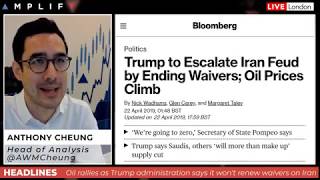
Okay, a very good morning to you. It is Tuesday the 23rd of April. Hope everyone had a fantastic Easter break. I'm going to get straight into things and look at the, the trading week ahead though and discuss a couple of stories that we can look at. Updates of course, and the recommencing of Brexit talks between the Conservative Party and and the Labour opposition, whether or not they can make any headway agreements. We'll have a look at that. The biggest move probably arguably from yesterday, actually without doubt, was that of WTI crude, a +3% move in crude oil. You're probably looking at the charts this morning and it does look impressive and it's held on to those gains. And in fact, we're actually just pushing above them. And we'll look at the charts in a second of where we could go from here and the reason why the price is so elevated. And then we're going to look at the, the kind of week ahead, and it's definitely a corporate earnings-inspired week in terms of the set scheduled events. In fact, there's 150 of the S&P 500 reporting just this week. I think there's 12 of the Dow 30 companies. There's also major UK banks reporting in the FTSE, and there's also some of the largest-cap stocks in both Germany and France, like Total, Sanofi, SAP, Bayer. They're all reporting this week, so So definitely a bit of an earnings spin to proceedings, as we can see from the calendar here that I'm showing you. But before we get into that, let's just have a quick look at how the charts reside this morning. So again, just to refresh your memory, I've got a cross-asset class kind of mix to the charts that I'm sharing. I've got EURUSD top left, cable then beside it, gold, which is down about marginally $3 this morning, futures in the top right. They got the DAX, uh, slight gap down but has kind of clawed back some of the gains, and we are slight positive on the session. US index futures the same, kind of flat to mild positive following a fairly mixed session overnight in Asia, which we'll take a look at as well because mainland China did underperform slightly. Otherwise, the Bund, uh, down about 17 ticks but just giving back some of the elevated move that we saw at the end of, of last week. Obviously, we saw those, uh, the continuation of German manufacturing sector in the PMI readings at the end of last week remaining in heavy contraction. So again, the kind of depressed euro, elevated Bund price still remains the same at this point in time. So just having a look then at the, the calendar of what's to come, obviously we can, we can scratch out Monday And Monday then was— and we'll go straight to it— very much dominated by movement that we saw in WTI crude oil. So let me just bring up the charts here and we can talk it through. So this was the, the price of oil yesterday, and if I just put a currency indicator on here from where we reopened kind of a trade— so we reopened around this price here and up to where we are at the moment, you're looking at a rally of about 3.3%. As you can see, the bulk of that rally coming pretty much at the recommencement of trade from overnight futures. This would have been coming into the first day US was back into markets. It was only UK and Europe that were out yesterday. And so almost a lack as well of normal kind of size volume probably helping exacerbate the move. But the bulk of that coming during the Asia Pacific session. Uh, and as you can see here, if I just remove that, that high price point that we've had, and that kind of forming of a short-term, uh, double top has now been largely tested and broken through. So just looking at here as to where the price now on the third attempt has managed to break above, and we're above importantly here, uh, psychologically you often get this when there's a fast money move traders tend to lock in on the handles, of which then 66 being the logical target as well as previous price points. And now we've broken above that, you can see we've extended gains by about a further 15 cents. On a longer time frame, obviously this technically, uh, we remain very much in a bullish setup. And interestingly, uh, on Friday you did have some data still coming out despite Easter which is from the CFTC, reflective of the market's futures positioning, and money managers or hedge fund managers continuing to remain the most bullish they've been since basically October, which is when we peaked at that north of $75 price point before we kind of tumbled into Q4. So, you know, hedge funds are definitely positioning themselves where they see potential, I guess, positives from the demand side with the ongoing nature of the progression in the US-China trade talks, with that looking to be signed at the end of May. And then also as well with the potential supply shocks, particularly now with focus on Iran, which has been the main story which has helped elevate this price. So the reason why we, we spiked higher yesterday, I mean, this was the headline: Trump to escalate Iran feud and basically ending waivers. So for any of those that aren't fully up to speed. If you remember, it was back just before— it was literally the day before Thanksgiving last year, so this would have been early November of 2018, and Trump tweeted that Game of Thrones kind of graphic with him saying, "The sanctions are coming." And the problem was is that when he did that, prices in oil were— at the time, we had been moving high on the price premise that his sanctions, you know, that was one of the whole reasons why we did get up originally up to north of $75 because of the fact that Iran was being sanctioned. You're looking at a country that produces in excess of 2 million barrels per day. However, when it came to light that there were several waivers— now what does a waiver mean? Well, it basically meant that a whole bunch of buyers of Iranian crude crude would, uh, had exemptions from being kind of subject to these sanctions. Now, if you actually look at who purchases Iran's crude, much of this comes from Asia. So China makes up the predominant amount of this, but you also have South Korea, sizable, and then India, as well as Turkey and Japan. So interestingly then, it was a number of these nations that were put on that list that were exempt. And so, in effect, Iran can keep producing its crude, and these guys can keep buying it. And obviously, the US is also mindful of the fact that it has to manage a trade negotiation that's ongoing with this country, of course, China, without upsetting them too much from the large amounts of, you know, north of 500,000 barrels of oil that they buy off Iran every single day. The problem that this has though is that Secretary of State Pompeo has been saying, you know, we're going to zero, and obviously this has been, or this could become highly now sensitive to news coming out of the Gulf region. And by this what I mean is the Iranian Revolutionary Guard have already commented overnight and basically said that if the US enforce aggressively these sanctions and do end these waivers, then it could well be that they could disrupt the Straits of Hormuz. Now that's that particular kind of choke point, if you like. Well, in fact, let's just get that up and have a look from a map point of view, just so we're all on the same page here. So here it is. This is the kind of the Gulf region of where the predominant amount of OPEC-supplied crude comes from. And as you can see here, you've got kind of 4 countries, I guess, of which are situated around the Persian Gulf. Saudi Arabia being the de facto kind of kingpin of OPEC. You then got Iraq, number 2 producer, Iran, number 3, and Kuwait, number Number 4. Now this area here with this particular choke point, or as it's formerly known, is one of the major seaborne going areas of traffic of oil. Now approximately about 30% of all seaborne oil has to go through this particular narrow point between the southern point of Iran and the northmost tip of Oman. As you can see here, now the problem you have is that this technically, if disrupted, would have major connotations for the price of oil. Now it's not unusual for the Iranian Revolutionary Guard to make such threats. They have done in many years gone by. However, a closure of the Straits of Hormuz, I mean, you can forget kind of a $75 handle. You'd be looking more like 85, 90 very quickly, just given how important that choke point is. Now, as you can imagine then, there's a lot of Western Allied military presence in this particular area of— guess who? Of course, the United States of America. And so with that being said, this definitely is something to keep an eye on, I think, as we go through, just given this latest news that we've had out of the US at the weekend. So if anything, it does make me feel still fairly bullish on oil. I kind of agree with the nudge higher that we've had. The technical break now above that $64.80 has helped us kind of punch higher again, up north to $65. But, you know, this is the difficult juggling act, of course, of which Donald Trump has, because he has in mind sharply the kind of political roadmap of campaigning then for potentially to be reelected in 2020. And the last thing that he wants is increased supply risk in that region, which could elevate prices back north of $70-plus, which definitely goes against then his kind of voting base in Middle America. So yeah, interesting things developing in oil. I'd say at the moment though, so still got an upside bias to proceedings. Some other news to quickly run through, and then we'll go back and circle back around to the calendar. And this is one of them. And we have had China come out overnight, and actually the Asian equity markets were a little bit mixed. Now overall, you've seen the European and US index futures are mildly positive. But China actually did underperform, and I guess this is one of the biggest potential uncertainties going forward. Now, we've had a fair degree of stabilization from the very dramatic Q4 sell-off that we saw globally. Now, these— this kind of recession risk, the inversion of the yield curve, which a lot of people were talking about several weeks ago, has gone pretty quiet, and that's because the equity markets markets recovered pretty much close to all-time highs if you look at the case of the US. But underpinning a lot of this is, as much as it's the dovish Fed, as much as it's an ongoing progression in the trade talks, a lot of this has come through the, uh, the kind of support of which the Chinese government and central bank have been giving the market. And that's come as welcome relief. And so when you get headlines where the Chinese government under what's called the Politburo. Now, the Politburo, in terms of the political structure in China, is basically like the UK Cabinet, if you like. It's where— well, big difference between the UK Cabinet, which cannot make any decision. The Politburo makes all decisions in China, literally. So the kind of fate of, you know, nearly 20% of the entire world's population comes down to 12 individuals that sit on the Politburo. So they're incredibly important. And what they've said is that they had a meeting at the weekend, and referring to deleveraging and property speculation, and they've basically signaled about the not being there constantly to add forever stimulus to China. And this is definitely a, an important part of the ability long-term for their economy to stand on its own two feet, feet, with less intervention from the government. It's almost critical that that takes place. But this obviously makes financial markets a little bit nervous about where do we go from here. So actually, the Chinese mainland market had its biggest loss in a month overnight, and it was down over 2%. But that hasn't really crept through into overall global sentiment, I'd to say for the reopening that we've got, but something to definitely be aware of. With that in mind, let's just have a quick look at the US indices. Let's just have a look at the chart here of the S&P 500. And so if we look at it on a shorter time frame, this is a 30-minute, it's a little bit choppy, a bit mid-range, you would say, of the, the pretty large move that we had on, on Thursday before the Easter break, where we had a pretty big swing up from 29, 22.5, all the way down to sub the 2900 handle. But stretching this out and looking on a daily continuation, there definitely is some, some price points I think to be aware of. We've kind of gone through two phases, I would say, of, of consolidation. One is this area here, and you can see that was kind of defined by 2877 on the downside to 2900. the figure, if you like, on the upside. And then flip that on the other side, you've had now the new area of consolidation on the other side, 2900 to 2350. So I'd say that's pretty much the range I'd be keeping a close eye on coming forward through the next couple of days. I'd say the biggest risk factor here is going to be corporate earnings. There's a lot of big technology names reporting this week, which we'll look at in a second. So kind of looking at this potential range play, any breach of that, then I'd be looking down at this kind of area, kind of really here as a zone of really decent support between 77.25 and 66. Any break on the upside, of course, starts to bring into play the all-time high in the S&P, 2944.75. So that's the kind of upper and lower bound if if we breach the rectangle, which is the current midpoint of the, the range that we're trading at the moment. Um, talking of corporate earnings then, let's have just a quick overview of what we've got coming out on that side, because it is an incredibly busy week. Again, it's probably the most busiest, um, from a calendar point of view. 150 S&P 500 companies, 12 of the Dow, and so it's very much a tech-oriented spin. And these are major market cap as well as sentiment-related kind of growth stocks. So there's two things really that I'm interested to see here, and one is from a sentiment more point of view. So with this, I'm looking at Tuesday— today we've got Twitter before the market open, you've got Snap after the close, you've got Tesla after the close on Wednesday. These are all companies which aren't turning around huge profits or have a large market-weighted cap, but they do give, I think, a good reflection of the market's appetite for risk in terms of these cyclical stocks. The other thing, of course, is then the larger tech names. So you've got Facebook reporting after the close on, on Wednesday. You've got Amazon reporting after close on Thursday. You've got Microsoft as well this week. Facebook, of course, always comes down to its kind of numbers surrounding the active daily users, and then therefore the performance as well of things like Instagram, which has been a massive hit for them having purchased it a few years ago. And it's about the monetization, I guess, of that product given its ever-growing user base. So that will be the key to Facebook. For Microsoft and Amazon, it's still very much time to particularly Microsoft, their commercial cloud computing unit. And then of course we have big Dow components as well. You've got Boeing pre-market on Wednesday, it's the biggest constituent of the Dow Jones Industrial Average. You've also got 3M before market on Thursday, another particularly large Dow component. Caterpillar, AT&T, uh, I guess the first Caterpillar will always kind of acts as a bit of a bellwether for general global, uh, kind of growth concerns, kind of whether being pessimistic or, or optimistic depending on the demand for their services given what they produce, uh, in terms of industrial-related goods. So yeah, it's going to be really interesting to see how these play out. We've kind of seen the banks, they've been mixed, haven't really had much of an influence just given the gravity of the size of these companies and given the kind of precarious nature of a lot of people questioning, are we at the top of the equity move? I think the tech sector, that does carry a lot of sway, uh, as to the thinking of where we are in that journey at the moment. Um, quick few other things to have a look at then. Uh, Brexit, there is an update unfortunately after having a bit of a break for the best part of 2 weeks, and for us all having a thankful kind of move away from Brexit headlines. I'm afraid it returns this week because now they've come back from Easter recess, the, the parliamentarians. And so Theresa May will set up cross-party negotiations on Brexit this week as the MPs return to the House of Commons. So let me give you a brief summary of a couple of things we're looking for. Of course, As we left it back earlier this month, Theresa May now has the extension of till October 31st for a Brexit deal to be struck, but she faces much more abrupt deadline if she wants to avoid UK participation in the European parliamentary elections in late May. They're happening on the 23rd of May, because if you think about it, the Conservatives, by taking part in a European-based election election, you can imagine they're going to take a real drumming in those local elections. You know, they had the mandate to deliver Brexit, and I guess in the general perception of the public, they have failed at every ebb and flow of the negotiations so far. If, as expected, the Labour-Tory talks falter, Mrs. May could have to switch her attention once again back to her own Eurosceptic backbenchers. And Northern Ireland's DUP, of course. Now, a couple of other things to be aware of. Downing Street says the elections, i.e., the European ones, could be cancelled up to 24 hours before they are due to take place. But even if Number 10 struck a surprise deal with Labour by the end of this week, it would have just 18 working days to pass all the necessary legislation. What happens if Mrs May fails to hit her May 22nd deadline, while simmering resentment against her leadership among Tory members will return to boiling point if the Conservative Party performs weakly. Many MPs will once again demand the replacement of the Prime Minister. Now, in theory, Mrs. May cannot be challenged again until December, one year after she successfully saw off a previous confidence vote by her own MPs. MPs, but at the moment there's Conservative activists who are plotting a new attempt to oust the UK Premier. And this is really what the FT are running this morning, where Brexit-backing Tory activists are seeking May's resignation. And what they're looking at here is tonight you've got a member, or I should say meeting, of the influential membership of the 1922 Committee of Backbenchers. and they're expected to meet tonight to discuss a potential change to the rules to enable a new leadership challenge. So basically they're looking to tear up the textbook that exists at the moment that protects any new no vote of no confidence in Theresa May. Now they're also looking to hold their own vote of no confidence by 800 senior members, but the important point here is this would be non-binding but nonetheless would carry obviously a lot of political clout if that was the case. So just because the technicality is that they can't call a vote of no confidence, that doesn't mean that that won't happen in order to just heap more pressure onto Theresa May and the existing government at this point in time. So yeah, a couple things here to think about, I guess, as the week goes on. One is I really don't think there's much appetite within the opposition party to support the government in this circumstance, to really strike a deal at this point. And of course, you've got the own complications within the Labour Party where you've had Tom Watson, the kind of deputy, if you like, of the Labour Party, really throwing his weight behind a second referendum. But Corbyn, the leader, has always been so reluctant to do that. And so we're in a bit of a stalemate again. And certainly this just draw out that we could remain at an impasse and quite quickly stumble through in having to hold these European elections. So looking at the price point, definitely Brexit headlines returns to the fold in terms of potential risk factors. Just looking on a third, what, 90-minute candlestick here of the price activity over the last, I guess, month of cable, and we are finding a bit of resistance resistance of what has been, uh, this kind of retest points of support which we broke right at the end of last week around 1.3026. So we're kind of sandwiched in, in the futures price at least, between that 1.3026 and really the S1 level on the daily, which is around the 1.30 handle, just short of it, that kind of range. Looking at a slightly longer time frame on the daily continuation. Obviously, 130, just psychologically, uh, I think a level of support to have a look at. Any recovery in the price, then you've got this trend line that's been in play pretty much since mid-March. Any breach of the 130, uh, we'll start looking down at 11th of March low, 2965. And then really, that opens up a little bit of clean air potentially for another push to the downside here, as you can see. So yeah, I mean, that's the Brexit story at the moment. Not expecting a great deal of actual progression, but nonetheless, all of the journalists will return, MPs back in the house, and so you can expect more, more commentary to come. A quick look at the euro currency for the week ahead. I mean, this was just make this visible so you guys can see it. This was that trendline break that we were looking at on Friday when the German PMIs came out, and it wasn't that the fact that the German manufacturing PMI actually did exceed expectations, but it's still so heavily in contraction, uh, that almost acted as the catalyst. Then markets are fairly illiquid going into the Easter break, so volumes are down. That typically exacerbates price movement, and you saw this wicked move here. And actually, if you can just about make it out on this chart, you can see the last times the PMIs came out, you know, it's had really quite spectacular sell-offs here. That was the last PMI reading you can see here, sizable decline in, in the euro. And then again on that trendline break. And so I guess these levels I had marked up from last week still remain. So any push back to the downside in the near-term intraday You've got the S1 here, but then any push below, you kind of be looking down to these other price points from the weekly low that we had. That was down towards the S2 today at 112.79 and a half. Okay, final points to be aware of. This was something I think that was interesting to just have a look at. Fed nominees, of course, Trump's put forward, I think it's Stephen Moore and Herman Cain, both have been just classified as basically yes-men for Trump. But one has pulled out, Herman Cain is facing resistance from his own political party as Donald Trump picks to fill the seat, the vacant seats on the federal board. But he's basically said it would be a decrease in influence influence in pay. And obviously we can't have a decrease in pay, and that's just seen as unsatisfactory. But yeah, so this chap Herman Cain has pulled out. Interesting point here, I think, with the Trump nominees that I saw that was in the Politico. And Politico is a resource which is going to become more and more, I guess, important as we get closer into this US political campaign period. and this is this second paragraph here, so let me just read it out to you. And they've reported that the theory holds that Donald Trump is simply having fun with the process and further setting up a scenario in which he can blame any economic slowdown on the Fed by saying Chair Powell screwed things up and he was denied people who would have been better. So if you remember, Stephen Moore Moore, one of the other people Trump has appointed, thinks that we should have a 50 basis point rate cut as of right now. So obviously this is way dovish beyond that of the current board's view, and this would definitely, um, support Donald Trump's will that he wants to prop up the market. But interestingly then, if the economy does collapse in the future— and again, I think this quite masterfully done by Trump strategically. He can then turn around and point the finger at Powell and say, well, I gave you— I told you you should have cut, I gave you all the people that were necessary to facilitate that, and you said no. So this is your fault, not my fault. So again, I think it's quite well played by Donald Trump in that respect. Finally, just going back, a quick overview of what else there is. The only other two major things here I wanted to point out were bank or central bank reports. So you've got the Bank of Canada. I think that's arguably the more interesting and potentially market-moving for the local currency out of the two other major central bank decisions. You've got the Bank of Japan going Wednesday night into Thursday morning, looking for a potentially dovish spin from the Bank of Canada, which does tend to be fairly correlated for obvious reasons with Federal Reserve policymaking. Since they've turned much more dovish on the 20th of March, will the Bank of Canada follow suit? We get their MPR, their monetary policy report, also released with their projections. Do we get any downgrades to the likes of inflation, for example, to facilitate that more dovish stance? And then, uh, the final points here, you've got US advanced GDP GDP coming out on Friday. A quick look at that, this is what the median consensus is, and actually there's probably going to be quite a lot of focus on this at the tail end of the week. Before that, it's obviously going to be more earnings in play from a US equity point of view, but then certainly we finish off with a main tier 1 piece of data. We are actually looking at 2.2% as the median consensus, which would be holding steady actually a little bit of a recovery from what was looking like a potentially sub-1% reading when we were getting a lot of downside surprises in US economic data. One thing to be aware of here is the Atlanta Fed GDPNow model, which is something which is a little bit more updating to recent economic data points in America and is used as a reflection of the same methodology of which the government calculates its own GDP number, that number is actually, uh, estimated for a higher 2.8% reading for Q1 GDP rather than a 2.2% that Wall Street, uh, are indicating. Uh, so yeah, could be definitely very interesting, definitely a win for Donald Trump, I think, if it does come out, uh, in more in line with the Atlanta Fed number. Um, and then finally Not forgetting as well, just so you're aware, you do have major European and UK corporate earnings coming. So if you are trading those types of indices, you know, just be mindful of the fundamental risks pre-market before the cash open. So from Germany, you've got SAP on Wednesday, Bayer on Thursday, Daimler and Deutsche on Friday. From France, Total, Sanofi on Friday. And then from the UK It's mainly bank stocks in focus. Barclays, Lloyds on Thursday, and you've got Astra and RBS coming on Friday as well. All right, that is it then for the, the look ahead for the week. I'll have the strategy report issued in a few hours' time and I'll send that out to everyone. But otherwise, good to be back. Hope you enjoyed the break. I'll see you in the Trading Live chat room. Any questions feel free to comment on the video. Alright, take care.
More from Anthony


Inside the Biggest Banking Stories You Need to Know This Week (Anthropic, Diageo, Private Credit)


Inside the Biggest M&A Deals You Need to Know This Week (UniCredit, GameStop, eBay, Eli Lilly)







AI Breakthrough or Hype? Anthropic’s Claude Mythos, Tim Cook Steps Down & LIV Golf Collapse