The Trading Week Ahead: 25th-29th March 2019
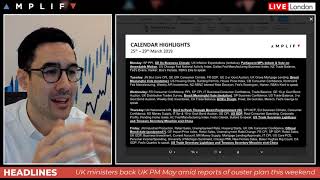
Anthony Cheung reviews weak German and US manufacturing data that triggered a global sell-off and yield curve inversion. He covers the ECB, US GDP, US-China trade talks, and Brexit's 29 March deadline with implications for GBP/USD, plus technical levels for major assets.
Chapters
Okay, very good morning, it's Anthony here. Hope you all had a great weekend. It's Monday the 25th of March. Just adjust my camera slightly. I hope everyone is well and enjoyed the, the sun this weekend, but getting straight down to business, let's have a look at the, the week ahead. And gonna start things off by taking a bit of a recap of what happened at the end of last week because it was an interesting one to say the least, and that was because of what we had materialize on Friday, which was very much a global equity sell-off initiated by some negative economic data coming out from Europe first of all, but then also ratified, if you like, by the PMI data later in the afternoon from the US. And this reigniting this concern about the inversion of the yield curve, which we're going to have a look at before we get into the, the week ahead. So this data you can see shared on my screen at the moment, this of course was the manufacturing PMI data out of Germany that we had that printed at 40, uh, 44.7, big miss on market expectations of 48. The latest reading pointed to the steepest pace of contraction in the manufacturing sector for Germany since August of 2012. New export orders fell for the 7th month in a row and at the quickest rate in over 6.5 years amid delayed decision-making among clients due to uncertainty as well as weaker demand in the automotive sector. And so manufacturing, of course, being the real kind of driver, if you like, of German economic growth and subsequently that for the euro area, this initiated kind of quite clear risk-off trade. And a few charts to have just a quick look at to remind you, I still had these marked up from the end of last week. This was Friday morning. You had the French data come out first. Which was weaker than anticipated. Then you had the German numbers come in, that was when the sell-off really took hold, broke through the prior day and recent days range. And you can see that quite significant red candlestick to the downside. As to where we are at the moment in the euro currency this morning, which is a slight bounce up about 14 pips, but still well below where we were from Friday session. Also, the DAX of course was a was a good mover as well, and we still remain under pressure this morning. This is just having a look again, annotated, because I just had them marked up from, from conversations with some of the traders from last week. And it was a real tumultuous week for the DAX, from negative news about potentially causing cancer— I think it's from one of their fertilizer materials— and Bayer, one of the largest companies in Germany. We had the gap down in the index Then you had the, the FOMC kind of post-volatility hard or headlines on US-China trade talks caused a little bit of a dip. However, that was reversed. Until then, the PMIs came out, uh, which saw us break then that previous day lows, and we continue to trend lower. Uh, that this low here on the latter ellipse was the 8th of March low. I think I could bring it in so you can see it here. And so technically these kind of fundamentals acting as the catalysts, if you like, and then the technical breaches just adding further weight to the downside on those moves. So yeah, that was pretty much the story, and we really finished Friday on, on quite a negative footing. Um, also that followed suit was of course the US Manufacturing PMI, and in a similar situation as well, coming down at the lowest expansion in factory activity since June of 2017. Softer rises in output, new orders, and employment. You know, so were the Fed right in this instance to turn dovish? And what we saw in the middle of last week in that FOMC surprise, what it meant was— and a couple of stats for you just to add a layer of context— the S&P 500 on Friday had its worst day since January. And in this, this is the sector breakdown of the S&P by percentage change. And as you can see here, as we'd had ever since last Wednesday when the Fed gave that announcement, it's financials that really had taken the brunt, given the fact that really there's possibly no more rate hikes now to come in future. And that, of course, squeezing their kind of margin room. Materials, because we saw the likes of oil obviously get a little bit hit amid then growing concerns about recessionary risk on Friday, and for sure on the back of the PMI numbers. So energy and materials and those return of growth concerns getting weighed upon, and then the rotation then into utilities, which actually finished quite strongly higher, uh, with gains in excess of 1%, which would be that traditional rotation in regards to risk-off strategies. Subsequently, the Treasury market, uh, 10-year Treasury now is eyeing its best March quarter in 3 years. So what we're looking at in this graphic is the basis point decline of the US 10-year Treasury yield. And as you can see here, we're now in the top table, if you like, of movements we've ever seen. Obviously, the biggest one, of course, was the aggressive reaction that we had to the global financial crisis back in 2008 when that was initiated. But you can see here the basis point loss we've had over Q1, you know, is quite, quite large here. It's only been beaten on the prior 5 occasions. This is the other thing that people have, have mentioned and have been talking about at the weekend, and following then this kind of, as I said, a very dovish turn from the Fed. Are they then kind of paying heed to the fact that the economy in the US is slowing, and therefore as a net result, the global economy is still at risk of kind of this late phase of the economic cycle going into recession. And then you have negative downside economic data surprises to further exacerbate that, that belief. And the yield spread between the 3-month bill, so the very short end of the curve, and the benchmark 10-year has now— the yield curve turned negative for the first time since 2007. And of course, this puts us back to the point of when we were kind of pre the financial crisis. What have the Fed said about this? Well, Fed's Evans, one of the Fed members from Chicago Reserve Bank, spoke yesterday. He said that it was understandable for markets to be nervous when the yield curve flattens So he's still confident about the US economic outlook growth. So I'd say that's pretty much standard rhetoric you would expect to hear from the Fed. This is more, I guess, a bit of preservation of their decision-making that they, they did last week, and also in order to calm markets as to not get too panicked by this type of yield curve euphoria that the press are kind of latching on to this weekend. Um, one thing though that's going to be quite interesting for the week ahead— we'll get on to the calendar in a second— but just given all this talk about yields, it comes at quite an interesting point of time because this week is a new round of government bond auctions coming out of the US. And in fact, the market's going to have to absorb $131 billion of Treasury notes coming to market and with the 10-year US yield below the 3-month rate for the first time, obviously, in about 12 years. Just to give you an idea, this is what we're looking at for the week ahead. If I scroll down to the bottom here, this is the Treasury auction schedule, and so it really kicks off tomorrow. We've got $40 billion of 2-year notes, $41 billion in 5-year, and we've got $32 billion to follow in 7-year notes coming out on Thursday. So always quite interested to see the pickup and appetite for those auctions when you have this type of yield movement that we have done to finish off last week. This is the week ahead, so this is the docket of things to come. And just given the aforementioned economic situation unfolding in Germany with the PMI weakness in manufacturing being so stark, then it will be very interesting to look at the German IFO Business Climate. That's of course coming out this morning. That being, for any of the new traders, basically a soft economic indicator, a survey by an institute called IFO, which basically will look at current but more importantly forward-looking expectations over the next 6 months. And what makes IFO very important rather than, say, ZEW, is that this one is companies that are surveyed rather than economists and analysts. So that's the real, you know, kind of people on, with, on the ground who are actually active within the economy. So it could be quite interesting to see how much or to what extent that has— sentiment has deteriorated, just given the slowdown that we've been witnessing. Otherwise, I'm going to quickly just give you an overview before we get into Brexit, because obviously that's a big thing that's dominated a lot of the headline press. And just going through the week, key things that you have got, you've got things like ECB's Draghi on Wednesday, just given this, these concerns about growth in the eurozone. For sure that's going to be interesting. I did have a look on their media page last night and I believe Draghi is talking to ECB watchers. And so this is normally then when he would look to give a bit of an update as to what towards his feelings from an official central bank point of view, from the latest information that we've had. You know, when they reference things like incoming data, obviously they need to be responsive to managing now market expectations going forward. And this comes after, again, what was a very dovish surprise in the last official central bank meeting from the ECB. So definitely he'll be one to watch on Wednesday. Otherwise, on Thursday, US GDP obviously will carry some significance, again, just given how many downside economic surprises that we've had in America of late. Although granted, it has somewhat stabilized to a certain degree. And then probably the big thing is going to be on Thursday and Friday, from a— outside of Brexit, from a global macro point of view, is going to be any updates in regards to China and the US trade talks.
Talks.
That's because Trade Secretary Lighthizer and Treasury Secretary Steven Mnuchin, they're flying to China on Thursday and Friday. A couple reports last week, sources were suggesting that their meetings weren't going to carry much substance, that basically China wanted them, the, the American contingent, to come back to China so that they've basically got an even score of who's gone to which home, um, in order for them to kind of save face and feel like they're being respected as equals. Something which sounds quite school playground but actually obviously carries some weight when you think about Far Eastern Asian culture. What has been said about this, um, this week? Well, let me just jump to here. This has been in the FT this morning. And might just, I guess, set the, the stall, if you like, for these talks coming at the end of the week. And I would be expecting potentially further updates and tweets to come before we get to Thursday. But ahead of fresh round of high-level talks this week, China is not conceding to US demands to ease curbs on technology companies. That's according to the FT reporting at the weekend, citing 3 people briefed with the matter. So So quite often this has been the way of which news has come out ahead of these big meetings, that they try and, I guess, set the framework for the narrative to be discussed and negotiated at the top-level meetings. So I'd say there's a little bit of a tail risk of potentially some more of these types of headlines coming out over the coming days. Okay, talk Brexit then. And obviously Sam will go over all the charts in full, so I will definitely leave that to him. But giving you a quick update, there's obviously a lot of Brexit news, so I'm going to try and keep it as short and concise as possible. I'm sure you saw lots of things at the weekend, but May faces endgame as UK leader is losing control of Brexit. So a lot of press attention was building late Saturday night, Sunday morning, about the Prime Minister may be being forced to resign as soon as today. But we'll get to that in a second, of what's happened, the latest comments that came Sunday afternoon to kind of quell those rumors. But Theresa May will face up to her desperately weak political position on Monday as UK's elected members of parliament move to take over Brexit policy and her own ministers plot to oust her. The prime minister, under pressure from her colleagues inside her cabinet to name a date when she'll step down, with some arguing this would help her win support for her Brexit deal, according to people familiar with the matter. Now, if I run through some of the headlines, um, who could be an interim prime minister? Because this was what, uh, obviously a lot of the journalists were banding about when rumors were rife at the beginning of the weekend about who could replace her. Two people really were top of the billing. Number one, was this chap here, David, uh, Lidington. Not sure if you remember or recognize him. He was quite influential in the Conservative Party under the reign of, of David Cameron, and he is partly responsible as part of the team that called for an EU referendum in the first place under that Conservative government. And so, as you can imagine, him being nicknamed in the past as Mr. Europe, has obviously got the Brexiteers up in arms if he was going to be the interim Prime Minister. So he is one, but he's been kind of a staunch ally in the cabinet of Theresa May and did vote to remain. So again, it would cause great disdain amongst the Brexiteers if that were the case. So the opposite candidate, of course, who's been someone who has supported the Prime Minister thus far. But if you cast your mind back to 2016, before Theresa May fell into the role of becoming Prime Minister, it was this guy and what was at the time his, his running mate Boris Johnson who were going to do a double act before they each stabbed each other in the back. And we had the whole kind of shenanigans and pantomime show that was the kind of conservative race to become leader, of which then Theresa May kind of fell into as the alternate candidate, you could say. So Michael Gove was the other fellow, of course, that has been jumping up the bookies' list of potential replacements. However, despite this talk, this was the main thing, later on Sunday you then had a series of UK cabinet members In particular, the Chancellor Philip Hammond came out and gave Theresa May their backing and looked to dismiss any rumours about this taking place. Importantly though, what you had was this. This was Liddington himself, who on Sunday said he had no interest in taking May's job. The one thing that working closely— and this was a fantastic— this was kind of my quote of the weekend. 'One thing that working closely with the Prime Minister does is cure you completely of any lingering shred of ambition that you want to do that task.' I think that absolutely summarises why Theresa May has remained as Prime Minister, as much as that has frustrated many MPs and many people in the public domain, because what politician wants to take the mantle right now. As much as you can bark a lot like Boris Johnson might do, so put him in that position, you know, does he really want or have the appetite to take it right now? Probably not. And kind of Liddington really hitting home that. The other thing of course was Gove. Gove did speak, uh, he was here later on in this article, I know, but he basically Anthony Cheung said that no, for the moment he continues to back Theresa May. We don't need a new captain, I think he said, for the ship. What we need is a new course. So that was what he was saying. The ways in which Parliament could take control of Brexit— I mean, this is a defining week because at the moment, all things remaining equal, although it's highly likely that that, um, we're not going to crash out of Europe on Friday, March 29th. At the moment, legally, that still is the date, and that still technically could happen as far as today is concerned. Now, that's likely to change, and I'll talk through that in a second, but just something to be aware of. Um, how could Parliament take control? Well, we could have a meaningful vote 3. So of the kind of calendar for today, this is being— you've got a cabinet meeting happening literally in an hour's time. I believe they're going to be discussing, um, and we'll, uh, this part. So according to the Daily Telegraph, Theresa May is considering offering lawmakers so-called indicative votes to find a way to break the Brexit deadlock. Those being heard are the PM's deal, no deal, another referendum, revoking Article 50, a free trade agreement with the Customs Union, and staying in the EU single market. So basically it feels like we're back at square one again. So everything is going to be heard. Have what's been going on— has the large-scale protest that was happening in London for a second referendum on the final deal, the People's Vote campaign, has it made any difference at all to what these cabinet members are thinking? So This is happening this morning. The cabinet meeting is going to be happening, and then there's going to be a debate and amendable motion happening later on today, this afternoon. So that could be very important for what's going to be heard and for the— how the land's going to lay for later on this week. The meaningful vote then could technically take place on Tuesday or Wednesday. The first obstacle, of course, was the House Speaker who rejected the fact that Theresa May could bring back her existing deal. But there's two ways you could get around this. One is Theresa May could basically drop one of her red lines, which means that ultimately the deal in itself is slightly different of its composition, which means it could be heard and voted upon again. Or if you have the support of the majority of the chamber, then the rule that Berco has put forward can be set aside and a meaningful vote can take place. So is this going to happen? I don't know. I'm a little bit skeptical now we've kind of agreed for the fact that April 12th is effectively the new D-Day, the new March 29th deadline for Article 50. I think that the strategy will be to buy a little bit more time, to put a little bit more pressure. I think still Theresa May is playing this game where she wants to hang MPs' feet over the over the furnace, if you like. Once they feel the burn, then everyone will start making some decisive decisions at that point. And I don't think that's this week, I think that's more next week and beyond as we get closer to that giving notice for the European parliamentary elections in mid-April. Other things: give Parliament time to debate options. So this is what they're talking about today. Monday is Parliament's last scheduled chance to intervene in Brexit. This is the various different amendments that are going to be heard. So this is what we're looking out for later. These are the other options, of course, but instead of going through each individual one, let me just show you this. Probably makes life a little bit more simplistic to have a look at. So here we are, March 29th, UK Parliament votes on Theresa May's deal. If that does happen, well then the UK leaves the EU with a deal. We get a technical extension of a couple of weeks and beyond this end date of Friday. Remember, Theresa May said initially she wanted the 30th of June. Europe have said no, they will give you until the 22nd of May. So that would be the agreed date, most likely, if that were the case. If though that doesn't happen and we go through various different ways and means of drawing this out, then by April 12th, the UK needs to decide, will it hold European parliamentary elections on May 23rd? If they cannot decide, then basically we crash out without a deal. No deal. That's, I'd still say, unlikely to happen. That means then we say, yes, the EU needs to decide for how long a delay it will grant for Brexit. But one would think if we're going to go down this route, we start talking about much longer time frames. And this then brings about the multi-option potential outcomes ranging from no renegotiating a completely new deal, which you would need a substantial amount of time. That could then lead to the third point, which is no Brexit, or then a new referendum would probably grow in weight, which could then lead to a new general election, a completely different outcome for Brexit, or you could still have no deal at that point. So yeah, if you thought this was getting clearer Unfortunately not. It's getting more and more complicated. But I guess from a trading point of view, the one thing I would say is you've just got to be fairly agile. I wouldn't really believe too much of what is said by MPs to initiate a more medium-long-term position because this is going to be— there's going to be a lot of kind of political posturing going on. If I go back to this graphic here, I mean, you've pretty much got Brexit things happening all week. So here Monday you've got the Parliament MPs debate and vote on amendable motions. And as I said earlier, that other article where you've also got here the indicative votes that are going to be discussed and heard by the cabinet. You've then got the Brexit meaningful vote tentative for either Tuesday or Wednesday. This is something you might not have heard of. This is called the SI, which is a statutory instrument, which is effectively something which gets used in very rare circumstances where the government will try to push through the legislation, legislation, a very short time frame to effectively postpone Brexit. Because like I said, at this point legally we still crash out on the 29th. And then Friday, of course, is the, the official end date to Article 50, at least for now. But obviously, as I've put in brackets, they're likely to be postponed. So yeah, words of advice: I'd say you're probably better off if you're looking for continuity and some degree of consistency in market prices to stay away from cable not unless you get something quite outlying of clarity as to what the situation is. And by that I mean, if Theresa May did resign, then actually I'd be anticipating probably an initial knee-jerk reaction lower and then a rally. If that was going to be the case, I think the initial would be hysteria of, oh my God, we've got absolute political uncertainty, what are we gonna do? That everything goes into an emotive kind of reaction, negativity, only then I think that we start to rally. And ultimately this increases, in my mind, the chance of, of a softer Brexit— or not a softer Brexit, a second referendum opportunity might come up, which might then consequently lead to a no, a no Brexit at all scenario. Quick look actually just to show you this I know it's a bit small, but I will share these charts in my weekly strategy I'll do later this morning. But for those interested, then I've talked a lot about obviously the, the macro fundamentals. This is a chart looking at Cable. I did tweet these from my Twitter account at the weekend. What I've got here in the red box in the top corner are exactly everything I've just been discussing, basically the risks to be aware of if you were trading that currency pair. And then I've got some— this is technical levels on a more overview perspective to encapsulate then things like if there was a deal, if the meaningful vote went through, if there was a no deal and we crash out accidentally at the end of the week, then obviously I think we'd definitely breach 1.25 down to 1.20 if that were the case, which would be the the post-EU referendum low. But here you can see there is a series of different charts that I did— the Japanese yen, the S&P 500, WTI crude futures. So I do do these on a, on a Sunday at the weekend if you're ever interested in getting a bit of a top-level overview of the fundamental kind of considerations for the week that could act as pivots for market direction. And in the kind of broader, longer-term technical setup of that chart. As you can see here with WTI crude, which has been edging higher but under some pressure this morning on the back of the fact that obviously people have got these renewed global growth concerns. All right, final thing that I just want to mention, then I'll hand you over to Sam thereafter, and it's this. You've probably seen Donald Trump has been tweeting a lot at the weekend. Very happy guy this weekend because basically the Attorney General says evidence is lacking on obstructing justice. Trump claims vindication as Mueller finds no Russian collusion. This has obviously been one of the biggest ongoing things that have happened ever since he became president back in 2016, and essentially He feels now that, well, this is a big win for him politically, and obviously this does come ahead of what's going to be the commencing of the build-up to 2020. This definitely will play in his favor, the fact that he's been found then of not having any collusion with the Russians in the run-up, which has been one of the things, a dark cloud hanging over his administration since the very beginning. Has that impacted markets in any way today? Well, no. I definitely think the much broader economic uncertainties are very much at the forefront for the moment, rather than something to do with, with Trump on that regard. All right, well, let me hand you over to Sam. As I said, I'm gonna issue the strategy report a bit later, but I'll let him go over the intraday charts and the setups in a bit more detail. Otherwise, have a good week. Thanks very much.
Hi guys, hope everyone had a good weekend. Uh, just having a quick look over that calendar again, you can see just how quiet it's likely to be this Monday from a calendar perspective. Obviously got the numbers out of Germany at 9, but not expecting too much perhaps ahead of a more busy week as we then get into it. So having a quick look over the charts and starting with equities, they're just having a bit of a recovery, if you like. This morning we had that global sell-off on Friday amid the inversion of bond yields. But for all those bears out there, I would just be a bit careful. Usually— well, historically, I should say— when there's been a sell-off his own in the, uh, the S&P of 1.0, at least 1.8%. The Monday more often than not is positive, 62% of the time. So I wouldn't be too aggressively selling this market. Um, yes, it was the second worst day in 2019, but would only have been the seventh worst day in December. I'm not convinced that this market right now is, is ready for a sell-off today anyway. So I'll just be a bit careful about getting in. Potentially though, you know, if we can push a bit higher, the, um, technical setups do look quite good. Pivot is obviously going to be pretty key. It's that 2825, which while just on this 60-minute chart doesn't look amazing, if we just longer time frame it out, you can see the importance of that level. If I just remove the pivots, 2825 around the previous, previous high that we had back last year in October. So really important, uh, point of view, line in the sand for, for the bears and the bulls. And coming into the last sort of few trading days of March— how long we've got? One. So next Monday will be the last one. You obviously got to start thinking about, uh, the quarter as well, where we're going to finish that, because, you know, it would take obviously quite a lot for this quarter to end anywhere near red. But another stat for you, uh, if quarter one finishes positive, uh, the rest of the year has an 82% chance of being so. So if it was negative, and of course that would take a long time, the rest of the year historically, uh, less than 50% chance. So the stats following a bad Monday usually see a positive— a bad Friday usually see a positive Monday. So I wouldn't be— just to reiterate that point— too aggressive in selling. Um, here we're just testing the overnight high, if you like, and 2800 on the futures. Uh, above that, yesterday's or Friday's sort of low before the, the other sell-off we had this morning. Uh, 2805 will be quite a key level to, to keep an eye on. There's also, just going back, uh, looking last week on the S&P, there's a decent trend line uh, that I was just looking at that will sort of come to this point where we're trading now. Yes, it's been cut through a tiny bit, but that along with 2800 and the high, uh, short-term resistance point to keep an eye on. But the main area I would be looking at, whether we can get that today or not, 2825 as a key level of sort of sentiment for, for whether Friday sell-off means anything or if it's just flip and we do continue to push up. We had a small gap higher this weekend, probably down to the Trump situation being removed, but that was, that was short-lived. Having a look at the currency pairs, euro and the dollar in general, except maybe against the yen as we'll see shortly, did have a big day to the downside. That trend channel that we were looking at the back end of last week did break and You've got to imagine quite a few people would have got long on the Friday, on the break of that. However, those PMIs significantly worse than expected. Having a look at how we're set up today, probably worth looking at this, this trend line from that low of Friday, not far from getting tested now. A break of that and we could get a continuation. The dollar index itself is pretty choppy this morning, um, so probably, you know, worth having that on the side. If we can get some dollar strength, this market likely to continue to break lower. I've also got written down a couple key resistance points to keep an eye on this week. You can just see how strong they were as support levels last week on the 19th, the 20th, and then almost that we had on the 21st as well. So around 114.22 futures, I'll be keeping close eye on, uh, that level as well. But more importantly, I think right now this trend line from those lows, the high overnight as well, just sort of being tested overnight— I mean, from Friday. So a continuation of the, the recent trend. Yeah, a break of that trend might be worth keeping an eye on. The pound just found support at the pivot, but more importantly, the previous high of Friday morning. You can see how many times we tested that as resistance there, working well with support. So I definitely have that marked up on the chart as a sort of line in the sand. Break below that, then 132 futures can come in quite quickly. Um, you can see, uh, the mini range that we're in. If we drop this down to a 15-minute period, you can see how many times we've now hit this level as resistance. So definitely, uh, little range coming into play here. Break either way might be the, the way to take this market if you indeed you do want to, to get involved trading the pound. As we know, it can be a volatile market, especially as we, we come close to the back end of March and those important April dates as well. Aussie dollar, just have another look at the, the currency pairs. You can see that Fed reaction again, another opportunity where people probably on the retracement to the 18th, would have looked to have got long early morning. And, and now you can see that we broke back down through those lows. The pivot looks, looks pretty key. You've got the low that we had back on Thursday, good sort of price action on Friday as well. And probably looking at this, you're gonna have a bit of a trend line. Let's have a look at those highs. It has broken through. I'll keep an eye on this pivot. I think as a sort of resistance area, it does look quite good. And while you could argue last few trading days we've been in a bit of a range, there does look like some good opportunities to get short here. R1 matches up with some nice resistance from Friday afternoon as well. So I favor for now the, the downside for this market, but keeping a close eye on the dollar, whether that euro can break break as well, might give the opportunity to get short as well. Having a look at the, the yen, while the dollar was strengthening, uh, risk-off in the market, the end was strengthening and pushing higher. I like this trend line. If I just get this on from Thursday's high, you can see we've respected it 1, 2, 3, 4, 5, 6 times on that hourly chart. Worth keeping an eye on the S&P and equities in general. If they were to maybe break out of that resistance range we were talking about the yen below here and the pivot to get short is not a bad little trade opportunity. You can just see how important that's acted today. So if we were to get a break, then I think you're going to see S&P, NASDAQ, Dow Jones push higher as well. So important trend line to have on, uh, as potentially that sort of line in the sand that I'd be looking at. Having a closer look at the, the markets, how we're trading as a bigger picture. Let's have a to just make this a bit smaller. Oil, as with other markets, came down quite heavily on, on Friday. That's having a bit of a recovery, as equities are as well. So worth keeping an eye on that. Gold, is it a safe haven? I mean, that's up for debate at the moment, but that's, uh, sort of pushing higher this morning. Um, and again, with these sort of dollar pairs, probably worth looking for some trend lines on these markets if we were to get some, some strength back into, uh, the late afternoon, late morning afternoon. Key level to the downside, you can see Friday's high respected as a low this morning. 13, 14.7 on the futures is a good level support I'll be keeping an eye on. European equities, uh, another bad day obviously on Friday, but we are getting that break, or trying to confirm that break above Friday's low right now. So I'll be looking at S&P to see if that can push on, and as well the yen on that trend line, which is not too far away from another retest. So seems like we might just be starting to get a bit of reversal. We have some support, uh, important support resistance depending which market you're looking at, but in terms of looking for this equity sell-off to continue straight away, I'd be a bit cautious, especially considering how the calendar looks. And, you know, from a volume perspective, probably not going to be too high today. I hope you all have a great trading day. We'll get the, the strategy out around midday as usual. But any questions in the chat, please do let me know. But if I don't speak to you, hope you'll have a great trading day and good rest of the week.
More from Anthony


Inside the Biggest Banking Stories You Need to Know This Week (Anthropic, Diageo, Private Credit)


Inside the Biggest M&A Deals You Need to Know This Week (UniCredit, GameStop, eBay, Eli Lilly)







AI Breakthrough or Hype? Anthropic’s Claude Mythos, Tim Cook Steps Down & LIV Golf Collapse