The trading week ahead: 8th - 12th Oct 2018
Markets face a busy week: China cut reserve requirements by 1.2 trillion yuan as stocks fell on slowdown fears, Bolsonaro won 46% in Brazil's first round, and Italy's Deputy PM reignited bond anxiety. Watch U.S. CPI, UK GDP, ECB minutes, and earnings season kicking off.
Chapters
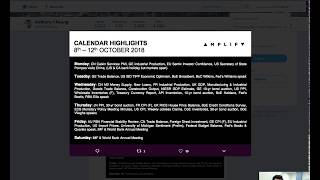
Okay, very good morning, Monday 8th of October. Hope everyone had a good weekend. We're going to cover a couple things, a look ahead to the week, as you can see on my screen now, where some of the kind of flashpoints activity may occur. We're also going to look at some news from China overnight from the PBOC cutting their RRR, their reserve requirement ratio, again. I think it's a fourth time now this year. Brazil update on elections. Italy kind of move back to some renewed concerns again weighing on their market this morning. And then oil, a couple of things to be aware of from comments out of Saudi and the US over the weekend. I'm gonna focus on the, the news this morning, and then what I'll do is I'll let Sam jump on after the, the briefing in itself, and he can look at some of the charts in more detail. So just given it's a Monday and I want to talk about the kind of fundamentals and the macro view. I'm just going to focus on the, the news for the time being. This is the shape of the week then and what's to come. Most notably, today is the return of Chinese participants from the week-long Golden Week, and they've not wasted any time being active, both from a monetary policy perspective, as I just mentioned, with the PBOC cutting the RRR but also with this just general reaction in the market playing catch-up to the negativity that developed from the kind of spike in US yields that prompted a US equity sell-off kind of theme for last week. We even saw that late post-payrolls on Friday where you had the kind of the blip, if you like, a miss on the headline, wages fairly stable, but then what happened that that kind of trend channel we're watching in the Nasdaq and US equities collectively saw some weaknesses as markets continue to see concerns about what this might mean for the overtly optimistic Powell that we've had of late. So we've had some pressure in the Chinese markets overnight. So let's just jump to that before we get really through every day of this week. And well, first of all, what is— I guess for some of the new people to market— what is the reserve requirement ratio? Because this is slightly different. This isn't the rate of interest like a traditional interest rate in the UK, for example. What this is, is the amount of cash lenders hold as reserves, essentially. So as a byproduct of the kind of financial global crisis that we had in the last decade, the RRR value went up in order to then, um, that banks are shored up in respect to negative economic scenarios, excuse me, uh, that they've got enough liquidity to be able to operate and keep the economy running. Now what's happened is the PBOC have lowered the reserved requirement ratio for some lenders by 1 percentage point. It's going to be effective the 15th of October. The cut will release— in terms of what does this mean in terms of monetary value, it will release around 1.2 trillion yuan. That's about just shy of $200 billion, of which approximately half of that will be used to repay existing medium-term funding facilities which are maturing. So again, it's, it's a little bit different from a rate cut of sorts. It's kind of a little bit softer move than that, but certainly would be akin to easing. It does come as the, the country looking to keep the economy on the path of a soft landing amid the persistent ongoing trade tensions. Obviously, we'll be expecting that to kind of come back to the forefront now they've returned from holiday, what otherwise was quite quiet during the week. And then We think more easing measures are needed to foster, according to some banks, more modest rebound in credit growth. This is why they've taken this on board. This does come as well amid Chinese economic data. You remember last week, obviously they weren't here, but their manufacturing sector worsened in September with the official reading for new exports falling to the lowest level since 2016. So a lot of reactionary effect to the, the the continued slowdown that we've seen in their economy. But despite that, the markets are negative overnight in China. The, the CSI, which is basically their, their larger-cap companies in both the mainland, um, in Shanghai and Shenzhen, were down about 4% as an index. Shanghai Composite also lower, so a little bit negative there irrespective of those moves. But I'd say this is more kind of catch up with what we saw predominantly led by the US from last week. Um, so going back to then other major things that we've seen from Brazil, we've had an update. Obviously we've been monitoring the emerging markets, so you've got China weakness overnight. I did see that the Indonesian currency has touched a fresh two-decade low as well, so the EM certainly are back in focus. But one particular more positive development has been in Brazil. Their president and parliamentary elections at the weekend have resulted in Bolsonaro getting 46%. So this is actually just short of having a majority, which would have been a surprise. The actual amount of which he managed to get of percentage of the entire vote was actually much higher than predicted and is seen as actually much more market-friendly. So the last print was that Bolsonaro wound up with 46.2%. Um, this then leads on to a second round runoff because there wasn't a majority achieved, which is going to happen on the 28th of October. But from a statistical point of view, I think it's every last time over the last 3 decades or so that we've gone into a second round, then the person who's led in the first round has gone on to win. So more than likely now that he's going, going to go on and win this election. Now, the showing was stronger than expected, although the market has been moving in recent days to price in momentum in his favour, as I said, has been more perceived to be market-friendly. Today's results should provide additional support to Brazilian assets when their market reopens. That's according to the likes of UBS Wealth Management. I've, I've seen Goldman's in a research report also saying similar. It comes after he's been seen as someone who can take control of the kind of various economic mismanagement of the country under the the left-wing party and the corruption scandals that we had seen. It does come irrespective of some pretty punchy comments that I've seen that he's made in the past about women and homosexuality. But irrespective of that, it seems the economic argument and this kind of crackdown on corruption has really kind of won out with the voting public. One of the other things are that it's still quite unclear about his economic policies. But he has enlisted an advisor who is in favor of privatizations and overhauling the pension and tax systems, all of which are then seen to be net beneficial for short-term pricing for the local stock market, just given how beaten down the EMs have been of late. So be interested to see how they react. And if anything, with emerging markets, see a lot of sensitivity around certain countries. This at least seems short-term is a little bit more positive. On the flip side, this not so positive. Italy, which had kind of gone from bad to good given the concession that we had last week where they had revised their budget deficit goals not for 2019 but for 2020 and '21. Now what you've had is the Deputy Prime Minister Di Maio has come out and basically said his anti-austerity view will grow stronger across the continent. He's been speaking out against Europe, sparked new controversy with the EU by saying Italy will not allow unauthorized flights carrying non-European migrants from Germany to land in Italian airports. He went as far then as to post an Instagram picture of Juncker and Merkel where the hashtag #CloseAirports. So this is obviously going to rile up the European officials and it's going to make markets for Italian assets panic again, I would imagine, and only going to bring more further pressure among what already has been there with their budget, which is due to come up for EU Commission who are going to review their submit draft budgetary plans on October 15th, so only in about 5 days' time. To give you an idea, the Italian parliament, they're debating the government's budget outline on Tuesday with their finance minister. So I'd have it a guess that we're going to see quite a bit more volatility picking up for Italy ahead. I have just seen a graphic flash up here on my, on my screen. If I just bring it up to bring it into a bit of perspective how the market's reacting this morning, you can see that the Italian 10-year yield rises to its highest level in 4.5 years again. So this latest commentary is causing some more concerns amongst investors for the Italian situation. Elsewhere for oil, a little bit backing off of prices, coming after really two things. Obviously we've had quite a significant run-up in prices of late, both technically breaking key levels, but also as well with this thinking that the market is overtly long positioned with the looming November implementation of the Iran sanctions, what that will do for their production. And the shortfall that will make, given that Saudi and Russia's contributions of any extra output are seen to be not enough to fill the gap. But over the weekend, a few comments— Saudi Arabia has come out and said that it can tap its spare production capacity immediately to offset any declines in Iranian crude exports, according to the Crown Prince in an interview at the weekend. Now, I guess this is slightly different. We know that we're at pretty much record levels in Saudi production. I think it was around 10.7 million reported last week. However, they can go to 12. The question marks are how quickly, and according to MBS at the weekend, they can tap into this immediately. So I think that's hence the reason why the market's seen a little bit of response to these comments. In addition to this, a little bit of backing off then of the, um, you know, this is kind of politics at play, you could say, because it's the US sanctions on Iran that's caused or been a key culprit for this spike in oil prices of late. So now the US is said to be in talks with Iranian oil buyers over waivers. So, you know, reading between the lines here, obviously higher oil prices equating to higher prices at the pump for Trump going into the midterms is obviously not a good thing. So what why not just then soften the kind of blow, if you like, of these sanctions by just allowing people to still have waivers. So that then, in addition to the Saudi comments, has seen a little bit of reversal of prices. The other story to update on then is Brexit. We've gone through the Tory Party conference, no real fireworks there to speak of. But then looking forward, what else is there to come this week? Is there anything you got to be aware of if you're a sterling trader? Well, couple things. So just skipping forward to where we are going this week. Tuesday, the DUP goes to Brussels. Arlene Foster expected to hold talks with Barnier. This obviously could be of interest just given that Theresa May's most pressing issue at the moment is resolving this issue on the Irish border, and that has prompted then some fraction between the ability for her to get a compromise with the EU, but also keeping happy the DUP, which she absolutely needs their support in Parliament, uh, just given the compromise of a working majority. Then we've got Barnier will present draft political declaration declarations, excuse me, to the EU commissioners on Wednesday. And this then comes ahead of the week after. So next week is when we've got the EU summit of where we're looking to make some real concrete progress. We've already got penciled in a November meeting. So a couple of things to look out for from the Brexit side. I'd say though, for me, there's bigger things I'd be more focused on, and that's going to be China playing just given the response of this move playing catch-up from what happened last week. This persistent movement in yields with the US economic data heating up from last week, I think it's key. Um, and then Italy, I think, is going to be quite a focal point for the week ahead as well. So I'd say Brexit for me is a little bit lower down the pecking order of things to look out for. Looking at the, the calendar, one thing is we've kind of had most of of the major US economic data out now. The one thing I guess that does capture a bit of interest is US CPI is going to be coming out on Thursday. Other highlights on the calendar to be aware of today, you do have— it's Columbus Day in America, so that does mean that it's a public holiday. But in terms of the NYSE, that is open as per normal, so equity trade is normal, but the cash Treasury market is closed, so no T-notes. But looking forward to Tuesday, pretty quiet. A couple of speakers to be aware of across the three major central banks: BOE's Broadbent, BoC's Wilkins, Fed's Williams. Wednesday, things pick up a little bit. UK GDP alongside manufacturing, industrial, and trade balance, as well as construction output and NIESR GDP estimates. A little cluster of UK updates on the economic situation. We've also got 10-year bond auctions coming out of the US and Germany Thursday. Looking out for the ECB policy minutes, always now something in this current, guys, given the winding up of QE table for the end of the year and the subsequent rate hike into Q3 of 2019. I do think that ECB minutes historically, which are typically quite dull, have now become quite interesting. So look out for that on Thursday. And then Friday could be interesting for the sake of when we come in in the morning, we're going to be able to look at the Chinese trade data and foreign direct investment. And just given the general slowdown and trying to ascertain the pace of the economic slowdown in China, whether it will be kind of hard or soft, I mean, they're attempting to do everything in their powers to make it the latter. The data on Friday could be quite telling from China. And then from the US, we'll get things like University of Michigan sentiment, the prelim report. And one thing that is missing off of here on Friday is you kind of blink and the next thing you know, another quarter is gone. And actually, it's US earnings season, and that starts on Friday. You've got the likes of Citi, JP Morgan, and Wells Fargo all due to report pre-market on Friday. Okay, so, so that's it for the moment. As I said, I'm gonna leave it at that. I'll let Sam jump on and talk through a couple of charts more technically in the next few minutes, but that's it for the kind of general broader news themes at play for the moment. I'll have the weekly strategy sent out to you before midday. Okay, thanks very much.
More from Anthony


Inside the Biggest Banking Stories You Need to Know This Week (Anthropic, Diageo, Private Credit)


Inside the Biggest M&A Deals You Need to Know This Week (UniCredit, GameStop, eBay, Eli Lilly)







AI Breakthrough or Hype? Anthropic’s Claude Mythos, Tim Cook Steps Down & LIV Golf Collapse