The Trading Week Ahead - Multi Asset Review
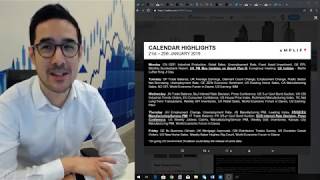
Anthony Cheung reviews the week of Jan 21-25, 2019. China's GDP hit a ten-year low at 6.4%, though industrial output and retail sales stabilized. The US government shutdown looms over markets, while the ECB meets Thursday and could signal more dovish policy.
Chapters
Very good morning, it is Monday, 21st of January. Hope you are well and had a good weekend. You're wrapped up warm this morning. Doing the briefing today is mainly about a look forward to the week. Obviously there's a US holiday, it's Martin Luther King Jr. Day in the US, which means their markets are closed or shortened electronic trading sessions. So do bear that in mind. As you can see to the side of me, trying to point side. That's this side. There's the calendar of the week as a whole. So for those internal at Amplify, we will— Sam and I send out a weekly strategy report with some technical kind of setups as well as a fundamental overview. But you can grab this off of Twitter at the moment, whether mine or the Amplify account. But running through here We're going to isolate a couple of key individual events to focus on. First is an assessment of the Chinese economy. We had some important economic data overnight, and what's the reaction? What does it mean, and what do we need to look for going forward? We've then of course got UK Prime Minister Theresa May due to give an update on Plan B, whatever Plan B is. and we'll discuss some potential options and timings around that for today. Then, as I said, it is a US holiday, so just— you want to be approaching today's session specifically with that in mind. The afternoon likely to be very quiet. Otherwise, the other main things I've got highlighted here, and I'll let you go through this in its entirety in your own time, but Thursday Uh, you get some really interesting data. We're going to have a look at the PMIs in a bit more color in a second, but they are the prelude, if you like, to the ECB interest rate decision. Not that we're expecting a great deal from the European Central Bank, but Mario Draghi's press conference could well be very interesting just given the economic global environment at the moment. And is there any potential risk of him changing that, um, the kind of the, the balance at the moment of his outlook for the global economy. Is that now more tilted downside to the point of becoming more dovish? Uh, is going to be quite key to, to interpret what he says. So yeah, that's a couple of overview points. We're going to talk through some of them now in a bit more detail, starting off Looking at the S&P 500, obviously that was a quite a big level we were looking at here last week, which was that kind of cluster, if you like, of economic indicators or technical indicators where you had the— what is the 50 DMA, the trend channel, the, uh, fib retracement 50% level, you know, a lot of different technical points that all came and were swiftly broken, and then we continued to push on to the upside at the end of last week. And you can see really how key that level was because when we broke above it on that day, which was the 17th, so what, last Thursday, came back, back down to the 50% fib retracement, and then it just exploded higher again at the end of last week to where we are at the moment. So things I've got marked up here are rectangles, kind of upside-downside targets if you like. I think if we continue to move higher here, then you've got that high that was printed back on the 12th of December here, which in the futures was 2686.5. And they're just above here, you've got kind of a bit of a cluster of other levels to be aware of, in particular the next kind of fib level, which is pretty much right on the 2700 handle as well. So that's going to be obviously quite key around here if we do get up to there. Beyond that point then, the red line is the 200 DMA. Then you've got the, the kind of trend line from those 3 peaks that we had, the October, November, December, that held the price action following that fall that we had going from the all-time high to the original October sell-off. Uh, that was also quite a key area, and that would probably likely come in around the 2800 mark as well. So yeah, I mean, you kind of look at these levels, certainly 2800, and you think, well, that's quite a long way off. But you know, just look how far we've come. I mean, it's only— it's not even really been a month, and we've rallied from the best part of 2330 well, 2320 all the way up to where we are in today's price point, which is 2662. So, you know, we've had a monster return, if you like. And obviously we know the reasons underlying this have been predominantly down to a change from the Fed, but also some positive noises coming out of the trade front. And on that note, that's certainly a subject still we need to keep a close eye on. The big one though at the moment going forward as to whether or not this equity market can continue to push to the upside is of course, well, two things. One, let's have a look at this, which is the global macro perspective of Chinese economic growth. We had a kind of cluster of data overnight and the Chinese economy slows to its weakest pace since 2009. So if I just go back to here, this is the China GDP annual growth rate printing at 6.4%. Um, you can see here we've got all the way back to that obviously strong downturn that we saw amid the global financial crisis. Anything below that 6 would be then going back all the way on a year-on-year annual basis to, you know, kind kind of the early 1990s. So you can see why people are starting to get a little bit nervous about this, this kind of China but global slowdown, as we get very close to quite key levels that this statistical data has printed before. One thing is though, as much as that's a pretty frightening headline, i.e., a 10-year low in growth rates in one of the world's most important economies, the fact is, is that people are already positioned for this. It's not really new information, it's just confirmation of what we already know. So if you thought you're going to see a kind of extreme bouts of risk-off this morning, then you're going to be disappointed. If that number was to come in at a real surprise of, let's say, the lower bound of 6%, 6 or 6.1, then sure, that's a massive slowdown in terms of its severity, whereas this has been fairly incremental. Underlying this as well is, is really two things. You had other data points coming out overnight that you had industrial output, fixed asset investment, and retail sales, all of which showed either stabilization or in fact some improvement. So that's also kind of mitigating any sentiment which might come off the headline. And then second to that, remember not just last week but recent weeks, and really this goes all the way back to November, you know, the government and the central bank, the PBOC, have been very vocal about their willingness to step into the market and do what's necessary to counteract this ongoing downturn. So I think at the moment the market is comfortable with this, and would I see at this point at least the present situation a big risk to this equity move? Well, I don't really think so. Um, obviously the trade wars at some point do need to see some progression, but that trade truce, you've still got another couple of weeks to run before those tariffs kind of kick into the higher level. And this is when you're already starting to see Trump kind of massaging this, uh, message of, of positive developments. And I'd expect that to kind of continue, uh, for the moment, but obviously a large tail risk should things not go, uh, in the right direction. The other thing, of course, which a lot of people are looking at is the government shutdown. Uh, let me just show you a graphic here. I think I had one, uh, there. So this is the government shutdowns. We already know it's a, it's a record, but just putting it into kind of a graphic form. You can see here, uh, going back to Clinton and Obama, the last time we had such a lengthy shutdown. But certainly it was quite interesting last week. Markets, as we've discussed, rallied. So I was anticipating potentially in the back end of the week maybe a bit of negativity would set in, but that hasn't been the case. And it looks like we could be in this situation for a number of days, if not more weeks to go. One of the key things I think here about trying to assess the timeline of when a compromise will be made on Capitol Hill to get some kind of progression— well, as long as the stock market is holding up and in fact rallying— I mean, I'm not sure if you check Trump's Twitter at the weekend, I think he must have had a few beers or something, but he rapidly fired out about 10 or 12 tweets just saying how great the stock market is looking and how fantastic unemployment is, how amazing his presidency is, and how fake news because no one's reporting what a great economy we've got. I suppose, yeah, if you want to look at it in one angle, sure. But the point being is that I think as long as the market's holding up, and we're not selling off like we were at the end of last year, I don't really see any reason for Trump to kind of give in to the Democrats at this point. I think he can force their hand as long as the, you know, the things that he defines as health of an economy, which is the stock market, continues to hold firm. You would think though there's only so long that that can run for, is the key. Well, on that note, from a timing point of view, well, here's a story on Bloomberg with a few things to be aware of. The number 3 House Democrat in the rankings— so obviously Pelosi at the top— um, Clyburn is his name— said Trump should first agree to open the government to give lawmakers several weeks to negotiate a deal that would include more money for a wall for the southern US border. This comes after Trump had tried to give a slight concession on this issue of Dreamers to appease some of the more kind of moderate Democrats. Dreamers, for those of you who are not aware of this policy, this is what a Dreamer is: it's a child of unauthorized immigrants to the US. So it's called DACA, the Deferred Action for Childhood Arrivals, which was designed to provide relief from the threat of deportation. And obviously this is all around this key issue of immigration. That's very important. So timing-wise, the Senate plans to hold a vote as early as tomorrow. Remember, it's a holiday today. And that would fund the parts of the government have been shut down till October 1st and provide $12 billion in disaster aid while enacting Trump's compromise immigration offer. Senate Majority Leader Mitch McConnell will attempt to amend the House-passed spending bill with the text of the new legislation on Tuesday, according to those familiar with the matter. Now, the reason why this quite interesting with the timing is that the vote would come then just before about 800,000 federal workers are set to miss their second paycheck on Friday from the shutdown. And again, this is when I think Trump is— you might see some movement on both sides of the table for some sort of deal to be made, because when people keep now not getting paid, this is that then knock-on effect of economic consequence that will start to manifest and build over time. And at that point, then it could become the trigger effect for the— for a meaningful move lower. For the moment, though, with the US on holiday and with Theresa May talking in Parliament for, what, the fourth time in 8 days or something, then I think this is an issue for certainly from Tuesday onwards, but probably the latter part of the week, I would suggest. Okay, moving on to Theresa. What have we got? Well, she's still alive and fighting over the weekend. The latest here is that obviously following the failed votes from Last week, Theresa May will return to Parliament today, having briefed her cabinet on Sunday evening. And the headline is, is that there's little prospect of a cross-party Brexit talk succeeding. Now, if you remember, if we go back to the pound, one of the main reasons that the pound really rallied, even though it was such a heavy defeat that Theresa May had with her original plan, was because this idea that, well, it's going to kind of force now the hand of cross-party coordination, which could ultimately lead to a more softer Brexit and a higher likelihood of then requiring an extension of Article 50. And we had what I'd probably classify as a relief rally, if anything, in the pound. And we got up to that kind of 61.8% retracement of that Q4 decline that we had in the pound, and which was coinciding roughly at around the 1.30 handle. And then we've had quite a decent pullback since that point, as we now await the next kind of move from May. So what are we looking at here from a story point of view? What are the main headlines? Well, those cabinet discussions that May was having at the weekend, apparently, according to people familiar with the talks, an extension of Article 50 process was not discussed. Yeah, I'm not sure if I believe that. I'm sure behind closed doors it probably is, but May certainly from a leverage point of view has been very much, uh, of the, uh, the kind of view that that should not really be discussed yet. We need to get this deal, the existing one, if anything updated, amended, and then re-voted upon. Because a lot of the play or belief has been that she wants to force force this right down to the 11th hour to get MPs on side. Monday, though, today, will also see moves by members of Parliament— and this is one of the big headlines from the Sunday Times at the weekend— moves by members of Parliament to seize control of the Brexit process. So the former Attorney General Dominic Grieve is drafting a temporary amendment to the Standing Orders of the House of Commons that would give time to a backbench motion on what should happen next. Another former minister, Nick Bowles, is proposing that this slot be used to pass a bill that would require the government to extend Article 50 if no deal could be reached. So yeah, that first one is probably the one of which again is kind of viewed as being more sterling friendly. The fact that if Parliament can kind of seize control means then you avert any possibility of having a no deal, is kind of removed off the table. And then do we then go into this kind of request for an extension of Article 50? Although the UK could on that point unilaterally withdraw Article 50, European officials have been discussing the idea at the weekend but according to the press reports and sources in the Sunday press, they're very divided and split over what is the best possible course of action here. Now, you had Angela Merkel, the German Chancellor, she's been actually very open to the prospect of this happening. She said that, "We will work until the last day to ensure an orderly Brexit." and signaled that it's the responsibility for a successful withdrawal doesn't lie solely on the UK and the EU must do its part. So, you know, a little bit of division here by, of what was looking like the new political coupling of Macron and Merkel, seemingly quite divided on how the best course of action is at the moment. Other people at the weekend, Trade Secretary Liam Fox talking on the BBC on Sunday, No Deal Brexit was a real possibility. I think, okay Liam, we've got the memo, we know this, we know that you don't mean that. I think that's pretty clear, but he's just kind of toeing the line of what he has to say essentially. But I think people have kind of got over that fact now. The Telegraph reported something that was relatively interesting, however I don't give it hardly any credibility. They said on Sunday evening that Theresa May was considering rewriting the Good Friday Agreement. I just cannot see that being even broached as an idea for discussion. I just think that that Good Friday Agreement is just so pivotal for that, that area on the border. So I don't think that's gonna have much legs, to be honest. So yep, Looking out, we don't have any real set times to hand at the moment, but as soon as this briefing is done, I'll update the chat room with all the timings of when we can expect Parliament. But normally it's from midday onwards. So final thing I wanted to say, and, and this could be, you know, not to go too conspiracy theorist, but this is Laura Koonsberg, who I'm sure everyone knows very well by now. This is the kind of chief political correspondent correspondent of the BBC. Now she said quite an interesting thing this morning, about half an hour ago. She said, another week and nothing's changed, which is pretty extraordinary just given the defeat and the size that we had from Theresa May. You would have thought that just given that, it could have been the catalyst needed for some sort of change, but that obviously hasn't happened. As I've gone through the news, not a lot really has moved on at this point. We kind of skip forward Without Labour frontbench being involved, a softening up of May's Brexit position may have pulled some Labour MPs across, but would there ever be enough to outweigh the dozens and dozens of Eurosceptics? Now this is the interesting part. Kuhnsberg says, but a softer Brexit may be where Parliament pushes the government in any case next week. For a long time, some conspiracists around the place have believed that this is what May ultimately wants. Parliament will take it out of her hands so she can't be blamed by her party. Quite an interesting concept, that, actually. So is this, is this all just part of the bigger play for Theresa May? She brings the deal, she even comes back in with a second deal which fails again. There is no possibility of her changing not because any of the other Tory members likely won't have sufficient backing, i.e., some of the Brexiteers, then you want a version of no deal. No one in any other political party apart from a faction of the Labour left wing want Jeremy Corbyn as Prime Minister, so she's kind of pretty robust on that side. But if you really want to get this government kind of getting rid of responsibility for here, the end outcome, and that you can remain in place even though there's no real great overall majority leadership. Well, how about you just go down the route of Parliament does take control, and then the decisions, really, you can say, well, it's not my fault, it's Parliament's fault. Um, so it could be quite interesting to see how that, that plays out. All right, moving on, a couple of other points here to have a look at for the week. I said Thursday was quite key. You you can see down here, about here. Thursday, you're looking at the French-German EU manufacturing service PMIs and ECB rate decision. Now, one thing that I was just looking at at the weekend was this, and I was looking at the previous manufacturing and service PMIs that we've had out of the big countries. So this is France. Now, you can see here that the manufacturing PMI in France kind of dripped lower in the last 6 months to the point of where we've gone under 50, and 50 being at the point of contraction. And so it marks the first deterioration in factory activity since September 2016. Further automotive sector slowdown, and of course something which is kind of having a, a noticeable impact on economic performance in France and confidence about the near-term future, which is the anti-government protests. Now, if you look at the service side, well, that number was the first contraction activity since the summer of 2016. Again, those protests were in focus. New orders fell for the first time in 34 months, and you can see there quite a dramatic drop that we had. We were fairly constant above 54, around 55 on an average over the last 6 or 7 readings, and it just drops like a stone through 50. Flipping over to other European areas, and obviously the kind of engine room, if you like, Germany and their manufacturing sector, their last PMI number was— the latest reading points to the weakest expansion in manufacturing sector since March 2016. New orders fell further, and both accumulation of finished goods stocks and backlogs of work continued to decline. So this is what the picture looks like for Germany. So this is that something that Piers and I discussed at the end of last year, our look ahead for 2019, something which we felt was a little bit underplayed was this, this kind of— there's just so many other big macro themes from Brexit to to Trump and the government shutdown, to the trade wars and China, that it's almost as if the European slowdown is going a little bit unnoticed. And actually, I think that this Thursday, the PMI data— important because these are the preliminaries, the most market-moving ones that we'll see— it's going to be interesting to see what is the current state of play, you know, politically in, in these individual countries. They've also got their own issues, whether it's in Italy, Germany, or France, and beyond. That, in the context of the broader picture, I think it's going to be very interesting for when then we get the ECB interest rate decision and press conference a few hours later on Thursday. That then, I think, could be a really interesting day for trading things like the euro, the Bund in particular, because this kind of balance of risks that the ECB sees You know, I think the more that Draghi talks about them, i.e., the different ones, and to what extent does he go into detail, will define then how worried the markets will believe that the ECB members are becoming about a deterioration in the global environment, and consequently then the ECB having to become more dovish. So yeah, I think Thursday actually could be quite interesting. Remember, we're not expecting anything from the ECB in terms of actual policy change or anything like that, but the wordplay on that, um, the kind of global environment will be absolutely key to trading that event. Um, otherwise you've got the World Economic Forum happening in Davos. Uh, that can be quite interesting actually as a trader or a market participant to monitor because that's all the major movers and shakers both in the political and finance world However, there's a government shutdown, there's Brexit, there's, you know, there's lots of other things that are happening which means a lot of the major heads of state will not be appearing. So it's lost a little bit of its gravitas as a meeting and its potential impact then in these headline keynote speeches to really move markets. It does kick off tomorrow and it goes through the entirety of the week, so just something to to be aware of. Um, final few things. This is the earnings calendar. I know the pictures are a little bit small, so let me just give you an overview. Um, there's— this is kind of that week between the major investment banks reporting, which we had last week. Then you have this week, then you have like the whole dump of the S&P 500, if you like. So key ones from this week, you've got IBM due after market on Tuesday, You've got a few other quite interesting names like Johnson Johnson, Halliburton. They're a little bit bigger from a market cap point of view. They'll be pre-open on Tuesday. Remember, very few coming out today because of the US holiday. Then moving on Wednesday, pre-market Procter Gamble, Comcast. Thursday, Intel aftermarket. The others again important from a single stock perspective but not so much from an index driving points of view that we're looking at in the futures market. Yeah, and then finally Friday, again quite interesting I think, will be— you've got the German IFO business climate. Now I had a question last night because I did like a live chat online, and it was, well, how important is German IFO? I think there's there's two ways to really look at when you're approaching this economic data. One is, is it important, as in, is there going to be an immediate move in the market? Now, with IFO, I think probably not. Now, expectation is, just given the economic environment in Europe as we've just discussed, then you would think that in a soft survey measure of forward-looking confidence for the next 6 months, German corporates are probably becoming more pessimistic. I don't think that's particularly that big a deal. It just depends, well, how severe has their confidence dropped, I guess, will be quite key. Could there be an immediate move? Possibly. But the bigger kind of idea here is then, well, what does this really mean for the ECB and their forward plans? You know, we heard from them, they were fairly constant even though they had their projections in their recent interest rate meeting, or the last one where they downgraded growth prospects, um, they didn't really change or alter too much their actual language. Now, that's kind of the next step, if you like, if they are going to become more responsive to a, uh, a kind of weakening overall outlook, which is going to be quite key. So I think IFO plays a, a pivotal role for more of an assessment of conditions going forward, not on an intraday, but in the kind of the short to medium term, if you like, and the consequences this can mean for monetary policy in the, in the euro area. All right, so that's it. There's no need for me to show you a calendar for the rest of today because obviously there is no major North American data coming because of the holiday. So remember, the New York Stock Exchange is closed As to as the floor in Chicago, you've just got shortened electronic trading hours in the US. So I think things to watch this morning is going to be particularly the pound to see how things play out. And I guess around midday we'll be looking out for those comments, but I'll look to confirm. And then yeah, that's it. So we'll send out a weekly strategy report shortly. Uh, Sam's going to be on that today, so I'm sure he'll have some good levels across different charts that he's looking at. As well from a technical perspective. Okay guys, that's it. Have a good day ahead and a good week. Thanks very much.
More from Anthony


Inside the Biggest Banking Stories You Need to Know This Week (Anthropic, Diageo, Private Credit)


Inside the Biggest M&A Deals You Need to Know This Week (UniCredit, GameStop, eBay, Eli Lilly)







AI Breakthrough or Hype? Anthropic’s Claude Mythos, Tim Cook Steps Down & LIV Golf Collapse