The Trading Week Ahead - Multi Asset Review
Anthony Cheung reviews the week ahead across currencies, stocks, and commodities. Brexit vote outcomes could push GBP/USD between 1.25 and 1.32. US earnings season starts with banks and Netflix as key signals, while WTI crude holds at $50 support.
Chapters
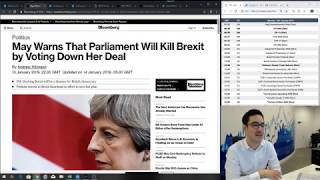
Very good morning, Monday 14th of January. Hope you had a fantastic weekend, ready to go for a fresh week ahead, and plenty to go at, whether it be the vote in Parliament, of course, for Theresa May's dreaded Brexit plan. We're going to talk about that quite a bit more detail in the next couple of moments. We've also got the extension ongoing US government shutdown, the longest of which in modern US history, and what that could mean for markets from an equity perspective. And then also an update on China because we've had some trade balance data overnight which continues to show that their economy is suffering at the moment. So getting things underway, um, as per always the case on a Monday, I usually like to start with a bit of an overview of the week in its entirety, and then what I do is essentially I circle back to this, right to the beginning, at the end. Now, looking at the major things to be aware of here before we go into them in more detail, we've got the US earnings season due to begin. I've got an overview for you, and as per the typical structure of earnings season, we get the big bank stocks stocks today being the first with Citi. They kick off proceedings, followed by JPMorgan, Goldman Sachs, Bank of America, Morgan Stanley. They're all due this week, and then the bulk of the S&P 500 start coming as of next week. One of the key ones there, of course, will be Netflix, not because they're a particularly big company, but they'll be the first of the, the kind of FANG names to report. We've then got the, the meaningful vote, of course, on Tuesday. A look through the overall week from the UK perspective, you've got UK inflation data CPI coming out on Wednesday alongside as well separately a Bank of England governor speech from Mark Carney. You've got things like the Fed's Beige Book, which is not typically a market mover but could be just given the context of now kind of more dovish-leaning Fed, a regional insight to the reserve banks and what they're thinking. More localized in the regions across the US. And then you've got this G20 meeting kind of bookending the latter part of the week. You'll note though here, both on my calendar and also the daily calendar here on the right-hand side, there's an asterisk on some of them. One thing for sure to be aware of today with US data and the coming days is we are in the midst of a government shutdown. And so it could be expected that a number of large data points will be delayed. That has been the case already from last week. Okay, well, let's kick things off and let's talk about this lady, obviously dominated the, the weekend's press, and that is Theresa May, because we are just one day away now from that vote on whether her current deal in its present form is enough to pass through Parliament. Now, a couple of headlines in the weekend here just to make you aware of, and a few things from the press this morning. One is Theresa May's going to be speaking later on today, significantly from the, the city of Stoke. Now, Stoke emphatically voted to leave the EU. In fact, the most out of anywhere in Britain. So obviously singled out and chosen by the PR team of Theresa May that she's going to be delivering this kind of keynote Brexit speech to kind of bang home the point that thwarting Brexit would betray millions of voters who obviously opted to vote to leave the EU. So not going to be surprising to hear that type of rhetoric from the Prime Minister. The more important thing here is how's this vote going to play out when we have it tomorrow. Now some of the headlines have read, and this was one, this was the Sunday Times reported that some lawmakers are planning to seize control of the legislative agenda from the government. Now essentially what this would mean, if you kind of read through the article at the weekend, is that Brexit is going to be delayed. And in fact, then, taking it— removal out of her hands brings about the prospects of potential other alternatives, one being that the whole Brexit idea inevitably comes into question, whether it could get reversed. Other things from other press is speculating about. If we go back to here, well, if it's pretty well known and it's the market consensus that this deal is gonna, gonna fail, well then what happens next? Now here's a— and I know you've had lots of these over recent weeks— but here's a path to Parliament tree of actions that could take place, and the vote is here at the top. The base case scenario is that it fails. We'll get to in a second how much it fails is really going to be quite crucial for in order to fathom how the pound might react. But if it gets rejected, this is when we go down the various different avenues, and there's kind of 3 initially. One is a no deal, and actually we remain completely at loggerheads and we go into March 29th and we have a no deal. That, I would say, is a very low probability. There's been lots of legislative changes that have happened recently, in fact last week on the Finance Bill and others, the Grieve Amendment, which has meant that that's probably a very low case scenario now. Enough cross-party support to avoid that worse economic case. Then it comes down to, and I think what will be the first most likely option, which is we kind of go back to Plan B. Any ideas? Any further EU concessions? But basically Theresa May gets another go at this. Remember, there was press reports 2 weeks ago saying that it could be the case that she's willing to go as many as 30 times back and forth. Now, it's highly unlikely it's going to get to that many, but one thing to be clear here is that if Theresa May fails I don't think she's going to fail by the amount that's going to lead to her having to resign or anything like that. I think she's just going to have enough time to go again back to Brussels, another plan slightly tweaked goes back to Parliament for another vote, and then we go back to accept or reject again, and then the whole thing begins. The other things though that people have spoken about, of course, are if Brexit is delayed, and this— does this go down to Labour Party forces an election. I just caught some shots this morning, I didn't watch it live, but Jeremy Corbyn looks like was on Andrew Marr on Sunday and pressed on the question of when and are you going to call a general election. Kind of true to form, being quite uncommitted to exactly the course of action. But he was quite forceful last week in calling for the fact that he will challenge the government, not Theresa May as he did previously. Theresa May calls an election. I think, well, I don't know why Bloomberg's really put that. I think that's incredibly unlikely. And then a second referendum, which obviously has been growing, although a low probability scenario at this present point. So a few things and a few other charts just to refresh our memories here. And that is one, well, I found this at the weekend, and this was a survey of 11 major financial institutions. This includes the likes of Credit Agricole, Nomura, RBC, SocGen, so on and so forth. And this is their forecasts for where they think cable could trade to with the associated percentage probability of the outcome. Now you'll see here 50%, so the highest probability outcome is an extension to Article 50, something which we've been talking about for a number of weeks. Which, you know, if there's any— there's no smoke without fire. The reports from last week that caused that high volatility spike at the end of last week in the pound was down to the fact that it's looking almost inevitable that that's likely to be the case. And I absolutely still think that that will occur. Otherwise, deal passes the second time is actually the next most probable event, both of these of which would be net positive. If Theresa May's plan passes tomorrow, get ready for that pound to move sharply to the upside. Now, that's not because Brexit is solved or anything like that. It's just because the market is not priced for that outcome, and it passing means then we can more smoothly or orderly move into a transition phase which removes then that kind of cliff-edge timeline of March 29th, meaning we've now got 2 years or even more to negotiate Brexit, which would mean that the pound now needs to appreciate, particularly in the context of what has been a generally softer dollar with a dovish Fed. Second referendum obviously has been growing, uh, that could be, um, the most pound-friendly according to these major 11 financial institutions. Now the reason for that is a second referendum could well open up the dawn prospect of Brexit is off, the entire reversal of the whole thing, and then that would be the most pound-positive outcome. The most impactful for the downside, of course, would be no deal. A general election would, would be seen on consensus by these banks to weaken the pound which makes sense because remember we looked at those average poll of polls before and it's a complete toss-up between Labour and the Conservatives, so you're likely to remain in as political uncertainty as we're in at the moment. It's not going to increase or help at all really. The other thing then is this, and this was something we were looking at behind the reasoning of the extension of Article 50. I did send this out to you last week, but this just really quite neatly putting together the reasons why this orange line, which signifies here the 29th of March, which is the, the current timeline of the lapse of Article 50, then if we did go down those alternate options of a renegotiation, a general election, or a second referendum, by definition from a legal perspective all of them would take us beyond that point requiring an extension of Article 50. If we did get that extension, some of the talk from last week was that could be extended for anything from 12 to 24 months. I mean, that's— talk about kicking the can down the road. But if you kick it far enough, well, then out of sight, out of mind, and we'll deal with this probably much later. And you're going to get a pretty powerful relief rally in the pound, would be my expectation. Having a look then, this is cable, um, sterling-dollar futures I'm looking at here on a daily continuation. And really, rather than look at the, the peak of the price activity we had at the end, really Q2 of 2018, when we pretty much almost fully reversed the EU referendum move, I'm looking more so to the, the Q4 period of the pound where we came under pressure here And where do we go from, from here? And there's a couple of, I guess, areas of significance I've tried to kind of highlight under these options just discussed. And on the upside, I do see this 130 area as quite a pivotal one for the pair, that being that kind of descending trend line from some of the price activity from SEP, October, November, so the latter part of last year. Uh, that also coming into the, the kind of 60% or so Fibonacci retracement of the move from the high that was seen in September to the low point in December with the handles. So there's kind of 3 decent reasons here, and with that 1.3050 being that previous support point, so you can see here on the left-hand side of the chart. So I'm really kind of looking at this area, this area. That's why I think here is quite pivotal for the pound on the upside. 1.30 to 1.3050 is a decent barrier should we get, um, May deals go through. I'd expect though that to be quite firmly taken out. Then you'd be looking at the 1.32 handle up here for those previous highs that were seen going back to the early part of November. On the flip side, and again, what's going to be very important for this vote tomorrow is, okay, we know likelihood is she's going to face defeat. The margin of defeat could be the most telling factor for how, how much downside potentially or not the pound sees. Now, a margin of defeat exceeding about 60 lawmakers would probably mean the government is close to death and negotiations are in uncharted waters, according to several EU officials which have been quoted in the press this morning. If she was to see a triple-digit defeat, that does bring about much more uncertainties about then Labour probably pulling the trigger and we potentially going down this challenge on the government and a general election route. And so that, I would say, would have quite severe immediate downside consequences for the pair. And if that were to play out, then I'd be looking down here this rectangle at the 1.2678, which was also the low point seen in the summer of 2018. And then the kind of bigger prevailing move would be any target down to that area, the 1.25 handle, which was the year-to-date low of last year, which takes us all the way back to the beginning of 2017 levels on the left-hand side here. Now, in order to, to kind of help try and smooth things over ahead of the vote tomorrow, The EU is expected to publish a letter today in which the bloc will reiterate that the so-called Irish backstop arrangement, if it is triggered, will only be temporary. Remember, that has been one of the most contentious issues, uh, has been fought upon over the last few months. The EU are going to say that, but I still don't think that's really going to change the equation of the outcome radically. So yeah, I'm going to leave it at that. That's the thoughts for the pound, and really I mean, if you talk about the levels I've been looking at here on this chart, I've basically got 125 on the downside, 132 on the upside. You might have thought in a normal situation, well, that's a 6-7 point move. Well, you know, welcome to the world of Brexit. And really, wherever this Brexit story goes, this week and coming weeks are really important because if we did— if extend Article 50, then really the pressure point is off. And this is going to be something then when the impact will start to dissipate because the timeline is pushed further out. Until that point, you're going to get very sharp, sudden market moves and probably large moves ahead. One thing that means for trading today's session, if you are going to be trading the pound, I would suggest staying out of any positions keeping a very close ear to the squawk and an eye on Twitter for the various journalists of— do you get a quite, um, definitive leak about the outcome of tomorrow? That could be potentially a tradable event. But otherwise, holding back, saving your ammunition for what really is going to be, uh, potentially a very big move in the market tomorrow, tomorrow night, going through Wednesday and for the rest of the week for this currency pair. Okay, let's flip over and let's have a look at something else. And this is the other one, of course, that's drawing quite a bit of attention. And this is S&P 500 futures. I mean, US net futures from an equity perspective, a little bit lower this morning. A lot of people talking about the US government shutdown. Now, very interesting that the government shutdown, which is going into must be what, the 22nd day or so, something of that nature, is now the longest government shutdown in modern history. Interestingly though, the markets have kind of brushed over this and haven't really been that concerned, but I think that that's definitely going to change this week for a couple of reasons. For one, if you were aware watching US networks at the end of last week, it was the first pay packet now that these federal staff did not get paid. Now, there's one thing working in, uh, and through that period, but when your payday comes and you don't receive pay, what you can expect then is people to start calling in sick. That means then that the 800,000 or so federal workers that were already not getting paid will now start— stop coming to work. That could then create even more, uh, kind of gridlock, if you like, and meaning that lots of different avenues start getting delayed. One being for us as, as traders in markets is the economic data releases because of departments like the Bureau of Labor Statistics, for example. And so it starts to become real very quickly. And at that point, I do think that equity markets come in the latter part of the week because they're not due to speak, Trump and Pelosi, until I think it's Wednesday, Thursday. I think equity markets will start to become increasingly sensitive if the government remains in shutdown as the week progresses, particularly the latter part of this week. So with that, the other thing is looking at this chart technically, there's a couple of, again, key areas that I've tried to mark up, uh, in advance, and one has been quite key from a technical point of view is that kind of trend channel. We were looking at that very much so a few months ago when we were threatening— there was that brief move on the 10th of December where we bolted lower through that level only to close back above it. But when we did close below there on the 14th, you can see the move. It came back up, retested the previous support turn resistance, and then that was the kind of technical setup for then that big move to the downside with the ongoing sell-off that we saw to see off the end of 2018. Point being here is we've recovered sharply. Now, we've discussed that a lot over the, over the last week, whether it's China's commitment to do whatever it takes, and really at the core of this, the Fed's change in rhetoric and tone to become more dovish and backing off now market pricing of further rate hikes to come. That's all helped this equity market recovery. The point being here is that I think now to go higher, I think you've got a real cluster of reasons here, whether it's the 50% retracement from the all-time high to the December sell-off. This is really this rectangle here I'm looking at. You've then got that, uh, the bottom side of that trend channel, which is acted as firm resistance when we tried to retest it before the move lower. And then you've got that kind of support point from some of the price levels as well going through the October-November period. So really here, um, from a technical point of view, I think it's quite a good barrier to the price movement. And we've even turned here more recently around the 2600 psychological level, which was also around that low point previously from the 29th of October. So a couple of key areas of resistance here. And what I feel now that the market's priced in the dovish Fed— I think that's kind of over and done with for the moment. If the Fed members speak and sound dovish, I think you're going to get diminishing returns from that in terms of equity upside movement, given the pricing and positioning now that we've had over the last week. Now, government shutdown, I think, puts a downside drag onto these equity prices. If we do move lower than 1 or 2552 in the futures, probably be looking at here that 38% fib retracement of that same move alongside that previous low that was seen back in the beginning of April. Uh, below there then bringing into play that February, um, sell-off that we had at the beginning of last year. That would come in at 2530 and a quarter. So any reversal on the recovery in play from last week. I'll be looking at those two key areas on the downside. The other thing, of course, aside from just the shutdown, there's a few other stories that could assist a kind of pullback, if you like. Now, when I say a pullback, I'm definitely not anticipating anything down to this region here. I'm looking more to this region here. Now, the other factors are you've got US earnings season Uh, as I said, the banks are kicking things off, and as the headline would suggest, there are some bank earning worries, uh, doing the rounds already ahead of time. So Citigroup kicks off earnings season amongst the major banks, uh, acting— and this is what happens with any first company of a sector that reports, it acts as a bit of a litmus test for the overall sector sentiment. So if Citi are bad, it's not that people wait then for JP Morgan, for Goldman Sachs, for Morgan Stanley later this week. The move, if there is to be one, they already start trading at that point. People are looking at increasing pessimism, a slew of rate cuts to kind of price target ratings that have been happening, whether it's cost management, geopolit— geopolitics, loan growth, lots of different issues which have been impacting them. And certainly the Fed now backing off their their committed rate hikes potentially would be also another net negative for the banks going forward. On that note, just while we're talking US earnings, this is what the— this is how the land lies. And yes, there are quite a few companies reporting here, but from an index trading point of view, such as what we do here at Amplify, well, really it's Citi today that's going to be a big one. You've got JP tomorrow, Bank of America, Goldman's, BlackRock on Wednesday. Got quite an eye though on Netflix, just to give us a bit of a flavor for these kind of growth stocks which really got hit. The FANG names were the biggest casualties of that December-November sell-off. How optimistic now can investors be about their forward-looking, uh, kind of medium to long-term future on their profit forecast will be very interesting again as a litmus test for those kind of technology names. So yeah, banking focus though for the earnings part. The other thing though for equities to take into consideration is the ongoing trade war. Now, not a lot of updates on trade war specifically between the US and China, conversations at the weekend, but overnight we've had trade balance data and full-year trade surplus was the biggest since 2015 on export rise. But actually, from the data in itself, the position worse since November as exports and imports weakened. So forget the full year, look at the current situation that's unfolding. And exports were a fairly considerable miss. I'm just trying to see if I can pick out the data from earlier, but it was a large miss on expectations, which continues to show about the, the kind of risks that— the downside risk that the Chinese economy is facing. And hence the reason they've already tried to get ahead of this by taking various different steps from the central bank and government intervention, whether it's liquidity injections via reserve requirement ratio cuts, whether it's regulatory change, all different forms to try and cultivate a turnaround. The other big important point here for China, which adds another worrying factor, is that actually their trade data and exports had been relatively robust for a decent period of time. Let me just stretch this out a little bit. And that was because everyone knew that these trade tariffs were coming. The way that the escalation of this has gone is that Trump had outlaid the tariff increases to kick, kick in after an X amount of period of time has passed. We know that with the current trade truce, which is due to expire on the 1st of March. So what everyone has done is they front-loaded their orders. So actually, exports in China have been relatively healthy irrespective of the fact that we've had this ever-increasing risk of a trade war. The problem is, is people can only front-load and build their inventories to a certain point where that's done, and now there's nothing much else to prop this this up, and hence you're getting a much more push to the downside. Remember, last week you had inflation, whether CPI or PPI, also weakening considerably as well because that demand has dropped off substantially. So another reason why the market can't relax just quite yet on this situation. Because the Chinese economy is still facing some quite severe headwinds at the moment. So yeah, equity-wise, I do think there's a bit of a downside bias potentially to this week. Technically looking at those areas, the kind of main themes you're monitoring are the ongoing government shutdown. Can that be— can a resolution be found? I would think that, you know, from a Trump point of view, he will continue to push this until the point that the equity market starts to sell off more meaningfully. If we did get through that 52 and started getting down to 2530, I think by the end of the week, knowing then how critical that level is, given that's that February low here, I think then Trump will, Trump will make the necessary moves and government will be reopened. So I do think there is a possibility of that happening, even in fact by the end of this week or the weekend, uh, going into a reopening for next week, um, is my kind of baseline scenario at the moment. Okay, that's pretty much it from a news perspective. So as I said, let's circle back around to, uh, today's calendar and the other things to look out for. One thing is we've talked all those reasons I've just mentioned for equities. One thing, of course, that's been moving quite in lockstep with the stock performance is that, as that of WTI crude. Now, fears of an ongoing slowdown in China, which have been evident from the statistical data overnight, fears of now the impact a government shutdown could have on the US these are all negative for the demand side of the kind of crude equation. And I was just looking here at the kind of setup for crude and key levels to monitor. And WTI crude is already down about the best part of a dollar this morning. Now, $50, I think, is quite an important point here as we do move down. You've got here a bit of a short-term trend line from some of the price activity from November, early December. And you can see the market has responded to that in the futures this morning, having acted again just like that trend channel in the S&P here. Previous support, now resistance. It's pushed back down. I think 50 is going to be quite key. So if you look, 50, you've got the psychological handle, you've got the down or kind of bottom end of the range of the consolidation of the move through the best part of November, December. And then if you go back on the charts, there's other reasons to look at that level as well. So here, quite a, quite a decent test of support coming up, and could even be within this session, uh, definitely within sight. Any move below there does start to open up, um, a bit of clean air again to potential further downside moves. So again, something to be mindful of is, is with this upside area, like I said with the S&P, if we did get up to that quite key area of resistance for those multiple reasons. And as I said, fundamentally I've got more of a downside bias for the week with the potential risk events on the docket. Then if you look here, that's just above about 26 points above current price. And with oil, I think above here, that kind of 54, 50, 55, I think is quite key as well because I think from there we also see a bit of a downturn. And I'd be expecting at the moment a fairly decent correlation between the equity and the oil performance on this basis. All right, well, that's, that's pretty much it. I'm not going to talk anymore, going to let you guys get on with things. Uh, Sam and I both available in the chat. We'll issue the weekly strategy report shortly in the next hour or so. So with that, I wish you all a fantastic day and a good week ahead. Thanks for listening.
More from Anthony


Inside the Biggest Banking Stories You Need to Know This Week (Anthropic, Diageo, Private Credit)


Inside the Biggest M&A Deals You Need to Know This Week (UniCredit, GameStop, eBay, Eli Lilly)







AI Breakthrough or Hype? Anthropic’s Claude Mythos, Tim Cook Steps Down & LIV Golf Collapse