The Truth About Working in Quant Finance with Nitish Maini, Chief Strategy Officer at WorldQuant
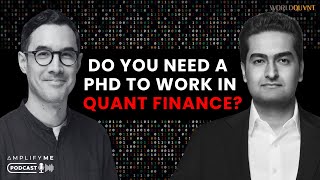
Nitish Maini, Chief Strategy Officer at WorldQuant, traces his path from IIT Kanpur through McKinsey to quant finance, debunking myths about needing a PhD or fearing AI replacement. WorldQuant runs the International Quant Championship, a three-stage competition that has drawn tens of thousands of participants from over 180 countries.
Chapters
Hello, Nitish, and really, really excited for this conversation because it's not very often where I get to talk to someone in your role as a Chief Strategy Officer, someone who works for WorldQuant and is kind of ties to the hedge fund space. So really appreciate your time and the insights I'm sure you're going to share. So for any listeners, the three areas that we're going to cover are going to be Nitish's background and his career path, which has been particularly interesting. Because it wasn't always quant finance, which we're about to find out. And then the evolution of quantitative finance and how it's changed, and interested to get your views, Satish, about where it's heading. And then finally, WorldQuant. Yes, a lot of people would've heard of WorldQuant, but not everyone. And there's this amazing competition you run that's just global and off the scale, that's off the charts. And I'd love to find out more. And there's lots of other resources as well. That I know this is a growing space of interest for students and young professionals, which I know you're going to share. So, yeah, welcome, and perhaps you could take us back to the beginning and a brief summary of your background from your childhood, student days, up to what you're doing today in your new role.
Thank you, Anthony. So I'm currently based in Connecticut, US. But I was born and brought up in Punjab, India, which is in North India. And then I trained myself for the competitive exam in India, which is called IIT JEE, which is required to, you know, you need to pass and get a good rank in that exam to go to one of the Indian Institute of Technologies, the IITs in India. So I was born and brought up in Punjab. Then I went to IIT Kanpur where I studied an integrated undergrad and master's in economics. After graduating from the university, I joined McKinsey and Company. I was very interested in business strategy, spent some time there, but then changed company, moved to WorldQuant, which is much, you know, over a decade now, 13 years at WorldQuant. As a researcher out of the India office in Mumbai, and then back in 2016, got an opportunity to move to US, uh, as a portfolio manager. And then a little over 5 years ago, I was offered to, uh, work with the CEO of WorldQuant, Igor Tsiolkovsky, to build the vision and strategy of the company. And that's what I'm doing right now. As a part of my strategy officer role, I, you know, identify the key strategic initiatives that WorldQuant should run, come up with short, medium, and long-term plans for our initiatives, decide on how we want to allocate resources of the firm across these initiatives. Then I also manage the capital allocation across various portfolio managers at the firm and across these initiatives. In addition to that, we are big on creating opportunity for the talent globally. So in my role, I run initiatives like Brain and International Quant Championship, which we'll talk about later today, to make this opportunity of quant finance available to talent across the globe.
Wow, so there's already a whole bunch of questions as you're explaining that. But the first one that actually jumped to mind was that, I guess places like India, and I wonder elsewhere in say Eastern Europe, I've heard as well. Is there, is it a normal thing for a student from those locations to then move to the US? And is that a common move or is it, or not?
Yeah. So if you're talking specifically about quant finance, then I would say quant finance was considered a very niche industry. Where you have to be in one of the big financial hubs like US or London and, you know, then Singapore, Hong Kong. But if you are in other geographies, this information about quant finance as an opportunity was not really available. But lately, say, as WorldQuant, we are running 27 offices and we are creating opportunity for the talent wherever they are. So this opportunity is now global. So if somebody does not really want to move, it is now being made available to individuals who are interested in their locations instead of having to move. But moving is also an option. Like you don't necessarily have to be in your hometowns, in your home locations, but you can also move to some of these territories, which are financial hubs. If you want to gain more exposure of how, say, Wall Street runs.
And also you mentioned McKinsey, you mentioned McKinsey and I know KPMG as well. And so I just wondered what drove the decision to pivot, because I know a lot of students kind of tend to think that their commitment very early in their career will define them, but you've done a kind of consulting and then switched to quite a different area. So what, what drove that decision-making for you? Yes.
Yeah. So for background, I was interning at KPMG in Germany, and then as my first job, I joined McKinsey Company. One of my deep interests is in business strategy, and McKinsey and other consulting firms offers you a chance to, you know, really practically execute that skill of designing strategies and making recommendations to your clients. But I was doing that role out of Delhi in India. One of my very good friends, a very intelligent friend, happened to join WorldQuant, and that is how I actually came to know about this industry, quantitative finance. Who doesn't get intrigued by, you know, the stock markets and finance? We are all interested about it, but we also know how technology has made advancements over the last 2 and 3 decades. And speaking to him, I realized that WorldQuant was one organization which was starting their operations in India. It was founded in 2007, and I joined it in 2012. It was one organization which was deeply involved with the financial markets, with the stock markets, but was also utilizing the advancement in technologies with the stock markets. So all of us may have seen how traditional trading used to work. You pick phones, you call, you try to place orders. But we all know how finance industry and stock markets are growing, the number of IPOs that are happening, how global exchanges are coming up, the market caps are growing, but how much can a human really do? How many stocks can they analyze? How many decisions can they move? So what I learned was quantitative finance was basically about writing systematic pieces of code to deploy your ideas across a large number of stocks. So you can trade thousands and tens of thousands of stocks using an algorithm to systematically execute your idea. So that idea came to me as a very intriguing idea, which I wanted to try. I wanted to test, came across as very future-oriented. Approach, something that was just starting in India. And fortunately, I put myself through the interview process. It was a 9-month-long interview process. I went through 14 rounds of interviews and I'm glad I, I made through. And the whole idea was to benefit from the growing advancements in technologies and the growing size of the global financial markets. And WorldQuant as a quantitative management firm was really bringing these two things together, led me to making this decision of switching the careers.
That makes sense. And on the back of this then, the roles that you held were different. So there was a quant research role and then a portfolio management role. Couple things then on that. One is, breaking down the roles and the differences of the skills required to facilitate each. And a second question on the back of that, do you have to be a researcher before being a PM or not? I'm not actually sure how that works in practice. Okay.
So a few questions in that. What is a quant researcher, a portfolio manager, then skills required, and then is one a prereq for the other? Okay. Um, when I was first introduced to this role of quant researcher from outside of WorldQuant, I had thought that I will be sitting in front of the screen and just coding mathematical models. But when I joined WorldQuant, I realized that there was such a big entrepreneurial element and creativity to this role of being a quantitative researcher. Imagine that you think that you have an idea, and if you will apply that idea to the stock market, you think that this idea can make money. And this is one idea. Now you can have a second idea, a third idea, and a fourth idea. What a quant researcher is actually about is to think of those ideas of your own. And then there are plenty of data sources available out there. You think, using which systematic data can I actually apply this idea? You need to have the capability to convert that idea into an actual execution using some data and writing a piece of code. And then it is about tracking the performance of your ideas and continuously coming up with improvements to find more and more things to be a successful researcher. So that is a quantitative researcher role. After doing quant research, you have created so many signals. A portfolio manager has a few steps in how he does portfolio management. First, he has to identify which signals out of the big pool of signals he wants to select to deploy the capital. Now, after selecting the signals, he has to combine those signals in an optimal way. Different signals have different ideas in them. So he has to decide on what idea do I want to take more risk on and on which ideas I want to take less risk on. And then he has to manage the risk which comes with it. There are some systematic risk factors that exist out there, so they have to manage how exposed their final combination of alphas is. To, to risk. And after all of this done, there comes final decisions on what stocks and how much of them do we want to trade in the market. So as a portfolio manager, you are selecting the signals, you are combining the signals, and then you are taking care of risks and other trading constraints before making the strategy go live in the market. So that's what a portfolio manager does. So the skills required for both roles are relatively common. You need to have the ability to think of ideas, to be able to write a little piece of code to implement those ideas, your ability to be able to understand the patterns, your out-of-sample performance, improvise on your research as a researcher and a portfolio manager.
It's fascinating. And can you educate me about, is WorldQuant, that element you were talking about, about creativity and entrepreneurialism, like for some reason, rightly or wrongly in my head, I have it that a quant hedge fund might have a particular strategy and then it's about strategy optimization, for example. But what you are talking about is a lot of freedom, a freedom to create, freedom to think. Test. Is that normal or is that a unique thing in the industry context?
Well, different funds have different structures in how they, you know, how they organize their talent and on what kinds of tasks. Some organizations may want the talent to work specifically on a particular kind of a problem and just keep thinking about that problem to improve and improve and improve just that problem statement. While there are others which provide a more broad opportunity to the talent to explore, also allowing them to go deep. If they choose to go deep in any particular problem, they can go deep, but also provide them the exposure of the breadth and transparency. Of the whole investment pipeline. WorldQuant fits more in the second category where we allow the talent to explore various domains we have, and that is where WorldQuant's quantity approach comes. We have a huge library of datasets. We believe in the creative thinking of the talent. If we give one idea, to a given researcher, to say a group of researchers, what we notice is different individuals will implement that idea in their own ways, and we will get uncorrelated signals, even though the original idea was the same. And this varies within a geography, but also varies more across geographies. So that is where we try to attract talent from across the globe because we get very creative and different thinking. From the talent.
Yeah, that makes complete sense. Thank you. And let's move on to the second segment, which is more about the evolution of quantitative finance. You kind of touched on this already so far in the conversation, but one was about, I think many students or professionals who work in finance, they're interested in quant finance, but I just wondered, are there misconceptions? 'Cause you've talked about kind of mathematics and programming. Is that other— I'm assuming there's other roles that sit within the spectrum and other complementary skill sets as well. So are there, what are some of the biggest myths about kind of working in quant finance, do you think?
Yes. So I think maybe first touching a little bit on the evolution of quantitative finance over time, and then demystifying some of these myths that exist out there. So, you know, going back, say, a decade, um, most of the resources required to do quantitative finance was not so easily available. The compute was so much more expensive. The hardware required to do this wasn't available out there. The amount of data required to build quantitative signals was not available. So the ability of the talent to explore their ideas and do quantitative finance was not so easily available. But as the technology has advanced over time, the amount of data has exploded over time, and the number of firms that have risen up across geographies in this space, like as of December 2023, there were over 400 quant fund funds. I think this opportunity became more mainstream because there are not easy ways to absorb so much data and growing stock markets, growing number of instruments and asset classes out there. So quantitative finance is becoming like a more important and a real thing for everybody to do to be successful. So this, this evolution has led to a lot of Talent focused on building themselves and generating the skills required to be a part of this industry too. But while this is happening, like you say, there are myths that, do I really have to have a PhD to be a quant? Do I have to have mathematics and computer science to be a PhD? So I shared with you in my introduction that I went through 14 rounds of interviews and 9-month-long process because WorldQuant at that point used to hire mathematics, computer science, and physics students, and I was an economist. So a lot of back and forth and discussions had to happen that how much can we venture out into other domains. And today at WorldQuant, we employ talent from such varied departments. Such varied geographies, such varied backgrounds in terms of education. Yes, we have a large number of PhDs, but we also have a large number of undergrads from various disciplines who can actually present that they have the creativity and the skill and the urge to do this. So you do not necessarily have to have a PhD or mathematics background. To make or be successful on these roles. Another big myth about, you know, the question that we are usually asked about quant finance is, is AI going to take over the humans, you know, in this industry? Because artificial intelligence with latest LLM and everything is getting so intelligent that why do we even need the humans anymore? So the analogy that I really like to give to answer this question is, say we have to walk from point A to point B, the amount of time it will take for us to walk on our legs to go from point A to point B versus say if we have a bicycle and we ride a bicycle from point A to point B, we can be so much more efficient just because we have a tool, a technology which can make the human more efficient and be able to do more. So similar analogy applies in quant finance too. Yes, there are tools, there is AI, there is machine learning, but these tools only make the humans more efficient, more productive to be able to deliver better results rather than being replaced by them. So that's the myth.
Yeah, that, that intellectual Diversity makes so much sense in the formula of the way that WorldQuant, it seems, is set up in that way. So no, thank you for that breakdown. I'm going to steal that analogy if you don't mind, for future reference. That was great. Okay, so let's move on and talk a little bit more about WorldQuant. I know you've kind of touched on it, but anything more color you'd like to give about the firm in itself, but then that would I'd love to move on and talk about your key platform, which is Brain, afterward.
Sure. Yes, I've been giving you analogy to understand the quant finance space using WorldQuant as an example, but to give a proper introduction to WorldQuant, WorldQuant is a quantitative asset management firm. It was founded in 2007 by Igor Tulchinsky. We are headquartered here in Old Greenwich, Connecticut. US, and WorldQuant today has over 1,000 employees across 27 offices. Right from the beginning, our approach has been to create an opportunity for global talent. We think that different individuals think creatively and bring very specific kinds of creativity, innovation, into how they approach solving the inefficiencies in the financial markets. Uh, I mentioned we have a huge focus towards quantity. We think quantity is quality. We design a large number of signals in our research ecosystem. We have a large number of portfolio managers who create thousands of strategies combining these millions of signals. So That is a brief introduction about WorldQuant, our presence, and the way our investment pipeline is organized.
Yeah. And then Brain to start things off. So there's 3 things I want to get out of the rest of our time together, which is Brain, the platform, and then also Learn to Quant. I saw your face on a number of really high-quality videos that have just been released on YouTube. And then also the International Quant Championship. So perhaps we could start with what is Brain for those who've never come across it.
Yes. WorldQuant Brain is our signal crowdsourcing initiative. So one of the taglines that we have is that talent is global, but opportunity is not. And we want to make that opportunity available globally. So the tool that WorldQuant has created to make that opportunity available globally is WorldQuant Brain. WorldQuant Brain allows individuals to participate by learning skills of quantitative finance, then deploying those skills on our web-based platform called Brain to create some alpha signals. And prove that they have the ability or the skillset to be able to do it. And in return, we offer consulting positions, internship positions, full-time job opportunities. So as of today, WorldQuant Brain has over 150,000 individuals from across the globe on the platform. And the whole idea is that there is so much talent across the globe. We want to give them an opportunity to learn about quantitative finance, get them engaged on the platform, and then successful quants at WorldQuant run regular trainings, tutorials, classes to educate the individuals who are on the Brain platform. And so far we have hired over 60 individuals since the inception of the platform for full-time roles at the company, and it has also become like a, a very important tool for us to identify good talent to work full-time at the organization as well.
If I was a student then listening to this, how would exactly would I go about getting access to WorldQuant Brain?
So you can search on Google, WorldQuant Brain. You just have to sign on onto the platform. It sends your application to be on the platform. So you go on the platform, enroll yourself. You start reading some of the tutorials and educational material on the platform. Start trying some of your ideas using a very simple expression language. You don't really have to code on the platform. We have made it much easier to implement the ideas on this platform. And then there are some threshold levels. You grow through bronze level, silver level, reach the gold level.
Am I too old? In my 40s or—
Everybody is welcome. Anybody who's interested is welcome. Given how interested and number of ideas you talk about the financial markets in your podcasts, Anthony, I think it makes you a very creative individual full of ideas to try this. You should. So anybody is eligible irrespective of age or backgrounds to participate in this.
Yeah, that's, that's super cool. I love, I love that tagline of it as well. So is the Learn to Quant YouTube series, is that like an onboarding or precursor to get you then into Brain? Would you suggest that's a good route for people to take?
Yes. So we as WorldQuant, we were analyzing, you know, that quant finance is definitely becoming important. Our mission to develop talent who knows about quant finance and wants to build careers here. But we noticed that there was no systematic practical series sitting out there which gives a good introduction to, you know, various individuals who want to learn what quant finance is and how— is it very difficult? Can I try it? So we thought, why don't we create, say, some videos which can— small 5-minute videos which can give them introduction into what is quantitative finance, then show them some ideas by using various datasets or some kind of common approaches that exist out there, which help them implement their ideas. So we did that in those videos to make them understand that yes, it sounds very difficult, but If you are disciplined, it is doable. So those videos give them that introduction, plus also teaches them some core skills required to be a quant, like how to manage risk, how to diversify your pool of signals, and how quant finance incorporates lots of advancements in data technology, financial markets as, as an industry. Which interested individuals may want to understand as they make their career choices. Okay.
For, for anyone listening, I'll save that Google search and I'll put all of the links to everything that's being mentioned in the show notes. So you just need to go to the show notes to the hyperlink to get to the Learn to Quant YouTube channel on the WorldQuant channel. But finally, I'd like to know a bit more about the International Quant Championship, because when I first found out and, and explored this myself, I was like, wow, this is another level. It's like, feels like the World Cup of quantitative finance. So can you explain, can you just give me some context of the size of this thing and then talk about its purpose and how it works?
Yes. So yesterday we launched the 5th iteration of the International Quant Championship. So like I mentioned, for WorldQuant Brain, the goal is to reach out to all the talent out there to help explore. But how do we reach out to the talent and tell them that an opportunity like WorldQuant Brain exists for them? And we thought competitions is a great way of bringing attention of the talent out there to try and explore this idea. And there is a little story behind this. When I was a student back in IIT Kanpur, I had an opportunity to participate in a global competition representing my university, my country. And being on that stage was such a great feeling, which I still remember. And I thought, why don't I replicate a similar feeling for a large number of individuals across the globe? That is how we came up with this idea of International Quant Championship. It's a 3-stage event today. The first stage is a university level where individuals from the university enroll, start competing. The second stage is a national level. The best teams from the top universities in stage 1 qualify at the country round, the national level, to identify the national winner. And then there is a third stage, which is the international round. To identify the International Quant Champion. So that is where the winning country teams come compete at the finals. Uh, we've mostly organized it in Singapore. Um, that is where the finals is, is organized. And that is how it's a 3-stage competition. In terms of scale, last year we had over 37,000 participants from 5,000+ universities, 180 countries. Enroll into this contest. And there are very successful stories from participants of, of this contest and the winners. So we, although we are just launching the 5th iteration, but we really hope that we are able to attract more and more people through this competition to try their hands on this quantitative finance opportunity.
I'm just curious. Because our audience of this podcast, this show, they come from a large portion in the UK, in Europe, in North America, there's some in South Asia. So in the last 4 years, is there any patterns of performance on who tends to perform well from a geography perspective? I'm just curious.
Yes. I would say the competition is very stiff. There is not necessarily one country or one continent which has outperformed. We have continued to surprise ourselves with the show that the talent puts out there on the stage in the finals. The first iteration of IQC, we had two women from Paris, France win the contest. The following year we had individuals from Taiwan win the contest. And in the other years, we've seen winners from UK, we have seen winners from US, we have seen winners from Indonesia and India. So it's very diversified. In the top 3 ranks, you will see a very good diversity of talent.
It's amazing. All right. Well, Nitish, it's been awesome chatting with you. Definitely really enjoyed when you were deconstructing, explaining the roles specifically because you've experienced them. I think WorldQuant as a business sounds super interesting in terms of how it's set up. And yeah, I applaud you and the firm for putting together these fabulous resources, which I will put in the show notes. So I encourage everyone to check them out. But Nitish, thank you for your time and for talking to me.
Thank you, Anthony, for having me as well.
More from Anthony


Inside the Biggest Banking Stories You Need to Know This Week (Anthropic, Diageo, Private Credit)


Inside the Biggest M&A Deals You Need to Know This Week (UniCredit, GameStop, eBay, Eli Lilly)







AI Breakthrough or Hype? Anthropic’s Claude Mythos, Tim Cook Steps Down & LIV Golf Collapse