This Week In Markets: 6th - 10th Sept 2021 (Incl. ECB Preview)
Saudi Arabia cut crude prices for Asian buyers as oil demand weakens. Aluminium hit a decade high after political unrest in Guinea threatened bauxite supply. The week ahead brings rate decisions from the RBA and Bank of Canada, plus an ECB meeting expected to discuss trimming pandemic stimulus.
Chapters
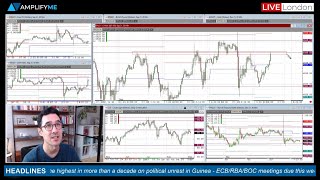
Okay, very good morning, Monday the 6th of September. Hope you all had a fantastic weekend. Gonna get you up to speed on some of the major news from this weekend. Also going to talk about what's happened overnight in Asia to kick off this week's trade, and then we'll look at the calendar of the main events in focus over the coming trading sessions. Before I begin though, don't forget we've just got now 8 days until the new AmplifyMe platform launches. So if you're a student and you want to be part of our growing global community, and you also want access to some of our leading simulation technology that we use to train the world's leading graduates at all the big Wall Street banks, then definitely check that out. And I'll drop a link below for you to register for that launch if you are interested. Otherwise, let's get straight to it and have a look at the charts this morning. And we have positive equity index futures trade Um, the DAX up about 55 ticks this morning. You can see you've had a bit of a breakout here, um, in otherwise fairly quiet trade. Do note we did have some German data out early this morning at 7 AM. Industrial orders actually came in quite a bit stronger than expected at 3.4% versus expected -1%. It's a bit of an injection of pace there, but more so a follow-through from overnight in Asia. You can see here, center chart, NASDAQ 100 and the S&P 500 is just coming back up to test here at a relative near-term point of technical resistance going back over the last couple of sessions. So looking to, um, just continuation of the Asia-Pac low, you can see here at the recommencement of trade on Globex, we initially dipped and then we've just rallied really since the Asia session all the way back up to that high that we were trading in towards the close of course on Friday where You can see here with the volatility that was seen on that big miss on payrolls, despite the initial dip met by strong dip buying and then rallying all the way into the close, we're back up to that same point to test this morning in the futures space. Remember, first things first, there is no US floor trade today, so the NYSE and the CME floor are shut. This of course is for US Labor Day closure. And there's going to be early closes on electronic trade on Globex as well. So equity index, interest rate, FX, energy, metals, all going to shut shop at 6 PM London time. And then there's a bit of an extended closure period before they then reopen for normal Globex trading hours at 11 PM London time, which would be 6 Eastern. So yeah, in terms of overall sentiment, equity index futures in a touch higher, gold not too much going on, moderately lower, finding some support from the overnight Asia-Pac session. So from the technical perspective, 1827, 1828 just holding for the moment. And the dollar in itself is just a touch firmer, up about 0.15%, but has drifted a little south since Europe has come in providing a bit of a floor for the major pairs. And then oil, we'll talk about in a moment, is down about a dollar or so Just following some news about Saudi Arabia cutting oil or crude prices for Asian buyers, which we can delve into in a second. But in terms of the Asia-Pac session, why was it positive? Well, just general carry-through, as I said, from where we finished on Friday on that kind of dip buying, on the premise of course that non-farm missing by such a large proportion kind of puts off any idea of an early taper move from the Fed, which generally has been positive for global equities. The MSCI Asia-Pac gauge climbed for its 7th session in a row overnight. It's the longest streak we've had now since the beginning of the year in January. The Nikkei outperformer once again, up about nearly 2%, spurred by the approaching leadership change in Japan after Suga, of course, announced he was going to step down, which has been viewed very positively there domestically given his bad handling of the COVID strategy. Separately as well, in the Far East, the Chinese Vice Premier has vowed China will continue to support the private sector, with a Chinese researcher suggesting room for a cut to the RRR or interest rates in the second half of the year. So further kind of pledges for monetary and government support in China just helping as well add some reassurance to market prices. Let's get into some of the stories then. There's only a few Nothing too major. And then we'll jump straight into what's coming out for the week ahead. And so, as I mentioned, oil prices a touch lower this morning. Some focus on the fact that Saudi Arabia slashed crude prices for Asian buyers. And this raises the prospect then of competition among sellers at a time of which we are seeing a general resurgence of COVID-19 clouding somewhat the demand outlook for this energy product. The kingdom cut the price of its flagship crude for October by more than double the expected amount. This comes, of course, just days after we had last week that OPEC+ agreed to continue boosting production. Last month, some Asian customers requested less crude from Saudi Arabia, and of course, that geographic region, predominantly China, being impacted by the spread of the ongoing Delta variant. So definitely interesting there from overnight. And then also something I wouldn't normally look at in base metals, but aluminium is probably worth a mention this morning. It's climbed to its highest in more than a decade. Um, so I'm just going to switch over my screens here. It's climbed to the highest in almost a decade as political unrest in Guinea fueled concerns over supply of the raw material needed to make the metal. So just very brief overview here. A unit of military has seized power and suspended the constitution. And bauxite, which is the feedstock to make alumina, which is further processed into aluminium, and Guinea accounts for more than half of all Chinese imports. Aluminium, of course, used for everything from car parts to drink cans, home appliances, things like that. They, as a metal, it performed very badly, of course, when the economic activity grounded to a halt in the initial onset of the pandemic, but is seeing quite a strong resurgence of late as the global economy and the vaccination rollout starts to show signs of further reopening, albeit still a little bit clouded on the horizon. And consumer demand, economic activity has generally been coming back. But yes, such as all things with metals and commodities in general, and geopolitics is always particularly important, particularly things like These base metals often located in areas of high degrees of political instability, which can be very problematic, problematic of course on the supply side. And you can see these big shocks in market price, of which we're seeing play out given that military seizing power and suspending the constitution there in Guinea. Otherwise, the only other thing to mention really from the weekend was this, which was an update on the booster shot situation in the US. So Anthony Fauci, the chap you can see here, the kind of medical advisor in the US, he was talking on Sunday that they're likely to soon get the regulatory go-ahead to administer the COVID-19 booster shot made by Pfizer, but Moderna may take a little bit more time. Separately, according to a source on the timing of that Pfizer booster, talk is that it's on schedule for a possible September 20th rollout. So would be not that far off towards just 2, 2 and a half weeks or so from now. All right, let's jump straight into the calendar. So obviously, um, today could be fairly quiet, certainly will be in terms of average volumes given the US Labor Day holiday. So worth bearing that in mind in terms of how you're deploying any strategies for today's session. We're seeing a bit of activity this morning, which is quite normal, but it might well start to dissipate as we go further into the North American trading hours given the lack of participation there across the pond. Otherwise, on Tuesday, just touching on upon a few highlights. So first off, we've got the RBA interest rate decision. Now that could be quite interesting, in fact. And brief summary here Analysts are definitely focusing on the RBA's decision around QE taper at this board meeting. 10 of 16 economists surveyed by Bloomberg expect that the RBA will defer scaling back quantitative easing when they meet overnight tonight. The main predominant factor here, of course, is that New South Wales, Victoria states, which account for about 55% of the country's GDP, have both largely been locked down because of the outbreak of Delta, which we've been seeing. The country is aiming to vaccinate their way out of the Delta crisis rather than drive cases back to zero. And just given that strategic kind of approach on behalf of the government, it means then likely that these lockdowns are going to remain in place for some time, and they'll be very gradual in lifting restrictions, which is going to impede the economic activity of that local economy, and thus probably most sensible then, according to most economists, that the central bank will adopt a kind of hold, wait and see approach. Authorities overnight— the latest we've heard from New South Wales, the epicenter of the country's kind of coronavirus outbreak, is that on Monday daily infections were expected to peak next week in terms of timing for that. Otherwise, back to the calendar. We've got the German ZEW survey coming out as well on Tuesday morning, often watched for economists and analysts' expectations of the current economic situation and forward-looking, importantly, for how optimistic, pessimistic about the future. So worth keeping an eye on that for any European-based assets. Also overnight, you'll notice you've got some Chinese trade data. Most of the expectation is this will largely conform to the general moderation that we've seen in Chinese data of late. The COVID outbreak which shut China's key Ningbo Zhoushan port, one of the busiest in the world, is expected to have some downside pressure in these August trade metrics. Something to be aware of. Otherwise, let's jump to Wednesday. You'll see we've got another interest rate decision coming out, this time from the Bank of Canada, but no expectation— no changes are expected from that meeting. Comes pre-election. Remember, those Canadian elections are happening on the 20th of this month, um, so it's a statement-only meeting, not looking for too many surprises there. Otherwise, other things you have here, and most notably, is Fed's Williams, who is discussing the economic outlook on Wednesday. And so just wrapping up really Fed speak for this week, it really kicks off with Williams on Wednesday, who is quite interesting actually, because on the hawk-dove kind of spectrum, um, he sits pretty much closely aligned with Fed Chair Powell. And just given in the wake of that disappointing employment report we had on Friday, I'm quite keen to see where the heads are at for upcoming Fed speakers. And Williams, as I said, is probably as close to Powell as you're going to get. So he's really key. He obviously is a voting member as well on the FOMC. On Wednesday, you also get Kaplan, and then Kaplan, Rosengren, and Kashkari also speak on Thursday this week. Kaplan being kind of an ultra, ultra hawk, Kashkari being the absolute opposite, the most dovish of the FOMC. So yeah, interested to get the full Fed spectrum of views, and particularly in the context of that weak jobs report, and obviously the emphasis on timing and details around tapering to come in the future. Otherwise, you've got the JOLTS job openings as well coming out the US, but, uh, pretty quiet overall. Thursday then, we'll move on. You've got the main kind of event almost of the week, which is the ECB meeting. Euro area inflation, of course, that we saw very recently surged to a 10-year high at 3%, so much higher and faster inflation than what general consensus was. The markets will be perhaps willing to overlook noise around price pressures generally, given that idea of, again, bottlenecks and transitory rationale behind why those inflationary pressures exist. But we've had a lot of hawkish commentary of late. Remember last week, a number of Fed hawk— ECB hawks, I should say, from Germany, the Netherlands, and Austria, all typically who are of that disposition anyway, but have given some reason for a little bit of unease around perhaps some commentary around time for the ECB to call the end of its emergency stimulus. It's not really a case of them ending it. It's more a case of them agreeing to slow the pace of bond buys. So the ECB's own version of tapering. Some interesting commentary out of a chief European economist at Barclays on this issue. She said that she expected ECB to trim its monthly bond purchases under— and remember, the ECB have their asset purchase program, their standard kind of quantitative easing program, and then bolted on top of that the reactionary effect to the pandemic. They have something called the Pandemic Emergency Purchase Program, otherwise known as the PEP. And the PEP is the one to focus on. And so this Barclays economist said that she expects the ECB to trim its monthly bond purchases under PEP to €60 to €70 billion a month from the current rate of €80. So again, this idea of gradual tapering down of bond purchases, and this comes as, given a much more accelerated now vaccine rollout, relative control of COVID outbreaks has allowed for further reopening and economic activity to recommence in Europe, which also means that this particular meeting we get the latest forecasts of expectations are the central bank, the ECB, will raise both growth and inflation projections going forward. Even so though, Barclays do note that the ECB will be keen to avoid any hawkish signal by taking such a step. And this, I guess, is an interesting part. They say that they think the ECB president Christine Lagarde, who of course will have a press conference as well on Thursday, will indicate the conditions for a change to broader monetary policy stance are not yet in sight. And that a change for the PEPP program should be interpreted as the beginning of tapering total asset purchases to zero rather than an adjustment to the emergency measures to a much improved growth and inflation outlook. So you can see there from the way that they're wording that it's a very central bank-esque way of kind of just alleviating any concerns of an accelerated kind of withdrawal of stimulus. That's all. And that's the challenge from a communication point of view, at least, that Lagarde will have to confront on Thursday, which could well cause a degree of market volatility if she doesn't handle that in a smooth, orderly way. And then, yeah, Fed speakers as well, batch of them on Thursday, as I mentioned. Then we get to Friday. You have got some UK GDP data very early in the morning to kick things off. Expectations are for the pace of monthly growth to slow a little bit by July. Which this data represents, the bulk of reopening efforts were already carried out, and therefore the latest release should begin to characterize a return to slightly more normal growth levels rather than that accelerated flush that we saw on the initial loosening of the lockdown measures. So things start to normalize to a certain degree. And we also get, um, the ECB President Christine Lagarde speaking again. So that'll be the day after the event. Very rare for the president to come out and say anything new, barring the official kind of platform needs to be meeting, but nonetheless to be aware of. You've also got US PPI data and Hawk Mester speaking on Friday as well. So that is it. Let you guys get on with the session. Hopefully that was useful. Any questions at all, feel free to just drop me a comment, ask a question, and register for that link if you're a student and you want to be part of that upcoming AmplifyMe platform launch. All right guys, Have a good session and a good week ahead. Thanks very much.
More from Anthony


Inside the Biggest Banking Stories You Need to Know This Week (Anthropic, Diageo, Private Credit)


Inside the Biggest M&A Deals You Need to Know This Week (UniCredit, GameStop, eBay, Eli Lilly)







AI Breakthrough or Hype? Anthropic’s Claude Mythos, Tim Cook Steps Down & LIV Golf Collapse