This Week In Markets: US Earnings (Apple, Amazon, Alphabet, Meta) & Fed, ECB and BoE Preview
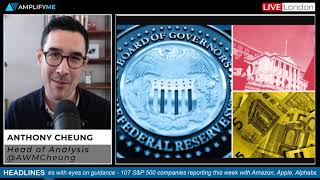
Apple, Amazon, Alphabet, and Meta report earnings this week while the Fed, ECB, and Bank of England meet on rates. Watch central bank guidance for signals about when rate hikes end, and track inflation data from the U.S., Spain, and Germany that could shift policy.
Chapters
So welcome to This Week in Markets, and it's an important one ahead because we've got central bank decisions from the Federal Reserve, the Bank of England, and the European Central Bank. And it's the busiest of all of the weeks for the earnings season with all of the big familiar names you've been waiting for: Amazon, Apple, Alphabet, Exxon, McDonald's, and many more. So let's get straight to it. And talk about some of the things in a bit more detail. Starting off then with earnings season before we delve into the central banks, and we've got 107 S&P 500 companies, 6 of the Dow 30 components will be reporting. Going through on a sector basis, some of the main highlights— I've really zoned in here on Tuesday, Wednesday, Thursday, very typical of an earnings season week. It tends to be, if you think of a bell-shaped distribution, the fewer companies reporting tail end on Monday and Friday, the bulk coming in the midpoint of the week. Sector-wise, technology, you've got Amazon. We'll be keeping a very close eye on them. Of course, we did see initially aftermarket earnings from Microsoft last week on reports of their cloud computing division. AWS actually rose, but of course you saw on the more tepid guidance for the cloud part of the business that Microsoft issued, their shares actually fell quite aggressively. So be keeping a very close eye on that indeed. We've also got the likes of Apple, Alphabet, and Meta. The later two, of course, we tend to look on a little bit on the macroeconomic climate, given the reliance that they still have on advertising revenues in particular. Then from an energy industrial perspective, headlines are going to be dominated by the likes of Exxon, ConocoPhillips, Caterpillar. Those industrial names are good— it's a good sense check of general appetite in the global economy. Remember, Caterpillar, the latter, tends to break down their numbers by certain geographic Continental regions. And then on a pharma side of things, Eli Lilly, Bristol-Myers Squibb, Pfizer, Amgen, Merck. So all of the big ones are coming out. On a consumer discretionary side of things, McDonald's and Starbucks. And then for carmakers, Ford Motor and General Motors as well will be reporting. So yeah, particularly busy one indeed. And it's Thursday after market when you get the big three in the tech space: Amazon, Apple, and Alphabet, the AAA. Looking then at central banks, this is really going to dominate the main focus for this week. And as you can see here, a good headline I saw coined by the FT, back to the future. And the reason why is that this is baking in the market's expectations that rates across all three central banks, to a slightly differing degree, are going to go up most likely this week. And that then taking interest rates back to where we were prior to the global financial crisis, obviously well over and above the previous interest rate cycle that we saw just before the pandemic hit. So what can we expect? And let's go through this in a, in an order of the Federal Reserve first. So here he is, the main man, Jerome Powell. The Fed are going off market pricing, very much expected to downshift. They've gone from 75 consecutive times to 50 to downshift now to 25. So a slowing pace in terms of their tightness of policy. So we're getting closer towards that terminal rate, the peak of interest, and all of this has come amid signs of cooling inflation, of course, in the, in the US. Now, the shift in the Fed's approach, obviously with the focus on inflation, a bit more detail there. Consumer price growth in December slowed. That was actually the 6th straight month that US inflation had slowed, clocking in at 6.5%. Though inflation remains far, of course, above the central bank's 2% target, the December level was its lowest that we've seen since October of 2021. Comment I saw out of economist at UBS, which I thought was quite good, was that he expects the step down to 25 basis point rate hike will come with the phrase or the notion of we have more work to do type of language. And also following up that this is going to be a meeting where they're going to try to not be too dovish. And that's really quite critical. The markets so far have more broadly had a really good start to the year in the equity space, at least in the US. And a lot of this is based on this idea that interest rates were getting towards a peak, and so therefore lesser tightening ahead. Although there's many bears on the street— Morgan Stanley, JP Morgan being two over the weekend— continue to reiterate that earnings evaluations, companies' valuations, still need to fall further, and thus then there might be some short covering that has explained some of the rationale for equity strength, and equities will pull back. But what the Fed will be conscious of is, look, not letting the markets get too carried away here. We are shifting down the gears, so to speak, that, that doesn't mean yet that we perhaps at the end of the rate hike cycle, or that we're not serious about still the threat of more broad-based, long-lasting inflationary conditions. And so it's just trying to harness that kind of runaway spirit that markets typically have with overextending, um, when we're particularly going through this pivot phase of, um, starting to talk about the end of the rate hike cycle. So yeah, it's going to be a tricky one. The main focus will be on that language, the press conference, what happens next, not so much what happens now. As you can see here, we can pretty much tell you what's going to happen. They're going to hike rates by 25 basis points. That's very much the expected outcome as far as how markets are positioned. So it's the forward guidance thereafter that's going to be really critical. One of the things that the FT isolated as potential language changes to look out in the statement that we'll get on Wednesday is the current terminology, which is ongoing increases in the target range would be appropriate, to be potentially updated to some further tightening, i.e., a step closer towards the end coming, is the idea. All right, well, let's pivot over and talk a little bit about Christine Lagarde at the ECB, the president. Now, she signaled earlier this month that the bank would, quote, stay the course of large interest rate increases, suggesting that the same half percentage point, so 0.5% increase at the last meeting, and if that were to materialize, it would take the deposit rate to 2.5% from what was -0.5%. In June of last year. Now, with little certainty on the rate change, the main point of interest of the ECB meeting will be the messaging about further rate hike decisions. So you can see there's a bit of a theme here emerging already that connect these all three from an investor's perspective. Now, one of the things that we saw this morning was Spanish inflation. And the reason why I'm talking about Spanish inflation is we do get flash CPI, I'll talk about in a moment, later on this week. So a bit of a litmus test here, and it was a surprise because Spanish inflation unexpectedly quickened, snapping 5 months of slowdowns that you can see here. A little bit of a blip up that we saw, and this was a big surprise. The reason why is because analysts were anticipating that inflation was actually going to drop again down to 4.8%. So it was 1% over and above expectations. Now, I must admit the analyst ranges were quite wide for this, and what's the rationale for that Spanish acceleration? It was driven by a rebound in fuel costs and smaller discounts in start-of-year apparel sales, was the reasoning. So this throws a little bit of a spanner in the works. However, we're going to get more intel ahead of the official ECB rate decision on Thursday. This comes with the flash PMI data on Wednesday. And from a policy perspective, the release will have, most think, little sway on the outcome of that Thursday meeting. Obviously, we have to wait and see for the numbers. That's because the market pricing is around 87% chance of a 50 basis point move. However, beyond February, a strong point for core inflation could convince some market participants that another 50 in March is on the cards, despite recent source reports that have been in circulation suggesting that 25 basis points may be on the table for that meeting. So sources, these kind of drip Fed leaks in, um, undisclosed from the central bank using media outlets have kind of pushed the market to think about, look, we're going to downshift as well at the ECB after this rate hike. So that flash CPI, the core reading, could be quite key or not, whether that's going to, to come to fruition. Now the other thing in Europe that we've had as a precursor to that rate decision is the German economy that unexpectedly contracted in the last quarter of 2022 as high gas prices and rising borrowing costs squeezed demand. That came out earlier today. Okay, so moving on to the Bank of England. So Andrew Bailey here, the governor, and markets are pricing in the Bank of England will raise interest rates by 0.5%. Um, that means then that that will take the bank rate to 4%, up from the historical levels, of course, the beginning of this cycle at 0.1%, and it would be the highest interest rates that we've hit since 2008 here in the UK. Uh, the reason why, supported by a tighter labor market whereby unemployment levels are relatively low, job vacancies are high. UK nominal wages rose at a near record pace in November with private sector pay reaching an annual 7.2%. We saw this only around a week ago or so. Headline inflation ticked down in December, but services inflation, particularly key given the way of which our economy is composed, heavily dominated by that side of things, a better measure of underlying inflationary pressures, perhaps that has accelerated still. So a couple things here that I saw, particular commentary coming out, HSBC. They said that they think the combination of lower near-term inflation, receding inflation expectations, and the rapid slowdown in the housing market, and the Bank of England's own sub-target of medium-term inflation forecast, may mean the NPC will opt for a slower pace of tightening. So perhaps then could they go for 25 this time round? So yeah, definitely keeping a close eye on that. That's coming on Thursday. So just to recap, Wednesday we'll get the Fed, and the following day you get the other two central banks. Just talking about the overall other events to conclude, of some things to watch out for going through in a chronological order. Going in the overnight session tonight into Tuesday, you get Chinese industrial profits and PMI data. You also get the rest of the eurozone GDP data on Tuesday. You then get the eurozone flash CPI I mentioned on Wednesday alongside manufacturing PMI. You also get the ISM manufacturing figure, of course, going to be looking out for in the States. Um, that comes then with the idea of nonfarm payrolls coming on Friday, which I'll, I'll go into in a moment. Then on Wednesday, for any oil traders, you do have the Joint Ministerial Monitoring Committee, otherwise known as the JMMC. C. So this is the people who observe then the adherence to the rules out set by OPEC+ for their quotas. They're going to be meeting on Wednesday to take stock of the energy market fundamentals at this present point in time. This is not, I repeat, not a decision-making meeting. It's one of the regular ones that they have. The next OPEC+ ministerial meeting is not slated until the 4th of June. If you remember, they've moved now the timelines from a less frequent monthly meeting to push these out a little bit now that prices relatively have stabilized post the Ukraine crisis. Other things looking out for on Thursday: US factory orders, initial jobless claims, US durable goods. And then we also get on Friday, aside from payrolls, the services PMIs coming out of the eurozone. But payrolls, what can we expect there? So overall, we're probably going to get a continuation of a trend. And that trend being that job creation in the US is continuing to moderate. The expectation, the headline is 175,000 this time round. That's against a previous of 223,000 and a 3-month average of just shy of 250,000. With monetary policymakers firmly though fixated on reducing inflationary pressures, less than the job creation number, it's going to be an outsized attention toward the average hourly earnings figure. They're expected to rise 0.3% month on month, and that would match then the same rate of what we saw in December. So that's the key metric to look out for there. But that is it. So thank you for listening. If you're not subscribed to the channel, please do hit that bell icon. You'll get notified when our next videos go out. But with that, take care and have a great week ahead.
More from Anthony


Inside the Biggest Banking Stories You Need to Know This Week (Anthropic, Diageo, Private Credit)


Inside the Biggest M&A Deals You Need to Know This Week (UniCredit, GameStop, eBay, Eli Lilly)







AI Breakthrough or Hype? Anthropic’s Claude Mythos, Tim Cook Steps Down & LIV Golf Collapse