UK Govt defeated as MPs seize control of Brexit
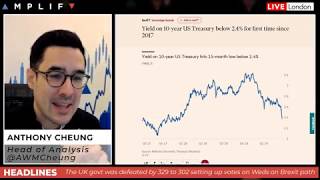
UK MPs voted 329-302 to seize control of the Brexit timetable from the government, triggering ministerial resignations and uncertainty over what comes next: soft Brexit, a second referendum, Norway-plus, or a general election. The pound barely moved despite the headlines, as markets price in a likely extension to Article 50.
Chapters
Okay, good morning. It is 26th of March. I hope everyone is well and had a good evening. Let's get straight into the briefing and discuss a couple things. Obviously, you've got to talk about Brexit with the update from the parliamentary vote last night. What does that mean? What exactly happened? What happens next going forward. And then there's a couple of articles I just wanted to share with you in regards to recent movement in the yield curve, which has drawn quite a lot of press attention, uh, given what's been happening with the inversion and then a pre-indicator or not whether we've got a looming recession heading our way. And then also just something for oil that I thought was quite interesting in regards to the Golan Heights from Donald Trump, which I think could be an influential factor from a more broader perspective for relationships in the Middle East. So that's what I'm going to cover, and then I'll hand you over to Sam, and then as per usual, he can look over the charts in much more detail in terms of technical levels of significance. So with that being said, let me just switch over my screens and let's just have a quick look at the charts as they reside this morning and Overall, relatively, uh, kind of neutral open. I'd kind of classify it as we've got EURUSD pretty much flat, sitting around pivot. Treasury markets just slightly lower, down about 3 ticks, just below pivot. Crude is up a touch with a slightly weaker dollar, but dollar index largely really is flat, and cable outperforming a little bit given what happened last night. So, well, let's just jump straight to the, the cable chart. And one thing I want to look at here is— I'm not sure if you can even quite see it, but I've got an ellipse marked here from the price movement of the vote when it came out last night. It was shortly after, uh, 10 PM when I was watching, uh, scenes from Parliament and these votes were taking place. So just to put it in a little bit of perspective That little tiny circle that you can see there was the reaction that you had. Now obviously everything you're reading in the press this morning is, you know, catastrophic, another defeat for Theresa May, the Brexit shambles, you know, Parliament takes control. That's the move we had last night. I mean, it's nothing basically as far as market reaction that happened. I mean, we moved a little bit higher, we're talking about 25 pips, but I mean, even if you look at the range from, from what would have been, what, the 21st last Thursday, we traded a range of 200. So, you know, just to put it in a bit of context, we then actually— and what's quite interesting, we actually dipped in the overnight session and then we've kind of rallied back this morning as UK participants have come into their desk and they've kind of bid it back up above the, the pivot level. But net-net, relatively contained for the moment. And so let's just dig into exactly what's happened and explain why then— a couple of things— why the market's been fairly tame in its response despite the kind of sensationalist headlines. And so let me run you through a couple of points here. First of all, What happened last night? Well, MPs voted 329 to 302 to seize control of the House of Commons timetable and begin testing support for alternatives to her withdrawal deal. Now, this means then Theresa May has been forced to abandon that third meaningful vote. There was some speculation at one point yesterday that that was going to happen today, but that's been pretty much put to bed now for the moment. So given the numbers and the size of the defeat that happened last night, some 30 Tory MPs joined forces with Labour and other opposition parties to take control in the Commons. This did mean then that Richard Harrington, the business minister, and Steve Bryan, the health minister, basically resigned. And obviously these are ministerial positions, and I believe there was 3 in total that had resigned in order to vote the other way against the government in protest. The so-called indicative votes now will take place on Wednesday, and the intention of this, of course, is to establish whether there is a majority for a softer form of Brexit or a second referendum. One thing though that I want to be absolutely clear upon is that Oliver Letwin, who is the former Tory minister that tabled the initiative that was voted and successful last night, he himself has said then that it's far from clear if there is a majority for any Plan B. So although it might feel like the government's lost and now this whole kind of deal is off the table, that's not necessarily the case, because even though there's enough commitment now cross-party to go against the government's existing deal, at this point there is no outright majority for what exactly a Plan B is. So even though this is one step closer, you could say, to potentially going down the routes of softer Brexit avenues, I would say it does make a little bit of sense that after the initial response— government defeat, pound rallies— it then comes back a little bit with the realization that, okay, we're going to have a Plan B, but hold on, what exactly is Plan B, and is there going to be a majority support for that Plan B? and I would suggest that's going to be highly complicated because it will create renewed fractures now. Not about government deal, but now about, well, do we have a second referendum? Do we have a general election? Do we have a renegotiation in Norway style? And I would imagine Parliament will be split over these decisions, so it's not quite possibly as straightforward as you might envisage. Now, of those things, couple of Points to be aware of: MPs are expected to vote on ideas such as what's being tabled as Norway Plus, which combines membership of the EU customs union and single market. And they're also going to discuss things like a second referendum, of course. Mrs. May said the government could not back any proposal that breached the Tory manifesto at the 2017 election. That would exclude support for any of the soft Brexit alternatives being considered. Senior— several senior ministers, including Liam Fox, the Trade Secretary, Stephen Barclay, the Brexit Secretary, said that there is a growing possibility that a general election might be needed to end the Brexit stalemate. So again, it's almost getting even more confusing because again, there's so many different permutations this could go. It just heightens uncertainty And in the short term at least, that can create negativity, if anything, not just an outright clear move to buying the pound outright, uh, given the fact that we're going to lead ultimately to a soft or potentially no Brexit outcome. Eurosceptics who met in Westminster last night fear the Brexit project may be slipping away from them. So if anything, does that then give some credence to support for Theresa May's deal, granted she would need to either go through a legislative loophole to get around Berco's dismissal of the meaningful vote, or could she present some sort of new-formed deal if she was to acquire that from Europe, given the new deadline being in a few weeks' time? One person that commented that caught a few headlines yesterday was Jacob Rees-Mogg, of course, kind of heads up the ERG, the European Research Group, who did give support to the plan of the Prime Minister if the DUP can give their backing. Big problem though, the DUP are pretty furious with how Mrs. Mayers handled this situation. And they were quoted as saying, this was Nigel, I think it's Nigel, Nigel Dodds, who's basically the deputy under Arlene Foster of the DUP party, and he said, "It's been a fundamental lack of preparation." And Sammy Wilson, another member of the DUP, saying they're nowhere near getting to a point of backing the government's plan. So without that, obviously, people like Jacob Rees-Mogg are not going to follow. So the government's deal is dead at the moment, not to say that that could change. And the EU has said that if the deal was not passed by the Commons this week, the UK will be due to leave the bloc on April 12th. On Monday, the European Commission said a no-deal Brexit on that date was increasingly likely. So That's the current status. The other thing I'm going back to the chart I wanted to point out here was, you know, this rather again muted reaction in the pound is— let's just put Cable on a daily continuation and let's not forget where we've come from since the beginning of the year, which if I just put a rectangle around the price action to make this just a bit more clear That's the move that we've had ever since the beginning of the year, and it's been a bit of a dual-fold effect. Of course, we had quite aggressive dollar weakness through the period at the beginning of the year when the Fed kind of took that shift to becoming very dovish, which was kind of cemented last week on Wednesday with the FOMC and the latest projections. But the other thing, of course, is that we've had is becoming a realization that really Brexit being so complicated that, um, it's almost inevitable that it's going to go down the route potentially of an increased negotiation period. Or what I mean by that is an extension to Article 50. And obviously, as that's been built into prices, the pound has come all the way back up to trade from a 1.2425 lower bound at the end of last year. We're trading up at 1.3380 kind of handle at the moment. And we found a bit of resistance at quite, I guess, a logical point for the current fundamentals that are in play, which is around that 3350, looking at the, the daily continuation on the futures. So the other thing is, even though what happened last night, as I said, might lead us ultimately down the route of options that could lead to a softer Brexit, at this point let's not forget how much the market has priced in this already to that degree. So again, it's gonna be lots of headlines, I'm sure, as we go through today. My understanding is, is that Theresa May has called an emergency cabinet meeting to discuss obviously the result and the next kind of possible action going forward. So I would expect probably lots more Twitter action as we go through the day. Paul Brand of the ITV, Laura Koonsberg BBC, Tom Newton Dunn of The Sun, they've all been absolutely on point with coverage of this news, way ahead of traditional financial newswires. So Twitter ultimately is still your best form of keeping on top of the latest breaking news and rumors coming out of the situation. So it's still a pretty fluid, fluid event and that meaning then that the pound can be quite jumpy because a lot of people are a little bit reluctant to be open or sat in an open position of risk. And so just be mindful of that. Trade execution obviously needs to be, to be factored in, uh, in that respect. So yeah, that's Brexit. I'm not going to go into it any more than that. I'll leave Sam to go over the kind of technicals in a bit more detail for the framework of, of cable for the intraday. The other thing I wanted to talk about was this, getting a lot of press obviously since the weekend, the kind of the PMI shocks that we had reverberate out of Germany, kind of filtered through and followed in the, the US reading we had late on the Friday afternoon. Well, this basically has prompted some pretty aggressive movements in, in yields then, and the yield on the 10-year US Treasury has hit a 15-month below 2.4%. So as you can see here, we've not really been at that level since late 2017. Now the reason why everyone gets so excited about this type of movement in the yield curve is because of this fact that an inverted curve— this phenomenon is known and has presided every US recession since the Second World War. So So hence the reason why investors, whether bond or external to the bond market more typically, as it gets pumped by the media agencies, start to get excited about the fact that, well, it's a historical indicator that's been indicative then for a recession to happen in the kind of medium term. Now, one thing to slightly quell those concerns has been Goldman Sachs have been out with a research note which is getting some airplay this morning, and they're saying basically the opposite. And it's also being supplemented by a large buy-side institution, Fidelity, and they're talking about the fact that, um, basically don't panic over this yield curve movement. Their suggestion to their clients is that they're sticking with the view on low but positive returns for equities is still, uh, possible. And Fidelity move getting excessive, and they're advising underweight. So what they're saying then is that the proportion of the yield curve that's inverted isn't as high as in past recessions, and part of the reason the 10-year Treasury yields have slumped can be attributed to dynamics outside of the US. What they're looking at here is this— what Bloomberg have termed the worry-o-meter. Not all rates are telegraphing forthcoming economic stress. Obviously The press love to jump on any part of inversion. If you remember a few months ago, I think it was the 3s and 7s that were inverted briefly. Now it's the 3-month and 10-year inversion, but the 2s, 10s, which is kind of the typical part of the, the spread that people would look at at the moment, as you can see in this, um, I believe this is the white line here, it's pretty static, and if anything, it's moved up. It's the opposite. Obviously, the short end of the curve in the STIRs, short-term interest rates, are very hypersensitive to interest rate fluctuations. They've obviously had to take into account this now pricing from what we've heard from the dovish Fed. So I do think that's a little bit of a reaction effect to that, whereas the 2.10s has been relatively stable. And actually, just saying that, one thing I wanted to quickly check— let me bring it up very quickly. Is the FedWatch. So this is what markets in the federal funds rates are pricing in for the next interest rate move from the Fed. And I did read a tweet, I just wanted to double-check it, was that in September— yeah, check that out. This is September pricing in federal funds rates, and that has shot up significantly following on from the Fed. And what's probably driving part of that movement on the short end is that participants have got very aggressive in pricing in a rate cut. Is now at 40%. So a rate cut of 25 basis points and the Fed funds range is now— that's the highest it's, it's been ever in the recent string of events. Let me just check December. Yeah, if you go to December, it's priced in. The most probable outcome now is 41.1%, a comparative to 33.7% to hold, is we're going to have a rate cut by Q4, basically. Fed's Rosengren, uh, and again, I don't want to overcomplicate things, but I know there's plenty of guys in the trading live room experienced enough, uh, to understand the kind of process of the balance sheet runoff. Um, this was quite an interesting comment here from Rosengren who said he was favoring shortening the balance sheet maturities. Basically what he was saying was that what they should do is increase the share of US Treasury bill purchases and more quickly lowering the duration of securities held as assets may be important goal as part of normalization. So basically what's happened is the average maturity on the buckets of the bonds of which the Fed hold has got longer What he's saying is they should be buying up some of the short end in order to then have the flexibility to then use that to flip and increase, to artificially manipulate the long end, to stop them or control a little bit better these kind of fears of inversion that are more driven by human psychology, if anything, rather than by actual economic fundamentals. I'll share that. Oh, I have shared that in the chat room. Worth having a read. If you want more details on that. The other thing, of course, from a news point of view, but I wanted to cover was this was headlines I was reading last night. This is talking about obviously a historical, highly contentious issue that's been for many, many years in focus, the Golan Heights, and this then the, the kind of conflict between Israel and Palestine And Trump has signed an order recognizing occupied area as Israeli. Now, I would imagine then this is going to cause a lot of reaction in that particular region. We understand and we're aware quite clearly of the US relationship that they have with Israel is a close one. What this isn't immediately cause though is quite emphatic denouncing of US recognition of that in Israeli territory from the Saudi Arabian government. Now, the reason why I think it's particularly interesting from Saudi Arabia's point of view is, of course, because of the conflict that they are likely to have in the future with America about what should happen with crude oil production. Now let me flick over my chart to oil prices. This is oil on a daily continuation. You can see here this takes into account the bigger picture over the last 12 months and this pretty powerful recovery that we've had since the stabilization in China, at least a little bit of a more consistent approach then to the, the what was a pent-up building of global growth concerns has somewhat been dissipating, at least recently. And then you've had now this policy tightening idea put on ice for the moment, led by the Fed that we had last week. Now going up to where we are at the moment, $60 is proving to be the, the kind of obstacle to the upside recovery in price from that Q4 sell-off. And that coinciding around $60 psychologically, but close to the 50% fib of that entire sell-off. What I'm saying here is that Saudi Arabia have been pretty persistent in backing of the continuation of even over-compliance of existing OPEC+ deal to control prices, if anything keep them higher. We know that Saudi, in order to implement its Vision 2030 and its diversification of its requires the price of oil to be much higher than where it is today. There's obviously a bit of a sweet spot here because they don't want to counteract that with a phenomenal boost to corporate profitability in North America, because that's almost self-defeating if oil production on that side gets more revenue in order to grow even faster. So we're not going to get up there to, you know, I'm not talking of 70 $85, $100, which technically is where they'd want it in order to fiscally break even. But what's interesting about this Trump announcement on the Golan Heights is that as we get closer to 2020, oil price going higher and higher, if it starts creeping back up to this $75 region where we were only about 6 months ago, Trump's gonna have a real problem when it comes to his political popularity for the presidential race, which isn't that far off. That meaning then that you're probably likely to hear Trump being fairly vocal again should prices break beyond $60 and start heading north, that he wants Saudi Arabia to turn the taps back on, to stop cutting, to start oversupplying the market, to control prices, to give the middle class in America another corporate— or another akin a tax cut. The only problem with that is by doing what he's done with signing recognition to the area to Israel is he's in direct conflict then to those of the opposing. And again, this goes into kind of religious beliefs on who should have the right to territory in these regions, and that does fly in conflict then with Saudi Arabia. And so is this going to lead to a very problematic relationship with Saudi going forward, who are likely to be less responsive then to Trump's demands. If Trump starts to up the ante and then starts to go down the route of sanctioning Saudi, does that in itself promote more unrest in the Middle East, which could create supply shocks and shoot, you know, oil very high at that point, which would be absolutely devastating for Trump from a political point of view. So I know all of this is a lot top-level geopolitics, but I just thought that actually this headline, although not like a one-dimensional gonna hit crude immediately, I do think this has quite grave connotations for crude going forward in the medium term. Okay, let's have a look at the calendar and then I'll hand you over to Sam. And you can look over the charts. So here's what the day ahead entails. Very quiet actually for this morning. We'll get to the speaker slate in a second. Let's look at the economic data first. So US, remember the time difference still in play until this weekend when UK clocks change. So you've got US building permits, housing starts happening at 12:30. Um, the Case-Shiller numbers, the monthly home price index. I would say you can ignore. That's very rarely market moving. So you've got the housing data, US consumer confidence at 2, and then you've got the API crude oil inventories later on this evening. Speakers— it starts to get a little bit more interesting. So from a meaningful vote point of view, you can scrap that off your calendar. That's not going to be happening. From a speaker's point, we've already had Rosengren. We've covered those comments. Harker this morning has spoken. Is a non-voting member, and Harker said reiterates that he is in wait-and-see mode, favoring at most one hike this year and one in 2020. So actually sitting a little bit more on the hawkish side with that comment, if anything. Fed Evans is speaking, is a voter, is talking a bit later on this morning, so do be aware of that for any dollar movement, speaking in a Q&A in Hong Kong. Bank of England's Broadbent. Uh, what can Broadbent say about Bank of England policy? I don't really think he can say anything, quite frankly, because of the situation that's unfolding in Westminster. His hands are kind of tied, I would say. There's no point him putting his neck on the line trying to call economic projections and subsequent reaction effects for the Bank of England when there's such uncertainty. So I'd be aware of this. I wouldn't be expecting too much from it though. Here's my summary. ECB's Makučić is speaking later and then another Fed speaker later on as well. The other thing, if you are interested in fixed income, if you remember, there's $131 billion worth of supply hitting the market from the US Treasury this week, which has given some of this yield curve focus. Could be quite interesting. It kicks off— there's two 5-7s this week. The 2-year for $40 billion is happening at 5 PM, the auction process from the Treasury, uh, late this afternoon. Okay, that is it from me. Let me hand you over to Mr. Sam North and he can talk you over the charts in more details. But I'll see you in the chat room. Have a good day ahead. Thanks very much.
Good morning, guys. Hope everyone had a good evening. Just gonna Yeah, a quick look over some of the charts, how we're positioned, uh, going into the European session. You just see equities in Europe just testing the low of the day here. Just bringing the DAX into, into picture, just coming up towards the, the pivot area as well. So worth keeping a close eye on how this, this acts out. That previous low of the day actually is a really good level of resistance having broken through. You can see it was also the highs that we had from yesterday afternoon. So for once, the, the DAX responding pretty well from a technical point of view. That area now a key resistance, one to keep an eye on. While it hasn't had the, the third test yet, probably worth having this trend line on to, to see how we, we come to, to test this level. You've got the, the low of the day from yesterday, you've got then the, the evening afternoon sort of low from 5 o'clock, and that and the pivot, bit support that we had like late last night around that area, uh, probably worth keeping an eye on as well. If you're short, definitely a place to take profit in any further move to the downside. You would want this whole area to break as well. Also having a look at a trend line on, on gold and didn't quite make it down this morning, but you can see just finding a bit of support and having a look at the, the lows going back to a couple of the levels from last week. The 20th, and then the day after that. You can see we're almost come down to test that this morning. Also matches up quite nicely with the high that we had on Friday and then the low of yesterday morning. So decent levels in the gold and the DAX to keep an eye on. With the, the DAX coming down, Euro stocks as well, back down to its low of the, the day. Very correlated there. However, that trend line wouldn't quite match up there. So for, um, the DAX, if that was to break through, the Euro Stoxx, you would imagine, would also do the same. Having a look at the pound, it's always risky talking about technical levels for, for the pound. Of course, it just takes one comment to drive price either way. But you can see this, this trend, um, trend line going back from the high that we had on the 13th through to the 19th, and tested again this morning. Quite good resistance up near the highs of the day going back to last week as well. Multiple days we could struggle to, to get through here. So as an area to have marked up where, you know, potential further push to the upside could happen, 3279 goes, then that's something I'd be looking at. And then the R1 yesterday's high would come into the mix quite quickly there, and then the highs going back to the 20th as well, uh, yesterday's high. Mini range that is in lows from yesterday mark up quite nicely with previous highs and lows from, from other days. As you can see here on the futures, 132.12, S1 in the mix there today as well. Almost probably worth not getting too involved in this unless we were to get above this trend line or back down towards the, the S1 region, uh, slash low of yesterday. In a day yesterday where the dollar was pretty range-bound, to be honest. You can see it took euro a while to come up to any of these previous lows that we talked about in the, in the briefing yesterday. Uh, the first sort of main one it came to, the low that we had back on the 18th, you can see marked up here, was a strong level of resistance. And I feel if this was earlier in the day and not a Monday, it would have been a lovely place to have got short, held quite well, and However, we've only just started to drift lower, uh, really not, not too much going on there from those highs. Probably worth getting on that trend line there, and if that was to, to break through, then you could get a further extension to the upside. But we've looked— most of these markets quite contained following yesterday's price action. S&P and the NASDAQ are the same. You can see— well, actually, it did finish lower, a decent push into, into the close and back, back above 2800. Uh, some really strong support down here to keep an eye on, 2791, perhaps in, in coming days to have that on the chart, or even today if we were to have a sort of negative morning and the DAX was to lead things, uh, to, to get a following push. Still the level I like the look of to the upside, which I think is key for the bulls to come back into the market, to 2825 on the futures, around sort of yesterday's today's, uh, I should say Friday sort of afternoon evening high. So below, uh, the range and above the range would be sort of where I'll be looking to really get a further direction from this market. As you can see right now, pretty lackluster in direction. Oil, just have a look. We can see S1 yesterday was fantastic, was also going back to, uh, previous day's highs, going from If I just mark it up here and move it above the camera so you can see, going back to the 22nd and the 1st, or the 1st of March, you can see it was also marking up very nicely with yesterday's S1. Really good level of support. Uh, since then we have pushed and we're just testing the, the high of the day now. Quite a lot of resistance just above where we're trading, 59.50. You've got the lows coming in here of, uh, the 20th, the day after that, and then a bit of resistance. Resistance from the 22nd. So quite a key level to, to have marked up. Also, the trend line would be around that area. So quite a few levels, uh, of, of interest coming up in a few markets, definitely worth keeping an eye on. Just have a look at the Euro Pound, which, um, after Friday sort of would have kept many people still in the trade if they weren't, uh, stopped out. That's you know, still back below those sort of double bottom from November and, and last year as well, although it's starting to get messy now, uh, as you can see, just sort of getting contained back within the middle of that range. And, and really, until we have any further Brexit developments, whether this could go or not, uh, I think is remaining to, to be seen. Just having a final look across the, the board, the dollar index is trying to strengthen, uh, a touch across a couple of these pairs, the pound and the euro, uh, back below their pivots. Uh, the Aussie dollar as well, one that I do want to have a look at just to finish up. Uh, you've got quite a bit of resistance where the highs of yesterday were. You can see in the market really struggled to get beyond there yesterday. However, we have drifted higher this morning, uh, and we're back now above the sort of the pre-FOMC levels quite substantially now. So while there's probably still a bit of room to the upside, R1 and anywhere around sort of 71.47 on the futures looks a very strong resistance point. You can see going back to Friday last week, um, how the sellers really start to take over from there. So that would be an area for the Aussie that I'll be keeping an eye on. Any questions, as usual, please do get them in the chat. It's the final quick look over the, the calendar again just to to reiterate the, uh, the points that are coming out of interest. Really, it's going to be a relatively quiet morning, so I wouldn't be again chasing the market, especially after yesterday where if you were too aggressive you would have got most likely burnt in, in many markets. So in case of taking your time, preferring maybe more slower range-bound trades before we perhaps get into the afternoon, building permits and consumer confidence out of the US to potentially give a bit of direction. But all in all, uh, you know, unless you're, you're sort of waiting for that Brexit comment to come out, I'd be a bit more cautious than normal. And then API, uh, back this evening at 8:30 UK time. But I hope you all have a good trading day, and I catch you all in the chat room.
More from Anthony


Inside the Biggest Banking Stories You Need to Know This Week (Anthropic, Diageo, Private Credit)


Inside the Biggest M&A Deals You Need to Know This Week (UniCredit, GameStop, eBay, Eli Lilly)







AI Breakthrough or Hype? Anthropic’s Claude Mythos, Tim Cook Steps Down & LIV Golf Collapse